
What’s actually slowing this PC down?
Pick the symptom - the matching free tool is one click away.
iTechGuides is reader-supported. When you buy through links on our site, we may earn an affiliate commission. As an Amazon Associate I earn from qualifying purchases. Learn more
A virtual reality (VR) display is the visual system in a VR device that presents a changing, immersive view of a virtual environment. In a typical headset, it combines a near-eye screen with optics that shape the image for the wearer. Rendering and tracking work with the display to update that view as the user moves.
How does a VR display work?
The display is the window through which a user sees a virtual scene. A lens in front of the screen alters the image so it fills more of the user’s view; software renders the scene from the appropriate perspective using tracking data about the user’s position and movement. Google describes this display-and-lens relationship in its VR developer documentation.
The screen alone is not the whole VR system. Rendering creates the image, tracking supplies information about the user’s pose, and the display presents the resulting view. Optics, rendering speed, tracking, latency, headset fit, and comfort all affect the experience. A panel’s resolution or refresh rate cannot describe the complete system by itself.
Recommended Free Tools
Which VR display specifications matter?
These specifications describe different aspects of the image and should not be collapsed into a single measure of display quality. A 2025 U.S. Department of Homeland Security notional procurement document identifies many of these fields for manufacturers to report; it is a requirements reference, not a set of consumer buying thresholds.
Popular on Amazon
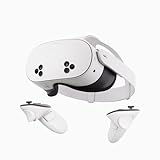
- NO WIRES, MORE FUN — Break free from cords. Game, play, exercise and explore immersive worlds — untethered and without limits.
- 2X GRAPHICAL PROCESSING POWER — Enjoy lightning-fast load times and next-gen graphics for smooth gaming powered by the SnapdragonTM XR2 Gen 2 processor.
- EXPERIENCE VIRTUAL REALITY — Take gaming to a new level and blend virtual objects with your physical space to experience two worlds at once.
- 2+ HOURS OF BATTERY LIFE — Charge less, play longer and stay in the action with an improved battery that keeps up.
- 33% MORE MEMORY — Elevate your play with 8GB of RAM. Upgraded memory delivers a next-level experience fueled by sharper graphics and more responsive performance.
- Resolution: The number of pixels in the image. Headset specifications often state resolution per eye. More pixels can support finer detail, but resolution alone does not determine perceived sharpness.
- Pixels per degree (PPD): Pixel density across the angular view. The DHS document defines it as horizontal pixel count divided by field of view. It helps relate the number of pixels to the width of the view.
- Field of view (FOV): The angular extent visible through the headset. Check whether a figure is horizontal, vertical, or diagonal; figures using different conventions are not directly comparable.
- Refresh rate: How often the display updates its image, measured in hertz (Hz). It is distinct from the application’s frame rate and from end-to-end latency.
- Motion-to-photon latency: The time between a user’s movement and the corresponding change appearing in the display. Excess latency can be perceived as lag and contribute to discomfort, as Google’s developer documentation explains. A latency target on that legacy page should not be treated as a current universal standard.
- Persistence: How long each frame remains visible. Low-persistence operation can reduce motion blur during head movement, though some users may be sensitive to its flicker.
- IPD accommodation: IPD, or interpupillary distance, is the distance between the centers of the eyes. Headsets differ in how they accommodate it; DHS includes this as a specification for manufacturers to report.
- Optical performance and viewing position: The lenses and where the eye sits relative to them affect what the wearer sees. A 2022 optical-bench study of three HTC headsets found that measured spatial resolution varied with viewing angle and eye position, with degradation toward the periphery in the tested devices. Those results are specific to those models, not a measurement of every headset.
The DHS specification definitions appear in its 2025 notional VR headset requirements. The device-specific optical measurements are reported in Scientific Reports (2022).
How do resolution and field of view differ?
Resolution describes how many pixels make up the image; FOV describes how much of the surrounding view is visible through the headset. They answer different questions: pixel count relates to potential image detail, while FOV describes angular coverage. PPD connects pixel count to angular coverage, but even that does not capture every factor that shapes perceived sharpness, including optics and eye position.
Also popular on Amazon

- GOLF+ — Play your next round at TPC Sawgrass. Get GOLF+, 1,800 in-game credits and more with Meta Quest 3.
- HOW TO REDEEM — Activate and set up your Meta Quest, pair your Meta Quest with the Meta Horizon app and claim GOLF+ during the pairing process.
- NEARLY 30% LEAP IN RESOLUTION — Experience every thrill in breathtaking detail with sharp graphics and stunning 4K+ Infinite Display.
- NO WIRES, MORE FUN — Break free from cords. Game, play and explore in immersive worlds — untethered and without limits.
- 2X GRAPHICAL PROCESSING POWER — Enjoy lightning-fast load times and next-gen graphics for smooth gaming powered by the Snapdragon XR2 Gen 2 processor.
Are OLED or LCD displays better for VR?
Neither technology is a universal winner. Current headsets use different display technologies, and the useful comparison is the complete display-and-optics system against the user’s priorities: pixel density, contrast and color, motion clarity, brightness, FOV, comfort, cost, and intended use. The National Research Council’s overview of VR design tradeoffs notes that resolution, FOV, color, ergonomics, safety, reliability, and cost must be considered for the specific application.
Quick wins for a faster PC:
Repair Windows errors before they cause bigger problemsFix Now →Fix the driver behind crashes, sound loss and screen glitchesFind Drivers →Clear out junk files and repair common Windows errorsFree Scan →For example, Meta’s developer comparison lists LCD in Quest 3 and Quest 3S, and micro-OLED in Meta VR Glasses. These are vendor-reported specifications, not independent measurements, and the devices differ in form factor and generation. The list is an illustration of variation, not a ranking. See the Meta Horizon OS Developers device comparison for its published figures.
Also popular on Amazon

- Your purchase of this item includes a new Meta Quest Pro 256 GB VR headset and a 12-month subscription to Optima Academy Online (OAO) field trips.
- Optima Academy Online (OAO) harnesses the power of virtual reality to make previously impossible learning opportunities just a few clicks away. Our VR Field Trips provide powerful ways of engaging users on a whole new level while providing learning experiences. With our VR Field Trips, we deliver users directly into an immersive educational experience that engages them like never before. We offer a one-month subscription to our VR Field Trips. During your subscription, you can spend as much time in our uniquely created Metaverse environments as you like. Each environment has its own theme, learning experiences, and adventures.
- High resolution mixed reality passthrough uses full-color sensors to let you see and engage with the physical world around you, even as you connect, work and play in virtual spaces.
- Share your true emotions and reactions with real time natural avatar expressions. Meta Avatars translate your natural facial expressions into VR so you can bring your true personality to meetings and gatherings with friends.
- Meta Quest Touch Pro Controllers translate instinctive hand gestures and detailed finger actions directly into VR with self-tracking cameras and precision controls. Multi-point, advanced haptics make virtual interactions feel entirely real
Example specifications from current and older headsets
The table separates manufacturer-listed specifications for three Meta devices from the older HTC models examined in a 2022 study. Values are examples, not a complete comparison of image quality; product specifications can change.
| Headset | Display type | Resolution per eye | PPD | Refresh rate | FOV |
|---|---|---|---|---|---|
| Meta Quest 3 | LCD | 2064 × 2208 | 25 | 120 Hz | 110° horizontal |
| Meta Quest 3S | LCD | 1832 × 1920 | 20 | 120 Hz | 96° horizontal |
| Meta VR Glasses | Micro-OLED | 2412 × 2288 | 37 | 120 Hz | 70° horizontal |
| HTC VIVE and VIVE Pro | PenTile OLED | Not stated in the cited study summary | Not stated in the cited study summary | Up to 90 Hz | Approximately 110° horizontal |
| HTC VIVE Pro 2 | Dual RGB LCD | Not stated in the cited study summary | Not stated in the cited study summary | Up to 120 Hz | Approximately 120° horizontal |
Meta’s figures are vendor specifications listed in its developer device comparison, accessed October 5, 2026. The HTC refresh-rate and FOV examples come from the tested models in the 2022 Scientific Reports optical measurement study; its authors measured image properties on an optical bench and noted variation across the field of view.
Quick Recap
Also popular on Amazon

- NEARLY 30% LEAP IN RESOLUTION — Experience every thrill in breathtaking detail with sharp graphics and stunning 4K Infinite Display.
- NO WIRES, MORE FUN — Break free from cords. Play, explore and exercise in immersive worlds — untethered and without limits.
- 2X GRAPHICAL PROCESSING POWER — Enjoy lightning-fast load times and next-gen graphics for smooth gaming powered by the Snapdragon XR2 Gen 2 processor.
- EXPERIENCE VIRTUAL REALITY — Blend virtual objects with your physical space and experience two worlds at once.
- 2+ HOURS OF BATTERY LIFE — Charge less, play longer and stay in the action with an improved battery that keeps up.

