
Outdated Drivers Are Slowing You Down
One free scan finds every outdated or missing driver and matches the right update for your exact hardware.Free scan · exact hardware matchPC Slower Than It Used to Be?
A free scan shows the junk files, broken settings and background clutter dragging Windows down - then fixes them in one click.Free scan · Windows 10 & 11iTechGuides is reader-supported. When you buy through links on our site, we may earn an affiliate commission. As an Amazon Associate I earn from qualifying purchases. Learn more
Microsoft and Pacific Northwest National Laboratory used AI and cloud computing to identify and test a promising lithium-sodium solid-state electrolyte, reducing the candidate’s lithium use by approximately 70% compared with the materials described by Microsoft. The result is a laboratory proof of concept, not a finished replacement for lithium-ion batteries.
The collaboration, announced on January 9, 2024, combines Microsoft’s Azure Quantum Elements platform and cloud high-performance computing with PNNL’s expertise in battery chemistry, materials science, and laboratory testing. The public result is significant because it connects computational discovery to a physical prototype, but the remaining engineering path is long.
Key takeaways
- Microsoft says AI screened approximately 32.6 million candidate materials, identified more than 500,000 stable candidates, and helped narrow the field to 18 promising materials.
- PNNL synthesized and tested a leading lithium-sodium solid-state electrolyte candidate and built a working all-solid-state battery prototype.
- Microsoft says the candidate could use approximately 70% less lithium than the comparison materials described in its announcement, but that figure does not mean a finished electric vehicle battery would use 70% less lithium.
- The computational screening stage reportedly narrowed the search to 18 candidates in approximately 80 hours, while the complete proof of concept took less than nine months.
- The reported work relied mainly on AI models, classical materials science, and cloud high-performance computing; it was not presented as a demonstration of a fault-tolerant quantum computer discovering a battery.
- No reviewed source shows commercial production, automotive qualification, consumer availability, competitive cycle life, or mass-market deployment of the electrolyte.
What does “Microsoft and PNNL team up to build better batteries using AI” actually mean?
Microsoft and PNNL did not unveil a finished battery. The two organizations announced a multi-year collaboration focused on energy storage and scientific discovery, then presented an early battery-material result as a proof point for that partnership.
PNNL’s collaboration announcement describes the division of labor: Microsoft contributed Azure Quantum Elements, AI-assisted materials-property prediction, and cloud computing, while PNNL contributed battery, chemistry, materials-science, and experimental expertise.
Popular on Amazon
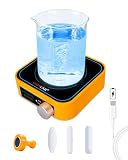
- The Rechargeable Magnetic Stirrer features a built-in lithium battery (3-6 hours standby) and a universal Type-C charging port. This Rechargeable Magnetic Stir plate eliminates the need for a dedicated charger, allowing for cordless use in labs, classrooms, or field environments via any standard USB cable.
- Equipped with a brushless DC motor, this Compact Magnetic Stirrer delivers a maximum speed of 3000 RPM and supports a stirring capacity up to 3000ml. The magnetic scientific stirrer provides consistent torque and adjustable speed control via a simple analog knob (clockwise to increase, anticlockwise to decrease).
- The magnetic stir plate countertop is made of waterproof ABS material for easy cleaning and maintenance, lightweight and space-saving, designed for easy storage and transport.
- Suitable for mixing low-viscosity liquids in labs, industry, classrooms, and diverse scientific applications. Please note: This is a non-heating model (NO HEATING function).
- Designed for mixing LOW-VISCOSITY LIQUIDS ONLY. Not suitable for HIGH-VISCOSITY substances such as viscous oils, resin, or chemical pastes. Each Compact Magnetic Stirrer includes 3 magnetic stir bars(each comes with different shapes) and 1 retriever. For better performance, use containers with thin, flat, and non-magnetic bases.
The first public result was a candidate solid-state electrolyte. An electrolyte is the ion-conducting material that allows charged ions to move between a battery’s electrodes during charging and discharging. The candidate contains lithium and sodium along with other elements. It is a compound or material structure—not a newly discovered element on the periodic table—and it is only one part of a complete battery.
What material did the AI-assisted search find?
The material is a lithium-sodium solid-state electrolyte candidate. Microsoft says the composition substitutes sodium for some lithium and could use approximately 70% less lithium than the comparison materials identified in Microsoft’s account.
The “70% less lithium” claim needs a precise reading. The public announcement describes a reduction associated with the candidate electrolyte or material relative to the comparison, not a guaranteed 70% reduction in the lithium contained in a finished battery pack. A complete cell also includes an anode, cathode, current collectors, separators or interfaces, packaging, and other components.
Recommended Free Tools
Lower lithium intensity could matter because lithium is strategically important to rechargeable batteries, while supply is finite and geographically concentrated. Sodium is more abundant and widely available than lithium. However, sodium substitution could affect voltage, capacity, mass, ion transport, energy density, processing requirements, and other aspects of cell design.
Lower lithium use does not automatically make a battery 70% cheaper, 70% safer, or 70% better for the environment. Battery economics and environmental performance depend on raw-material processing, manufacturing yield, energy density, cycle life, safety systems, transport, recycling, and the entire cell and pack design.
How did Microsoft and PNNL use AI to search for the material?
The workflow combined computational generation, AI prediction, scientific filtering, and laboratory verification:
- Generate candidate structures. The system enumerated or generated millions of possible inorganic crystal structures that could potentially have useful battery properties.
- Predict material properties. Microsoft’s AI models estimated characteristics including energy, force, stress, electronic band gap, and mechanical properties.
- Filter for stability. The computational process removed candidates that appeared unstable or unsuitable for further consideration.
- Apply battery-specific criteria. PNNL scientists helped define additional screening criteria relevant to energy-storage applications.
- Choose a small laboratory set. Researchers selected a limited number of promising structures rather than attempting to physically synthesize every computational candidate.
- Synthesize and characterize materials. PNNL made the leading candidate from raw materials and examined its structure and behavior.
- Build and test a cell. PNNL used the material in a small all-solid-state battery prototype to test whether the computational result translated into a functioning device.
Microsoft says its property-prediction models could estimate specified material characteristics approximately 1,500 times faster than traditional density-functional-theory calculations. That comparison applies to a computational prediction step; it does not mean the full battery-development process became 1,500 times faster. Microsoft’s detailed technical account describes the models, filtering, synthesis, and prototype work.
Also popular on Amazon

- Measure the potential heat capabilities of various solid or liquid fuels
- Connects with a 6 Volt battery (NOT included)
- 5 degree Centigrade increase in temperature in approximately 10 minuets
- Supporting posts and coil are coated to prevent electrolysis
- Includes instructions
How large was the battery-material search?
Microsoft describes several stages of the funnel, and the figures should not be treated as interchangeable:
| Stage | Reported result | What the figure means |
|---|---|---|
| Initial computational search | Approximately 32.6 million candidates | Possible material structures screened computationally |
| Stability screening | More than 500,000 candidates | Materials identified as stable enough for further consideration |
| Promising shortlist | 18 candidates | A small group selected for deeper attention in one Microsoft account |
| Laboratory focus | One leading candidate | The material PNNL synthesized, characterized, and used in a prototype |
Microsoft’s newsroom account says the process narrowed the original search to 18 promising candidates in approximately 80 hours. The 80-hour figure describes computational narrowing, not the physical testing of 32.6 million samples. Nearly all candidates were evaluated by models and simulations; only a very small number reached the laboratory.
Microsoft separately says the end-to-end proof of concept took less than nine months. That broader period includes the computational work, material selection, synthesis, characterization, and prototype testing. The distinction matters: AI can shorten candidate discovery, but laboratory synthesis, full-cell engineering, durability testing, scale-up, safety qualification, and manufacturing still require time.
What did PNNL validate in the laboratory?
PNNL synthesized the leading candidate from raw materials, characterized its structure, measured its ionic conductivity, tested conductivity across a range of temperatures, and assembled a working all-solid-state battery prototype. Microsoft says the prototype operated in tests at room temperature and at approximately 80°C.
The laboratory work establishes an important chain of evidence: a computationally selected structure could be physically produced, could conduct ions, and could function in a prototype cell. That is stronger than a computer-only prediction because the material survived the transition from model to physical experiment.
The public account does not establish how the prototype compares with commercial lithium-ion cells or established solid-state electrolytes on energy density, power, cycle life, charging speed, low-temperature behavior, cost, or manufacturing yield. The prototype demonstrates technical viability, not commercial readiness.
Why is a solid-state electrolyte important?
A solid-state electrolyte is a solid ion-conducting layer between a battery’s electrodes. Many conventional lithium-ion batteries use a liquid electrolyte. A solid electrolyte could support different cell architectures and may reduce some leakage or flammability concerns associated with liquid electrolytes.
Also popular on Amazon

- Constructed with a high-transparency, high-strength cylinder, this experiment device is durable, break-resistant, and displays clear experimental phenomena with an attractive appearance.
- Features a reasonably sized design that ensures outstanding experimental effects while effectively reducing the usage of chemical reagents.
- Equipped with a movable electrode mounting structure for easy electrode replacement, which is more practical than the fixed electrode design used in similar products.
- Built with a freely detachable partition in the square cylinder, allowing the device to be used for both electrolysis and electroplating experiments.
- Perfect for high school chemistry galvanic battery student experiments, and also suitable for student electrolysis and electroplating practical training.
Changing the electrolyte alone does not solve every solid-state battery problem. Solid materials must maintain intimate contact with electrodes while the electrodes expand and contract during cycling. Rigid or brittle electrolytes can crack, and interfaces can develop resistance that limits power or shortens life. Some solid-state designs may also need carefully controlled pressure, specialized manufacturing, or demanding processing conditions.
| Question | What the announcement supports | What remains unknown |
|---|---|---|
| Does the material conduct ions? | Microsoft says PNNL measured viable ionic conductivity. | Whether conductivity is competitive under practical full-cell conditions. |
| Can the material work in a battery? | PNNL built and tested an all-solid-state prototype. | Long-term cycling, high-rate operation, and performance at scale. |
| Does it reduce lithium use? | Microsoft reports approximately 70% less lithium for the candidate relative to its comparison. | The lithium reduction in a complete commercial cell or battery pack. |
| Is it safer? | A solid electrolyte may change leakage and flammability risks. | Whole-cell abuse tolerance, thermal behavior, and failure mechanisms. |
| Is it manufacturable? | The candidate was synthesized in a laboratory. | Kilogram- or ton-scale production, yield, equipment, cost, and quality control. |
Does this battery replace lithium-ion technology?
No. The reported material is not a market-ready replacement for lithium-ion batteries, and the candidate still contains lithium. The announcement does not provide evidence of commercial-scale production, automotive-format cells, competitive energy density, long cycle life, fast charging, low-temperature performance, abuse tolerance, cost competitiveness, recycling performance, certification, or deployment in consumer products.
The candidate is also an electrolyte material rather than a complete battery chemistry. A commercially useful battery would require compatible electrodes, stable interfaces, reliable packaging, a repeatable manufacturing process, thermal and battery-management systems, and validation under realistic operating conditions.
The most defensible interpretation is that AI helped researchers accelerate the discovery and initial testing of a potentially lower-lithium solid-state electrolyte. The work does not show that Microsoft created a battery that uses no lithium or that electric vehicles, phones, or grid-storage systems are about to switch to the material.
Was quantum computing responsible for finding the battery?
Not according to the public description of this result. The demonstrated workflow primarily used AI models, classical computational materials science, cloud-based high-performance computing, and laboratory experiments.
Azure Quantum Elements is designed to support future integration with quantum computing, and Microsoft presents quantum methods as part of the platform’s longer-term scientific roadmap. The announced battery proof of concept was not presented as a demonstration that a fault-tolerant quantum computer discovered the electrolyte. Microsoft’s broader Azure Quantum Elements explanation places AI-augmented chemistry, accelerated calculations, and future quantum capabilities within the same platform, but those capabilities should not be conflated.
Independent reader supportYour contribution helps us test, update, and keep practical guides available for everyone.What would have to happen before the material became commercially useful?
The next stage would require much more than reproducing the initial prototype. Researchers and manufacturers would need to establish:
Also popular on Amazon

- COMPACT DESIGN - This mini magnetic stirrer is small in size, strong in support, light in weight, easy to carry and store. The magnetic stir top plate is crafted by ABS plastic, which is easy to clean and waterproof. There is no need to worry about the damage of the instrument caused by liquid spillage when stirring.
- SMALL BUT STABLE - Our stir plate has strong magnetic force, low power consumption, low noise and stable performance. The maximum speed can reach 3000 rpm. It is suggested that the maximum mixing capacity is 1000 ml (based on water).
- ROTATION SPEED ADJUSTABLE & RECHARGABLE - Easy to use, just rotate the knob to adjust the speed. Adjustable speed regulation function to meet your different mixing needs. The built in 1200mAh rechargable battery will support 4 to 5 hours use after fully charged. Don't need to consider the power location, brings you more convenience in use.
- WIDELY USED - The 3L liquid lab mixer is widely used for low-concentration liquid mixing in the fields of scientific research, industry, agriculture, medicine, schools, education and scientific research, and can also be used for living mixing coffee, milk powder, perfume making supplies, etc. It is the ideal mixing equipment of the family, laboratory and small-scale processing centers.
- WHAT YOU GET - Comes with magnet stirrer, 4pcs stir bars, stir bar retriever, USB charging cable, user manual. If there's any technical or service problem, please feel free to tell us. We'll try our best to help you with it.
- Ionic conductivity: whether the electrolyte supports useful power output across the required temperature range.
- Electrochemical stability: whether the material remains stable against the selected anode and cathode, especially at high voltage.
- Interface compatibility: whether contact between the solid electrolyte and electrodes remains effective during repeated cycling.
- Cycle life: how many charge-discharge cycles the complete cell can survive under defined current, temperature, pressure, and depth-of-discharge conditions.
- Energy density: whether the full cell stores enough energy by mass and volume to compete with existing technologies.
- Temperature performance: whether the cell works reliably in freezing conditions as well as at elevated temperatures.
- Mechanical durability: whether expansion, contraction, vibration, and pressure changes cause cracking or loss of contact.
- Manufacturing scalability: whether the material can be produced consistently at kilogram or ton scale without unusual atmospheres, extreme pressure, or expensive precursors.
- Safety and abuse tolerance: whether the complete cell remains safe during overcharge, puncture, crushing, overheating, and other failure scenarios.
- Supply-chain impact: whether sodium and the other ingredients avoid simply replacing one bottleneck with another.
- Independent validation: whether other laboratories and industrial partners can reproduce the reported properties.
PNNL and Microsoft continue to describe their relationship as an ongoing collaboration in energy storage, materials science, and AI-assisted research. PNNL’s collaboration page supports treating the battery result as an initial demonstration rather than proof that the specific electrolyte has entered commercial production. A later PNNL 2025 laboratory agenda can provide context about continuing research priorities, but it does not by itself prove commercialization of this specific material.
Can organizations use the same kind of AI platform?
Organizations conducting chemistry or materials research can investigate Microsoft Azure Quantum Elements, the cloud platform Microsoft identifies as supporting this battery-material search. The platform is relevant to battery companies, chemical manufacturers, pharmaceutical companies, universities, advanced-materials groups, and government laboratories—not to consumers looking to buy a new battery.
Quick wins for a faster PC:
Scan for outdated or missing drivers - takes under a minuteDriver Scan →Clear out junk files and repair common Windows errorsFree Scan →The reviewed sources do not identify a public price, plan, or per-run cost for Azure Quantum Elements. Prospective users should treat the service as an enterprise or research-sales conversation rather than assume it is a simple consumer subscription. Organizations should also compare cloud HPC, conventional density-functional-theory software, national-laboratory resources, university clusters, specialized materials-informatics platforms, and open-source tools. Those options differ in licensing, scientific expertise, hardware requirements, model quality, workflow integration, and support.
Frequently Asked Questions
Does the Microsoft and PNNL battery use 70% less lithium overall?
No. Microsoft reports approximately 70% less lithium for the candidate electrolyte or material relative to the comparison described in its announcement. That figure does not establish a 70% reduction in the lithium used by a complete electric-vehicle battery pack.
Did AI physically test 32.6 million batteries or materials?
No. Approximately 32.6 million candidate materials were screened computationally. PNNL synthesized and tested a leading candidate, while Microsoft’s reported shortlist contained 18 promising candidates.
Is the Microsoft-PNNL electrolyte commercially available?
No commercial availability is established by the reviewed official sources. The material was demonstrated in a laboratory all-solid-state battery prototype, with further validation and optimization still required.
What’s actually slowing this PC down?
Pick the symptom - the matching free tool is one click away.
Did a quantum computer discover the new battery material?
No. The reported proof of concept primarily used AI models, classical materials science, cloud high-performance computing, and laboratory testing. Microsoft describes quantum computing as a future capability of the Azure Quantum Elements platform.
The Bottom Line
Bottom line: The Microsoft–PNNL project demonstrates a promising AI-assisted route to discovering battery materials faster. PNNL turned one computational candidate into a functioning lithium-sodium solid-state prototype, and Microsoft reports substantially lower lithium use for that material. The result is scientifically meaningful, but it is not yet evidence of a cheaper, safer, longer-lasting, or commercially available replacement for lithium-ion batteries.

