
What’s actually slowing this PC down?
Pick the symptom - the matching free tool is one click away.
iTechGuides is reader-supported. When you buy through links on our site, we may earn an affiliate commission. As an Amazon Associate I earn from qualifying purchases. Learn more
The best robot mowers of 2026 depend on lawn size, slope, layout, tree cover, installation preferences, and support expectations. Segway Navimow i2 AWD is the strongest fit for many smaller lawns; Segway X4/X430 and Mammotion LUBA 3 AWD suit large or steep yards; Husqvarna Automower is the established-support choice.
There is no universal winner. A compact mower can be excellent on a small, open lawn and completely wrong for a half-acre property with steep transitions, narrow corridors, or several disconnected zones. The recommendations below separate manufacturer specifications from independent hands-on testing and explain which trade-offs matter before spending roughly $800 to $6,000 in the U.S. 2026 market.
Key takeaways
- Segway Navimow i2 AWD is the best fit for many small-to-medium, moderately sloped lawns, with wire-free navigation, a 0.15-acre manufacturer coverage rating, a 45%/24-degree slope specification, and a listed starting price of $999.
- Segway Navimow X4/X430 is better suited to large, steep properties, with a manufacturer slope claim of up to 84%/40 degrees and a listed starting price of $2,499.
- Mammotion LUBA 3 AWD is a strong alternative for large, complex, multi-zone lawns, but its newer technology stack has less long-term reliability evidence than established product lines.
- Husqvarna Automower 410 iQ supports physical or virtual boundaries and is aimed at buyers who value dealer installation and established support; the 435 iQ AWD is the more suitable Husqvarna direction for demanding terrain.
- Wire-free navigation removes perimeter-wire installation but does not remove mapping, charging-station placement, signal troubleshooting, app setup, blade care, or edge trimming.
Best robot mowers of 2026: Which model is right for your lawn?
The right robot mower is determined more by the difficulty of the mowable grass than by the size of the property. Measure the grass the mower must actually cut, then account for separate zones, narrow passages, slopes, trees, obstacles, wet areas, and edges that may still need a string trimmer.
The Tool Desk
Outbyte Driver Updater FREEFix the driver behind crashes, sound loss and screen glitchesFind Drivers →Outbyte PC Repair FREERepair Windows errors before they cause bigger problemsFix Now →| Model | Best for | Navigation | AWD | Coverage or slope information | Price information | Main drawback |
|---|---|---|---|---|---|---|
| Segway Navimow i2 AWD | Small-to-medium lawns with moderate slopes | Wire-free, vision-assisted, automatic mapping | Yes | 0.15 acre; 45%/24 degrees manufacturer rating | From $999 in Segway’s buying guide | Limited coverage and remaining edge work |
| Segway Navimow X4/X430 | Large, steep, complex lawns | Wire-free positioning with obstacle-avoidance features | Yes; X4 uses four-wheel drive | Up to 84%/40 degrees manufacturer claim | From $2,499 in Segway’s buying guide | Expensive and excessive for simple lawns |
| Mammotion LUBA 3 AWD | Large multi-zone lawns and difficult terrain | LiDAR, RTK, and AI vision | Yes | Around 38 degrees in launch coverage; verify model details | North American launch/pre-order pricing reported from $2,399 | Premium price and limited long-term evidence |
| Husqvarna Automower 410 iQ | Support-focused buyers with moderate residential lawns | Physical or virtual boundaries; EPOS positioning option | No | Approximately 0.5 acre rating | Verify current U.S. dealer pricing | Not an AWD large-yard model |
| Husqvarna Automower 435 iQ AWD | Husqvarna buyers with more demanding terrain | Virtual-boundary capability with Husqvarna ecosystem | Yes | Model-specific rating; compare test conditions carefully | Verify current U.S. package and installation price | Premium purchase and service cost |
| Segway Navimow i210E LiDAR Pro | Medium landscaped lawns where sensor-rich mapping matters | LiDAR, RTK, and vision cameras | Not the primary selling point | Hands-on review found strong tree-lined-garden performance | Reviewed pricing was U.K./European, not transferable to U.S. | Narrow cutting width and three-wheel design |
| Sunseeker X3 Plus | Mid-sized lawns and value comparison | Model-specific; verify current mapping and support | Verify configuration | Approximately 0.3 acre reported | $1,599 reported by Tom’s Guide | Availability and support require checking |
Specifications in the table are not equivalent evidence. The slope, coverage, and price figures identified as manufacturer or reported figures should be rechecked for the exact U.S. model, package, and purchase date. Independent testing is more useful for judging whether a mower handles real grass, transitions, obstacles, and slopes consistently.
Popular on Amazon

- Wire-Free Robotic Lawn Mower with LiDAR Navigation - GOAT A2000 LiDAR PRO is a wire-free robotic lawn mower that requires no perimeter wire or RTK antenna. The HoloScope 360° Dual-LiDAR system automatically maps your yard and delivers precise 2 cm positioning — even under trees, near fences, or in shaded areas where GPS mowers lose signal.
- Built-In Edge Trimming for Clean Borders - Unlike standard robot lawn mowers, this model features an integrated TruEdge trimmer for true edge-to-edge cutting. It trims along driveways, sidewalks, flower beds, and irregular lawn borders — reducing the need for manual string trimming after mowing. (Includes 2 rolls of trimming line, each covering approximately 3km of edging.)
- High-Power 32V Platform for Thick Grass - Designed for American lawns with Bermuda, Zoysia, Fescue, and St. Augustine grass. The 32V motor and dual-blade disc system provide stronger cutting torque and faster blade rotation, helping this robotic mower handle dense, fast-growing grass and uneven terrain.*Compared to previous GOAT models, based on ECOVACS lab testing.
- Fast Charging Robotic Mower for Medium to Large Yards - Equipped with a durable 3.0Ah battery and 113.4W fast charging, this robot lawn mower recharges in about 50 minutes. Ideal for homeowners looking for automated lawn care with minimal downtime and consistent scheduled mowing performance.
- Smart App-Controlled Lawn Mower with Custom Zones - Control your smart lawn mower through the ECOVACS app. Create multiple mowing zones, set no-go areas, adjust cutting height and speed, define travel paths between zones, and customize mowing schedules. Designed for complex yard layouts and personalized lawn care.
How were these robot mowers selected?
The comparison uses a practical scoring framework rather than treating the longest feature list as proof of superiority. The weighting is 25% mowing performance and cut consistency, 20% navigation reliability, 15% obstacle avoidance and safety, 15% slope and terrain handling, 10% app and setup experience, 10% maintenance, support, and repairability, and 5% value and ownership cost.
For a large or hilly lawn, terrain handling and navigation reliability should receive more weight. For a budget purchase, installation cost and value deserve more weight. Bob Vila’s comparative testing method provides a useful example of structured evaluation: its testing used a 14-day home trial and scored ease of use, cut quality, performance, durability, and value.
The evidence hierarchy matters. Hands-on independent tests and independent measurements are stronger evidence of real-world behavior than manufacturer specifications. Owner reports can help identify recurring failure modes, but isolated reports should not establish precise performance scores. The current market is also changing quickly; WIRED’s August 2026 update changed recommendations after further testing and added newer budget and premium alternatives.
Is a robot mower suitable for your lawn?
A robot mower is suitable when the mower can reliably reach every grass zone, maintain positioning, avoid hazards, and return to charge without requiring more supervision than the owner wants to provide. Lawn acreage alone cannot answer that question.
Check these seven conditions first
- Mowable area: Measure grass, not the entire lot. A large house, driveway, pool, beds, and woodland may leave much less mowable area than the property acreage suggests.
- Zones and access: Count separate grass areas and measure the paths between them. A mower may support multiple zones but still fail to travel autonomously through a narrow, steep, or obstructed route.
- Terrain: Identify slopes, wet patches, roots, ruts, loose soil, curbs, retaining-wall edges, and sharp transitions. AWD helps traction, but AWD does not make every surface safe or navigable.
- Signal environment: Dense tree cover, tall buildings, fences, and narrow side yards can interfere with satellite-based positioning.
- Obstacles: Toys, hoses, cables, balls, branches, pet waste, and low objects should be removed before mowing. Obstacle detection reduces risk but is not fail-safe.
- Installation tolerance: Decide whether you will bury and maintain perimeter wire, configure virtual boundaries, place a reference antenna, or pay a dealer to install the system.
- Connected ownership: Confirm that you are comfortable with app-based setup, firmware updates, cloud accounts, Wi-Fi or cellular requirements, and troubleshooting after a lost signal or failed map.
Segway’s robot mower buying guide organizes the decision around lawn size, slope, layout complexity, setup preference, obstacle avoidance, and signal reliability. Those are more useful buying questions than simply asking which mower has the highest acreage claim.
What is the difference between boundary-wire and wire-free robot mowers?
Boundary-wire mowers use a physical perimeter cable to define the cutting area, while wire-free mowers use technologies such as RTK/NRTK satellite positioning, cameras, LiDAR, inertial sensors, or a combination of systems to create virtual boundaries.
| Consideration | Boundary-wire system | Wire-free system |
|---|---|---|
| Initial installation | Requires laying, burying, or securing perimeter wire and connectors | Requires charging-station placement, mapping, virtual-boundary setup, and sometimes an antenna or network connection |
| Signal dependence | Less dependent on satellite reception; can work beneath trees and near buildings | Satellite, base-station, camera, LiDAR, or network performance varies by model and environment |
| Changing lawn layout | Requires moving or extending cable | Usually easier to edit virtual boundaries in software |
| Complicated edges | Physical wire can define edges precisely | Requires a safety margin around walls, ponds, steps, and drop-offs |
| Common failure mode | Wire break, movement, or damage from edging, aeration, animals, or landscaping | Lost positioning, poor mapping, antenna placement problems, or cloud/app dependency |
Wire-free does not mean installation-free or maintenance-free. Mapping may require manual driving or boundary correction, and a reference station may need a clear enough position to provide reliable data. Physical-wire systems remain attractive for tree-covered or building-obstructed lawns where satellite reception is unreliable.
Husqvarna illustrates a hybrid approach. The Automower 410 iQ product page describes support for physical or virtual boundaries and EPOS positioning assisted by satellite and cellular-network information. Buyers should confirm exactly which boundary method, reference equipment, and installation package are included with the U.S. model they are considering.
Which navigation technology matters most?
No single navigation technology solves every lawn problem. The best choice depends on whether the lawn’s main challenge is boundary accuracy, tree cover, object recognition, narrow passages, or rough terrain.
RTK and NRTK positioning
RTK or NRTK positioning can keep a mower accurately inside virtual boundaries and help it follow planned routes. The benefit depends on receiving adequate positioning data from satellites, a reference station, or a network service. Buildings, dense canopy, and narrow corridors can reduce reliability.
LiDAR
LiDAR measures surroundings for mapping and detection and can be useful when lighting or visual texture changes. LiDAR does not eliminate problems caused by dense vegetation, narrow spaces, poor layout, or objects that are difficult to classify.
Do these 3 things before closing this tab:
1Clear out junk files and repair common Windows errors2Fix the driver behind crashes, sound loss and screen glitches3Repair Windows errors before they cause bigger problemsCamera and AI vision
Cameras can help identify pets, people, toys, balls, and garden objects. Recognition can vary with lighting, shadows, glare, object color and size, camera cleanliness, tall grass, leaves, and whether an object is partly hidden. A camera-equipped mower must not be treated as safe around children or pets without supervision and lawn preparation.
Sensor fusion
Premium mowers increasingly combine satellite positioning, cameras, LiDAR, and inertial sensing. Sensor fusion can improve robustness across different conditions, but additional hardware can increase purchase price, software complexity, and potential repair cost.
In a TechRadar hands-on review, the Segway Navimow i210E LiDAR Pro’s combination of LiDAR, RTK, and vision cameras performed effectively in a tree-lined garden. The same review noted that the mower’s 22-centimeter cutting width and three-wheel design make it less suitable for very large or especially rough terrain. That is a test observation, not a guarantee for every garden.
How much slope capability does a robot mower really need?
Slope figures must be compared in the same unit and treated as maximum claims, not promises of equal performance in every condition. Percentage grade and degrees describe the same incline differently: a percentage expresses rise relative to horizontal run, while degrees express the angle of the slope.
Recommended Free Tools
| Mower | Published or reported slope figure | Evidence and qualification |
|---|---|---|
| Segway Navimow i2 AWD | 45% / 24 degrees | Segway manufacturer specification; compact mower for smaller lawns |
| Segway Navimow X4/X430 | Up to 84% / 40 degrees | Segway manufacturer claim; independent coverage also gave the X430 strong marks for steep-slope handling |
| Mammotion LUBA 3 AWD | Around 38 degrees | Launch coverage; verify exact model and conditions |
| Other models | Model-specific | Do not transfer a slope number from one model or brand to another |
The Segway buying guide lists the i2 AWD at 45%/24 degrees and the X4 series at up to 84%/40 degrees. Bob Vila’s tested comparison lists the Mammotion LUBA 3 at 38.6 degrees and the X430 at 40 degrees.
Also popular on Amazon
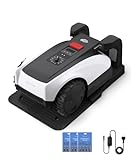
- RTK Precision Navigation for Wire-Free, Accurate Mowing. Powered by advanced RTK technology, this robotic lawn mower delivers centimeter-level positioning accuracy without the need for perimeter wires. It follows efficient, systematic mowing paths instead of random movement, ensuring full lawn coverage, cleaner lines, and a consistently even cut.
- CARE Version Upgrade – Extra Blades for Long-Term Performance. The O1000 RTK CARE bundle includes 36 additional replacement blades, significantly extending maintenance cycles and keeping cutting performance sharp over time. Ideal for homeowners looking for lower long-term cost, fewer interruptions, and consistently clean results.
- RTK Extension Cable Included – Stronger Signal, Flexible Setup. Comes with an RTK extension cable that allows optimal antenna placement for improved satellite signal reception. This ensures more stable positioning, better boundary accuracy, and reliable performance, even in complex yard environments with trees or obstacles.
- Smart Auto Mapping & Multi-Zone Lawn Management. Automatically scans and maps your yard, enabling precise multi-zone management through the app. Customize mowing schedules, define different cutting areas, and optimize efficiency for front yard, backyard, and side zones with ease.
- Fully Automated Lawn Care – Set It and Forget It. From intelligent path planning to automatic recharging, the mower handles everything on its own. Enjoy a hands-free lawn care experience, saving time and effort while maintaining a perfectly trimmed lawn every day.
Real performance can be lower on wet grass, loose soil, worn tires, diagonal traversals, sharp transitions, or edges where one wheel loses contact. A mower that reaches a stated maximum under ideal conditions may slip, mark turf, or stop on a lawn with poorer traction. For a steep property, prioritize independent traction observations and a return policy rather than choosing solely by the largest printed angle.
Which robot mower is best for small or medium lawns?
Segway Navimow i2 AWD: best fit for many smaller sloped lawns
The Segway Navimow i2 AWD is the strongest general-purpose recommendation for a smaller lawn with moderate slopes and an owner who wants to avoid perimeter-wire installation. Segway lists wire-free navigation, vision-assisted obstacle avoidance, automatic mapping, a 0.15-acre coverage rating, a 45%/24-degree slope specification, and a starting price of $999 in its buying guide.
All-wheel drive gives the i2 AWD a better rationale on sloped or uneven grass than a basic entry model. The i2 AWD is still a compact mower: a 0.15-acre rating makes it a poor choice for a large property, and AWD does not turn it into a large-terrain machine. Bob Vila also identified edge trimming as a drawback, so owners should expect to use a string trimmer around fences, beds, walls, and other boundaries.
PC Slower Than It Used to Be?
A free scan shows the junk files, broken settings and background clutter dragging Windows down - then fixes them in one click.Free scan · Windows 10 & 11Crashes, No Sound, or Screen Glitches?
Random freezes, missing sound and display glitches usually trace back to one bad driver. Find and replace yours safely.Free scan · under a minuteChoose it when: the mowable lawn is small, slopes are moderate, wire-free setup matters, and the owner accepts app-based configuration and occasional finishing work.
Do not choose it when: the property is large, highly fragmented, dominated by rough terrain, or covered by trees and structures that compromise positioning.
See the official Segway Navimow i2 AWD product page for the current U.S. configuration and availability.
Segway Navimow i210E LiDAR Pro: best sensor-rich mid-range direction where available
The Segway Navimow i210E LiDAR Pro is a compelling option for a medium-sized, landscaped lawn where mapping and obstacle detection matter more than maximum cutting width. TechRadar’s hands-on review found the combination of LiDAR, RTK, and vision cameras effective in a tree-lined garden and reported orderly parallel mowing and quiet operation.
The i210E’s limitations are important. Its 22-centimeter cutting width can make larger jobs slower, and its three-wheel design is less suitable for especially rough or field-like terrain. The reviewed pricing was U.K./European pricing and should not be transferred to a U.S. purchase. Confirm American availability, warranty, cellular terms, and package contents before treating the model as a U.S. shortlist recommendation.
Which robot mower is best for large or steep lawns?
Segway Navimow X4/X430: best terrain-focused choice
The Segway Navimow X4/X430 is the clearest choice for a large, steep, or complex lawn when four-wheel drive, zero-turn steering, and a wide cutting system justify a premium purchase. Segway lists up to 40 degrees/84% slope capability and starting pricing of $2,499 for the X4 series in its U.S. buying guide. Independent coverage from Android Authority and Bob Vila gave the X430 strong marks for large-yard coverage, difficult slopes, obstacle avoidance, and its dual-disc cutting system.
The X4/X430 is overkill for a small, flat lawn. The mower is also heavier and more expensive, and mapping can require hands-on setup. Vision features may be less effective in poor lighting, and a manufacturer maximum slope figure should not be treated as a guarantee on wet or loose turf.
Choose it when: the lawn is large, hilly, open enough for reliable positioning, and difficult terrain makes traction and productivity worth the premium.
Do not choose it when: the lawn is small and flat, the budget is strict, or the owner wants the simplest possible mower with minimal connected technology.
Check the official Segway Navimow X4 page for the current model, accessories, and U.S. purchase details.
Mammotion LUBA 3 AWD: best for complex multi-zone layouts
Mammotion LUBA 3 AWD is a strong alternative for large gardens with slopes, multiple zones, and buyers seeking a feature-rich wire-free system. Its specified technology mix includes AWD, LiDAR, RTK, AI vision, dual cutting discs, and multi-zone mapping. Launch coverage reported North American pricing starting at $2,399, but current U.S. pricing should be verified before publication or purchase.
LUBA 3’s premium technology stack can make it more capable but also more complex to configure and service. The model is newer than established product families, so launch capabilities should not be described as proof of multi-year durability. Buyers who require a long-established service network should investigate local support, parts access, and return terms carefully.
Quick wins for a faster PC:
Fix the driver behind crashes, sound loss and screen glitchesFind Drivers →Clear out junk files and repair common Windows errorsFree Scan →Scan for outdated or missing drivers - takes under a minuteDriver Scan →Tom’s Guide’s launch coverage of the Segway X4 and Mammotion LUBA 3 provides context for the reported North American pricing and 2026 product positioning. Mammotion’s official vendor site should be used to confirm the current U.S. model and package.
Also popular on Amazon

- Dual AI Vision System with NRTK Technology:The M5 robotic lawn mower, featuring Adaptive Cruise Control (ACC) and RTK positioning system, delivers centimeter‑level precision through its integrated dual‑camera vision system. M5 easily adapts to diverse lawn layouts and maintains reliable performance even in challenging environments
- Package Contents: This set includes 1 ANTHBOT M5 robotic lawn mower, 1 charging base station, 1 blade set (5 blades in total), and 1 RTK reference station.Your items will be shipped in multiple separate packages
- Efficient Mowing Performance: Handles slopes up to 45% gradient, M5 is suitable for over 99% of residential yards. Features adjustable cutting height (1.2-2.7in) and 5 Free-Rotating Blades design to create a carpet-like lawn. Intelligent path planning allows selection of multiple mowing paths via the app
- Multi-Zone Management & App Control: Easily manage up to 20 work zones via the app. Create seamless paths between different areas and set customizable no-go zones for a tailored lawn care experience. Its self-charging feature ensures it returns to recharge and resumes work automatically, while the ANTHBOT app allows you to monitor your yard anytime, anywhere.
- Beginner-Friendly Design: The ANTHBOT M5 robot lawn mowers is ideal for small to medium-sized yards, max mowing size 0.15 Acre. Powered by advanced AI vision technology, M5 creates a virtual map all by itself in the ANTHBOT app in only 10 minutes-no need to manually drive it around the property anymore, making setup a breeze
Which robot mower is best if dealer support matters?
Husqvarna Automower 410 iQ: best established-brand option
Husqvarna Automower 410 iQ is the better fit for buyers who prioritize an established outdoor-power brand, dealer installation, and flexible boundary options over the lowest upfront price. Husqvarna’s U.S. residential range includes iQ and AWD models, with the range shown at approximately 0.5 acre to 1.3 acres of capacity. The 410 iQ supports physical or virtual-wire installation and EPOS reference-station support.
The 410 iQ is not an AWD large-yard mower. Husqvarna models can also cost more than newer wire-free competitors, and dealer installation may add to the ownership cost. The exact boundary method, reference-station requirements, warranty, and service availability should be confirmed with a local dealer rather than assumed from the brand name.
Husqvarna’s U.S. robotic mower range and Automower 410 iQ specifications are the appropriate sources for current model details. No reliable U.S. price was visible in the reviewed product evidence, so a dealer or official product page is preferable to an unverified price claim.
Free tools Windows power users keep installed
One-click scans. No signup required.
Husqvarna Automower 435 iQ AWD: best Husqvarna direction for demanding terrain
The Husqvarna Automower 435 iQ AWD combines Husqvarna’s dealer ecosystem with all-wheel drive and virtual-boundary capability for more demanding residential terrain. It is the Husqvarna model to investigate when slopes or rougher ground exceed the practical remit of a compact 410 iQ.
The 435 iQ AWD is a premium purchase, and its slope figure should not be compared directly with Segway or Mammotion ratings unless the test conditions and measurement methods match. Verify current coverage, package contents, reference-station requirements, installation pricing, and local service before buying. The official Automower 435 iQ AWD page is the relevant U.S. source.
What is the best lower-cost alternative?
For a flat, open lawn where AWD, LiDAR, and large-area capability are unnecessary, an entry Segway i1/i2 model or Sunseeker X3 Plus may offer better value than a premium mower. Segway’s official guide lists i1-series pricing from $799 and i2 AWD pricing from $999. Tom’s Guide reported the Sunseeker X3 Plus at $1,599 and approximately 0.3-acre coverage.
A cheaper mower is only a better value if the lawn suits its navigation, traction, coverage, and support limitations. Check current U.S. availability, warranty terms, parts access, and service before choosing the Sunseeker option. The reported Sunseeker figure is not a guaranteed current price.
See Tom’s Guide’s Sunseeker X3 review and Segway’s official range and pricing guide for the evidence behind these value comparisons.
How should you compare cutting performance and edge quality?
Cutting width, disc design, cutting height, route pattern, recharge behavior, and edge reach determine whether a robot mower produces a tidy result or leaves substantial finishing work.
- Cutting width: A wider deck can reduce the time required for a large lawn, while a narrower mower may fit passages more easily.
- Cutting discs: Dual-disc systems can cover more grass per pass, but disc count alone does not prove better cut quality.
- Cutting height: Compare the mower’s adjustment range with the grass height you maintain; do not assume every model suits long or neglected grass.
- Route pattern: Parallel lines may look more orderly and make coverage easier to understand than random movement, but navigation reliability matters more than appearance.
- Recharge cycles: Coverage ratings commonly assume repeated mowing and charging rather than one uninterrupted pass. Dense, wet, or tall grass can extend the job.
- Edges: Walls, fences, beds, curbs, ponds, and drop-offs often leave a strip that requires a string trimmer. Robot mowing usually reduces, rather than eliminates, all lawn maintenance.
Frequent light mowing can produce a mulch-like finish because the mower cuts small amounts repeatedly. Frequent operation does not remove the need to inspect blades, clear debris, maintain safe margins, and perform seasonal care.
How safe are robot mowers around children, pets, and obstacles?
Robot mowers can combine blade shutdown, obstacle detection, theft alarms, GPS location, PIN locks, and geofencing, but no obstacle-detection system should be treated as fail-safe around children or pets.
Quick wins for a faster PC:
Clear out junk files and repair common Windows errorsFree Scan →Scan for outdated or missing drivers - takes under a minuteDriver Scan →Small toys, cables, balls, dark or thin objects, low objects below the camera’s view, shadows, glare, leaves, and partially hidden items can challenge camera-based systems. Tall grass and a dirty camera can also reduce recognition performance. Remove loose objects and dog waste before every mowing schedule, and keep children and pets away from the active mower unless the manufacturer’s safety instructions and your own supervision make the situation appropriate.
TechRadar reported that the Segway i210E recognized many garden objects, pets, children, and small obstacles during testing. That observation is useful evidence about one tested mower and environment, not a guarantee that the mower will detect every hazard on every U.S. lawn.
Independent reader supportYour contribution helps us test, update, and keep practical guides available for everyone.What installation and ownership costs should you budget?
The purchase price is only one part of robotic mower ownership. A realistic budget should include the charging station, reference antenna where required, boundary wire and connectors where applicable, professional installation, replacement blades, wheels, battery replacement, cellular connectivity, winter storage, repairs, dealer labor, theft recovery, and electricity.
| Cost category | Why it matters | Questions to ask before purchase |
|---|---|---|
| Mower and package | Model suffixes and regional packages can change included equipment | Is the quoted price MSRP, sale price, or retailer price? What country and date apply? |
| Installation | Wire laying, antenna placement, mapping, and boundary correction can require time or dealer labor | Can the owner install it, and what does professional installation cost locally? |
| Connectivity | Remote controls, theft tracking, mapping, or updates may depend on Wi-Fi, cellular service, or cloud accounts | Is a subscription required, and what functions remain available offline? |
| Consumables | Blades and other traction or cutting components wear out | Are replacement parts readily available in the U.S.? |
| Battery and repairs | Battery replacement and connected-hardware repairs can alter long-term value | Who performs repairs, how long is typical turnaround, and what is covered? |
| Seasonal care | Winter storage, cleaning, firmware management, and charging-station care remain necessary | What storage and maintenance steps does the manufacturer require? |
Prices are volatile and should be checked immediately before publication or purchase. A price observed in research is not necessarily the current U.S. selling price, and installation, accessories, taxes, shipping, and dealer labor may be extra.
What’s actually slowing this PC down?
Pick the symptom - the matching free tool is one click away.
What are the most common robot mower failure points?
Lost satellite positioning
Wire-free mowers may struggle beside tall buildings, dense tree canopies, fences, and narrow side yards. Review the manufacturer’s coverage guidance, plan the base-station or antenna location, and use the return policy as protection if the lawn has difficult signal conditions.
Also popular on Amazon

- Centimeter-Level RTK Cloud Accuracy: Commercial-grade RTK Cloud technology delivers centimeter-level positioning for this robotic lawn mower with no local antenna installation and no additional cloud costs.
- Auto Mapping for More Complete Coverage: Vision AI helps the robot lawn mower understand lawn shapes and boundary types, then automatically maps your yard for smooth paths, closer edge-following, and fuller coverage from day one.
- AI Obstacle Avoidance with Neural Processing: Vision AI recognizes and understands common yard objects, using a trained neural network and up to 10 trillion operations per second to help mowing stay smooth, safe, and uninterrupted.
- Infinite Zone Mowing & App Remote Control: Create unlimited mowing zones, set custom paths, define no-go areas, edit your map, and monitor your remote control lawn mower from the app anytime.
- Reliable Navigation Even in Shade: RTK Cloud provides centimeter-level accuracy in open areas, while V-SLAM sensor fusion with Vision AI helps maintain precise navigation in shaded or partially covered lawn spaces.
Narrow passages and disconnected zones
Multi-zone mapping does not guarantee that a mower can reach every zone. Measure passage width, slope, surface changes, gates, and obstacles rather than relying only on the number of zones advertised.
Wet grass and poor traction
Wet turf can increase wheel slip, turf marking, and failed climbs. Maximum slope specifications should not be assumed to apply equally in wet conditions.
Edges and drop-offs
Set a safety margin around retaining walls, ponds, steps, driveways, and other drop-offs. The safety margin may leave uncut grass, and a trimmer may still be necessary.
Leaves and debris
Robot mowers are primarily grass-cutting appliances. Heavy leaves, branches, hoses, toys, and dog waste can stop a mower, damage blades, or reduce cut quality.
Software and connectivity
A mower may be less convenient if mapping, remote control, theft tracking, or firmware updates depend on an account, app, Wi-Fi, cellular coverage, or cloud service. Check what happens after a lost signal or failed map and whether basic mowing remains available.
New-model reliability
New 2026 models may offer better sensors and mapping but have less long-term reliability evidence than established models. Describe early products as promising rather than proven, and look for parts availability, warranty handling, and recurring owner-reported failure patterns.
Husqvarna versus Segway: Which brand approach is better?
Husqvarna is the stronger direction for buyers who want an established ecosystem, dealer support, installation assistance, and a choice between iQ virtual boundaries and conventional physical-wire installation. Segway offers a more aggressive wire-free range, including compact AWD models and larger terrain-focused products.
The comparison should not be reduced to brand reputation. Segway Navimow i2 AWD is a better match than a premium Husqvarna for many small, moderately sloped lawns where value and wire-free setup matter. Segway X4/X430 or Mammotion LUBA 3 AWD is a more logical direction for large, steep terrain. Husqvarna becomes more compelling when local dealer service, installation, and established support are worth the premium.
Husqvarna’s “world’s leading” and “number one selling” language is a marketing claim based on Euromonitor retail-value sales data for 2024 under Husqvarna’s stated category definition. Such a claim describes brand sales evidence, not proof that every Husqvarna model is the best performer for every lawn.
Robot mower buying checklist
- Measure the total mowable grass area.
- Draw every separate zone and measure connecting paths.
- Record the steepest slopes in both percentage grade and degrees where possible.
- Mark trees, buildings, fences, narrow corridors, walls, ponds, steps, and drop-offs.
- Decide whether physical wire or virtual boundaries suit the property.
- Confirm the exact U.S. model suffix, AWD configuration, coverage rating, cutting width, and included accessories.
- Check whether RTK, EPOS, LiDAR, Wi-Fi, cellular service, a reference station, or a subscription is required.
- Read the installation instructions and price professional installation locally.
- Confirm the return policy, warranty, local repair route, battery availability, blades, wheels, and software-support policy.
- Plan for edge trimming and remove toys, hoses, branches, leaves, and pet waste before scheduled mowing.
- Compare real-world testing with manufacturer claims, especially for slopes, obstacle avoidance, and coverage.
Which robot mower should you buy?
Buy the Segway Navimow i2 AWD if the lawn is small to medium, moderately sloped, and you want a relatively accessible wire-free starting point. Buy the Segway X4/X430 if the lawn is large and steep enough that four-wheel drive, wide cutting coverage, and difficult-terrain performance justify the price. Consider Mammotion LUBA 3 AWD for a large, multi-zone property where advanced mapping and AWD are more important than a long-established support network.
Choose Husqvarna Automower 410 iQ if dealer help, established support, and physical-or-virtual boundary flexibility matter most for a moderate residential lawn. Choose the 435 iQ AWD if you want Husqvarna’s ecosystem but have more demanding terrain. Consider the Segway i210E LiDAR Pro only after confirming U.S. availability and pricing, particularly if the lawn is landscaped and tree-lined rather than large and rough.
The best robot mower is the model that matches the lawn’s hardest constraint—not the model with the longest list of sensors or the highest advertised slope number. Before buying, validate signal coverage, access between zones, edge expectations, installation cost, local service, and the exact U.S. package.
Frequently Asked Questions
Are robot mowers worth it for a small flat lawn?
Robot mowers can be worthwhile for a small flat lawn if the owner values automatic mowing and accepts app setup, charging-station installation, blade maintenance, and remaining edge work. A simpler entry model may offer better value than a premium AWD or LiDAR mower when slopes and complex mapping are unnecessary.
Do wire-free robot mowers work under trees?
Wire-free robot mowers can work under some tree cover, but dense canopies, buildings, fences, and narrow corridors can degrade satellite positioning. LiDAR and camera systems may improve environmental awareness, but buyers should verify signal conditions, antenna placement, and the return policy for the specific lawn.
Can robot mowers safely operate around dogs and children?
Robot mowers should not be treated as fail-safe around dogs or children, even when they include cameras, AI vision, blade shutdown, or obstacle detection. Remove pet waste and loose objects, supervise use, and follow the manufacturer’s safety instructions.
Outdated Drivers Are Slowing You Down
One free scan finds every outdated or missing driver and matches the right update for your exact hardware.Free scan · exact hardware matchPC Slower Than It Used to Be?
A free scan shows the junk files, broken settings and background clutter dragging Windows down - then fixes them in one click.Free scan · Windows 10 & 11Do robot mowers eliminate the need for a string trimmer?
Most robot mowers do not eliminate the need for a string trimmer because fences, walls, beds, curbs, ponds, and other obstacles can leave an uncut edge strip. Edge performance varies by model and boundary setup, but buyers should expect some finishing work.
Is a manufacturer’s maximum slope rating a guarantee?
A manufacturer’s maximum slope rating is not a guarantee of equal performance on every lawn. Wet grass, loose soil, worn tires, diagonal travel, sharp transitions, and poor edge traction can reduce performance below the published ideal-condition figure.
The Bottom Line
Bottom line: Segway Navimow i2 AWD is the most broadly useful pick for a smaller, moderately sloped lawn; Segway X4/X430 is the stronger large-and-steep-lawn choice; Mammotion LUBA 3 AWD suits complex multi-zone terrain; and Husqvarna Automower remains the support- and dealer-focused option. Match the mower to signal conditions, access routes, terrain, installation tolerance, and local service before comparing prices.
Quick Recap
Product prices and availability are accurate as of the date/time indicated and are subject to change. Any price and availability information displayed on Amazon at the time of purchase will apply.

