
Do these 3 things before closing this tab:
1Fix the driver behind crashes, sound loss and screen glitches2Repair Windows errors before they cause bigger problems3Scan for outdated or missing drivers - takes under a minuteiTechGuides is reader-supported. When you buy through links on our site, we may earn an affiliate commission. As an Amazon Associate I earn from qualifying purchases. Learn more
Seagate’s 30TB HAMR drives moved beyond prototypes and limited customer qualification into volume production, then reached worldwide channel availability on July 15, 2025. The 30TB Exos M targets enterprise and cloud data centers, while the 30TB IronWolf Pro targets high-capacity NAS users; neither drive is an SSD replacement.
That answer needs a timeline qualifier. Seagate announced the Mozaic 3+ platform and 30TB-plus Exos drives on January 17, 2024, but “volume ramp” initially described a manufacturing and customer-qualification phase rather than immediate retail availability. Seagate later announced channel availability for 28TB and 30TB Exos M and IronWolf Pro models.
| # | Preview | Product | Price | |
|---|---|---|---|---|
| 1 |
|
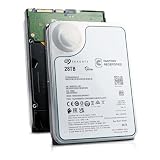
Seagate Exos 28TB Internal Hard Drive HDD - 3.5 in CMR SATA 6Gb/s, 7200 RPM, 512MB Cache, 2.5M MTBF... | $899.99 | Buy on Amazon |
Key takeaways
- Seagate announced Mozaic 3+ and 30TB-plus Exos drives on January 17, 2024, but global channel availability for 28TB and 30TB Exos M and IronWolf Pro drives arrived on July 15, 2025.
- The 30TB Exos M and 30TB IronWolf Pro use Seagate’s Mozaic 3+ HAMR platform; the IronWolf Pro model ST30000NT011 is a 7,200 RPM, CMR, SATA 6Gb/s drive with a published maximum sustained transfer rate of 275MB/s.
- Seagate’s July 15, 2025 manufacturer price was $599.99 for a 30TB Exos M or IronWolf Pro, but that launch-period price is not a verified August 2026 street price.
- HAMR primarily increases areal density, allowing more capacity in the same 3.5-inch bay; HAMR does not provide SSD-like latency or turn a mechanical HDD into a high-IOPS device.
- The strongest use cases are cloud, object storage, backup, archive, AI data retention, media, and surveillance capacity tiers rather than databases, virtual machines, or desktop applications.
Seagate Begins Ramp of 30TB HAMR Drives: what does “ramp” actually mean?
In storage manufacturing, a volume ramp means that a product is moving from engineering, qualification, sampling, or limited production toward increasing-volume manufacturing and shipments. A volume ramp does not automatically mean that every retailer has inventory, that every capacity is shipping at the same rate, or that production has reached its maximum.
Free tools Windows power users keep installed
One-click scans. No signup required.
Seagate’s January 17, 2024 announcement described Mozaic 3+ as entering volume ramp and presented 30TB-plus Exos capacity points. The announcement was an important commercialization milestone, but it was not proof that ordinary buyers could immediately order a 30TB HAMR disk from every region or reseller. Seagate’s January 2024 announcement used the language of a production transition, not a universal retail launch.
Popular on Amazon
- MASSIVE 28TB CAPACITY – Store and manage enormous datasets with ease. Ideal for data centers, servers, NAS systems, cloud storage, and large-scale backup solutions.
- ENTERPRISE-CLASS PERFORMANCE – 7,200 RPM spindle speed, SATA III 6Gb/s interface, and large cache deliver fast, consistent throughput for demanding 24/7 workloads
- CMR TECHNOLOGY (CONVENTIONAL MAGNETIC RECORDING) – Designed for predictable performance, reliability, and compatibility in RAID and enterprise storage environments.
- BUILT FOR 24/7 OPERATION – Engineered for continuous use with enterprise-grade durability, making it suitable for mission-critical applications and high-density storage arrays.
- STANDARD 3.5” SATA FORM FACTOR – Seamlessly integrates into most enterprise servers, workstations, and NAS enclosures that support 3.5-inch SATA hard drives.
Later disclosures make the sequence clearer: cloud customers qualified early products, Seagate increased production with a leading cloud-service-provider customer, and Seagate eventually announced worldwide channel availability. The most accurate short version is that 30TB HAMR drives entered volume production before they became broadly available through commercial channels.
When did Seagate’s 30TB HAMR drives become available?
Seagate’s 30TB HAMR commercialization happened in several stages rather than on one release date.
| Date | Milestone | What it means |
|---|---|---|
| January 17, 2024 | Mozaic 3+ and 30TB-plus Exos announcement | Seagate announced the platform and described a volume-ramp phase; this was not the same as broad retail availability. |
| 2024 | Customer qualification and production ramp | Cloud customers continued qualification while Seagate worked toward higher-volume shipments. |
| January 21, 2025 | Exos M ramp to 32TB and samples up to 36TB | Seagate said it was ramping Exos M drives up to 32TB with a leading CSP and sampling products up to 36TB to selected customers. |
| July 15, 2025 | Global channel availability | Seagate announced worldwide channel availability for 28TB and 30TB Exos M and IronWolf Pro drives. |
| March 3, 2026 | Mozaic 4+ production | Seagate said Mozaic 4+ was qualified and in production with two hyperscale providers, marking the next generation rather than a replacement of the original 30TB-class launch. |
The January 21, 2025 announcement is particularly important because it separates sampling from general availability. Seagate described the 36TB products as samples for select customers, while the 32TB products were being ramped with a leading cloud-service-provider customer.
What’s actually slowing this PC down?
Pick the symptom - the matching free tool is one click away.
On July 15, 2025, Seagate announced that 28TB and 30TB versions of both Exos M and IronWolf Pro were available through its global channel. “Worldwide channel availability” should still be read carefully: it indicates a commercial distribution path, not equal inventory, pricing, or delivery times in every country. Seagate’s channel-availability announcement listed a manufacturer price of $599.99 for the 30TB models and $569.99 for the 28TB models.
What are HAMR and Mozaic 3+ doing inside the drive?
HAMR, or heat-assisted magnetic recording, briefly heats a microscopic area of the magnetic medium with a laser so the drive can write data to a stronger, more stable recording surface. The medium rapidly returns to its normal magnetic state after the write operation.
HAMR addresses the areal-density problem: manufacturers need to place more bits into the same physical area as hard-drive capacities grow. Seagate’s broader Mozaic platform combines laser-assisted writing with high-coercivity media, nanoscale magnetic structures, advanced read sensors, and integrated controller and signal-processing technologies. Seagate’s HAMR explanation describes the recording method, while its Mozaic 3+ technical overview describes the platform components and density strategy.
Seagate says Mozaic 3+ delivers more than 3TB per platter and identifies a path toward 4TB and 5TB per platter. The commercial 30TB design uses 10 platters at 3TB per platter. The practical benefit is not primarily faster access; the benefit is putting more raw capacity into a standard drive bay, enclosure, or rack footprint.
Which products use the 30TB Mozaic 3+ platform?
The phrase “30TB HAMR drive” refers to at least two different Seagate product families. Exos M is designed for enterprise and data-center deployments, while IronWolf Pro is the NAS-oriented product that creates a more direct buying path for businesses and advanced home laboratories.
| Product | Primary buyer | Platform and recording | Availability context | Best-fit workloads |
|---|---|---|---|---|
| Seagate Exos M 30TB | Cloud providers, hyperscalers, enterprises, storage-system vendors | Mozaic 3+ HAMR; enterprise 3.5-inch HDD | Initially qualified and ramped with cloud customers; global channel availability announced July 15, 2025 | Object storage, data-center archives, backup, AI data retention, and dense capacity tiers |
| Seagate IronWolf Pro 30TB, ST30000NT011 | Business NAS users, media teams, surveillance operators, research groups, and high-capacity homelabs | Mozaic 3+ HAMR; CMR; 3.5-inch SATA HDD | Global channel availability announced July 15, 2025; actual stock and pricing vary by market | NAS file storage, media libraries, surveillance, backup, and large local archives |
Seagate’s official Exos M product page positions Exos M for enterprise and data-center use. The official IronWolf Pro product page covers the NAS family. A buyer should not assume that an Exos M and an IronWolf Pro are interchangeable merely because both can reach 30TB.
What are the verified 30TB IronWolf Pro specifications?
The 30TB IronWolf Pro model identified in Seagate’s datasheet is ST30000NT011. The drive is a helium-filled, 7,200 RPM, CMR SATA HDD with a five-year warranty and a three-year data-recovery service.
| Attribute | 30TB IronWolf Pro specification |
|---|---|
| Model | ST30000NT011 |
| Capacity | 30TB |
| Recording method | CMR |
| HAMR platform | Mozaic 3+ |
| Form factor | 3.5-inch |
| Interface | SATA 6Gb/s |
| Rotational speed | 7,200 RPM |
| Cache | 512MB |
| Maximum sustained transfer rate | 275MB/s |
| Average idle power | 6.8W |
| Average operating power | 8.3W |
| Startup current | 2.0A at 12V |
| Reported operating-temperature limit | 60°C |
| Workload rate limit | 550TB per year |
| MTBF | 2.5 million hours |
| Warranty | Five years |
| Data-recovery service | Three years |
| Weight | Approximately 695g |
| Helium-filled | Yes |
These are manufacturer-published specifications, not independent long-term reliability results. The 30TB IronWolf Pro datasheet is the appropriate reference for the model, electrical requirements, workload rating, warranty, and performance figures.
Outdated Drivers Are Slowing You Down
One free scan finds every outdated or missing driver and matches the right update for your exact hardware.Free scan · exact hardware matchPC Slower Than It Used to Be?
A free scan shows the junk files, broken settings and background clutter dragging Windows down - then fixes them in one click.Free scan · Windows 10 & 11Seagate’s CMR/SMR product list identifies Mozaic HAMR capacities including 28TB, 30TB, and 32TB as CMR products. CMR is relevant for NAS and enterprise users because sustained updates and parity operations do not have the same shingled-recording behavior associated with SMR drives.
Why do data centers care about 30TB HAMR drives?
Data centers care because higher capacity per bay can reduce the number of drives, enclosures, racks, backplanes, and supporting infrastructure required for a given amount of raw storage. The value is storage density and potentially lower cost and power per stored terabyte, not a transformation in HDD latency.
A 30TB disk can provide three times the raw capacity of a 10TB disk in the same nominal 3.5-inch slot. Fewer spindles can also reduce the aggregate power and cooling burden, although the real result depends on the complete storage design, including redundancy, controllers, networking, idle behavior, and workload.
Seagate has claimed that an Exos M upgrade from a typical 10TB installed-base drive can provide three times the capacity in the same slot and roughly 70% lower power consumption per terabyte. Those are Seagate comparisons, not independent measurements. Seagate has also claimed up to 300% more capacity in the same footprint, approximately 25% lower cost per terabyte, and approximately 60% lower power consumption per terabyte in a 10TB-to-30TB comparison. The company’s comparison claims depend on the baseline drive, deployment design, workload, and whether the analysis includes system-level costs.
Recommended Free Tools
Per-terabyte efficiency does not mean that every 30TB drive consumes less absolute power than every smaller drive. A 30TB drive can draw more power than a smaller individual drive while still requiring fewer drives for the same total capacity. That distinction matters when estimating an actual NAS, RAID group, or data-center bill.
How does AI increase demand for high-capacity HDDs?
AI systems generate training data, checkpoints, logs, generated content, and retained datasets. Much of that information is valuable but not accessed frequently enough to justify storing every copy on expensive flash.
High-capacity HAMR HDDs therefore fit the capacity tier around AI infrastructure: data-center archives, object storage, backup repositories, training-data retention, cold and warm datasets, video, surveillance, and media libraries. “AI-ready” in this context describes the economics and scale of the storage workload; it does not mean that the HDD contains an AI accelerator or delivers AI-specific latency.
Flash remains the better fit for hot datasets, database working sets, virtual machines, metadata, scratch space, and workloads dominated by random I/O. A sensible architecture can use SSDs for active data and high-capacity HDDs for the larger, less latency-sensitive data population.
Quick wins for a faster PC:
Repair Windows errors before they cause bigger problemsFix Now →Fix the driver behind crashes, sound loss and screen glitchesFind Drivers →Clear out junk files and repair common Windows errorsFree Scan →Who can buy the 30TB drives?
Enterprise customers could access Exos M through storage-system vendors, data-center suppliers, and Seagate’s enterprise channel. The earliest ramp centered on cloud-service providers and large data-center operators because those buyers can qualify firmware, shelves, airflow, power delivery, RAID or erasure-coding behavior, and failure-recovery procedures at scale.
The IronWolf Pro 30TB provides a commercial path for NAS and local-storage buyers. High-end NAS systems, business file servers, media-production environments, surveillance archives, research groups, and large homelabs may have a reason to consider it. Availability remains market-specific even after Seagate’s worldwide channel announcement, so a buyer should check the actual reseller, region, warranty coverage, and current price.
NAS compatibility is not guaranteed by the SATA connector alone. Check the NAS vendor’s supported-drive list, maximum validated capacity, bay and chassis airflow, vibration environment, RAID implementation, operating-system support, and whether the storage software has been tested with disks of this size.
Is a 30TB HAMR drive a good choice for a NAS or homelab?
A 30TB IronWolf Pro can make sense when reducing drive count and maximizing capacity are more important than minimizing purchase price, noise, or rebuild exposure. A 30TB drive is excessive for many ordinary desktop systems and small NAS units, especially when a smaller CMR disk provides enough usable capacity at a lower initial cost.
| Situation | Likely decision | Reason |
|---|---|---|
| Large business NAS with validated 30TB support | Consider IronWolf Pro 30TB | CMR, high capacity, NAS positioning, five-year warranty, and fewer bays for a given raw capacity. |
| Small NAS with limited cooling or uncertain drive support | Prefer a validated lower-capacity model | Compatibility, power, vibration, and purchase cost may outweigh density benefits. |
| Media or surveillance archive | Consider a high-capacity HDD tier | Large sequential files and infrequently accessed data align better with HDD economics. |
| Database, VM, or high-IOPS working set | Use SSDs for active data | HAMR increases capacity but does not remove mechanical seek latency. |
| Parity array with weak backup practices | Do not treat the drive as a backup | A larger disk increases the amount of data involved in a failure and rebuild event. |
Thirty terabytes of raw capacity is not thirty terabytes of safe usable capacity. RAID level, filesystem overhead, reserved space, snapshots, and the number of parity or erasure-coding fragments determine the usable result. A large disk should be part of a tested backup strategy rather than the strategy itself.
Independent reader supportYour contribution helps us test, update, and keep practical guides available for everyone.What are the RAID and rebuild trade-offs?
A failed 30TB disk can create a larger and longer recovery task than a failed smaller disk because the array must read and reconstruct more data. No universal rebuild time can be stated: array width, filesystem, controller, workload, rebuild policy, disk speed, and the amount of occupied data all change the result.
Operators using large drives should plan for multiple parity disks or erasure coding where appropriate, independent backups, monitoring for latent sector errors, stable power, sufficient cooling, and storage software that supports the intended capacity. Distributed layouts can reduce the concentration of risk compared with one very large traditional parity group, but the correct design depends on the application and failure model.
Rebuild planning is especially important for arrays that are already busy. A rebuild competes with production reads and writes, stresses surviving disks, and may expose a second failure or unreadable sector. Capacity growth should therefore be accompanied by a review of protection levels, scrub schedules, spare capacity, and recovery procedures.
The Tool Desk
Outbyte PC Repair FREEClear out junk files and repair common Windows errorsFree Scan →Outbyte Driver Updater FREEFix the driver behind crashes, sound loss and screen glitchesFind Drivers →Does HAMR make a hard drive faster or less reliable?
HAMR primarily increases areal density; HAMR does not give a hard drive SSD-like access latency. The 30TB IronWolf Pro’s published maximum sustained transfer rate of 275MB/s is strong for a mechanical HDD, but random-access latency remains HDD-class because the drive still uses spinning platters and moving heads.
Adding a laser does not create a user-visible special operating mode. From the host’s perspective, the IronWolf Pro remains a conventional 3.5-inch SATA HDD. Seagate emphasizes that Mozaic 3+ uses many proven components from previous generations, but that statement is not independent long-term field validation.
The appropriate reliability evidence is the published specification: the 30TB IronWolf Pro has a listed 2.5-million-hour MTBF, a 550TB-per-year workload rate limit, and a five-year warranty. MTBF is a statistical product specification, not a promise that an individual drive will operate for 2.5 million hours, and the warranty is not proof that every deployment will have the same failure rate.
How much did the 30TB HAMR drives cost?
Seagate listed a manufacturer price of $599.99 for the 30TB Exos M and $599.99 for the 30TB IronWolf Pro in its July 15, 2025 channel announcement. Seagate listed $569.99 for the corresponding 28TB models. Those figures are launch-period manufacturer prices from July 2025, not verified August 2026 retail prices.
| Model capacity | Product families announced for channel availability | Seagate-listed July 15, 2025 manufacturer price | How to interpret it |
|---|---|---|---|
| 30TB | Exos M and IronWolf Pro | $599.99 | Launch-period price signal; current reseller pricing may differ by country and stock. |
| 28TB | Exos M and IronWolf Pro | $569.99 | Launch-period price signal; not a current street-price guarantee. |
For a real purchasing decision, compare cost per usable terabyte rather than raw drive price alone. Include parity overhead, the number of bays, enclosures, power, cooling, backup storage, replacement logistics, and the cost of downtime or data recovery.
What is the roadmap beyond 30TB?
Thirty terabytes was the first major commercial capacity point for Mozaic 3+, not the endpoint of Seagate’s HAMR development.
Seagate said in January 2025 that it was ramping Exos M products up to 32TB with a leading cloud provider and sampling capacities up to 36TB to select customers. Sampling does not mean that 36TB drives had broad retail availability.
The next generation is Mozaic 4+. On March 3, 2026, Seagate announced that Mozaic 4+ had been qualified and was in production with two hyperscale providers. Seagate’s fiscal-2026 material said Mozaic 4+ was expected to represent the majority of HAMR exabyte shipments exiting calendar 2026. Seagate also described a path toward 100TB drives through higher per-platter density. These are company roadmap and shipment-mix expectations, not guaranteed future retail products or dates. Seagate’s Mozaic 4+ announcement provides the company’s current public description of that progression, while its fiscal-2026 supplemental material describes the expected shipment mix.
What does Seagate’s 30TB ramp mean for the storage market?
The important development is not simply that one hard drive reached 30TB. The larger significance is that HAMR moved through the stages required for a production storage platform: technology announcement, customer qualification, volume ramp, and commercial channel availability.
For hyperscalers and enterprises, 30TB-class HAMR can improve capacity density and potentially reduce infrastructure cost per stored terabyte when the deployment is designed around fewer, larger disks. For NAS buyers, the IronWolf Pro 30TB makes that density available outside hyperscale environments, but only where the NAS, protection scheme, budget, and recovery plan can support it.
HAMR therefore matters most as a way to make bulk storage denser and more economical. It does not remove the need for SSDs, redundancy, backups, cooling, compatibility testing, or careful rebuild planning. The 30TB drives are commercially real, but the best reason to buy one is a genuine capacity-tier requirement—not the novelty of the HAMR label.
Frequently Asked Questions
Are Seagate’s 30TB HAMR drives available to ordinary buyers?
Yes. Seagate announced worldwide channel availability for 30TB Exos M and IronWolf Pro drives on July 15, 2025, although inventory, warranty terms, and reseller pricing can vary by country. Exos M is aimed at enterprise buyers, while IronWolf Pro is the more relevant model for NAS customers.
Is the Seagate IronWolf Pro 30TB drive CMR or SMR?
The Seagate IronWolf Pro 30TB model ST30000NT011 uses CMR recording. Seagate’s CMR/SMR list also identifies 28TB, 30TB, and 32TB Mozaic HAMR capacities as CMR products.
Does HAMR make the 30TB drive as fast as an SSD?
No. HAMR primarily increases magnetic areal density. The 30TB IronWolf Pro has a published maximum sustained transfer rate of 275MB/s, but its mechanical seek latency remains fundamentally different from SSD latency.
Was the 36TB Seagate HAMR drive available for general purchase in January 2025?
No. In January 2025, Seagate described capacities up to 36TB as samples for select customers, while it said Exos M drives up to 32TB were being ramped with a leading cloud-service-provider customer.
The Bottom Line
Bottom line: Seagate’s 30TB HAMR drives are no longer just a demonstration or hyperscale-only announcement. Mozaic 3+ products entered production ramping and reached global channel availability in July 2025. Exos M is built for dense enterprise capacity, while IronWolf Pro 30TB gives qualified NAS and high-capacity local-storage buyers access to the same broad technology direction. The value is capacity density and potential infrastructure savings—not SSD-like speed.
The Tool Desk
Outbyte PC Repair FREEClear out junk files and repair common Windows errorsFree Scan →Outbyte Driver Updater FREEFix the driver behind crashes, sound loss and screen glitchesFind Drivers →
