
Do these 3 things before closing this tab:
1Scan for outdated or missing drivers - takes under a minute2Repair Windows errors before they cause bigger problems3Fix the driver behind crashes, sound loss and screen glitchesiTechGuides is reader-supported. When you buy through links on our site, we may earn an affiliate commission. As an Amazon Associate I earn from qualifying purchases. Learn more
The ideal dimensions for your 12-inch subwoofer box cannot be determined from speaker diameter alone. For many conventional car subwoofers, a sealed enclosure starts around 1.0–1.4 cubic feet net, while a ported enclosure often starts around 1.5–2.0 cubic feet net. The exact woofer model, enclosure type, port tuning, mounting depth, and vehicle space decide the final dimensions.
In practical terms, choose the subwoofer’s required net internal volume first and calculate the box’s physical dimensions second. A box that fits a nominal 12-inch driver can still have the wrong airspace, port tuning, cutout, or mounting depth.
Key takeaways
- A typical sealed 12-inch car-subwoofer enclosure may require about 1.0–1.4 cubic feet of net internal volume, but the exact woofer specification controls.
- A typical ported 12-inch enclosure may require about 1.5–2.0 cubic feet of net volume plus a correctly sized and tuned port.
- External dimensions are not enclosure volume; 3⁄4-inch material reduces each opposing pair of dimensions by approximately 1.5 inches internally.
- Net volume must account for the woofer, port, bracing, terminal cup, double-thick baffle, and other internal obstructions.
- A 12-inch subwoofer’s cutout diameter, mounting depth, magnet clearance, and port clearance must be checked separately from airspace.
- The safest buying order is exact woofer model, enclosure type, net volume, port specification, vehicle fit, and then external box dimensions.
What are the ideal 12-inch subwoofer box dimensions?
There are no universal ideal 12-inch subwoofer box dimensions because 12 inches describes the nominal driver diameter, not the driver’s acoustic requirements. A useful general starting point is approximately 1.0–1.4 cubic feet net for a sealed box or 1.5–2.0 cubic feet net for a ported box.
| Enclosure type | Broad starting range | Why people choose it | Main caution |
|---|---|---|---|
| Sealed | 1.0–1.4 ft3 net | Compact, simple, and relatively forgiving | Usually less efficient in the selected low-frequency range |
| Ported | 1.5–2.0 ft3 net | Can produce more output and efficiency around its tuning range | Volume, port area, port length, and tuning must all be correct |
| Shallow sealed | Model-specific | Fits behind seats and in shallow cargo areas | Shallow drivers may need different airspace and have different output limits |
| Bandpass | Highly model-specific | Can produce high output in a restricted response range | Least forgiving enclosure type for an improvised design |
The ranges above are broad examples, not universal specifications. For example, the JL Audio 12W3v3 enclosure information lists 1.125 cubic feet sealed and 1.75 cubic feet ported. The same 12-inch diameter does not make those figures applicable to every other woofer.
Popular on Amazon

- Designed to hold one 12-inch car audio subwoofer, offering 1.65 cubic feet of air space that pumps out great sound for optimal audio performance by reducing vibration and enhancing sound clarity
- Sturdy construction with solid MDF wood construction with a tabletop mounting feature for portability, enhanced bass response, and lessened floor vibration as you boost the volume of your speaker
- Efficient heat management with vented design that improves bass performance; Ensures safety of both you and your speakers by allowing air to move within the box freely
- Seamlessly blends into your vehicle with a charcoal carpeting cover and also doubles as a subwoofer, speaker and box protection for a superior audio performance
- Tuned-to-42-hertz design that adds more bump to your ride with powerful bass and smooth audio and has dimensions of 16 by 18 by 13.25 inches that can be easily tucked in your car
Why does a 12-inch subwoofer’s diameter not determine box size?
A subwoofer enclosure is an acoustic system, and the enclosure requirement depends on the specific driver’s design parameters, suspension, excursion capability, motor structure, power handling, and intended sealed or ported alignment. Two 12-inch woofers can have different recommended volumes even when their baskets have similar outside diameters.
The enclosure recommendation also depends on whether the manufacturer specifies a compact sealed alignment, a higher-output vented alignment, a shallow installation, or a specialty design. JL Audio’s published information illustrates the variation among 12-inch models: the W1v2, W3v3, WX, and W7 use different enclosure recommendations and physical plans. A nominal driver size is therefore only the beginning of the selection process.
What is the ideal sealed-box volume for a 12-inch subwoofer?
A sealed 12-inch subwoofer box commonly falls near 1.0–1.4 cubic feet net, with approximately 1.25 cubic feet serving as a useful generic starting point for some conventional drivers. A 1.25-cubic-foot target is not a universal answer and can be wrong for shallow-mount, high-excursion, competition, home-audio, or other specialty subwoofers.
PC Slower Than It Used to Be?
A free scan shows the junk files, broken settings and background clutter dragging Windows down - then fixes them in one click.Free scan · Windows 10 & 11Crashes, No Sound, or Screen Glitches?
Random freezes, missing sound and display glitches usually trace back to one bad driver. Find and replace yours safely.Free scan · under a minute| Example woofer | Published or cited sealed recommendation | What the example shows |
|---|---|---|
| JL Audio 12W3v3 | 1.125 ft3 | A conventional 12-inch driver may use less than 1.25 ft3 |
| JL Audio 12W1v2 | 1.25 ft3 | 1.25 ft3 is appropriate for some models |
| JL Audio 12WX | 1.375 ft3 | Some drivers require more sealed airspace |
| JL Audio 12W7 | 1.375 ft3 | High-output designs cannot be judged by diameter alone |
| Rockford Fosgate T112D2 | 1.0–1.5 ft3; 1.25 ft3 ideal | The manufacturer range can be wider than one ideal target |
| Rockford Fosgate P112S4 | Approximately 0.85–1.5 ft3, depending on design | Model-specific recommendations can vary substantially |
These model examples are listed in the respective JL Audio 12W1v2 enclosure information, JL Audio 12WX enclosure information, JL Audio 12W7 enclosure information, and Rockford Fosgate T112D2 enclosure information.
Sealed boxes are generally easier to build because they do not require a port-tuning calculation. Sealed designs are also more tolerant of modest dimensional errors than ported designs. “Tighter” or “more controlled” is a common subjective description of sealed bass, not a guarantee that every sealed system will sound better. Sealed systems can also require more amplifier power to produce comparable output in a chosen frequency range.
What is the ideal ported-box volume for a 12-inch subwoofer?
A ported 12-inch subwoofer box commonly starts around 1.5–2.0 cubic feet net, with approximately 1.75 cubic feet appearing in several representative model recommendations. A ported enclosure is not simply a larger sealed box with a hole cut into it: the net volume, port area, port length, and tuning frequency must be designed together.
| Example woofer | Ported or vented recommendation | Additional port information |
|---|---|---|
| JL Audio 12W3v3 | 1.75 ft3 | The cited plan includes a specified slot-port design |
| JL Audio 12W1v2 | 1.75 ft3 | The cited plan includes a specified slot-port design |
| JL Audio 12WX | 1.75 ft3 | 30 Hz tuning; 4-inch-diameter port, 18.75 inches long, with an elbow in the cited design |
| Rockford Fosgate T112D2 | 1.25–2.25 ft3; 1.75 ft3 ideal | Example 4-inch port lengths are 14 inches at 1.25 ft3, 9 inches at 1.75 ft3, and 6.5 inches at 2.25 ft3 |
| Rockford Fosgate P112S4 | Approximately 1.25–2.0 ft3; about 1.75 ft3 cited | Example 4-inch port, 11 inches long, for the 1.75-ft3 design |
The cited specifications come from the JL Audio 12WX enclosure listing, the Rockford Fosgate T112D2 enclosure listing, and the Rockford Fosgate P112S4 enclosure listing. Do not copy a port length from one woofer’s design into another box unless the port area, net volume, and target tuning are recalculated.
Incorrect port dimensions can create port noise, weak or boomy response, poor low-frequency extension, reduced power handling, and excessive cone movement below the tuning frequency. Kicker’s subwoofer-box guidance also discusses enclosure type, ported-box trade-offs, and the need for appropriate filtering. A subsonic filter may be required in a ported application, depending on the woofer, amplifier, tuning, and system settings.
How do you calculate 12-inch subwoofer box dimensions?
Calculate rectangular enclosure volume from the internal width, height, and depth:
Volume in cubic feet = internal width × internal height × internal depth ÷ 1728
Use inches for all three dimensions. The result is the box’s gross internal volume before subtracting the driver, port, bracing, terminal cup, and other obstructions.
How does 3⁄4-inch MDF change the measurements?
For a simple box made from 3⁄4-inch MDF, subtract approximately 1.5 inches from each external dimension that spans two opposing panels:
Internal dimension = external dimension − 1.5 inches
Also popular on Amazon

- Dual Sub Enclosure: Houses two 12-inch car audio subwoofers in separate chambers, each displacing 1.6 cubic feet of air for deep, powerful bass response across your entire stereo sound system
- Single Slot Port Vent: A single slot port vent shared across both chambers helps regulate speaker temperature during extended listening sessions, protecting your subs from heat buildup
- Solid MDF Construction: Built with solid MDF wood panels that withstand continuous bass pressure, the box holds its structure through daily use in trucks, SUVs, and other car audio setups
- Charcoal Carpet Finish: A charcoal carpet covering wraps the exterior for a clean look that blends into most vehicle interiors, while protecting the MDF surface from scuffs and wear over time
- Total Air Space and Dimensions: Combined air space across both chambers totals 3.2 cubic feet and enclosure measures 16.25 x 36 x 13.25 inches and weighs 42 pounds; subwoofers sold separately
For example, a box measuring 20 × 15 × 14 inches externally has approximate internal dimensions of 18.5 × 13.5 × 12.5 inches when built from 3⁄4-inch material.
The gross internal volume is:
18.5 × 13.5 × 12.5 ÷ 1728 ≈ 1.81 ft3
The net usable volume is lower after accounting for the woofer, bracing, terminal hardware, and port. A box that is advertised or calculated as “2 cubic feet” may therefore not provide 2 cubic feet of usable airspace.
Kicker’s enclosure-building guidance emphasizes using internal dimensions and following the specific woofer recommendation. Kicker’s CompVR enclosure manual also distinguishes enclosure air volume from port displacement.
Worked sealed-box example: how large should a 1.25-ft3 enclosure be?
A generic sealed design can begin with internal dimensions of approximately 17 × 13 × 10 inches:
17 × 13 × 10 ÷ 1728 = 1.28 ft3 gross
With 3⁄4-inch MDF, the approximate external dimensions would be 18.5 × 14.5 × 11.5 inches. Those dimensions do not yet guarantee a 1.25-ft3 net enclosure because the woofer and bracing occupy space.
If the woofer and bracing together displace 0.10 ft3, a 1.28-ft3 gross box would finish near 1.18 ft3 net. The builder would need to enlarge one or more dimensions to reach a 1.25-ft3 net target. The actual displacement value must come from the woofer documentation or a reliable measurement; the example only demonstrates the calculation method.
Quick wins for a faster PC:
Fix the driver behind crashes, sound loss and screen glitchesFind Drivers →Repair Windows errors before they cause bigger problemsFix Now →Another useful illustration is an internal box measuring 18 × 13 × 11 inches:
18 × 13 × 11 ÷ 1728 = 1.486 ft3 gross
After subtracting driver displacement and bracing, the net volume may move toward a 1.25–1.4-ft3 target. The final dimensions still must be checked against the exact woofer’s recommendation, cutout, depth, and baffle requirements.
How should a ported enclosure be calculated?
A ported enclosure must be calculated as a combined airspace-and-port design. Start with the woofer’s required net volume and target tuning frequency, then select an adequate port area and calculate the port length. The physical port occupies space inside the enclosure, so port displacement must be included in the design.
For example, a nominal 1.75-ft3 ported enclosure cannot be treated as 1.75 ft3 of empty internal space before installing a large slot port. The gross enclosure must be large enough to leave the specified net airspace after the port, woofer, bracing, and terminal hardware are deducted.
The Tool Desk
Outbyte Driver Updater FREEFix the driver behind crashes, sound loss and screen glitchesFind Drivers →Outbyte PC Repair FREEClear out junk files and repair common Windows errorsFree Scan →Slot ports also require enough width, height, length, and clearance from the enclosure walls. Long ports may need a bend or folded route. A port opening that is blocked by a wall, carpet, seat, or cargo panel will not behave like the published design.
Manufacturer plans show why a list of outside dimensions is incomplete. The cited JL Audio 12W3v3 example includes a ported enclosure measuring 29 × 14 × 12.625 inches externally and a slot port measuring 1.375 × 12.5 inches with a specified 26.125-inch length plus a right-angle extension. Those dimensions belong to that particular design; they are not a universal 12-inch ported-box recipe.
What must be subtracted from the enclosure volume?
Net internal volume is the airspace remaining after internal components are accounted for. Before cutting panels, make a net-volume checklist:
Also popular on Amazon
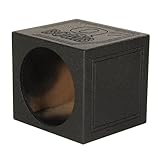
- Instant Bass Upgrade for 12-Inch Subs: Designed for a wide range of 12-inch subwoofers, this sealed enclosure delivers tighter, punchier bass response, perfect for improving sound quality in cars, trucks, or SUVs without custom fabrication.
- Stout, Rattle-Free Construction: This 12-inch subwoofer box features sturdy, rattle-resistant 3/4-inch MDF construction with reinforced seams that help reduce vibration and acoustic distortion in vehicles. Enjoy clean, controlled bass at peak volumes in your car or truck cab.
- Durable & Sleek Design: A black bed-liner-style exterior with spray-finished coating protects this 12-inch subwoofer container from moisture and scuffs. Stow this compact sealed subwoofer inside trunks or hatch areas, or fit it neatly behind the driver’s seat for music on the go.
- Easy Wiring with Secure Terminals: A spring-loaded terminal cup ensures fast, reliable connections for your car or truck subwoofer, no soldering required. Each high-output subwoofer enclosure is engineered with optimized internal air space to enhance audio quality.
- Complete Kit: Delivered ready to load, this audio box comes with a preinstalled terminal cup, mount accessories, and baffle materials. That’s everything needed for a straightforward installation right out of the package.
- Subwoofer basket, magnet, and motor displacement
- Port displacement, including folded slot-port sections
- Internal bracing and window braces
- Terminal cup, binding post, or connector displacement
- Internal amplifier rack, divider, or shelf
- Double-thick front baffle
- Any unusual internal structure
A common mistake is to calculate the outside of a box, call that figure cubic feet, and ignore both material thickness and internal obstructions. A second common mistake is to calculate a ported enclosure’s airspace before adding the port. Kicker’s CompR enclosure manual provides model-specific guidance for handling port volume and enclosure dimensions.
What’s actually slowing this PC down?
Pick the symptom - the matching free tool is one click away.
What is the difference between sealed and ported 12-inch boxes?
| Decision factor | Sealed | Ported |
|---|---|---|
| Typical size | Smaller; often about 1.0–1.4 ft3 net | Larger; often about 1.5–2.0 ft3 net |
| Construction | Simple airtight chamber | Chamber plus accurately designed port |
| Design tolerance | More forgiving of small volume errors | More sensitive to volume and port errors |
| Output | Usually less efficient in a selected low-frequency range | Can provide greater output and efficiency around tuning |
| Space requirement | Better for compact trunks and behind-seat installations | Needs room for the enclosure and port path |
| Filtering | No port-tuning protection is required | A suitable subsonic filter may be important below tuning |
| Failure risk | Incorrect volume changes system behavior but has no port-noise problem | Wrong port area or tuning can cause chuffing and excessive excursion |
Choose sealed when compact size, simpler construction, and tolerance for design mistakes matter most. Choose ported when the specific woofer supports it and the goal is more output over a selected range, provided the larger enclosure and accurate port design fit the vehicle.
A larger box is not automatically better. A larger sealed box changes system behavior and mechanical control, while a larger ported box changes tuning and response. Kicker notes that larger ported enclosures can introduce more group delay, so enclosure size should follow the driver design rather than the assumption that more airspace always produces deeper or louder bass.
Which physical measurements must be checked besides volume?
Correct airspace does not guarantee that the woofer will physically fit. Confirm the following measurements from the exact subwoofer model.
Front-baffle fit
- Cutout diameter: the diameter of the hole in the baffle.
- Overall frame diameter: the outside diameter of the speaker frame and gasket.
- Baffle width: enough flat surface must remain around the cutout for mounting screws and sealing.
- Corner and port clearance: the woofer frame must not collide with corners, port openings, trim, or grille components.
Depth and rear clearance
- Mounting depth: the woofer’s required front-to-back installation depth.
- Magnet clearance: space behind the motor for ventilation and movement.
- Brace clearance: internal braces must not touch the basket or magnet.
- Vehicle clearance: the magnet and rear panel must clear the trunk wall, seat, hatch, or truck body.
Port fit
- The port opening must fit on the selected front, side, or rear panel.
- The port must have adequate clearance at its internal entrance and exit.
- A long port may need a bend or folded slot design.
- The external port opening must not be blocked by carpet, a seat, or the vehicle floor.
How do you choose a box for a trunk, SUV, truck, or behind-seat installation?
Vehicle space determines which enclosure shapes are practical, but vehicle fit should not be solved by arbitrarily shrinking the recommended airspace. If the ideal enclosure will not fit, change the shape or consider a different woofer.
| Installation situation | Practical enclosure choices | Important check |
|---|---|---|
| Large trunk or SUV cargo area | Rectangular sealed or ported enclosure | Measure hatch opening, cargo depth, and port clearance—not just floor space |
| Tight trunk | Wedge or compact sealed enclosure | Preserve net volume while angling the rear panel |
| Behind a truck seat | Shallow sealed enclosure or shallow-mount woofer | Mounting depth and rear clearance may be more limiting than volume |
| Down-firing installation | Woofer mounted toward the floor | Leave enough gap above carpet or flooring for cone movement and airflow |
| Two 12-inch woofers | Shared chamber or two separate chambers | Start near twice the single-driver net volume, then account for both drivers, ports, and bracing |
Shallow-mount 12-inch subwoofers may fit behind seats or in shallow enclosures, but shallow drivers can require different airspace and mounting-depth limits. High-excursion and competition drivers may need deeper clearance, stronger bracing, a thicker baffle, larger ports, and more space. A dual-voice-coil configuration affects amplifier wiring and final impedance; the voice-coil arrangement alone does not determine enclosure dimensions.
For two 12-inch subwoofers, approximately twice the recommended single-subwoofer net volume is only a starting principle. A shared chamber is not automatically interchangeable with two independent sealed chambers, and a dual-sub port must also provide suitable area and tuning for both drivers.
Can a prefabricated 12-inch subwoofer box work?
A prefabricated box can work when the box’s net volume, enclosure type, port tuning, cutout diameter, mounting depth, and internal construction match the selected woofer. “Fits a 12-inch subwoofer” only describes nominal driver size and does not prove acoustic compatibility.
Before buying a prefab enclosure, verify:
- The exact net internal volume, not only an advertised external or gross volume.
- Whether the enclosure is sealed or ported.
- The port area, length, and tuning frequency if ported.
- The subwoofer cutout diameter and frame clearance.
- The mounting depth and magnet clearance.
- The material thickness, baffle construction, bracing, terminal, and airtight seals.
- Whether the enclosure physically fits through the vehicle opening and in the intended location.
A generic prefab box can be a poor purchase even when the woofer drops into the cutout. A wrong airspace or port alignment can make the system sound very different from the woofer manufacturer’s design.
Free tools Windows power users keep installed
One-click scans. No signup required.
What material and construction details matter?
3⁄4-inch MDF is the conventional baseline for many car-audio DIY enclosures. Higher-power systems may benefit from thicker material, a double-thick front baffle, or additional bracing. Thin panels can flex, waste acoustic output, and create unwanted vibration.
- Seal every joint with appropriate enclosure adhesive or sealant.
- Brace large panels so they do not flex.
- Use a strong, flat baffle around the woofer cutout.
- Ensure the woofer gasket seals against the baffle.
- Seal the terminal cup and all cable penetrations.
- Keep port walls rigid and smooth, with adequate clearance.
- Check that screws do not penetrate into the driver or port path.
Construction strength does not compensate for incorrect airspace or tuning. A strong box still needs the right net volume and physical fit.
Independent reader supportYour contribution helps us test, update, and keep practical guides available for everyone.What are the most common 12-inch box mistakes?
Mistaking external volume for internal volume
External dimensions include MDF thickness and cannot be divided directly to obtain usable airspace. Calculate from internal dimensions and then subtract obstructions.
Copying dimensions from another 12-inch subwoofer
Two 12-inch drivers can have different recommended sealed and ported volumes, cutout diameters, mounting depths, and port designs. Copy the model-specific plan, not merely the nominal driver size.
Recommended Free Tools
Also popular on Amazon
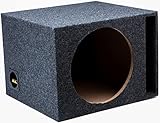
- HIGH-GRADE CONSTRUCTION: The ASC 12-inch single vented subwoofer enclosure is expertly assembled with precise cuts and joins, resulting in a seamless and airtight construction. This prevents air leaks, ensuring that the subwoofer operates optimally. The vented design of the enclosure promotes efficient cooling for your subwoofer, preventing overheating during extended listening sessions.
- VENTED / PORTED DESIGN: Designed with acoustics in mind, this enclosure ensures that your music resonates with precision and clarity. The precisely tuned ported design enhances bass response, allowing for deeper and more impactful low frequencies. This enclosure delivers a well-balanced audio experience.
- ENHANCED AUDIO EXPERIENCE: With the 112VH in your car, you'll experience music the way it was meant to be heard. Feel the music, sense the rhythm, and immerse yourself in a concert-like audio experience every time you hit the road.
- DIMENSIONS: Width 18-1/4" x Height 13-1/4" x Depth 16-1/4"
- ADDITIONAL ITEM SPECS: Mounting Depth of 15-1/4" making it compatible with the majority of 12-inch subwoofers and a total Air Space of 1.60 Cubic Feet for increased output
Forgetting port displacement
A large slot port occupies real volume. If port displacement is ignored, the finished ported box can have less airspace than intended.
Using the wrong port length
Port length depends on port area, enclosure volume, and target tuning. A 4-inch port length that works for one model or volume is not automatically correct for another.
Making the port too small
A small port can produce audible turbulence or “chuffing” at high output. The port must be sized for the woofer’s intended output and design alignment.
Building a ported box without suitable filtering
Below the tuning frequency, cone excursion can rise sharply in a ported system. The amplifier and signal chain may need an appropriate subsonic filter.
Ignoring rear clearance
A woofer can fit the front cutout while its magnet strikes the rear wall or internal brace. Measure the complete motor depth and provide ventilation clearance.
Assuming bigger is always better
Larger sealed and ported enclosures change the system’s behavior. Larger ported designs can also involve increased group delay, so more airspace should not be treated as an automatic upgrade.
Overpowering or clipping
Correct enclosure dimensions do not protect a woofer from amplifier clipping, excessive gain, unsuitable equalization, or an electrical system that cannot support the amplifier.
What is the correct design order?
- Identify the exact subwoofer model and version. Do not design from “12-inch” alone.
- Find the manufacturer’s enclosure specifications. Record sealed and ported net volumes, if both are provided.
- Choose sealed or ported. Base the choice on available space, desired output, construction skill, and the model’s supported alignments.
- Record the target net volume. Confirm how the manufacturer defines volume before calculating panels.
- Record all fit dimensions. Note cutout diameter, frame diameter, mounting depth, and magnet clearance.
- Record port specifications if ported. Note port area, dimensions, length, and tuning frequency.
- Measure the vehicle. Check floor space, opening size, seat or hatch clearance, and the planned port direction.
- Choose external dimensions and shape. Convert the external dimensions to internal dimensions using the actual material thickness.
- Account for displacement. Subtract the woofer, port, bracing, terminal, and other internal structures from gross volume.
- Build airtight and rigidly. Seal joints, brace large panels, and reinforce the baffle when necessary.
- Verify the system settings. Match amplifier impedance and power, set gain correctly, and use suitable crossover and subsonic-filter settings.
Final 12-inch enclosure checklist
- Exact subwoofer model and impedance identified
- Sealed or ported alignment selected from the model’s documentation
- Target net volume recorded
- External and internal dimensions clearly distinguished
- Material thickness included in the calculation
- Woofer displacement accounted for
- Port displacement accounted for if ported
- Port area, length, and tuning confirmed if ported
- Cutout diameter and baffle width verified
- Mounting depth, magnet clearance, and brace clearance verified
- Vehicle opening, final location, and port exit measured
- Box sealed, braced, and structurally appropriate
- Amplifier impedance, power, gain, crossover, and filtering checked
Frequently Asked Questions
Is 1.25 cubic feet the ideal size for every 12-inch subwoofer box?
No. Approximately 1.25 cubic feet is a useful generic sealed-box starting point for some conventional 12-inch drivers, but published sealed recommendations in the examples range from approximately 0.85 to 1.375 cubic feet. The exact woofer model determines the correct net volume.
What’s actually slowing this PC down?
Pick the symptom - the matching free tool is one click away.
Can I use a 2-cubic-foot box for a 12-inch subwoofer?
A 2-cubic-foot box may work for some ported 12-inch subwoofers, but it may be too large for many sealed designs and may not provide the correct net volume after subtracting the woofer, port, and bracing. Check the model’s enclosure recommendation before using it.
Do dual voice coils change the required box dimensions?
A dual-voice-coil configuration primarily affects wiring and final amplifier impedance; the enclosure recommendation remains specific to the subwoofer model. Do not select box volume from the voice-coil arrangement alone.
How much box volume do two 12-inch subwoofers need?
Two 12-inch subwoofers generally start near twice the recommended net volume for one driver, but the final design must also account for both driver displacements, port displacement, bracing, baffle width, and whether the drivers use one shared chamber or separate chambers.
Can I make a ported box smaller if it will not fit in my vehicle?
Do not arbitrarily shrink a ported enclosure because the box must preserve the woofer’s required net volume and port alignment. Consider a different shape, a sealed enclosure approved for the woofer, a shallow-mount driver, or professional enclosure design instead.
The Bottom Line
Bottom line: The right 12-inch subwoofer box is not defined by a single set of outside dimensions. Start with the exact woofer’s recommended net volume—often roughly 1.0–1.4 ft3 sealed or 1.5–2.0 ft3 ported for conventional car subwoofers—then calculate external dimensions around the woofer, port, bracing, material thickness, and vehicle clearances.

