
iTechGuides is reader-supported. When you buy through links on our site, we may earn an affiliate commission. As an Amazon Associate I earn from qualifying purchases. Learn more
The best IoT device management platform depends on the devices, update model, connectivity, deployment environment, and commercial model—not simply fleet size. AWS IoT Device Management is strongest for AWS-native teams, Azure IoT Hub for Microsoft-centric enterprises, ThingsBoard for self-hosting, and specialized platforms such as Mender, Memfault, Particle, Cumulocity, and Digi fit narrower operational needs.
A device-management platform can handle secure provisioning, fleet organization, remote configuration, software and firmware updates, monitoring, diagnostics, security operations, and integrations. No product in this comparison is the universal best choice because these platforms occupy different layers of the IoT stack.
Key takeaways
- AWS IoT Device Management is the strongest shortlist candidate for teams already using AWS identity, analytics, storage, serverless, and security services.
- Azure IoT Hub combined with Device Update for IoT Hub suits Microsoft-centric enterprises, but Azure device management is distributed across multiple services and tiers.
- ThingsBoard is the leading self-hosting candidate in this comparison, while self-hosting transfers availability, backup, upgrade, and security responsibilities to the customer.
- Mender is primarily an embedded Linux OTA and lifecycle-management layer, whereas Memfault focuses on embedded diagnostics, crash analysis, observability, and OTA.
- Particle, Cumulocity IoT, and Digi Remote Manager can reduce integration work when the fleet fits their hardware, industrial, or connectivity ecosystems.
- A production evaluation must test interrupted downloads, power loss, poor signal, invalid images, wrong hardware targeting, certificate failures, rollback, and post-update health—not merely verify that a dashboard lists OTA updates.
Which IoT device management platform is best?
There is no single best IoT device management platform. The best choice is AWS IoT Device Management for AWS-native infrastructure, Azure IoT Hub with Device Update for Microsoft-oriented enterprise deployments, ThingsBoard for self-hosted control, Particle for an integrated hardware-and-connectivity product stack, Cumulocity IoT for industrial AIoT, Digi Remote Manager for Digi cellular gateways, Mender for embedded Linux OTA, and Memfault for embedded reliability observability.
What’s actually slowing this PC down?
Pick the symptom - the matching free tool is one click away.
| Platform | Best fit | Primary strength | Main caution |
|---|---|---|---|
| AWS IoT Device Management | Large or complex AWS-native fleets | Provisioning, thing groups, fleet indexing, jobs, and AWS integration | Usage-based pricing and substantial architecture work |
| Azure IoT Hub + Device Update | Microsoft-centric enterprise and industrial deployments | Device twins, cloud-to-device management, Azure integration, and OTA workflows | Capabilities are spread across services and tiers |
| ThingsBoard | Self-hosted dashboards, asset models, and multi-tenant deployments | Open-source control, device modeling, provisioning, OTA, and integrations | The customer operates the platform and its infrastructure |
| Particle | Connected products using Particle hardware or supported connectivity | Coordinated hardware, connectivity, device cloud, fleet administration, and OTA | Economics and flexibility depend on the Particle ecosystem |
| Cumulocity IoT | Industrial, multi-tenant, and enterprise AIoT programs | Asset management, bulk operations, OTA, monitoring, remote access, and protocols | Potentially excessive and expensive for simple sensor fleets |
| Digi Remote Manager | Digi routers, gateways, and remote cellular infrastructure | Network-device monitoring, configuration, firmware, alerts, and remote access | Best fit requires Digi hardware or its ecosystem |
| Mender | Embedded Linux appliances, gateways, and industrial computers | Controlled OTA updates and device lifecycle add-ons | Not a complete IoT data or industrial application platform |
| Memfault | Embedded diagnostics and fleet reliability | Crash analysis, coredumps, health visibility, and OTA | Does not replace connectivity management or a full device registry |
What does IoT device management include?
IoT device management includes the operational controls required to identify, enroll, configure, update, monitor, troubleshoot, secure, and retire connected devices. A product that only transports MQTT messages, stores telemetry, or provides a remote terminal may be useful, but it is not automatically a complete device-management platform.
#1 Best Overall

- UNIVERSAL REMOTE - SMART HUB FOR 8,000+ BRANDS: Matter-certified IR & IoT hub with built-in alarm. Control TVs, ACs, fans and other smart devices from anywhere with 2.4 GHz WiFi. Voice commands, automations and fast alerts deliver a seamless connected home.
- EXPANSIVE COMPATIBILITY ACROSS YOUR HOME: Supports 18 appliance types and thousands of IR brands—TV, Air Conditioner, Set-Top Box, Robot Vacuum, Fan, Light, Air Purifier, Humidifier, Water Heater, Electric Heater, Electric Curtain, Projector, Amplifier, DVD, Camera, Foot Tub, Drying Rack, and Box devices. Easily consolidate control for both new and legacy electronics within IR range, replacing multiple remotes with one powerful smart home hub.
- SEAMLESS VOICE ASSISTANT SUPPORT: Hands-free control with Alexa, Google Assistant or Siri through Matter. Adjust temperature, switch channels and activate routines without touching a remote or phone.
- REAL-TIME ALERTS WITH BUILT-IN 93 DB ALARM: Connect Tapo sensors for real time alerts on motion, door or window activity. Hear important events with loud audible feedback and customizable tones.
- FULL REMOTE ACCESS IN THE TAPO APP: Use the Tapo app on iOS or Android to access devices wherever you are. Turn off forgotten appliances, adjust AC settings before arriving home and keep energy use under control.
Identity and onboarding
A production platform should support unique device identity, certificate or token provisioning, secure first boot, factory enrollment, certificate rotation and revocation, device claiming, ownership transfer, and the handoff from manufacturing to production. “Zero-touch provisioning” still requires a manufacturing process for injecting credentials, registering hardware, or approving a device.
Fleet organization and control
Fleet operations normally require groups, tags, labels, models, sites, tenants, customer accounts, role-based access control, audit logs, search, and bulk actions. Dynamic groups based on reported properties are particularly useful for targeting firmware or configuration changes without manually maintaining thousands of device lists.
Configuration and commands
Look for desired-versus-reported state, device shadows or twins, remote configuration, scheduled commands, per-device policies, and safe handling of intermittently connected devices. A command that is queued until a sleeping device reconnects is operationally different from a command that requires a continuously reachable device.
Free tools Windows power users keep installed
One-click scans. No signup required.
Software and firmware updates
OTA support should be evaluated as a complete recovery workflow, not as a checkbox. Important capabilities include signed artifacts, compatibility checks, staged or canary rollouts, percentage-based deployment, retry and resume behavior, rollback or A/B partition support, update health checks, failure reporting, maintenance windows, and controls for battery, bandwidth, and storage constraints.
Monitoring, diagnostics, and security
Useful monitoring includes last-seen state, connectivity, battery, signal quality, CPU, memory, disk, temperature, application logs, crash reports, coredumps, health metrics, alerts, and historical views. Security controls should cover TLS, certificate lifecycle, hardware-backed identity where appropriate, secure boot and signed firmware integration, least privilege, fleet segmentation, auditability, encryption, regional hosting, retention, vulnerability response, and device end-of-life procedures.
Connectivity and integration
The platform should match the actual network: Ethernet, Wi-Fi, cellular, LPWAN, satellite, private networks, NAT, intermittent links, high latency, or sleep-heavy battery operation. Integration requirements may include MQTT, HTTP, CoAP, LwM2M, AMQP, REST APIs, events, webhooks, Kafka, databases, data lakes, analytics, ERP, CRM, ticketing, field service, and industrial protocols.
How were these IoT device management platforms evaluated?
The comparison separates documented platform capabilities from independent hands-on test results. The dossier provides vendor documentation and current pricing signals, but it does not provide a controlled benchmark of update success rates, latency, uptime, or total cost. Feature claims therefore describe the documented product positioning rather than an independent performance ranking.
For a production connected-product team, a reasonable starting scorecard weights OTA reliability and recovery at 20%, security and identity lifecycle at 20%, device compatibility and integration effort at 15%, fleet operations and observability at 15%, cost predictability at 10%, scalability at 10%, deployment and data residency at 5%, and vendor support and exit strategy at 5%. Industrial, cellular, regulated, or self-hosted deployments should change those weights.
| Criterion | Questions to answer | Why it matters |
|---|---|---|
| Device compatibility | Does the platform support the hardware, CPU, OS, bootloader, storage, and connectivity? | A cloud service cannot make an unsuitable device updateable. |
| Provisioning | How are credentials installed, rotated, revoked, and transferred? | Identity mistakes can affect an entire production fleet. |
| OTA | Are artifacts signed, staged, retried, verified, and recoverable? | A failed update can brick a remote device. |
| Observability | Are metrics, logs, crashes, alerts, and post-update health available? | Deployment completion is not proof of application health. |
| Remote operations | Are commands, tunnels, terminals, or VPN access available? | Operations teams need to diagnose devices that telemetry cannot explain. |
| Deployment | Is the service SaaS, private cloud, edge, on-premises, hybrid, or disconnected? | Data residency and network restrictions can eliminate otherwise capable products. |
| Cost predictability | Are charges based on devices, messages, operations, data, storage, OTA, support, or egress? | A low entry price may not predict the production bill. |
| Exit strategy | Can identity, telemetry, metadata, agents, and update infrastructure be migrated? | Migration risk is part of vendor selection. |
Which platform is best for AWS-native fleets?
AWS IoT Device Management is the strongest candidate for teams already building on AWS. AWS documents provisioning, thing groups, fleet indexing, jobs, and remote software updates as core capabilities in its AWS IoT Device Management documentation.
AWS is attractive when the surrounding architecture already uses AWS identity, storage, analytics, serverless services, and security controls. Device-management primitives can be composed with the rest of the AWS environment rather than introducing a separate operational control plane.
AWS IoT Device Management is a service layer rather than a complete turnkey product. The buyer may still need to build the customer-facing fleet console, support workflows, device-specific diagnostics, update approval process, tenant isolation, retention and export controls, and field-service integration. A small team seeking one polished console and a fixed monthly bill may find the implementation burden disproportionate.
AWS pricing is usage-based. The AWS IoT Device Management pricing page states that there are no minimum fees and that the free tier includes 50 remote actions per month. The service separately meters areas such as bulk registration, remote actions, fleet indexing, and index queries, so a device-count estimate alone is not enough.
Choose AWS when: the organization is already AWS-native, needs composable fleet primitives, and has cloud engineering capacity.
Look elsewhere when: the organization needs a turnkey operations product, built-in interactive troubleshooting, or a simple fixed-price commercial model.
Is Azure IoT Hub a good device-management choice?
Azure IoT Hub combined with Device Update for IoT Hub is a logical choice for Microsoft-centric enterprises and industrial programs. Microsoft describes IoT Hub device management as including cloud-to-device messaging and device twins, while Device Update for IoT Hub handles publishing and distributing OTA updates in its device-management overview.
Recommended Free Tools
Azure works particularly well where Microsoft identity, Azure governance, enterprise data services, and existing industrial systems are already architectural standards. Device twins help represent desired and reported state, while Device Update provides a more controlled path for software distribution.
“Azure IoT” is not one monolithic product. A practical deployment may combine IoT Hub, Device Update, identity and security services, storage, monitoring, downstream analytics, and other Azure components. Microsoft notes that some device-management capabilities are limited to the Standard tier, so the edition and service combination must be checked before implementation.
Choose Azure when: the enterprise already has Azure governance and identity, needs device twins, and can operate a service-based architecture.
Look elsewhere when: the team wants one compact product that combines device management, observability, applications, and transparent pricing.
Crashes, No Sound, or Screen Glitches?
Random freezes, missing sound and display glitches usually trace back to one bad driver. Find and replace yours safely.Free scan · under a minuteWindows Errors? Fix Them Before They Spread
Repair common Windows errors and clear accumulated junk for a smoother, more stable PC - no reinstall needed.Free scan · no reinstallIs ThingsBoard the best open-source and self-hosted option?
ThingsBoard is a strong candidate for organizations that want control over hosting, data location, tenant structure, dashboards, and integrations. The vendor’s Professional Edition feature list includes device and asset modeling, claiming and provisioning, bulk provisioning, OTA updates, LPWAN integrations, and integrations with AWS, Azure, Pub/Sub, and Kafka.
ThingsBoard is well suited to private deployments, industrial dashboards, multi-tenant applications, and teams that prefer to own the control plane. The product can serve as a broader device-and-application foundation rather than merely an update service.
The free or open-source edition and paid editions must be evaluated separately. Feature availability, support, hosting options, and operational requirements can differ materially. Self-hosting does not remove lifecycle work; it transfers high availability, backups, upgrades, database scaling, security patching, certificate management, monitoring, incident response, and disaster recovery to the customer.
Choose ThingsBoard when: data control, private hosting, extensibility, dashboards, and tenant modeling matter more than minimizing operational responsibility.
Do these 3 things before closing this tab:
1Scan for outdated or missing drivers - takes under a minute2Repair Windows errors before they cause bigger problems3Fix the driver behind crashes, sound loss and screen glitchesLook elsewhere when: the team lacks DevOps capacity or wants a vendor to own availability, patching, backup, and platform security.
Is Particle the best integrated hardware-and-connectivity platform?
Particle is compelling for connected-product teams that want hardware, connectivity, device cloud, fleet administration, and OTA software updates from one coordinated ecosystem. Particle is a good fit for cellular products and rapid productization when the fleet can use Particle hardware or supported connectivity.
The integrated approach can reduce the number of vendors and the amount of device-cloud integration work. The trade-off is less hardware and cloud neutrality. Mixed-hardware fleets, unusual connectivity arrangements, or teams planning to move away from vendor-specific APIs should model migration effort before committing.
Particle’s pricing page, observed in the research pass on August 16, 2026, lists a free plan with up to 100 devices and 100,000 Data Operations, a Basic plan at $299 per month per 100-device block, and a Plus plan at $599 per month per 100-device block. Particle lists OTA software updates as included in every plan. Prices and plan details are volatile and should be rechecked before publication or purchase on the Particle pricing page.
Quick wins for a faster PC:
Scan for outdated or missing drivers - takes under a minuteDriver Scan →Clear out junk files and repair common Windows errorsFree Scan →Fix the driver behind crashes, sound loss and screen glitchesFind Drivers →Rank #2

- Echo Hub — An easy-to-use smart home control panel redesigned for your home. Arrange controls on your dashboard to quickly adjust devices, view cameras, start routines, and more.
- Customize your dashboard — Arrange devices into sections and resize them to focus on what matters most. Create a personalized layout that matches how your family uses their connected devices.
- Reimagined for your home - With an Alexa+ and compatible Ring subscription (sold separately), get Ring camera event summaries to stay in the know. Search your Ring footage using simple voice commands. Create routines by voice, activate modes to manage multiple devices at once, and chat with Alexa to easily control your smart home.
- Home security for the whole family — Use Echo Hub to easily arm and disarm your compatible security system, making it easy for everyone in your family to manage home security. Use the Alexa app and compatible cameras, locks, alarms, and sensors to check in while you're out.
- Works with thousands of Alexa compatible devices — WiFi, Bluetooth, Zigbee, Matter, Sidewalk, and Thread devices sync seamlessly with the built-in smart home hub.
| Particle pricing signal observed August 16, 2026 | Published limit or price | Important qualification |
|---|---|---|
| Free | $0 per month; up to 100 devices and 100,000 Data Operations | Particle positions the free tier for prototyping and personal projects. |
| Basic | $299 per month per 100-device block | Data Operations and plan terms affect the effective cost. |
| Plus | $599 per month per 100-device block | Confirm current inclusions and billing terms before purchase. |
| OTA software updates | Listed as included in every plan | Included OTA does not remove hardware, connectivity, or data-operation costs. |
Choose Particle when: the product team values an integrated hardware, connectivity, cloud, and OTA experience.
Look elsewhere when: the fleet requires broad hardware neutrality, cloud-provider independence, or economics that do not track Particle’s Data Operations model.
Is Cumulocity IoT the best industrial device-management platform?
Cumulocity IoT is better understood as an industrial AIoT and asset-management suite than as a basic MQTT registry. Cumulocity lists zero-touch provisioning, OTA updates, fleet monitoring, bulk device operations, certificate management, remote access, log retrieval, digital twins, and protocol gateway capabilities on its device-management product page.
Cumulocity is a strong fit for industrial equipment manufacturers, utilities, enterprise asset fleets, multi-tenant deployments, and programs that need device management connected to business applications. Industrial protocol gateways, asset hierarchies, remote operations, and tenant capabilities can justify the larger platform.
The platform may be too much for a few hundred simple sensors with basic telemetry and a straightforward firmware process. An industrial buyer should also distinguish vendor-stated availability, support, compliance, and protocol claims from independent validation.
Cumulocity’s Starter plan is listed at €215 per month billed annually, with up to 2.5 million platform messages per month, one tenant, 30-day data retention, community support, and a 95% uptime guarantee. Business and Enterprise pricing is custom. These details come from the Cumulocity pricing page and Cumulocity Starter plan page; geography, billing terms, and current availability should be confirmed directly.
Choose Cumulocity when: industrial assets, protocols, multi-tenancy, digital twins, remote access, and enterprise workflows are core requirements.
Look elsewhere when: the fleet is small and simple or the team only needs embedded OTA.
Is Digi Remote Manager best for cellular gateways?
Digi Remote Manager is a strong choice for Digi routers, gateways, embedded systems, and remote cellular infrastructure. Digi describes the platform as a cloud service for deploying, monitoring, configuring, diagnosing, and updating devices, with group operations, API integration, remote access, and optional on-premises management on its Remote Manager product page.
Digi Remote Manager addresses network-device operations that a generic MCU fleet platform may not cover well: remote infrastructure configuration, modem and gateway management, field access, firmware, alerts, and diagnosing inaccessible sites. Its strongest fit is therefore a Digi-centered infrastructure fleet rather than arbitrary microcontrollers.
Digi’s store shows one-, three-, and five-year Remote Manager subscription products priced per device license, but some current prices require login or purchase context. This article does not publish a numeric Digi price because regional store context and account access can change the amount. Buyers should verify the applicable license in the Digi Remote Manager store.
Choose Digi Remote Manager when: the fleet consists of Digi routers, gateways, or remote cellular infrastructure.
The Tool Desk
Outbyte Driver Updater FREEScan for outdated or missing drivers - takes under a minuteDriver Scan →Outbyte PC Repair FREEClear out junk files and repair common Windows errorsFree Scan →Look elsewhere when: the fleet is vendor-neutral MCU hardware or needs a general-purpose device-cloud application platform.
Is Mender the best OTA platform for embedded Linux?
Mender is the strongest specialized candidate when the central problem is safely updating and maintaining embedded Linux devices in the field. Mender is appropriate for Linux gateways, appliances, industrial computers, staged software rollouts, and teams that want to retain control of their broader cloud architecture.
Mender should not be evaluated as a complete replacement for every IoT platform. The product is primarily an OTA and device-lifecycle layer; a buyer may still need separate connectivity, device registry, telemetry, dashboards, tenant management, and industrial application services. The device must also have a suitable integration path, storage layout, bootloader and recovery design, and a resident Mender-compatible component.
Mender’s current add-ons page describes OTA configuration, monitoring, predictive-maintenance, and remote-troubleshooting capabilities and promotes a free trial. A trial can validate enrollment and a basic update, but it does not by itself prove recovery after power loss, poor signal, a full disk, an invalid image, or a wrong hardware revision.
Free tools Windows power users keep installed
One-click scans. No signup required.
Choose Mender when: reliable embedded Linux OTA and deployment control are the main requirements.
Look elsewhere when: the organization needs a complete industrial data, analytics, tenant, or customer-facing IoT application platform.
Is Memfault a complete IoT device-management platform?
Memfault is best positioned as an embedded device reliability and observability platform that can complement a broader IoT platform. It is particularly relevant to teams that need crash diagnostics, coredumps, firmware health, fleet visibility, and OTA for MCU, Linux, or Android devices.
Memfault is not a substitute for cellular plan administration, a general connectivity control plane, an industrial protocol gateway, or a complete tenant-facing IoT application. Its value is diagnosing why deployed devices fail and connecting device health information to firmware and fleet operations.
Memfault advertises per-device pricing, no data-volume or per-log/coredump charging, and unlimited OTA updates included in every plan. Those are vendor claims, not independently validated cost findings. Memfault uses a quote-based process through its pricing and quote page, so buyers should request an estimate using actual device counts, support needs, and deployment requirements.
Choose Memfault when: embedded reliability, crash analysis, coredumps, and health observability are the main gaps.
Look elsewhere when: the main requirement is connectivity, industrial asset management, or a full device-cloud product.
What is the difference between IoT connectivity, fleet management, OTA, and observability platforms?
IoT connectivity platforms transport data and connect devices, complete fleet-management platforms coordinate device identity and lifecycle operations, OTA systems specialize in software deployment and recovery, industrial suites add asset and business context, and observability platforms explain device health and failures. These categories overlap, but they are not interchangeable.
| Platform category | Core job | Typical gap | Example in this comparison |
|---|---|---|---|
| Cloud IoT service layer | Identity, registry, messaging, groups, queries, jobs, and cloud integration | Customer-facing consoles and device-specific workflows may need to be built | AWS IoT Device Management; Azure IoT Hub plus Device Update |
| Complete fleet-management platform | Provisioning, assets, dashboards, configuration, operations, and integrations | May be too broad or costly for a narrow OTA requirement | ThingsBoard; Cumulocity IoT |
| Integrated hardware and cloud | Hardware, connectivity, cloud administration, and OTA from one ecosystem | Hardware and vendor lock-in | Particle |
| Cellular/network-device management | Routers, modems, gateways, network access, configuration, and remote support | Limited fit for arbitrary MCU fleets | Digi Remote Manager |
| Embedded Linux OTA | Deploying and recovering operating-system or application updates | Usually not a complete telemetry or business platform | Mender |
| Embedded observability | Crashes, coredumps, health, diagnostics, and firmware reliability | Does not replace connectivity or industrial asset management | Memfault |
How much do IoT device management platforms cost?
IoT device-management cost depends on more than the number of registered devices. A serious estimate includes active devices, telemetry messages, remote operations, OTA traffic, storage and retention, tenants, users, support, data residency, connectivity, professional services, egress, and integrations.
| Platform | Public pricing signal in the dossier | Cost model to investigate |
|---|---|---|
| AWS IoT Device Management | Usage-based; no minimum fees stated; free tier includes 50 remote actions per month | Registration workflows, remote actions, fleet indexing, queries, data, storage, and related AWS services |
| Azure IoT Hub and Device Update | Azure consumption pricing; service and tier combinations vary | IoT Hub tier, Device Update, storage, monitoring, identity, analytics, and egress |
| ThingsBoard | Open-source/self-hosted and paid-edition paths | Edition, hosting, database, high availability, backups, support, upgrades, and staff time |
| Particle | $0 for up to 100 devices and 100,000 Data Operations; Basic $299/month per 100-device block; Plus $599/month per 100-device block, observed August 16, 2026 | Data Operations, device blocks, connectivity, hardware, plan features, and contract terms |
| Cumulocity IoT | Starter listed at €215/month billed annually for up to 2.5 million platform messages/month | Messages, tenants, retention, support, industrial features, and custom Business or Enterprise pricing |
| Digi Remote Manager | One-, three-, and five-year device-license products are shown; some prices require login or regional context | Device licenses, term, hardware, region, support, and optional on-premises deployment |
| Mender | Free-trial route and paid add-ons for configuration, monitoring, predictive maintenance, and remote troubleshooting | Base product, devices, add-ons, hosting, support, storage, and OTA traffic |
| Memfault | Quote-based; vendor advertises per-device pricing and unlimited OTA updates included in every plan | Device count, plan, support, integrations, and contract terms |
Do not publish a production cost from a free tier or “starting at” price without documenting the assumptions. Particle’s free plan is positioned for prototyping and personal projects, and a free tier may limit devices, data operations, messages, retention, support, multi-tenancy, credentials, commercial use, API calls, or OTA volume.
For a 1,000-, 10,000-, or 100,000-device estimate, build a usage model with daily telemetry per device, monthly configuration actions, one or two OTA campaigns, retained data, concurrent updates, inactive devices, support tier, and connectivity. The dossier does not provide enough complete public pricing data to calculate comparable bills for all eight platforms responsibly, so a vendor quote or calculator is required before ranking by cost.
Rank #3
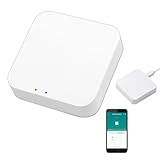
- 2 MODES IN 1 GATEWAY: This Smart home hub support Bluetooth mesh (SIG) + Zigbee3.0 multi-protocol communication. Only one gateway is needed to connect devices of different protocols to the 2.4Ghz network.
- APP REMOTE CONTROL: Smart Bluetooth Zigbee hub works with smart life/Tuya App, Support Adding devices, device reset, third-party control and group control. You can manage and remotely control the device through the Smart Life App. You can manage and remotely control your lights, fingerbot and other smart devices via the app, even when you're not home.
- VOICE CONTROL: The smart hub Support voice control, Simply give a voice command to Alexa or Google home to control devices(such as turn on/off the smart plug, turn on/off the Finger Bot).
- SMART HOME AUTOMATION: Sub-devices of the gateway act as trigger conditions for Interacting with devices such as ZigBee, Bluetooth, Wi-Fi, for device linkage. Featured as one powerful network bridge for whole house linkage in a real sense for all smart home devices.
- SUPPORT 128 DEVICES: Support up to 128 Tuya smart home devices, such as ZigBee Motion Sensor, Leak Detector, BLE Finger Bot, Zigbee Door Sensor, BLE Thermometer, ZigBee Window Gate Sensor, etc. NOTE: Supports Tuya/SmartLife devices only.
How should you choose a platform by device type?
Start with the device operating model, because the right platform for a battery-powered MCU is different from the right platform for an embedded Linux gateway or cellular router.
Recommended Free Tools
| Device type | Priorities | Most relevant candidates |
|---|---|---|
| MCU sensor | Small-footprint SDK, power efficiency, secure boot, signed firmware, small OTA artifacts, and recovery | Particle where supported; Memfault for diagnostics; AWS or Azure for cloud-native architectures |
| Embedded Linux gateway | OS and application OTA, rollback, remote diagnostics, logs, containers, disk health, and interrupted-update recovery | Mender; Memfault; AWS or Azure as broader cloud layers |
| Cellular router or gateway | Modem, SIM, network, VPN or remote access, configuration, and gateway firmware | Digi Remote Manager for Digi fleets |
| Industrial equipment | Asset hierarchies, alarms, digital twins, protocols, edge deployment, multi-tenancy, and compliance | Cumulocity IoT; ThingsBoard; Azure |
| Consumer connected product | Manufacturing provisioning, customer separation, privacy, segmentation, support tooling, and predictable per-device economics | Particle; AWS; Azure; a specialized OTA or observability layer where needed |
What should a production OTA evaluation test?
A production OTA evaluation should deliberately attempt to fail an update and prove that the device remains recoverable. A dashboard showing “deployment complete” does not prove that the device installed the image, rebooted successfully, passed application health checks, remained connected, preserved battery life, or can roll back.
- Test the oldest and smallest device. Verify CPU architecture, operating system, flash, RAM, storage, bootloader, partition layout, secure boot, and resident agent requirements.
- Test artifact safety. Confirm signing, verification, hardware compatibility checks, version rules, and protection against an image intended for another product revision.
- Test interrupted downloads. Remove power, interrupt connectivity, fill the disk, reduce signal quality, and resume the campaign.
- Test installation failure. Use an invalid image, an incompatible image, and an application that fails its health check.
- Test rollback and recovery. Prove whether rollback is automatic, bootloader-supported, A/B-partition based, or merely a redeployment workflow.
- Test a canary rollout. Define the canary-fleet size, health signal, pause threshold, approval process, and operator responsible for stopping the campaign.
- Test post-update behavior. Check connectivity, battery consumption, application health, logs, crash data, and reported version after reboot.
- Test mass operations. Simulate reconnect storms, concurrent updates, intermittent devices, and devices that remain offline for the entire maintenance window.
What device-side requirements can eliminate a platform?
A platform may advertise broad device compatibility while still requiring a particular operating system, resident agent, CPU architecture, bootloader, amount of flash storage, persistent connectivity pattern, hardware security module, or vendor-specific modem. Device compatibility must be validated on the actual hardware, not inferred from a product page.
The cloud platform is only one part of the update chain. The device also needs a credential-injection process, secure identity storage, a signed-artifact verifier, a bootloader and partition strategy, enough temporary storage, a power-loss recovery path, and an application health signal. These requirements are especially important for constrained MCUs and remote Linux gateways.
What are the main failure modes when selecting a platform?
Choosing by fleet size alone
Connection-count claims do not reveal the cost or operational behavior of fleet indexing, telemetry, storage, remote operations, tenant count, update concurrency, or mass reconnects. Ask how many devices are concurrently connected, how many messages each device sends, how many fleet actions run monthly, and how many simultaneous updates are expected.
Do these 3 things before closing this tab:
1Clear out junk files and repair common Windows errors2Scan for outdated or missing drivers - takes under a minute3Repair Windows errors before they cause bigger problemsConfusing remote access with device management
SSH, a browser terminal, a VPN, or a remote tunnel can solve troubleshooting, but remote access alone does not provide secure provisioning, fleet identity, staged OTA campaigns, rollback, audit trails, desired state, or decommissioning. Conversely, a fleet-management platform may provide excellent lifecycle controls but weak interactive debugging.
Assuming that self-hosting is free
Self-hosted ThingsBoard or another private stack may improve data control and reduce dependence on a SaaS vendor, but the customer owns high availability, backups, upgrades, database scaling, security patching, certificate management, monitoring, incident response, disaster recovery, and long-term compatibility.
Buying too much industrial platform
Cumulocity IoT and similar products can be justified by industrial protocols, asset hierarchies, digital twins, multi-tenancy, remote access, and enterprise support. A simple sensor fleet may not need those capabilities and may pay for complexity that does not reduce operational risk.
Ignoring hardware lock-in
Particle and Digi can reduce integration effort by coordinating hardware, connectivity, firmware, and cloud services. The trade-off can include fewer hardware choices, vendor-specific APIs, migration effort, contractual dependence, and difficulty supporting a mixed fleet. Hardware lock-in is not automatically bad, but the integration savings should be compared with the cost of leaving.
Quick wins for a faster PC:
Fix the driver behind crashes, sound loss and screen glitchesFind Drivers →Clear out junk files and repair common Windows errorsFree Scan →How can a buyer compare total ownership and migration risk?
Ask every vendor and internal team to document what happens when the platform is unavailable, becomes too expensive, changes its API, or must be replaced. The exit plan should cover device identity, telemetry, metadata, device agents, firmware artifacts, certificates, customer and tenant mappings, OTA infrastructure, proprietary hardware, connectivity, and data deletion.
- Can device identities and certificate metadata be exported?
- Can telemetry, configuration, tags, and asset relationships be exported in usable formats?
- Can the device agent be replaced without a hardware redesign?
- Can firmware signing keys and update artifacts remain under the customer’s control?
- Can devices continue operating if the cloud control plane is temporarily unavailable?
- Can devices be transferred between customers, tenants, sites, or owners?
- What happens to data after contract termination?
- Which hardware, connectivity, APIs, and protocols are proprietary?
- How much engineering is required to rebuild provisioning, OTA, dashboards, support tools, and integrations?
Which platform should each type of buyer shortlist?
AWS-native product team: Start with AWS IoT Device Management and add the device-specific console, diagnostics, and support workflows the product requires. Consider Memfault for embedded observability or Mender for embedded Linux OTA when AWS primitives do not provide enough device-side lifecycle tooling.
Microsoft enterprise or industrial team: Start with Azure IoT Hub and Device Update for IoT Hub, then verify the required tier, identity, monitoring, data, and analytics services. Consider Cumulocity IoT or ThingsBoard when industrial asset modeling, multi-tenancy, or self-hosting is more important than staying within one hyperscaler.
Self-hosting or data-residency-led organization: Shortlist ThingsBoard first, but price the people and infrastructure required to operate it. Confirm backups, upgrades, high availability, certificate operations, disaster recovery, and security ownership before treating self-hosting as a cost advantage.
Connected-product company: Shortlist Particle when supported hardware and connectivity materially reduce product-development effort. Compare the convenience against Data Operations, device-block pricing, hardware choice, customer separation, and migration constraints.
Industrial equipment manufacturer: Shortlist Cumulocity IoT when asset management, industrial protocols, bulk operations, remote access, multi-tenancy, and business integration are central. Avoid paying for an industrial suite if the actual requirement is only a small, reliable Linux OTA workflow.
Cellular infrastructure operator: Shortlist Digi Remote Manager for Digi-based routers and gateways. Verify regional subscription terms, remote-access requirements, modem and SIM workflows, API needs, and whether optional on-premises management is required.
Embedded Linux engineering team: Shortlist Mender for OTA and lifecycle control, then add a broader IoT cloud or observability service if needed. Prove bootloader, partition, rollback, agent, and offline-recovery behavior on the actual product hardware.
Embedded reliability team: Shortlist Memfault when crash analysis, coredumps, fleet health, and firmware reliability are the main gaps. Pair it with the connectivity, registry, industrial, or customer-facing platform that the product still needs.
Production-readiness checklist
Before signing a contract or deploying beyond a pilot, require written answers and a working demonstration for the following areas:
- Identity: manufacturing credential injection, first boot, rotation, revocation, ownership transfer, and device retirement.
- Security: signed artifacts, secure boot integration, hardware-backed identity where required, RBAC, audit logs, encryption, regional hosting, and vulnerability response.
- OTA recovery: canary releases, staged rollout, pause thresholds, retry and resume, power-loss recovery, rollback, A/B partitions, health checks, and wrong-hardware protection.
- Connectivity: NAT, intermittent cellular, low-bandwidth links, sleeping battery devices, offline queues, and mass reconnects.
- Operations: groups, tags, tenants, sites, desired state, bulk actions, scheduled commands, remote access, logs, alerts, and support workflows.
- Observability: last-seen state, battery, signal, resource usage, application logs, crashes, coredumps, historical data, and post-update health.
- Cost controls: telemetry sampling, retention limits, OTA bandwidth, operation volume, storage, egress, support, connectivity, and inactive devices.
- Resilience: platform outage behavior, local device operation, backup and restore, disaster recovery, regional failure, and incident communications.
- Migration: export of identity, metadata, telemetry, firmware, certificates, and customer relationships, plus an estimate for replacing the device-side agent.
Final recommendations
Use AWS IoT Device Management when AWS integration and composable fleet primitives matter most. Use Azure IoT Hub with Device Update when Microsoft governance, device twins, and Azure services are already established. Use ThingsBoard when self-hosting and control justify operating the platform. Use Particle when integrated hardware and connectivity shorten the product path. Use Cumulocity IoT for industrial asset operations, Digi Remote Manager for Digi cellular infrastructure, Mender for embedded Linux OTA, and Memfault for embedded diagnostics and reliability.
The final decision should come from a hardware-specific failure drill, a realistic usage-based cost model, a security and identity review, and a documented migration plan. A platform that lists more features is not necessarily safer; the best platform is the one that can update, observe, recover, and retire the actual devices in the actual operating environment.
What’s actually slowing this PC down?
Pick the symptom - the matching free tool is one click away.
Frequently Asked Questions
What is the best IoT device management platform for a small startup?
There is no universal best platform for a startup. Particle can reduce integration work when the product fits Particle hardware and connectivity, while AWS IoT Device Management, Azure, ThingsBoard, Mender, or Memfault may be better when the startup needs cloud neutrality, self-hosting, embedded Linux OTA, or diagnostics.
Can an IoT device management platform update any device?
No. Device compatibility depends on the operating system, CPU, resident agent, bootloader, flash and storage capacity, secure-boot design, connectivity, and recovery path. Test the oldest and smallest production device rather than relying on a general “any device” claim.
What is the difference between Mender and Memfault?
Mender primarily focuses on embedded Linux OTA and device lifecycle management, while Memfault primarily focuses on embedded observability, crash analysis, coredumps, fleet health, and OTA. The two products can be complementary rather than direct substitutes.
Are free IoT platform tiers suitable for production?
Free tiers are often suitable for prototypes but may limit devices, data operations, messages, retention, support, multi-tenancy, commercial use, API calls, credentials, or OTA volume. Production buyers should model usage and support requirements rather than treating a free tier as a long-term operating plan.
The Tool Desk
Outbyte PC Repair FREEClear out junk files and repair common Windows errorsFree Scan →Outbyte Driver Updater FREEFix the driver behind crashes, sound loss and screen glitchesFind Drivers →Should an IoT platform be self-hosted?
Self-hosting is appropriate when data control, private deployment, or operational independence outweighs the cost of running the platform. Self-hosting transfers responsibility for availability, backups, upgrades, database scaling, security patching, certificate management, monitoring, and disaster recovery to the customer.
The Bottom Line
Bottom line: choose by device type and lifecycle risk, not by a generic feature count. AWS and Azure are powerful cloud service layers, ThingsBoard emphasizes self-hosted control, Particle and Digi benefit from ecosystem fit, Cumulocity targets industrial operations, Mender specializes in embedded Linux OTA, and Memfault specializes in embedded reliability. Validate the device-side recovery path and total cost before committing.
Quick Recap
Product prices and availability are accurate as of the date/time indicated and are subject to change. Any price and availability information displayed on Amazon at the time of purchase will apply.

