
KNN and ARIMA forecast time series in different ways, and neither is universally more accurate. KNN predicts from historical examples that resemble the current context; ARIMA models a series’ autocorrelation using past values, past forecast errors, and differencing. Choose between them by testing leakage-safe forecasts on the same future dates and at the horizons your task actually requires.
How KNN and ARIMA make forecasts
The central difference is how each method represents useful history. KNN compares the current situation with stored examples. ARIMA describes dependence within a series through a statistical model.


KNN: predict from similar historical windows
K-nearest neighbors (KNN) is an instance-based method: it retains training examples and predicts for a new case using nearby examples. For forecasting, you first convert the series into examples, often by using a fixed number of earlier observations as lagged features. For example, a window containing the last several days can be paired with the value on the following day. KNN finds similar windows in the training data and uses their associated outcomes to produce a forecast. Scikit-learn’s nearest-neighbor documentation describes the underlying approach.
The representation matters. Window length, feature scaling, distance measure, number of neighbors, and whether neighbors receive equal or distance-based weights are choices to test—not universal defaults. KNN can be useful when similar historical contexts recur and the chosen features make those contexts genuinely comparable. It may be less dependable when comparable examples are scarce, the series has drifted, distances are uninformative, or the feature set is high-dimensional. Those are risks implied by the method, not proof that KNN will lose on a particular series.
#1 Best Overall
ARIMA: model autocorrelation and changes in level
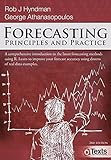
ARIMA stands for autoregressive integrated moving average. Its non-seasonal form is written ARIMA(p,d,q): p is the autoregressive order, d is the degree of differencing, and q is the moving-average order. Autoregressive terms use earlier values; moving-average terms use earlier forecast errors; differencing models changes between observations to help address non-stationarity, such as changes in level or trend. Forecasting: Principles and Practice explains the ARIMA framework.
Autocorrelation and partial-autocorrelation plots can inform order selection in simpler cases, but they do not mechanically reveal the best model. Mixed structures can make identification less clear. A non-seasonal ARIMA model also should not be assumed to capture every seasonal or nonlinear pattern; seasonal extensions or separate treatment may be needed. The statsmodels time-series analysis documentation includes ARIMA among its available tools.
Which method is better for your time series?
There is no general winner. The answer depends on the series, sampling cadence, forecast horizon, available predictors, and the error measure that matters for the decision. A KNN model can benefit when meaningful analogues exist in the past; ARIMA is a natural candidate when a univariate series’ dependence can be represented by its autoregressive, differencing, and moving-average components.
Compare them on the actual forecasting task rather than on their names or in-sample fit. A model that performs best one step ahead may not perform best several steps ahead, and a single aggregate score can conceal periods or horizons where its errors are larger. Include a simple baseline, such as a forecast based on a recent value, when running an applied comparison so that a more involved model must demonstrate practical value.
How to compare KNN and ARIMA fairly
- Define the task. Specify the target, sampling cadence, forecast horizon or horizons, allowed predictors, and evaluation loss before fitting either model.
- Use chronological test data. Reserve later observations or use rolling-origin evaluation. At each forecast origin, train only on information available before the target time; do not shuffle time-series rows into ordinary random folds. Scikit-learn explains why time-series validation should use future observations: Cross-validation of time-series data.
- Tune within the past only. At each origin, give both methods the same history and permitted inputs. For KNN, construct lagged examples without putting future target values into features; choose window size, neighbor count, distance, scaling, and weighting using training data only. For ARIMA, select transformations, differencing, and orders using that training data only. Scikit-learn’s lagged-feature forecasting example illustrates temporal evaluation for supervised features.
- Score matching forecasts. Compare predictions for the same dates and each relevant lead time. Report an interpretable absolute-error measure and, where useful, a scale-normalized measure. State how scores were aggregated across forecast origins.
- Check consistency. Inspect errors by horizon and across different origins or historical periods. If one method wins only in a particular period or at one lead time, keep the conclusion limited to that evidence.
In-sample residuals do not substitute for genuine forecasts. Forecasting: Principles and Practice’s guidance on forecast accuracy distinguishes evaluation on held-out observations, while its time-series cross-validation chapter describes rolling-origin evaluation.
Independent reader supportYour contribution helps us test, update, and keep practical guides available for everyone.What to report in a KNN-versus-ARIMA comparison
- The target series, sampling frequency, forecast horizon or horizons, and any permitted predictors.
- The chronological evaluation design, including training window or expanding-window policy and forecast origins.
- For KNN, how lagged examples were built and which window, scaling, distance, neighbor-count, and weighting choices were evaluated.
- For ARIMA, the selected differencing and orders, and any seasonal extension or transformation used.
- Scores by horizon, the error aggregation method, and variation across evaluation periods—not only one headline average.
- A baseline result and a conclusion limited to the tested data and setup.
Without a specified series and evaluation design, a claim that KNN or ARIMA is generally more accurate is not established. The useful result is the one that holds for the future observations, horizons, and loss function relevant to your use case.
Quick Recap
Best Value
Rank #4

- Used Book in Good Condition
Product prices and availability are accurate as of the date/time indicated and are subject to change. Any price and availability information displayed on Amazon at the time of purchase will apply.

