
Perovskite-silicon tandem solar cells stack two light-absorbing materials to capture more of the solar spectrum than silicon cells alone. MIT Technology Review included them in its 2024 list of 10 Breakthrough Technologies, reporting laboratory efficiencies above 33%. That is a cell-testing result—not the expected output of an ordinary installed solar panel—and the technology’s durability and field performance remain important questions.
What is a perovskite-silicon tandem solar cell?
It is a solar cell that combines a perovskite absorber with a conventional silicon cell. Each material responds to different wavelengths of sunlight; stacked together, they can use a broader part of the spectrum and potentially convert more incoming light to electricity than silicon alone. MIT Technology Review described this approach as a way to improve the amount of electricity produced per cell.
Silicon remains the established material: the feature attributed 95% of the solar-cell market to silicon cells in 2024. Perovskite-only cells use the perovskite material without the silicon tandem layer. The tandem design combines the two rather than replacing silicon outright.
How do tandem cells compare with silicon and perovskite-only cells?
| Cell type | Absorber and sunlight use | Efficiency evidence in the feature | Durability and field evidence |
|---|---|---|---|
| Conventional silicon | Silicon absorber; captures the wavelengths it can use. | No comparable efficiency figure stated in the feature. | No comparable outdoor durability or field-yield result stated in the feature. |
| Perovskite-only | Perovskite absorber; the feature does not give a separate spectral-coverage comparison for this cell type. | No perovskite-only figure stated in the feature. | The feature describes moisture and heat as degradation risks for perovskites, but does not provide a separate field result for perovskite-only cells. |
| Perovskite-silicon tandem | Layers absorb different parts of the spectrum, broadening its use compared with silicon alone. | The feature reported more than 33% laboratory conversion efficiency for tandem cells. It also reported Oxford PV’s May 2023 announcement of 28.6% for a commercial-size tandem cell. | The feature said tandem panels had seen little outdoor testing at the time; it gives no comparable field-yield result. |
The figures in the tandem row are cell efficiencies, not comparable measurements of deployed module output or annual energy production. The feature’s market-share and efficiency statements describe the situation it reported in 2024, not independently verified current figures.
Quick wins for a faster PC:
Clear out junk files and repair common Windows errorsFree Scan →Fix the driver behind crashes, sound loss and screen glitchesFind Drivers →#1 Best Overall

- Works Indoors & Outdoors - Generates power from ambient indoor lighting, window light, and sunlight
- Perovskite Solar Technology - Advanced photovoltaic material designed to capture more usable energy in low-light environments than traditional silicon panels.
- Built for Energy Harvesting - Ideal for powering or extending battery life in low-power electronics and IoT devices.
- Ultra-Thin & Lightweight - Compact form factor makes integration easy, even in space-constrained projects.
- Easy to Integrate - Simple wire output design for fast prototyping and product development.
What does the reported efficiency mean?
Conversion efficiency describes how much incoming sunlight a cell converts into electricity under test conditions. The above-33% result reported by MIT Technology Review was a laboratory figure. Oxford PV’s 28.6% announcement, made in May 2023 and reported by the feature, referred to a commercial-size cell; “commercial-size” does not mean a complete panel installed in the field.
A cell result cannot by itself tell a buyer how much electricity a solar module will generate over a year. Module construction, operating conditions, degradation, and the installation all matter. The feature does not provide comparable module results, annual yields, costs, or warranties. Its suggestion that tandems could produce more electricity at lower cost if deployed at scale is a possibility, not an established outcome.
Rank #2
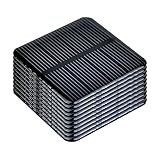
- 【Accurate power】All data are actually measured under the condition that the solar light is sufficient. In full sunlight, the voltage will be higher than 2V.
- 【Product Parameter】10Pcs Monocrystalline silicon solar panels;Power:2V 160mA;Size:1.96"x1.96";Epoxy resin AB glue, PCB+ glass fiber base plate
- 【Experience the fun of DIY】 Build your DIY powered models/solar toys / solar displays/Solar Powered String Lights.
- 【Widely used and Widely temperature range】Suitable for outdoor activities, emergencies and outdoor work. Power is continuously supplied even on cloudy days;Suitable for outdoor activities, emergencies and outdoor work. Power is continuously supplied even on cloudy days.
- 【High Conversion EffIciency】 Constructed of high-efficiency solar arrays,convert up to 21.5-23.5% of solar power into free energy.
Why is durability the key challenge?
Perovskites can degrade when exposed to moisture and heat. For a solar panel expected to operate outdoors over many years, protecting the absorber and maintaining performance are as important as reaching a high laboratory efficiency. MIT Technology Review reported that tandem panels had undergone limited outdoor testing when its feature was published in January 2024.
The feature described two approaches researchers were pursuing: stronger barriers to protect the material and more stable perovskite compounds. Those research directions address degradation, but the article did not establish long-term field durability or provide warranty data. A laboratory record therefore does not settle whether a tandem module can retain its performance in real installations.
Windows Errors? Fix Them Before They Spread
Repair common Windows errors and clear accumulated junk for a smoother, more stable PC - no reinstall needed.Free scan · no reinstallCrashes, No Sound, or Screen Glitches?
Random freezes, missing sound and display glitches usually trace back to one bad driver. Find and replace yours safely.Free scan · under a minuteRank #3

- Lightweight and Portable Design: with its ultra-thin and lightweight construction, this solar panel is nice for those convenient situations; Although it's fragile and requires careful handling, its compact size makes transportation effortless, allowing you to harness solar energy wherever you are; Ideal for outdoor enthusiasts and travelers alike
- Powerful Polycrystalline Efficiency: equipped with 200 pcs of high efficiency polycrystalline silicon, this panel offers a potent energy output at 0.5V and 400mA, easily meeting your power needs; Experience up to 18% energy conversion, ensuring maximum solar energy utilization even on cloudy days
- Easy DIY and Customization: unlock your creativity with our solar cells, ideal for building DIY powered models, solar things, and displays; Easily adjust power and voltage by connecting in series or parallel, empowering you to tailor the output to your specific requirements
- Versatile Outdoor Application: engineered for versatility, this solar panel suits a variety of outdoor activities, emergencies, and work scenarios; Depend on continuous energy supply regardless of weather conditions, keeping your devices charged up and ready
- Seamless Connectivity: ensure correct connections with the color-coded design: blue side for negative (-) and the other side for positive (+); For enhanced power delivery, use solder strips, thus effectively stabilizing your solar projects for optimal performance
Are perovskite tandem panels available?
MIT Technology Review’s January 19, 2024 feature said Oxford PV planned a first panel deployment and manufacturing progress during 2024, and anticipated that other companies might announce products later that year. Those were forecasts made at publication, not proof of what is available in October 2026. The evidence cited here does not establish current availability, markets served, warranty terms, or independently measured field performance.
For a purchase decision, verify the specific product’s market availability, module-level specifications, warranty, and independently documented outdoor performance with the manufacturer and installer. The historical cell-efficiency figures alone cannot answer those questions.
Rank #4

- Easy : Simple to set up and use, making it ideal for junior high school students to learn about solar energy conversion.
- sturdy Construction: Made of premium material for long-lasting durability, ensuring years of educational use.
- Motor & Music Demonstrations: Includes ability to drive a motor and music sounder, providing hands-on experience with solar power.
- Real-Time Energy Conversion: Students can observe the conversion of solar energy into electrical energy with the included voltmeter.
- Complete Experiment Kit: Comes with all necessary components for a comprehensive solar energy experiment, including solar panel, wind blade, connecting cables, and base.
Why MIT Technology Review named the technology a 2024 breakthrough
The case for the breakthrough was a rapidly improving laboratory efficiency trajectory paired with the prospect of combining perovskite and silicon’s different spectral responses. In its January 2024 feature, Emma Foehringer Merchant reported tandem-cell results above 33% and described the technology’s potential to produce more electricity at lower cost at scale. The promise is substantial, but commercial impact depends on translating cell performance into durable, economical modules that work outdoors.
Quick Recap
Best Value

- [HIGH DRIVING EFFICIENCY] This solar light control panel features high driving efficiency and long discharge time, providing a superior user experience.
- [DESIGNED FOR] Our solar lawn light control panel designed for use with 1.2V NiMH batteries, is for meeting your specific needs. This solar light control panel charging during the day, turning on the lights in the evening
- [DISCHARGE ] With a built-in 2V solar charging module, our solar light control panel offers various protective features, including , discharge , and constant current drive.
- [ MATERIAL] This solar lawn lamp control board kit is made of high-quality PCB material, our solar light control panel ensures durability and stability for long-term use.
- [PACKAGE INCLUDING] The package list has 2 x solar panel, 2 x light control board, 2 x battery slot, 2 x storage box, 1 x instruction manual
Product prices and availability are accurate as of the date/time indicated and are subject to change. Any price and availability information displayed on Amazon at the time of purchase will apply.

