
iTechGuides is reader-supported. When you buy through links on our site, we may earn an affiliate commission. As an Amazon Associate I earn from qualifying purchases. Learn more
Use standard single-mode fiber for most distributed vibration-monitoring and distributed acoustic sensing (DAS) projects. Commercial coherent Rayleigh DAS and phase-sensitive optical time-domain reflectometry (φ-OTDR) interrogators are generally designed for single-mode fiber, whose low attenuation is better suited to long pipelines, utility corridors, perimeters and infrastructure. Multimode fiber can detect vibration, but usually through a different modal-interference or speckle-analysis architecture. It is best treated as a specialized short-range or laboratory option, or used only when the instrument explicitly supports multimode sensing.
What the two fiber types mean for vibration sensing
Single-mode and multimode describe how light propagates through the fiber core. A single-mode fiber is designed to carry one spatial propagation mode at the operating wavelength. A multimode fiber supports many modes, each taking a slightly different path and arriving with a different phase. That optical difference determines what a vibration interrogator can measure reliably.


In a conventional DAS installation, a laser sends coherent pulses down the sensing fiber. Tiny reflections from microscopic index variations produce Rayleigh backscatter. A vibration changes strain along the glass, which changes the phase of that backscattered light. By comparing returned signals over time and along distance, the interrogator detects and localizes acoustic or vibration events. Nature Communications described the underlying principle this way: the optical phase of coherent Rayleigh scattering is highly sensitive to external perturbations such as vibration, enabling distributed acoustic sensors.
Recommended Free Tools
Multimode sensing generally does not use the same phase-stable, single-spatial-mode assumption. Instead, a disturbance changes the distribution of optical energy among modes. The output may appear as a changing speckle pattern or a change in spatial energy that is captured by a camera, photodiode array or another spatial-analysis system. A foundational Applied Optics experiment demonstrated vibration detection from changes in the spatial distribution of energy at the output of a multimode fiber, including structural-vibration and buried-cable-intrusion tests.
Popular on Amazon
Direct comparison: single-mode versus multimode
| Decision axis | Single-mode fiber | Multimode fiber |
|---|---|---|
| Typical vibration architecture | Coherent Rayleigh DAS, coherent OTDR or phase-sensitive OTDR | Modal interference, speckle-pattern or modal-energy sensing |
| Long-distance suitability | Preferred because attenuation is low and mode behavior is controlled | Usually limited by modal dispersion and higher loss for long coherent runs |
| What the signal processor analyzes | Phase and amplitude changes in Rayleigh backscatter | Changes in spatial intensity, speckle or modal energy |
| Best-fit deployments | Long pipelines, fences, rail and road corridors, utilities, geophysical lines and large infrastructure | Short local sensors, laboratory demonstrations and selected reuse of installed multimode cable |
| Interrogator compatibility | Matches the fiber interface of most commercial DAS systems | Not automatically compatible with a single-mode DAS interrogator |
| Installation sensitivity | Still depends on strain transfer, cable construction, bends and connector quality | Especially sensitive to launch conditions, mode mixing, bending and connector changes |
The table compares architectures, not a claim that one glass type is universally superior. A multimode instrument designed around speckle can be the right tool for a short experiment, while a single-mode interrogator cannot simply be connected to multimode cable and expected to work normally.
Why single-mode is the default for DAS
Coherent Rayleigh measurements assume a stable spatial channel
Phase-sensitive OTDR and coherent DAS rely on a repeatable optical field so that small phase changes can be distinguished from the normal backscatter pattern. Single-mode propagation removes the multiple spatial paths that would otherwise interfere unpredictably. The interrogator can therefore track the phase response associated with strain along successive sections of fiber.
Distributed acoustic sensing is also called distributed vibration sensing, coherent OTDR (COTDR) or phase-sensitive OTDR. These labels can describe closely related systems, but the practical question remains the same: check which fiber type the interrogator manufacturer specifies before buying or splicing cable.
Lower attenuation supports longer runs
Single-mode fibers are preferred for long-distance distributed sensing because they have lower attenuation. A 2017 review in Sensors reports an attenuation value of 0.2 dB/km at 1550 nm for single-mode fiber. That figure is a wavelength-specific value reported in the review, not a guarantee for every cable, splice, connector or installed route. Bends, dirty connectors, poor splices and cable damage add loss in the field.
Lower loss preserves the returned Rayleigh signal as the sensing distance grows. It also gives the system more margin for losses at patch panels, joints and end-of-line components. Multimode fibers can work over short distances, but modal dispersion and generally higher loss make them a poor default for a long coherent sensing path.
Longitudinal strain is the quantity DAS sees best
DAS responds primarily to strain along the fiber axis. This directional response matters when you decide how to route and attach the cable: vibration that stretches the fiber longitudinally produces a stronger response than motion that merely moves the cable sideways without transferring axial strain. The cable must therefore be coupled to the asset in a way that transfers the vibration into the glass.
How multimode vibration sensing works
Modal interference and speckle changes
In multimode fiber, many propagation modes interfere at the output. A bend, pressure change, vibration or strain perturbation alters the relative phase and energy of those modes. The resulting speckle pattern or spatial intensity distribution changes, and an optical detector can classify that change as vibration.
The Tool Desk
Outbyte PC Repair FREEClear out junk files and repair common Windows errorsFree Scan →Outbyte Driver Updater FREEScan for outdated or missing drivers - takes under a minuteDriver Scan →Also popular on Amazon

- 【Modle】The FS-N18 fiber-optic amplifier provides ultra-stable performance and smart tuning for high-speed, reliable detection for standard or demanding applications.
- 【Supply Voltage】DC 12-24V (brown-positive pole, blue-negative pole, black-signal output).Products include: optical fiber amplifier, product English user manual.
- 【Simple Setup】One push setting with the PRESET Button,Laser, fiberoptic, and photoelectric models all sharethe same simple functionality.
- 【Features】 It is a sensor type component with Button ,adjustment switch, output indicator light,HD LED dual digital display and signal strength indicator light, high sensitivity and low delay.
- 【Scope of application】Fibre optic sensors are suitable for use in a wide range of industries including automotive, liquid crystal, food and pharmaceutical packaging, smartphones and electronics, Position counting ,distinguish colors ,and detect positive negative products,lithium ion batteries and solar cells. (Recommended to use with the store's optical fiber)
The Applied Optics work by Spillman and colleagues (1989) demonstrated this concept experimentally and included both structural-vibration detection and buried-cable intrusion tests. Its significance is architectural: multimode fiber can be a useful sensing element, but the instrument needs a detector and signal-processing method that preserves or analyzes the spatial information.
Why this is not interchangeable with standard DAS
A conventional single-mode DAS interrogator is built to measure coherent backscatter returning through a single-mode optical path. A multimode cable creates many paths and mode-dependent delays. Connecting it through an ordinary adapter does not turn the system into a multimode speckle sensor, nor does it make the modal response compatible with the interrogator’s calibration.
Conversely, a camera-based multimode experiment may not provide the long-range localization, timing and event-processing functions expected from a commercial DAS system. The detector, launch optics, acquisition rate, spatial filtering and algorithms all belong to the multimode design. Treat multimode as a complete sensing architecture rather than as a cheaper replacement cable.
Which fiber should you choose?
Choose single-mode when the project uses commercial DAS
Select standard single-mode sensing cable when the specification calls for coherent Rayleigh DAS, COTDR or phase-sensitive OTDR. This is the normal choice for monitoring long assets such as pipelines, perimeter fences, roads, railways, power and communication corridors, tunnels and geophysical lines.
What’s actually slowing this PC down?
Pick the symptom - the matching free tool is one click away.
Confirm the interrogator’s required operating wavelength and optical interface. A system optimized for 1550 nm, for example, should be paired with fiber and components specified for that wavelength. Do not assume that any cable labeled “single-mode” has the same attenuation, coating, connector polish, armoring or mechanical behavior.
Choose multimode only for an explicitly multimode design
Multimode is reasonable when the instrument documentation specifies modal, speckle or spatial-energy analysis; when the sensing distance is short; or when an experiment must reuse an existing multimode link. It can also be appropriate for a local structural sensor where the detector is placed at the fiber end and spatial changes are the measured signal.
Ask the instrument supplier whether the system accepts the installed core size, numerical aperture, wavelength and launch conditions. A mismatch can change which modes are excited and produce a response that is not repeatable after a connector is cleaned, a jumper is replaced or the cable is bent.
Also popular on Amazon
Do not select by the cable label alone
“OS2” identifies a common category of single-mode telecommunications fiber, but it does not by itself guarantee that a cable is mechanically optimized for vibration sensing. Generic telecom cable may have loose tubes, fillers or jackets that reduce strain transfer to the glass. A sensing cable may instead use a bonded construction, tight buffer or armor selected for the asset and environment.
Use the cable data sheet and the interrogator requirements together. The optical fiber type, cable construction and installation method jointly determine whether vibration reaches the sensing glass and whether the returned signal remains within the instrument’s dynamic range.
Requirements to verify before ordering cable
- Fiber type: single-mode or multimode, including the core and cladding specifications where relevant.
- Operating wavelength: the interrogator’s wavelength and the cable’s attenuation specification at that wavelength.
- Connector polish and interface: the exact connector family and polish required by the interrogator; incompatible polish types can create excessive reflection or damage.
- Cable construction: loose-tube, tight-buffer, bonded, armored, aerial, direct-burial or other construction appropriate to the route.
- Bend radius: both the static installation radius and the larger radius required while pulling or handling the cable.
- Strain-transfer design: whether the cable is intended to be bonded, clamped, buried, attached to a fence or installed in another coupling arrangement.
- Environmental rating: temperature, moisture, chemicals, rodents, crush, tensile load and fire requirements for the site.
- Splice and patch plan: every splice, connector, panel and transition adds optical loss and can alter mechanical coupling.
- Interrogator limits: maximum optical loss, sensing distance, launch power, pulse settings and approved fiber models.
Installation: getting useful vibration transfer
Route the cable where the target strain occurs
DAS does not measure every motion equally. Because its response is directional and tied to longitudinal strain, place the fiber where the asset’s vibration will stretch or compress it. A cable loosely resting beside a pipe may detect some ground or handling noise while missing the pipe’s most important axial events.
Use a coupling method suited to the asset
Bonding can provide strong strain transfer on a prepared surface, while clamps, protective conduits or buried installation may be safer for other assets. The mechanical method must protect the cable without isolating it from the vibration of interest. Follow the sensing-cable manufacturer’s stated bend radius, pulling tension and attachment method rather than improvising with ordinary telecommunications practices.
Control bends, connectors and transitions
Sharp bends can increase attenuation and create localized mechanical responses. Connector contamination adds loss and reflection. Transitions between cable types can create sections with different sensitivity, so document their locations in the DAS map. Test the optical path after every splice or connector change and compare the trace with the pre-change baseline.
Record the installation geometry
Keep a route map showing fiber distance, asset distance, slack loops, splice points, unused ends and protected sections. DAS software reports position along the fiber, not automatically the physical asset coordinate. Accurate mapping is necessary to turn an event at a fiber kilometer marker into a maintenance location.
Signal processing and what each system can tell you
Single-mode coherent DAS
A coherent interrogator analyzes changes in Rayleigh backscatter phase and, depending on the system, amplitude. The result is a time series distributed along the fiber. It can show where vibration starts, how it propagates and whether an event is repeated, provided the event produces sufficient axial strain and remains within the instrument’s spatial and frequency settings.
Also popular on Amazon

- 【Product parameters】 Model: FRS-610, Induction mode: Diffuse Reflective Optical Fiber Sensor, Outer diameter of optical fiber: 2mm, Internal diameter of optical fiber: 1.0mm. Line length: 1m
- 【High-quality Material】Made of TPV, the internal use of high-quality wire,Sheath protection up to 10000000 times bending.
- 【Features】 The built-in wire core has good light transmittance, low transmission loss, strong and durable optical fiber line, strong anti-aging performance, simple installation, and easier circuit connection.
- 【Safe Design】Insulation, non - inductive electrical properties, resistant to water, high temperature and corrosion.
- 【 Applications 】 New energy, lithium batteries, 3C, semiconductors, vibration discs, production equipment testing, automation equipment product positioning, counting, labeling, etc.
The 2016 fiber-sensing review identifies Rayleigh, Brillouin and Raman scattering as principal backscatter mechanisms in distributed sensing. For vibration monitoring, Rayleigh-based phase analysis is the usual high-speed approach. A separate 2016 dynamic-strain review concluded that Rayleigh-based sensors offer longer sensing range and higher frequency range, whereas Brillouin-based systems can provide higher spatial resolution but lower frequency and sensing ranges. Those are technology-level trade-offs; the exact performance still depends on the interrogator and installation.
Multimode modal or speckle systems
A multimode system may use a camera or another spatial detector to observe the output pattern, then use spatial filtering, correlation or modal-energy calculations to identify disturbances. Its measurement is strongly influenced by launch alignment, connector condition, fiber bends and mode mixing. Those dependencies can be useful for a compact sensor but complicate calibration over a long outdoor route.
PC Slower Than It Used to Be?
A free scan shows the junk files, broken settings and background clutter dragging Windows down - then fixes them in one click.Free scan · Windows 10 & 11Outdated Drivers Are Slowing You Down
One free scan finds every outdated or missing driver and matches the right update for your exact hardware.Free scan · exact hardware matchCommon failure modes and fixes
“The multimode cable gives no useful DAS trace”
Cause: the interrogator expects a single-mode coherent channel, while the installed cable supports many modes.
Fix: replace the sensing path with the specified single-mode fiber, or redesign the instrument as an explicit multimode modal/speckle sensor. An adapter alone does not solve the architecture mismatch.
“The far end is noisy or disappears”
Cause: accumulated attenuation from cable, bends, splices, dirty connectors or damaged sections reduces the Rayleigh return.
Fix: inspect and clean connectors, measure splice loss, verify bend-radius compliance and compare the optical-loss budget with the interrogator limit. Check the cable’s attenuation at the operating wavelength rather than relying on a nominal label.
Quick wins for a faster PC:
Clear out junk files and repair common Windows errorsFree Scan →Fix the driver behind crashes, sound loss and screen glitchesFind Drivers →Repair Windows errors before they cause bigger problemsFix Now →“The system sees traffic but not the target structure”
Cause: the fiber is not mechanically coupled to the structure or is routed in a direction that produces little longitudinal strain.
Also popular on Amazon
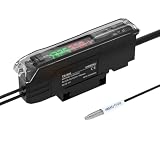
- 【Modle】FS-S40 fiber-optic amplifier npn output, with ultra-high stability performance and intelligent tuning function for high-speed, reliable detection for standard or demanding applications.
- 【 Simple Setting 】 SET one click setting, align with the workpiece, long press SET button for 3 seconds, automatically complete the optimal matching of light quantity, threshold, and sensitivity, no need for professional engineers, refer to the manual for quick setting
- 【Supply Voltage】DC 12-24V (brown-positive pole, blue-negative pole, black-signal output).Products include: optical fiber amplifier, product English user manual.(Excluding fiber optic cables)
- 【Features】It belongs to sensor type components ,adjustment switch, output indicator light,HD LED dual digital display and signal strength indicator light,strong anti-interference, high sensitivity and low delay.
- 【 Scope of Application 】 Fiber optic sensors are suitable for a wide range of industries, including new energy, industrial products, semiconductors, 3C, automotive, electronics, position counting, color differentiation and detection of positive and negative products, lithium-ion batteries, and vibration discs. (Recommended to be used together with the fiber optic cable in the store)
Fix: review attachment, slack, conduit and route orientation. Move or bond the cable where the target vibration produces axial strain, then update the fiber-to-asset map.
“The response changes after a connector or jumper is replaced”
Cause: launch conditions and mode distribution changed. This is particularly important in multimode systems, but connector reflections and loss can also affect single-mode traces.
Fix: use the approved connector type and cleaning procedure, preserve launch geometry, document the change and run a baseline test before returning the system to service.
“A multimode prototype works on the bench but not in the field”
Cause: outdoor bends, temperature, connector movement and uncontrolled mode mixing alter the speckle pattern independently of the target vibration.
Fix: provide strain relief and stable launches, characterize environmental drift, protect connectors and recalibrate after mechanical changes. If the requirement is a long, continuously mapped corridor, evaluate a standard single-mode DAS architecture instead.
A practical selection procedure
- Define the measurement: write down the asset, expected vibration source, required coverage, event location accuracy and whether the measurement must be distributed continuously or only at one point.
- Identify the interrogator architecture: determine whether it is coherent Rayleigh DAS/phase-sensitive OTDR, Brillouin or Raman sensing, or an end-of-fiber modal/speckle instrument.
- Match the fiber type: use the interrogator’s approved single-mode specification for coherent DAS. Use multimode only when the instrument explicitly supports its modal or speckle method.
- Check the optical budget: total the cable, splice and connector losses at the operating wavelength and compare them with the interrogator’s limit.
- Choose mechanical construction: select jacket, armor, buffer and strain-transfer method for the environment and asset, not merely for optical compatibility.
- Design the route: set bend-radius, pulling-tension, slack and transition rules, and mark every splice and protected section.
- Baseline the installed system: record an optical trace and vibration baseline before field operation. Repeat it after repairs or connector changes.
- Validate with a known event: apply a controlled vibration at mapped locations and confirm that the measured response appears at the expected fiber distance.
Cost and procurement considerations
Fiber price alone is not a reliable indicator of project cost. The interrogator, ruggedized cable, installation labor, splicing, protection, mapping and data processing usually dominate the monitoring system. A generic single-mode telecommunications cable can be optically compatible yet require additional attachment hardware to transfer strain. A purpose-built sensing cable may cost more per meter but simplify coupling and protect the measurement.
For multimode, include the detector and spatial-processing hardware in the comparison. A camera, stable launch optics and calibration workflow are part of the sensor, not optional accessories. Conversely, a commercial single-mode DAS interrogator may already include the coherent receiver and localization software but require a specified cable family and installation practice.
Free tools Windows power users keep installed
One-click scans. No signup required.
Obtain written confirmation of fiber compatibility, maximum loss, connector polish, wavelength, bend radius and approved cable constructions before placing an order. Current retail prices and availability vary by region and were not established here, so do not treat an unverified listing or nominal “single-mode” description as a complete specification.
Quick Recap
Bottom line for common scenarios
| Scenario | Recommended starting point | Reason |
|---|---|---|
| Long pipeline or utility corridor with a commercial DAS interrogator | Standard single-mode fiber | Matches coherent Rayleigh architecture and minimizes attenuation over the route. |
| Perimeter or buried-cable intrusion monitoring using phase-sensitive OTDR | Standard single-mode fiber | Supports distributed localization and the interrogator’s coherent measurement model. |
| Short laboratory experiment measuring output speckle | Multimode fiber | Multiple modes provide the changing spatial pattern used by the detector. |
| Existing installed multimode link | Multimode only if the instrument explicitly supports it | Launch and modal behavior must be characterized; it is not automatically usable by a single-mode DAS interrogator. |
| Unclear requirements or mixed cable plant | Pause procurement and obtain an interrogator-specific specification | Fiber type, wavelength, connector, loss and mechanical coupling must be matched as one system. |
Key takeaways
- Standard single-mode fiber is typically used for distributed acoustic sensing, as Corning’s technical guidance states.
- Single-mode is the practical default for long distributed vibration runs because its lower attenuation preserves signal over distance; a 2017 Sensors review reports 0.2 dB/km at 1550 nm for single-mode fiber.
- DAS detects coherent Rayleigh phase changes caused by strain and has a directional response to longitudinal strain along the fiber.
- Multimode fiber can sense vibration through modal-interference or speckle changes, as demonstrated in Applied Optics, but it requires a purpose-built detector and processing chain.
- Never assume a multimode cable will work with a single-mode DAS interrogator. Match the fiber, wavelength, connector, cable construction, bend radius and strain-transfer method to the complete sensing system.
Product prices and availability are accurate as of the date/time indicated and are subject to change. Any price and availability information displayed on Amazon at the time of purchase will apply.

