
Do these 3 things before closing this tab:
1Clear out junk files and repair common Windows errors2Fix the driver behind crashes, sound loss and screen glitches3Repair Windows errors before they cause bigger problemsRP2350-E9 is a conditional leakage-current problem in RP2350 A2 silicon—not a fault that affects every GPIO or every Pico 2. It can occur when a Bank 0 pad is configured as an input, its output is disabled, and its voltage sits between valid low and high logic levels. The practical first checks are therefore the chip stepping and the pad’s electrical state; a board’s “Pico 2” label alone does not identify its silicon revision.
What RP2350-E9 means
Raspberry Pi’s official erratum title is “Increased leakage current on Bank 0 GPIO when pad input is enabled.” It applies to RP2350 A2 and describes current sourced by a GPIO pad in a specific state. A symptom may look like a weak pull-down failing or a pin lingering at an unexpected voltage, but the formal issue is input-mode leakage—not a general latching defect.
The condition concerns GPIO pads 0–47 when all of the relevant conditions are present: input enable is set, output is disabled, the pad voltage is between VIL and VIH (the undefined logic region), and the specified isolation state applies. The current depends on the chip and pad voltage. At IOVDD 3.3 V, Raspberry Pi reports around 120 μA typical and says the pad can source current strongly enough to hold the voltage near 2.2 V. At IOVDD 1.8 V, the datasheet gives around 30 μA peak. These are condition-specific figures, not guaranteed readings for every pin or chip.
The internal pull-down is significantly weaker than the leakage in the affected state. Conversely, the internal pull-up still works and can pull a floating signal high out of the problematic voltage range. A strong source, such as a strong potential divider, can nevertheless hold the pad in the affected condition. QSPI pads and USB PHY pins are unaffected. SWD pads use the same pad macro, but Raspberry Pi says there is no ill effect because they are pulled up by default.
#1 Best Overall

- RP2350A microcontroller chip designed by Raspberry Pi in the United Kingdom. Adopts unique dual-core and dual-architecture design: dual-core Arm Cortex-M33 processor and dual-core Hazard3 RISC-V processor, flexible clock running up to 150 MHz
- 520KB of SRAM, and 2MB of onboard Flash memory. Type-C connector, keeps it up to date, easier to use. Castellated module allows soldering directly to carrier boards
- USB 1.1 with device and host support. Onboard 1x USB Type A expansion port via PIO, compatible with USB 2.0/1.1 transmission. Low-power sleep and dormant modes
- Drag-and-drop programming using mass storage over USB. Adapting 15 × multi-function GPIO pins. 2 × SPI, 2 × I2C, 2 × UART, 4 × 12-bit ADC, 14 × controllable PWM channels
- Accurate clock and timer on-chip. Temperature sensor. Accelerated floating-point libraries on-chip. 12 × Programmable I/O (PIO) state machines for custom peripheral support
These definitions and electrical figures appear in Appendix E, RP2350-E9, of the RP2350 datasheet, updated 2 October 2026 according to Raspberry Pi’s product portal.
How to tell whether a board has affected silicon
The erratum is tied to the chip stepping, not simply to a product name. Raspberry Pi’s datasheet identifies A2 as affected and says A3 fixed E9. In a 29 July 2025 announcement, Raspberry Pi said A4 also fixes the issue, described A3 as an intermediate qualification stepping, and reported that production had moved from A2 to A4 by that time. The announcement also said roughly 30,000 A3 units would be used in Pico 2 and Pico 2 W products and that all Pico 2 products would eventually use A4. Those are historical transition statements, not a guarantee about the stepping in a particular board purchased today.
Rank #2
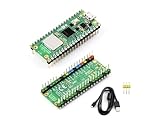
- RPi Pico 2 W Microcontroller Board (pre-soldered header (color-coded)), Based on Official RP2350 Chip, Dual-core & Dual-architecture Design. Upgraded hardware from Pico 2 with wireless communication, onboard antenna, features 2.4GHz 802.11n WIFI and Bluetooth 5.2.
- Adopts unique dual-core and dual-architecture design: dual-core Arm Cortex-M33 processor and dual-core Hazard3 RISC-V processor, flexible clock running up to 150 MHz.
- Onboard Infineon CYW43439 wireless chip, supports WIFI 4 wireless and Bluetooth 5.2.
- 520KB of SRAM, and 4MB of on-board Flash memory.
- Castellated module allows soldering direct to carrier boards. USB 1.1 with device and host support. Low-power sleep and dormant modes. Drag-and-drop programming using mass storage over USB.
Identify the silicon revision in the specific unit before deciding whether an E9 workaround is needed. Raspberry Pi’s datasheet describes checking the package markings or reading the revision register. The Pico 2 product page establishes that Pico 2 is RP2350-based hardware, but the product name alone does not establish whether an individual board contains A2, A3, or A4 silicon.
Workarounds for A2 designs
For a design that needs pull-down behavior on affected A2 silicon, Raspberry Pi recommends clearing the pad’s input enable so the internal pull-down can pull the signal low. If the firmware needs to sample the pin, it can enable input immediately before the read and disable it immediately afterward. If the pad is already at logic 0, re-enabling input does not disturb the pull-down.
Rank #3

- Dual-Core and Dual-Architecture Design: RP2350-PiZero is powered by dual ARM Cortex-M33 or dual Hazard3 RISC-V processors, offering flexibility with clock speeds up to 150 MHz for enhanced processing capabilities.
- Expandable Memory: It features 520KB of Static Random, 16MB of onboard Flash memory, and includes reserved solder pads for PStatic Random chip expansion, offering scalable storage options.
- Comprehensive Connectivity: The board includes a DVI interface for HDMI screens, TF card slot for storage, and a PIO-USB port, providing versatile connections for different projects.
- Mobile-Friendly Power Features: Equipped with a Type-C connector for easy use, and a lithium battery recharge/discharge header, making it perfect for mobile and low-power applications.
- Extensive I/O and Customization: With 5 × multi-function GPIO pins, SPI, I2C, UART, ADC, PWM, and 12 programmable I/O state machines, this board allows extensive customization for various peripherals.
- Firmware-controlled input: Disable input except while sampling, where the application’s timing and signal behavior allow it.
- External pull-down: Use 8.2 kΩ or less to overcome the leakage, as specified by Raspberry Pi. Whether this is appropriate depends on the rest of the circuit and its acceptable loading.
- PIO-constrained designs: PIO programs cannot toggle pad controls. Depending on the application, an external pull may therefore be needed.
- ADC use: If ADC channels are used on a pin, the datasheet directs the reader to clear the relevant GPIO input enable.
Raspberry Pi CEO Eben Upton wrote in the 29 July 2025 announcement that, on the fixed stepping, “external resistors are no longer required to pull inputs low, though they may safely be retained in existing designs.” That statement applies to the fixed silicon discussed in the announcement; it is not a reason to assume an unidentified board is fixed.
Independent reader supportYour contribution helps us test, update, and keep practical guides available for everyone.What changed in the erratum’s description
Descriptions of the problem can emphasize a pull-down or pin-voltage symptom, which is useful when searching for a board-level behavior. The datasheet’s formal description is more precise: increased leakage current occurs when the Bank 0 pad input is enabled under the stated conditions. That framing explains why an internal pull-down may appear ineffective and why the issue is conditional rather than a blanket failure of GPIO pins.
Rank #4

- RP2350-Plus Development Board is a Pico-like MCU board based on Raspberry Pi RP2350A dual-core & dual-architecture microcontroller chip, compatible with most of Raspberry Pi Pico add-on modules
- RP2350 MCU Board Plus with 520KB of Static Random-Access Memory, and 4MB of on-board Flash memory, Type-C connector, keeps it up to date, easier to use
- Onboard recharge/discharge header, suitable for mobile devices, onboard DC-DC chip MP28164, high efficiency DC-DC buck-boost chip, maximum 2A load current
- 26 × multi-function GPIO pins, 2 × SPI, 2 × I2C, 2 × UART, 4 × 12-bit ADC, 16 × controllable PWM channels, configurable pin function, allows flexible development and integration
- Support C/C++, MicroPython, Comprehensive SDK, online dev resources and tutorials to help you easily get started
For a design review or bug report, record the stepping, GPIO number, IOVDD, pad voltage, source impedance, whether input enable remains set, and whether output is disabled. Also note whether PIO or ADC use constrains a firmware workaround and whether an external low-impedance pull-down is acceptable. These details distinguish an E9-compatible symptom from a broad claim that every A2 pin or every Pico 2 board is defective.
Quick Recap
Best Value

- Note: The Pico 2 W comes with no program by default, so you won’t see any lights when plugged in. Please upload a simple blink program to verify it's working.
- Built-in Wireless Connectivity: Integrated Wi-Fi (802.11b/g/n) and Bluetooth 5.2 for seamless IoT and embedded applications.
- High-Performance RP2350 Chip: Dual-core Arm Cortex-M33 with FPU and Hazard3 RISC-V cores, delivering double the speed and flexibility of the RP2040.
- Increased RAM: Equipped with 520 KB of on-chip RAM, facilitating efficient data handling for complex applications.
- Expanded Flash Storage: Provides 4 MB of onboard flash memory, suitable for storing extensive codebases and data.
Product prices and availability are accurate as of the date/time indicated and are subject to change. Any price and availability information displayed on Amazon at the time of purchase will apply.

