
Recommended Free Tools
iTechGuides is reader-supported. When you buy through links on our site, we may earn an affiliate commission. As an Amazon Associate I earn from qualifying purchases. Learn more
Choose the shape that suits the route, not the speed you want. A flat Ethernet cable is convenient for short, concealed indoor runs behind furniture, along a baseboard, or beneath a carpet edge. A round cable is usually the safer choice for permanent, exposed, high-traffic, wall, ceiling, attic, or mechanically demanding runs because it is easier to support and commonly has more protective construction. Neither shape is a performance rating: category (Cat5e, Cat6, or Cat6A), copper quality, shielding, connectors, length, and installation determine network performance.
The practical verdict
For a typical home network, use a certified Cat6 cable and select the profile that fits your installation. Pick flat Cat6 when concealment and a low profile are the main concerns and the run is short, indoors, and protected from crushing. Pick round Cat6 or Cat6A for cable that will be pulled through walls, ceilings, attics, conduit, or high-traffic areas, or whenever you need conventional clips, J-hooks, or raceway support.
That recommendation is about installation reliability, not an inherent speed advantage. A well-made flat cable can carry the same Ethernet category as a round cable, while a poorly made round cable can perform badly. Read the cable’s category, conductor material, shielding, jacket rating, connector construction, and bend instructions before buying.
What “flat” and “round” actually describe
Flat and round refer to the cable’s physical profile. Ethernet still uses four twisted pairs in either format, but the internal arrangement, separator, insulation, and jacket can differ substantially between products. A flat jacket can pass through a narrow gap under a door or behind a cabinet. A round jacket generally presents a more even cross-section that is easier to clamp, suspend, and protect.
Popular on Amazon
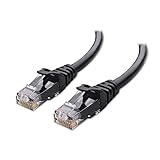
- High-Performance Connectivity: This Cat 6 ethernet cable is designed for superior performance, with a 24 AWG copper wire core. It provides universal connectivity as an ethernet cord for LAN network components such as PCs, servers, printers, routers, and more, ensuring reliable and fast network connections
- Advanced Cat6 Technology: Experience Cat6 performance with higher bandwidth at a Cat5e price. This network cable is future-proof, ready for 10-Gigabit Ethernet and backwards compatible with any existing Cat 5 cable network. It meets or exceeds Category 6 performance according to the TIA/EIA 568-C.2 standard
- Reliable Wired Network Solution: Known variously as a Cat6 network cable, ethernet cable Cat 6, or Cat 6 data/LAN cable, this RJ45 cable offers a more secure and reliable connection than wireless networks. It's ideal for internet connections that demand consistency and security
- Durable and Secure Design: The connectors of this ethernet cable feature gold-plated contacts and strain-relief boots for enhanced durability. Bare copper conductors not only improve cable performance but also comply with communication cable specifications
- High-Speed Data Transfer: With up to 550 MHz bandwidth, this ethernet cord is ideal for server applications, cloud computing, video surveillance, and streaming high-definition video. It also supports Power over Ethernet (PoE, PoE+, PoE++) for powering devices like IP cameras, VoIP phones, and wireless access points, ensuring fast and reliable network performance.
Shape alone does not tell you whether a cable is Cat5e, Cat6, or Cat6A, whether it contains solid or stranded conductors, or whether it is shielded. Two cables with the same shape can have different electrical limits and construction quality. Treat the profile as an installation choice and the category and construction as performance and safety choices.
Flat versus round: the differences that matter at home
| Consideration | Flat cable | Round cable |
|---|---|---|
| Concealment | Low profile fits narrow gaps, behind furniture, along baseboards, and under a carpet edge. | Bulkier, so it is more visible unless placed in a raceway, conduit, or structured wiring path. |
| Support | May need low-profile clips or a raceway designed for its width; tight ties can crease or compress it. | Works readily with common clips, J-hooks, and cable supports. |
| Mechanical protection | Construction varies; a thin jacket can be more vulnerable to crushing, sharp folds, and traffic. | Products commonly provide more jacket and crush protection, but the individual specification is decisive. |
| Bending | Can fold easily, but a sharp fold can damage the pairs or change their geometry. | Usually tolerates routing around supports more predictably; still obey the stated minimum radius. |
| Permanent installation | Best reserved for protected, short indoor routes unless the manufacturer explicitly rates it for building installation. | Usually easier to secure and protect in wall, ceiling, attic, or exposed runs. |
| Electrical performance | Determined by category, pair geometry, copper, shielding, connectors, and length—not by being flat. | Determined by the same factors, not by being round. |
Are flat Ethernet cables slower?
Not automatically. A certified Cat6 flat cable and a certified Cat6 round cable are designed for the same category-level transmission requirements when their construction and installation meet those requirements. In practice, a flat product may have less room for separators, shielding, or robust strain relief, so you must inspect the exact model rather than assume every flat cable is equivalent.
Home throughput is also limited by the slowest link: the router or switch port, network adapter, transceiver, patch panel, and cable. A Cat6 cable cannot make a 1-gigabit port negotiate at 10 gigabits. Conversely, a high-category cable will not compensate for a damaged plug, an over-tight cable tie, excessive length, or electrical interference.
Free tools Windows power users keep installed
One-click scans. No signup required.
Eaton’s Ethernet cables explained states that, for cable runs up to 50 feet, Cat6 is capable of 10 Gbps versus 1 Gbps for Cat5e. That is a guidance figure for that run length and equipment context, not a guarantee that every Cat6 installation will reach 10 Gbps. Confirm that both connected devices and all intermediate hardware support the target rate.
Choosing Cat5e, Cat6, or Cat6A
Cat5e
Cat5e is adequate for many existing 1-gigabit home networks and is often inexpensive. It is a sensible replacement when your router, switch, and devices are limited to 1 GbE and the run is straightforward. Do not choose it solely because a cable is flat; select a standards-compliant product with clearly identified conductors and category marking.
Also popular on Amazon

- High Performance Cat6 Cable - The Cat6 ethernet cables 100ft supports frequencies of up to 500 MHz and high-speed 10GB internet connection for LAN network applications such as PCs,computer servers,printers,routers,switch boxes,network media players,NAS,VoIP phones and more, while remaining fully backward compatible with your existing network.
- Outdoor&Indoor Ethernet Cable - The cat 6 ethernet patch cable features 8 solid copper conductors 24 AWG. Each of the 4 unshielded twisted pairs (UTP) are separated by a PE cross insulation to isolates pairs and prevent crosstalk and covered by a 5.8mm PVC jacket with RJ45 connectors and gold-plated contacts. The molded strain relief boots help avoid snags that will damage your cables. They are molded for flexibility and resist common wear and tear.
- Lan Cable with RJ45 - UTP(Unshielded Twisted Pair) patch cable with RJ45 gold-plated Connectors, this cat6 cable support Cat8 and Cat7 network and provides performance of up to 500 MHz 10Gbps and is suitable for 10BASE-T, 100BASE-TX (Fast Ethernet), 1000BASE-T/1000BASE-TX (Gigabit Ethernet) and 10GBASE-T (10-Gigabit Ethernet)
- High Quality Control - are designed with extremely well-matched components for outstanding uniform impedance and very low return loss, providing lower crosstalk, and a higher signal-to-noise ratio. Each Cat 6 internet cable 6 ft goes through rigorous testing to ensure a secure wired internet connection with exceptional speed and reliability.
- Support – Cat6 Ethernet cable with CM grade PVC jacket complies with TIA/EIA 568-C.2, is ETL verified and RoHS compliant. If an item is defective or breaks within a year, we will issue a replacement. For questions or concerns please contact our friendly, USA-based customer Support team.
Cat6
Cat6 is the best default search term for most new home patch cables: “certified Cat6 Ethernet cable.” It provides more headroom than Cat5e for modern equipment, while remaining widely available in flat and round versions. For a short concealed route, a flat Cat6 can be practical if its jacket, bend guidance, and connector quality fit the installation. For a permanent route, round Cat6 is usually easier to support.
Cat6A
Cat6A is appropriate when you are deliberately wiring for higher-performance links, longer-term upgrades, or environments where the installation standard calls for it. The cable is often thicker and less flexible, so account for conduit capacity, bend radius, termination hardware, and space behind wall plates. A Cat6A label does not eliminate the need to verify the individual cable’s construction.
What’s actually slowing this PC down?
Pick the symptom - the matching free tool is one click away.
Do not infer category from color, thickness, or shape. Read the printing on the jacket and the manufacturer’s specification, and make sure plugs and jacks are rated for the same category.
Length limits and why they are installation limits
Eaton gives the commonly used channel limit for Cat5e and Cat6 as about 295 feet (90 meters) of permanent cable, plus up to 16 feet (5 meters) of patch cable at each end, for a total of 328 feet (100 meters). That is a channel design limit, not a promise that an arbitrary cable can be coiled to that length and still perform. Include patch leads, wall outlets, couplers, and patch panels when estimating the total.
For a normal room-to-room connection, buy the shortest length that reaches without tension. Excess cable should be arranged in broad loops rather than tightly coiled or stuffed behind a device. If a route approaches the 100-meter channel limit, plan the network with a switch, fiber link, or another architecture instead of relying on an unverified long patch cable.
Also popular on Amazon

- Cat 6 performance at a Cat5e price but with higher bandwidth
- High Performance Cat6, 30 AWG, RJ45 Ethernet Patch Cable provides universal connectivity for LAN network components such as PCs,computer servers,printers,routers,switch boxes,network media players,NAS,VoIP phones
- Jadaol cat6 standard cable support Cat8 and Cat7 network and provides performance of up to 250 MHz 10Gbps and is suitable for 10BASE-T, 100BASE-TX (Fast Ethernet), 1000BASE-T/1000BASE-TX (Gigabit Ethernet) and 10GBASE-T (10-Gigabit Ethernet)
- UTP(Unshielded Twisted Pair) patch cable with RJ45 gold-plated Connectors and are made of 100% bare copper wire, ensure minimal noise and interference
- The unique flat cable shape allows for a cleaner and safer installation. You can easily and seamlessly make the cable run along walls, follow edges & corners or even make it completely invisible by sliding it under a carpet.
Bend radius, crushing, and support
Every cable has a minimum bend radius, measured from the centerline of the cable. Use the exact value in the product’s installation sheet. A commonly cited four-pair rule is a radius greater than four times the cable’s outside diameter for unshielded twisted pair (UTP) and shielded cable. The Leviton Cat 6A Reference Guide, quoted by nVent CADDY, gives that 4× outside-diameter guidance. Montana State University’s installation guideline likewise specifies a minimum horizontal bend radius of four times the cable diameter for Category 6A under no-load conditions and warns that cable ties must not strain or compress the jacket.
nVent’s reference to EN 50174-2 uses an eight-times-diameter bend radius for four-pair balanced cables during and after building installation. Its typical Cat6A example is 6.9 mm cable diameter and a 54.9 mm bend radius. The example illustrates why a thick high-category cable needs more space; it does not replace the value printed for your cable.
- Measure the cable diameter and convert the manufacturer’s multiplier into a physical radius before drilling or installing a raceway.
- Make gradual turns around corners; never force a flat cable into a crease or fold a round cable back on itself.
- Use clips, J-hooks, or a raceway sized for the cable. Fasteners should hold the jacket, not crush it.
- Leave slack in broad, supported loops near outlets and equipment rather than hanging the cable from the plug.
- Do not pull on a terminated connector to route the cable through a wall or conduit.
Can you run a flat Ethernet cable under a carpet?
You can place a low-profile flat cable under a carpet edge for a short, protected indoor route, but it is not automatically safe or suitable. Foot traffic, furniture legs, rolling chairs, and a tight transition at a doorway can crush the jacket or create a sharp fold. A cable rated only as a flexible patch lead may not be intended for concealed building installation.
If you use this route, keep it away from door hinges and chair wheels, avoid placing heavy furniture on it, and maintain the manufacturer’s bend radius where it rises to the wall or device. A low-profile raceway along the baseboard is a better choice when the cable will be walked over repeatedly. For a route inside a wall or ceiling, use a cable with the appropriate building, temperature, and jacket rating rather than hiding a generic patch cable.
Do round cables last longer?
There is no universal test proving that every round cable lasts longer than every flat cable. Durability depends on jacket material, pair separator, conductor construction, strain relief, bend history, support, temperature, moisture, and exposure to crushing or abrasion. Round products commonly offer more physical protection and are easier to secure without flattening, which is why they are usually favored for permanent or exposed runs. Check the exact product’s ratings instead of treating round shape as a lifetime guarantee.
Outdated Drivers Are Slowing You Down
One free scan finds every outdated or missing driver and matches the right update for your exact hardware.Free scan · exact hardware matchWindows Errors? Fix Them Before They Spread
Repair common Windows errors and clear accumulated junk for a smoother, more stable PC - no reinstall needed.Free scan · no reinstallAlso popular on Amazon

- 40 Gbps 2000 Mhz High Speed: The Cat 8 ethernet cable support max. 40 Gbps data transfer and 2000 MHz Brandwith, ideal for gaming and streaming, greatly improving upload and download speed, sound, image and resolution quality
- Excellent Anti-interference: The ethernet cable comes with 4 shielded foiled twisted pairs (F/FTP), pure copper core and gold-plated RJ45 connector, reducing interference, noise and crosstalk, making network speed faster and more stable
- Marvelous Durability: Internet cable wrapped with quality cotton braided cord, which makes the LAN cable stronger and more durable. The test proves that this internet cable can be bent at least 10000 times without broken, very suitable for long-term use
- PoE Supported: All lengths of ethernet cord can support the PoE power supply function except 65ft. You don't need additional power supply when installing a PoE camera, which is very convenient and safe
- Wide Compatibility: With the RJ45 Connector, network cable can be perfectly compatible with computers, laptops, modems, routers, PS5, X-Box and other networking devices. It can also be fully backward compatible with Cat7, Cat6e, Cat6, Cat5e, Cat5
Flat cables can last for years when they are protected, routed without sharp bends, and not repeatedly flexed at the same point. Their main risk is often installation abuse: a tight tie, a kink behind furniture, or pressure from a door or chair.
Shielding: when it helps and when it complicates the job
Shielding is most useful when the cable runs close to power wiring, motors, fluorescent-ballast equipment, or other strong electrical-noise sources. In an ordinary room, a quality unshielded twisted-pair cable is often adequate and simpler to terminate. Shielded cable must be paired with compatible shielded jacks, plugs, patch panels, and a correctly implemented grounding path; otherwise you may gain complexity without solving the interference problem.
Keep data cable separated from mains wiring and cross power cables at approximately a right angle where they must intersect. Do not use shielding as a substitute for sensible routing, proper support, or a cable with the correct jacket rating.
Avoid copper-clad aluminum (CCA)
Look for solid bare-copper conductors when buying permanent or high-quality patch cable. Copper-clad aluminum (CCA) uses an aluminum core with a copper coating. Eaton warns that CCA is weaker and does not perform as well as compliant copper cable. CCA can be harder to terminate reliably and may not meet the performance and safety expectations associated with a standards-compliant category marking.
Product listings should state “solid bare copper” or equivalent conductor information. If the listing only says “copper” without identifying the conductor, inspect the manufacturer’s specification or choose another product. A low price is not useful if the cable creates intermittent links or fails when pulled through a route.
Also popular on Amazon

- 👌 𝗠𝗜𝗟𝗜𝗧𝗔𝗥𝗬-𝗚𝗥𝗔𝗗𝗘 𝗤𝗨𝗔𝗟𝗜𝗧𝗬 -> 𝟭𝟬𝟬% 𝗚𝗨𝗔𝗥𝗔𝗡𝗧𝗘𝗘𝗗!: Each & every of our cable is individually tested with a 𝐃𝐒𝐗-𝟖𝟎𝟎𝟎 𝐂𝐀𝐁𝐋𝐄 𝐂𝐄𝐑𝐓𝐈𝐅𝐈𝐄𝐑 to ensure customer satisfaction, the most highest & consistent quality & compliance with 568.2C standards
- 💪 𝗛𝗘𝗔𝗩𝗬-𝗗𝗨𝗧𝗬 𝗖𝗢𝗡𝗦𝗧𝗥𝗨𝗖𝗧𝗜𝗢𝗡, 𝗥𝗘𝗠𝗔𝗥𝗞𝗔𝗕𝗟𝗘 𝗣𝗘𝗥𝗙𝗢𝗥𝗠𝗔𝗡𝗖𝗘 & 𝗦𝗨𝗣𝗘𝗥-𝗗𝗨𝗥𝗔𝗕𝗟𝗘: Our cable produces the strongest signal, along with the best conductivity, when compared to any other cable of the whole market | Our cable is an outstanding choice for 10 gigabit ethernet | RoHS certified | REACH certified | ISO 9001:2015 certified
- 🤝 𝗛𝗜𝗚𝗛𝗘𝗦𝗧 𝗖𝗢𝗣𝗣𝗘𝗥 𝗖𝗢𝗡𝗧𝗘𝗡𝗧 𝗢𝗙 𝗧𝗛𝗘 𝗪𝗛𝗢𝗟𝗘 𝗠𝗔𝗥𝗞𝗘𝗧: Copper & aluminium mix ensures the most perfect price-to-performance & durability ratio for customers | Monk Cables enable customers to reap the rewards of CCA through huge savings
- ❤️ 𝗕𝗥𝗜𝗧𝗧𝗟𝗘-𝗙𝗥𝗘𝗘, 𝗘𝗔𝗦𝗬-𝗧𝗢-𝗪𝗢𝗥𝗞-𝗪𝗜𝗧𝗛 & 𝗖𝗢𝗠𝗣𝗔𝗧𝗜𝗕𝗟𝗘 𝗪𝗜𝗧𝗛 𝗜𝗡𝗗𝗢𝗢𝗥 𝗨𝗦𝗔𝗚𝗘: Our cable comes packaged in a hassle-free & tangle-free easy-pull box | Running "ft" count after every foot makes measuring the cable extremely easy | Fire-retardant, sunlight-resistant & weather-proof plenum jacket fulfils rigorous fire protection safety standards for usage in plenum air spaces which typically are above drop ceilings or below raised floors
- ✅ 𝗧𝗛𝗘 𝗢𝗡𝗟𝗬 𝗖𝗔𝗧𝟲 𝗣𝗟𝗘𝗡𝗨𝗠 𝗖𝗔𝗕𝗟𝗘, 𝗬𝗢𝗨'𝗟𝗟 𝗘𝗩𝗘𝗥 𝗡𝗘𝗘𝗗 𝗧𝗢 𝗕𝗨𝗬!: Ridiculously easy 30 days return policy | 24/7 super-friendly customer support, with 100% satisfaction guarantee | If you ever face any issues while using our product, we will replace it right away, no questions asked!
Match the cable to the route
| Home-network situation | Practical choice | Reason |
|---|---|---|
| Router to a nearby streaming device behind furniture | Certified Cat6 flat or round patch cable | Choose the profile that fits the gap; protect the connector from sharp bends. |
| Baseboard run across one room | Flat Cat6 with suitable clips or a low-profile raceway | Concealment matters, but the cable must not be crushed by furniture or doors. |
| Through a wall, ceiling, or attic | Round Cat6 or Cat6A with the appropriate installation rating | Round cable is easier to support and protect; verify jacket, temperature, and bend requirements. |
| High-traffic floor or doorway | Round cable in a protective raceway, or reroute the cable | Do not rely on a flat jacket alone to withstand repeated impact and compression. |
| Near substantial electrical equipment | Correctly installed shielded cable, if separation is not practical | Shielding can reduce interference only when the entire link and grounding approach are compatible. |
| Existing 1-Gbps equipment and short replacement lead | Certified Cat5e or Cat6, solid copper | Category should match the hardware and upgrade plans; shape is secondary. |
What to check before buying
- Category marking: Confirm Cat5e, Cat6, or Cat6A on the jacket and listing. Do not rely on “high speed” wording.
- Conductor: Prefer solid bare copper and avoid CCA for a standards-compliant installation.
- Certification: Look for verifiable category compliance and a manufacturer specification, not just an unsubstantiated speed claim.
- Construction: Check solid versus stranded conductors, pair separator, jacket thickness, and whether the cable is a flexible patch lead or intended for in-wall use.
- Shielding: Select UTP for ordinary indoor routing; select shielded construction only when the environment and termination hardware justify it.
- Length: Measure the route and include bends, wall plates, and patch leads. Avoid buying a long cable simply to have spare slack.
- Jacket and fire rating: For concealed spaces, verify the applicable building and temperature rating for your region and installation location.
- Connectors: Inspect plug strain relief and latch quality. A good cable with a damaged or poorly crimped plug can still drop link speed.
- Installation instructions: Record the stated minimum bend radius and maximum pulling tension before routing the cable.
Installation procedure for a reliable home run
- Map the path. Identify the router, switch, wall outlet, or device at each end. Mark power cables, heat sources, doors, moving furniture, and likely crush points.
- Select the profile and rating. Use flat Cat6 for a short protected route where concealment is important. Use round Cat6 or Cat6A for permanent, exposed, or concealed building routes when its jacket rating fits the space.
- Measure total channel length. Add permanent cable and patch leads. Keep the design within the 100-meter channel guidance cited by Eaton for Cat5e and Cat6.
- Plan bends before pulling. Apply the cable’s specified bend radius; use the 4× or 8× guidance only as the relevant standard or manufacturer directs.
- Install supports. Place clips, J-hooks, or raceway so the cable is supported without compression. Do not staple directly through the jacket or cinch a tie until the cable flattens.
- Pull gently. Pull on a temporary leader or pulling eye, not on the RJ45 plug. Keep the cable away from sharp edges and do not exceed the stated pulling tension.
- Terminate without untwisting excessively. Preserve pair twists as close to the connector or jack as the termination instructions require. Use matching category hardware.
- Test both ends. Verify link negotiation, then copy a large file or use your network’s normal throughput test. If the link falls back to a lower speed, test the cable separately and inspect each termination.
Troubleshooting common problems
Link negotiates at 100 Mbps instead of 1 Gbps
Check that both ports support gigabit, then replace couplers and patch leads one at a time. Inspect the plug latch and pin seating, look for a kink or crushed section, and test with a known-good cable. A damaged pair can force a lower negotiation even when the jacket says Cat6.
Link drops when furniture moves
Relieve strain at the device and route the cable with a broad loop. Move the cable away from a chair wheel, door edge, or furniture leg. If the route remains exposed, install a raceway or replace a vulnerable flat lead with a protected round run.
Intermittent errors near electrical equipment
First increase physical separation from power wiring and motors. If separation is impossible, evaluate a complete shielded link with compatible terminations and grounding. Changing only the visible patch cable may not solve interference introduced elsewhere in the channel.
The Tool Desk
Outbyte Driver Updater FREEScan for outdated or missing drivers - takes under a minuteDriver Scan →Outbyte PC Repair FREERepair Windows errors before they cause bigger problemsFix Now →Cable will not fit the planned conduit or bend
Measure the actual outside diameter, not just the category name. A Cat6A cable can be substantially larger than a slim Cat6 patch lead. Use a larger raceway, a gentler route, or a cable whose installation sheet provides a suitable diameter and bend radius.
New cable performs worse than the old one
Check for CCA, an incorrect category claim, a defective connector, or excessive length. Confirm that the router and switch ports are configured for auto-negotiation and that no intermediate wall jack or coupler is below the required category.
Bottom line for a home purchase
Search for a certified, solid-copper Cat6 Ethernet cable, then choose flat or round according to the route. Flat is the practical answer for a short, protected, low-profile indoor connection. Round is the dependable default for permanent, exposed, high-traffic, wall, ceiling, attic, or otherwise demanding installation. Verify the exact cable’s category, conductor, shielding, jacket rating, connectors, length, and bend instructions; those details—not the silhouette—determine whether the network remains fast and reliable.

