Splink
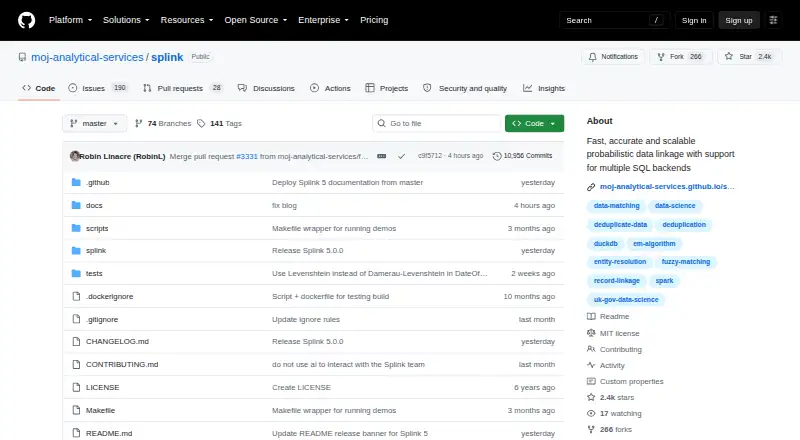
Splink: A configurable, open-source toolkit for probabilistic linkage across analytical data environments. Ranked #20 of 27 in Data Deduplication Software by our editors (7.4/10); pricing: Free plan; best for open-source probabilistic linkage pipelines.
At a glance
- Editor score7.4 / 10
- PricingFree plan
- Best forOpen-source probabilistic linkage pipelines
- Free planYes
- Paid fromFree
- Fuzzy matchingYes
- Facts checked20 Sep 2026
Where it wins
- Supports within-dataset deduplication and cross-dataset record linkage
- Combines fuzzy logic, blocking, clustering, and unsupervised training
- Runs with DuckDB, Spark, PostgreSQL, SQLite, or Athena
Where it doesn't
- Requires analytical implementation rather than a hosted SaaS workflow
- Does not verify merging decisions or duplicate-prevention workflows
- Its breadth may exceed the needs of simple deduplication tasks
Our verdict on Splink
Splink is an open-source Python package for probabilistic record linkage and entity resolution. It is designed for analysts working with records that lack unique identifiers, including teams handling government, academic, private-sector, and large-scale data-linkage projects. The package supports deduplication within a single dataset as well as linking across multiple datasets, making it suitable for pipelines where exact matching is insufficient and configurable comparison logic is important.
Its strongest technical advantage is the combination of probabilistic modelling and practical data-preparation controls. Splink uses a Fellegi-Sunter-based model, supports user-defined fuzzy matching logic, and provides SQL-based blocking rules to reduce candidate comparisons. Unsupervised model training helps develop linkage models without requiring labelled training data, while clustering produces estimated entity identifiers. Interactive visualisations support model diagnosis and evaluation, giving analysts a way to examine how linkage decisions behave. These capabilities make Splink a fit for complex entity-resolution work rather than only straightforward duplicate removal.
Execution flexibility is another important consideration. DuckDB and Spark backends support different processing environments, while optional PostgreSQL installation and integrations with SQLite and Athena broaden its database fit. Splink remains a library rather than a hosted SaaS product, so adoption is oriented toward teams that can build and operate Python- and SQL-based analytical workflows. It should appeal to organisations seeking an open-source, configurable linkage pipeline with no license cost. Teams wanting verified merge outcomes, duplicate-prevention workflows, or a managed hosted experience should choose an alternative designed around those requirements.
Your product? Our editors can test Splink in depth and publish a review, labelled as paid · from $149/mo →
Splink pricing
Splink fact sheet
| Free plan | Yes |
|---|---|
| Paid from | Free |
| Fuzzy matching | Yes |
| Automatic merging | Not verified |
| Duplicate prevention | Not verified |
| CRM integrations | Not verified |
| API access | Yes |
| Merge review workflow | Not verified |
| Deployment | Self-hosted |
| Support | Community, Docs |
| Built for | Solo, Small business, Mid-market, Enterprise (editorial estimate) |
| Integrations | 5 integrations: DuckDB, Spark, PostgreSQL, SQLite, Athena |
| Pricing | Free plan |
| Website | github.com |
| Facts checked | 20 Sep 2026 |
Splink integrations
Splink lists 5 integrations on its own site.
- DuckDB
- Spark
- PostgreSQL
- SQLite
- Athena
Alternatives to Splink
- DataMatch EnterpriseA broad data-quality platform for complex CRM, ERP, and master-data programs.9.4
- Data8 DuplicareA focused deduplication solution for Dynamics 365 and Dataverse data quality.9.3
- TiloresA developer-focused platform for real-time matching, unification, and duplicate prevention.9.2



Used Splink? Be the first to review it
The editor score above is our own research. What this page doesn't have yet is a reader's view — what you used Splink for, what worked and what didn't. No stars are seeded and no review is paid for; an editor reads every one before it appears.
Write a reviewTwo minutes · verified accounts only · read by an editor before it appears
Featured on iTechGuides

Splink is listed in our Data Deduplication Software directory. Add the badge to your site — it links back to this page.
<a href="https://www.itechguides.com/products/splink/"><img src="https://www.itechguides.com/best/badge/splink.svg" alt="Featured on iTechGuides" width="230" height="46"></a>
Reviewed by iTechGuides Editors · Editorial team · Updated Oct 2026
Advertiser disclosure: iTechGuides is reader-supported. Vendors can pay for top positions in our rankings and for a place on other products' pages, and we may earn a commission when you click some links. Bought places stand at the number bought; this page and our disclosure say so. Paying vendors may get a fuller, more detailed review from our editors, and that review can change their score. How we rank.
Last updated · How we research and update