pyJedAI
pyJedAI: A broad Python toolkit for researchers evaluating linkage and deduplication workflows. Ranked #21 of 27 in Data Deduplication Software by our editors (7.3/10); pricing: Open source; best for researchers evaluating linkage algorithms.
At a glance
- Editor score7.3 / 10
- PricingOpen source
- Best forResearchers evaluating linkage algorithms
- Paid fromFree
- Fuzzy matchingYes
- Facts checked20 Sep 2026
Where it wins
- Covers blocking, comparison cleaning, matching, clustering, and evaluation
- Supports embedding-based, supervised, and unsupervised machine learning
- Integrates with pandas, FAISS, Gensim, PyTorch, and NetworkX
Where it doesn't
- Requires technical workflow design rather than offering a turnkey product
- Breadth may add complexity for simple deduplication projects
- Self-hosted use places setup and operation within the user's environment
Our verdict on pyJedAI
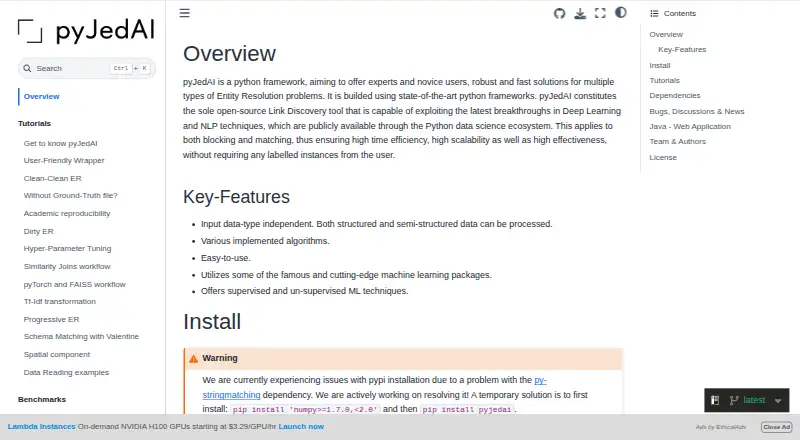
pyJedAI is an open-source Python framework for entity resolution, record linkage, duplicate detection, and link discovery. It is designed for novice and expert users working with structured and semi-structured data, especially researchers evaluating linkage algorithms and data integration workflows. The toolkit covers the main stages of deduplication, including blocking, comparison cleaning, entity matching, clustering, and workflow evaluation and comparison. Fuzzy matching and API access are supported, and the project runs on Windows, Linux, and self-hosted environments.
Its strongest fit is the surrounding Python and machine-learning ecosystem. pyJedAI integrates with pandas for data handling, FAISS for nearest-neighbor search, Gensim and sentence-transformers for language and embedding workflows, PyTorch for machine learning, and NetworkX for graph-oriented processing. Blocking options include token, sorted-neighborhood, q-gram, and suffix-array methods, while embedding-based nearest-neighbor blocking extends the workflow beyond conventional similarity approaches. This combination gives technical teams room to compare methods and connect deduplication work with existing analytical pipelines.
The trade-off is scope and operational focus. pyJedAI provides a broad technical toolkit rather than a complete operational deduplication product, so teams need to shape workflows around their own data, matching strategy, and evaluation requirements. Its support for conventional similarity methods, NLP, embeddings, supervised learning, unsupervised learning, and clustering suits experimentation and method comparison, but may be more than a simple project needs. Choose pyJedAI when flexibility, algorithm evaluation, and Python integration matter; choose an alternative when the priority is a more packaged operational workflow with less technical design.
Your product? Our editors can test pyJedAI in depth and publish a review, labelled as paid · from $149/mo →
pyJedAI pricing
pyJedAI fact sheet
| Free plan | Not verified |
|---|---|
| Paid from | Free |
| Fuzzy matching | Yes |
| Automatic merging | Not verified |
| Duplicate prevention | Not verified |
| CRM integrations | Not verified |
| API access | Yes |
| Merge review workflow | Not verified |
| Deployment | Self-hosted |
| Platforms | Windows, Linux |
| Support | Community, Docs |
| Built for | Solo, Small business, Mid-market (editorial estimate) |
| Integrations | 6 integrations: pandas, FAISS, Gensim, PyTorch, NetworkX, sentence-transformers |
| Pricing | Open source |
| Website | pyjedai.readthedocs.io |
| Facts checked | 20 Sep 2026 |
pyJedAI integrations
pyJedAI lists 6 integrations on its own site.
- pandas
- FAISS
- Gensim
- PyTorch
- NetworkX
- sentence-transformers
Alternatives to pyJedAI
- DataMatch EnterpriseA broad data-quality platform for complex CRM, ERP, and master-data programs.9.4
- Data8 DuplicareA focused deduplication solution for Dynamics 365 and Dataverse data quality.9.3
- TiloresA developer-focused platform for real-time matching, unification, and duplicate prevention.9.2



See all pyJedAI alternatives →
Used pyJedAI? Be the first to review it
The editor score above is our own research. What this page doesn't have yet is a reader's view — what you used pyJedAI for, what worked and what didn't. No stars are seeded and no review is paid for; an editor reads every one before it appears.
Write a reviewTwo minutes · verified accounts only · read by an editor before it appears
Featured on iTechGuides

pyJedAI is listed in our Data Deduplication Software directory. Add the badge to your site — it links back to this page.
<a href="https://www.itechguides.com/products/pyjedai/"><img src="https://www.itechguides.com/best/badge/pyjedai.svg" alt="Featured on iTechGuides" width="230" height="46"></a>
Reviewed by iTechGuides Editors · Editorial team · Updated Oct 2026
Advertiser disclosure: iTechGuides is reader-supported. Vendors can pay for top positions in our rankings and for a place on other products' pages, and we may earn a commission when you click some links. Bought places stand at the number bought; this page and our disclosure say so. Paying vendors may get a fuller, more detailed review from our editors, and that review can change their score. How we rank.
Last updated · How we research and update