
openGauss
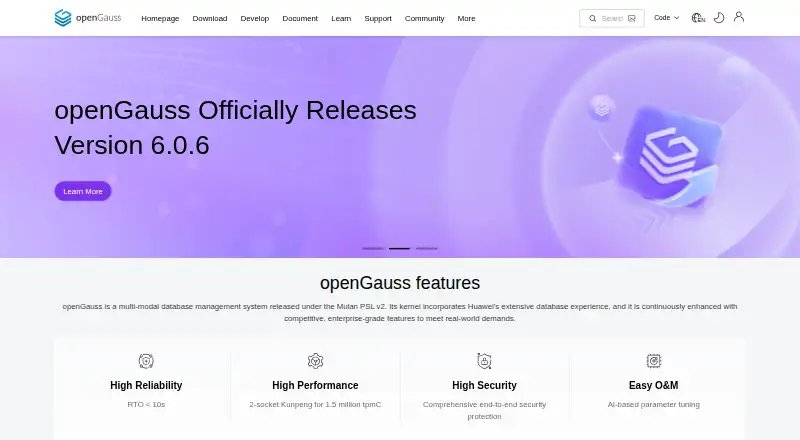
openGauss: A self-hosted Linux database with standby reads, JSONB, partitioning and recovery tools. Ranked #30 of 37 in Relational Databases by our editors (6.5/10); pricing: Free plan; best for linux teams wanting a free PostgreSQL-style server.
At a glance
- Editor score6.5 / 10
- PricingFree plan
- Best forLinux teams wanting a free PostgreSQL-style server
- Free planYes
- Paid fromFree
- Deployment modelSelf_hosted
- Facts checked23 Sep 2026
Where it wins
- Standby nodes support synchronization, switchover and read-only queries.
- JSONB includes operations, functions and indexing.
- Backup and restoration tools include point-in-time recovery.
Where it doesn't
- Deployment and operation are self-hosted rather than vendor-managed.
- Linux is the only listed platform.
- Support channels are community and documentation.
Our verdict on openGauss
For teams that want to operate a relational database on Linux, openGauss is an open-source option for standard SQL workloads, including online transactions and IoT data. It can run standalone or in a primary/standby configuration, and its documented capabilities span row- and column-store models, partitioning, JSONB, backup and recovery. That breadth may suit small teams through enterprise organizations, but the self-hosted model means the team must take responsibility for deployment and operation. It is a less suitable fit for buyers seeking a vendor-hosted database service.
High availability is a notable part of the feature set: primary and standby nodes can synchronize and support switchover, while standby nodes can be configured for read-only queries. The database also supports range, list and hash partitioning, as well as row-store and column-store models. JSONB support includes storage, operations, functions and indexing. This combination is relevant for teams that need relational workloads alongside JSON data or read queries distributed to standby nodes, rather than a database focused on a narrower single use case.
Backup and operational analysis add further depth. Full and incremental backup and restoration tools are documented, along with point-in-time recovery, SQL self-diagnosis and workload analysis reporting. These features make openGauss worth considering for Linux teams comfortable managing database infrastructure and evaluating its documentation and community support channels. Teams that prefer a hosted managed service, or need a platform beyond Linux, should look elsewhere. The published product information describes free, open-source software rather than paid tiers, so buyers should assess the operational effort alongside the absence of a hosted-service option.
Your product? Our editors can test openGauss in depth and publish a review, labelled as paid · from $149/mo →
openGauss pricing
openGauss fact sheet
| Free plan | Yes |
|---|---|
| Paid from | Free |
| Deployment model | Self_hosted |
| Managed service | No |
| High availability | Yes |
| Read replicas | Yes |
| Backup retention | Not verified |
| JSON data support | Yes |
| Maximum connections | Not verified |
| Deployment | Self-hosted |
| Platforms | Linux |
| Support | Community, Docs |
| Built for | Small business, Mid-market, Enterprise (editorial estimate) |
| Pricing | Free plan |
| Website | opengauss.org |
| Facts checked | 23 Sep 2026 |
Alternatives to openGauss
- PostgreSQLA free, extensible relational database for production workloads and technical teams.9.4
- MySQLA versatile open-source SQL database with replication, JSON, connectors, and failover.9.3
- Oracle DatabaseA mature enterprise database with unusually broad data-model and availability capabilities.9.2



See all openGauss alternatives →
Used openGauss? Be the first to review it
The editor score above is our own research. What this page doesn't have yet is a reader's view — what you used openGauss for, what worked and what didn't. No stars are seeded and no review is paid for; an editor reads every one before it appears.
Write a reviewTwo minutes · verified accounts only · read by an editor before it appears
Featured on iTechGuides

openGauss is listed in our Relational Databases directory. Add the badge to your site — it links back to this page.
<a href="https://www.itechguides.com/products/opengauss/"><img src="https://www.itechguides.com/best/badge/opengauss.svg" alt="Featured on iTechGuides" width="230" height="46"></a>
Guides on relational databases
- The Best Distributed Relational Databases: How to ChooseOct 2026
- A Step-by-Step Guide to Creating an RDS (Relational Database Service) in AWS CloudAug 2026
- Disadvantages of a Relational Database: Limitations, Trade-Offs, and AlternativesAug 2026
Reviewed by iTechGuides Editors · Editorial team · Updated Oct 2026
Advertiser disclosure: iTechGuides is reader-supported. Vendors can pay for top positions in our rankings and for a place on other products' pages, and we may earn a commission when you click some links. Bought places stand at the number bought; this page and our disclosure say so. Paying vendors may get a fuller, more detailed review from our editors, and that review can change their score. How we rank.
Last updated · How we research and update