
Google Cloud Load Balancing
Google Cloud Load Balancing: A managed load balancer for global, regional, Layer 4, and Layer 7 traffic. Ranked #2 of 31 in Load Balancing Software by our editors (9.2/10); pricing: Paid; best for global, multi-backend cloud applications.
At a glance
- Editor score9.2 / 10
- PricingPaid
- Best forGlobal, multi-backend cloud applications
- Paid from$0.01/unit usage-based
- Layer 7 routingYes
- Facts checked20 Sep 2026
Where it wins
- Supports global and regional Layer 4 and Layer 7 traffic distribution
- Connects VM, container, serverless, hybrid, and external backends
- Includes TLS termination, health checks, and content-based routing
Where it doesn't
- Usage-based pricing requires tracking forwarding rules and data processing
- Regional data-processing charges can apply beyond forwarding-rule pricing
- A documented 50-backend limit applies to specified backend types per service
Our verdict on Google Cloud Load Balancing
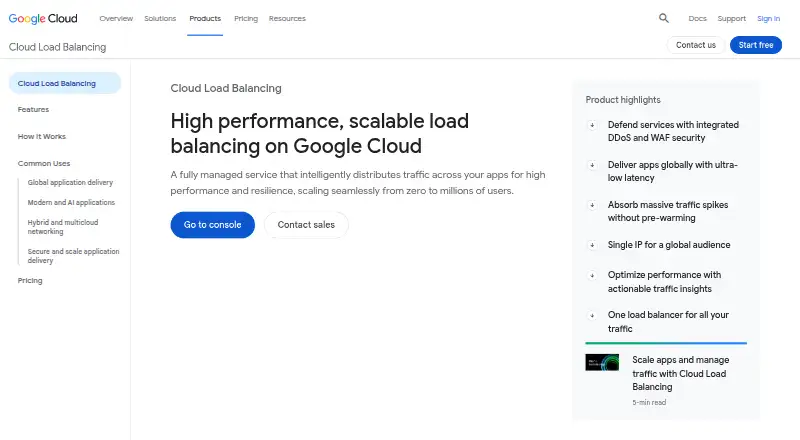
Google Cloud Load Balancing is a fully managed service for distributing application and network traffic across backend resources. It is designed for organizations running scalable, distributed applications across Google Cloud, other public clouds, or on-premises infrastructure. The service supports HTTP(S) Application Load Balancing for Layer 7 routing and Network Load Balancing for Layer 4 TCP, UDP, and TLS traffic. Deployments can be global, regional, external, or internal, making it suited to applications with varied traffic-distribution requirements and backend environments.
Its main strength is breadth across traffic types and infrastructure. Layer 7 content-based routing, Layer 4 balancing, SSL/TLS termination and offload, session affinity, and health checks cover core application delivery needs. Backend support spans virtual machines, containers, serverless resources, hybrid environments, and external services. Traffic logging and monitoring integrations add operational visibility. This makes the product a strong fit when one managed service must handle multiple application architectures rather than a narrowly defined backend setup.
Pricing is usage-based rather than organized into conventional subscription tiers. According to the published plans, the first five global forwarding rules cost $0.025 per forwarding rule per hour, while additional forwarding rules cost $0.01 per additional forwarding rule per hour. Regional data-processing charges and other applicable charges can also apply, so the forwarding-rule rate is only one part of the service cost. The documented 50-backend limit applies to specified backend types per backend service, not universally to every configuration. Choose Google Cloud Load Balancing for globally distributed applications with mixed backends and Layer 4/7 requirements; consider an alternative if you need simple, conventional subscription pricing for a narrower deployment.
Your product? Our editors can test Google Cloud Load Balancing in depth and publish a review, labelled as paid · from $149/mo →
Google Cloud Load Balancing pricing
All 2 Google Cloud Load Balancing plans and prices →
Google Cloud Load Balancing fact sheet
| Free plan | Not verified |
|---|---|
| Paid from | $0.01/unit usage-based |
| Managed service | Yes |
| Layer 7 routing | Yes |
| Layer 4 routing | Yes |
| Global traffic management | Yes |
| TLS termination | Yes |
| Backend limit | 50 backends |
| Deployment | Cloud |
| Platforms | Web |
| Compliance & security | ISO 27001, GDPR |
| Support | Docs |
| Built for | Mid-market, Enterprise (editorial estimate) |
| Pricing | Paid (source) |
| Website | cloud.google.com |
| Facts checked | 20 Sep 2026 |
Alternatives to Google Cloud Load Balancing
- AWS Elastic Load BalancingBroad Layer 4 and Layer 7 load balancing for AWS production environments.9.3
- Alibaba Cloud Server Load BalancerA broad Alibaba Cloud balancing service with Layer 4/7 routing and a low published entry price.9.1
- Cloudflare Load BalancingAffordable global traffic steering with health-based routing, analytics, and failover.9.0



See all Google Cloud Load Balancing alternatives →
Google Cloud Load Balancing vs the competition
- Google Cloud Load Balancing vs AWS Elastic Load Balancing
- Google Cloud Load Balancing vs Alibaba Cloud Server Load Balancer
- Google Cloud Load Balancing vs Cloudflare Load Balancing
- Google Cloud Load Balancing vs Progress Kemp LoadMaster
- Google Cloud Load Balancing vs NGINX Plus
- Google Cloud Load Balancing vs HAProxy Community Edition


Compare Google Cloud Load Balancing with any tool side by side →
Also Ranked In
Google Cloud Load Balancing is ranked in 2 of our directories.
Used Google Cloud Load Balancing? Be the first to review it
The editor score above is our own research. What this page doesn't have yet is a reader's view — what you used Google Cloud Load Balancing for, what worked and what didn't. No stars are seeded and no review is paid for; an editor reads every one before it appears.
Write a reviewTwo minutes · verified accounts only · read by an editor before it appears
Featured on iTechGuides

Google Cloud Load Balancing is listed in our Load Balancing Software directory. Add the badge to your site — it links back to this page.
<a href="https://www.itechguides.com/products/google-cloud-load-balancing/"><img src="https://www.itechguides.com/best/badge/google-cloud-load-balancing.svg" alt="Featured on iTechGuides" width="230" height="46"></a>
Reviewed by iTechGuides Editors · Editorial team · Updated Oct 2026
Advertiser disclosure: iTechGuides is reader-supported. Vendors can pay for top positions in our rankings and for a place on other products' pages, and we may earn a commission when you click some links. Bought places stand at the number bought; this page and our disclosure say so. Paying vendors may get a fuller, more detailed review from our editors, and that review can change their score. How we rank.
Last updated · How we research and update