FIR (Fast Incident Response)
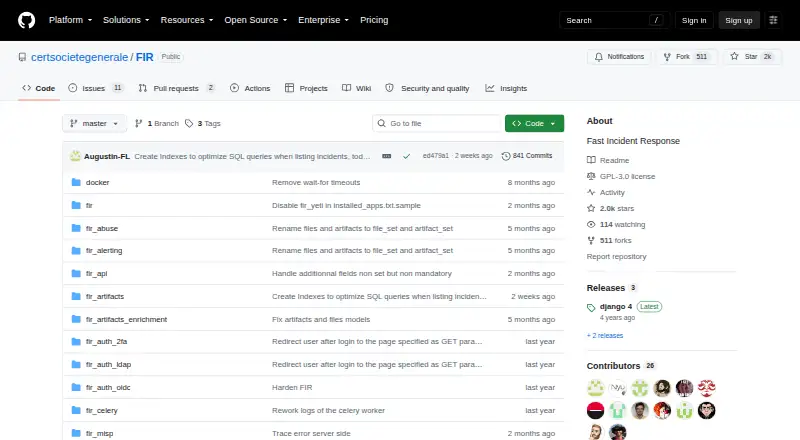
FIR (Fast Incident Response): A self-hosted incident record system built for documenting cybersecurity investigations. Ranked #27 of 28 in Incident Management Software by our editors (6.3/10); pricing: Open source; best for self-hosted security incident documentation.
At a glance
- Editor score6.3 / 10
- PricingOpen source
- Best forSelf-hosted security incident documentation
- Paid fromFree
- Facts checked19 Sep 2026
Where it wins
- Configurable incident fields cover severity, status, detection, and remediation.
- Separate timelines capture incident activity and technical investigation evidence.
- Artifact extraction, metadata search, and printable follow-up reports aid documentation.
Where it doesn't
- Requires self-hosted deployment rather than a SaaS service.
- No documented on-call, escalation, or status-page capabilities.
- No documented mobile app, postmortem workflow, or audit logs.
Our verdict on FIR (Fast Incident Response)
FIR (Fast Incident Response) is an open-source, self-hosted platform for CSIRTs, CERTs, SOCs, and other teams that need to document and manage cybersecurity incidents. It centers on configurable incident records, letting teams capture categories, severity, status, detection, confidentiality, actors, and remediation plans. Its focus is incident documentation and investigation rather than the full operational lifecycle found in broader incident-management systems.
The recordkeeping features are the main reason to consider FIR. Teams can start records from templates, track open, closed, and blocked statuses, add comments, and maintain both an incident timeline and a separate investigation timeline for technical evidence. FIR can extract artifacts such as IP addresses, hostnames, URLs, email addresses, and hashes, while related files and attributes can be attached to incidents. Logical-operator search and metadata filters help locate records; printable follow-up reports are intended for PDF delivery. This combination suits teams that need structured case documentation and evidence context.
Deployment is self-managed: the project is implemented in Python with Django and supports Docker or a production installation. That makes FIR a better fit for teams prepared to operate a self-hosted tool than for organizations seeking a hosted service. Its documented emphasis is on capturing, investigating, finding, and reporting incidents; buyers who need on-call coordination, escalation policies, status pages, mobile apps, postmortem workflows, or audit logs should consider a product centered on those operational needs. Choose FIR when control over deployment and detailed security-incident records matter more than those broader response workflows.
Your product? Our editors can test FIR (Fast Incident Response) in depth and publish a review, labelled as paid · from $149/mo →
FIR (Fast Incident Response) pricing
FIR (Fast Incident Response) fact sheet
| Free plan | Not verified |
|---|---|
| Paid from | Free |
| Escalation policies | Not verified |
| Post-incident reviews | Not verified |
| Status pages | Not verified |
| Mobile apps | Not verified |
| Audit logs | Not verified |
| Incident retention | Not verified |
| Deployment | Cloud, Self-hosted |
| Platforms | Web |
| Pricing | Open source |
| Website | github.com |
| Facts checked | 19 Sep 2026 |
Alternatives to FIR (Fast Incident Response)
- AlertOpsBroad incident response coverage with a free plan and paid tiers from $10 per user monthly.9.4
- PagerDutyPagerDuty routes incidents to on-call responders and coordinates response across teams.9.3
- incident.ioA chat-native incident platform with on-call, workflows, status pages, and postmortems.9.1



See all FIR (Fast Incident Response) alternatives →
Used FIR (Fast Incident Response)? Be the first to review it
The editor score above is our own research. What this page doesn't have yet is a reader's view — what you used FIR (Fast Incident Response) for, what worked and what didn't. No stars are seeded and no review is paid for; an editor reads every one before it appears.
Write a reviewTwo minutes · verified accounts only · read by an editor before it appears
Featured on iTechGuides

FIR (Fast Incident Response) is listed in our Incident Management Software directory. Add the badge to your site — it links back to this page.
<a href="https://www.itechguides.com/products/fir-fast-incident-response/"><img src="https://www.itechguides.com/best/badge/fir-fast-incident-response.svg" alt="Featured on iTechGuides" width="230" height="46"></a>
Reviewed by iTechGuides Editors · Editorial team · Updated Oct 2026
Advertiser disclosure: iTechGuides is reader-supported. Vendors can pay for top positions in our rankings and for a place on other products' pages, and we may earn a commission when you click some links. Bought places stand at the number bought; this page and our disclosure say so. Paying vendors may get a fuller, more detailed review from our editors, and that review can change their score. How we rank.
Last updated · How we research and update