Azure Service Operator
Azure Service Operator: An open-source operator for managing Azure infrastructure through Kubernetes workflows. Ranked #20 of 29 in Infrastructure as Code Tools by our editors (7.3/10); pricing: Open source; best for azure teams standardizing on Kubernetes.
At a glance
- Editor score7.3 / 10
- PricingOpen source
- Best forAzure teams standardizing on Kubernetes
- Paid fromFree
- Configuration languageYaml/json
- Facts checked22 Sep 2026
Where it wins
- Manages more than 150 Azure resource types
- Reconciles declared and actual Azure resource state
- Supports FluxCD, Argo CD, imports, and identity options
Where it doesn't
- Supports Microsoft Azure only
- Requires a self-hosted Kubernetes cluster
- State management and execution remain self-hosted
Our verdict on Azure Service Operator
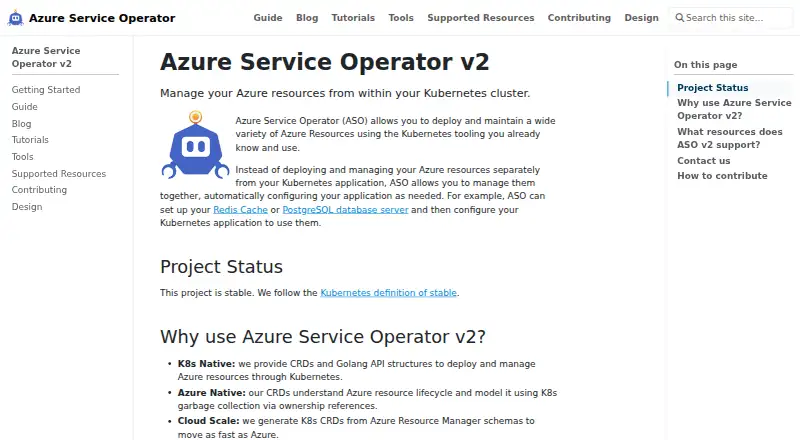
Azure Service Operator is an open-source Kubernetes operator for teams that want to provision and manage Microsoft Azure resources alongside Kubernetes applications. It uses Kubernetes custom resources and kubectl, allowing infrastructure configuration in YAML or JSON and lifecycle ownership through Kubernetes references. The active v2 project supports more than 150 Azure resource types, including Redis Cache and PostgreSQL, making it a fit for Azure-focused platform teams standardizing infrastructure workflows around Kubernetes.
Its central capability is reconciliation: Azure Service Operator compares declared resource configurations with actual Azure state and works to keep them aligned. Teams can import existing Azure resources with asoctl, export Azure-generated values to Kubernetes Secrets or ConfigMaps, and choose among Azure Workload Identity, service principals, and managed identities. Kubernetes, kubectl, Helm, FluxCD, and Argo CD integrations also support GitOps-oriented operating models, particularly where infrastructure and application delivery already share a Kubernetes control plane.
The project is open source, and its execution and state management are self-hosted. That model gives teams a Kubernetes-native way to manage Azure resources, but it also makes a Kubernetes cluster a prerequisite rather than an optional interface. Azure Service Operator is therefore suited to organizations already operating self-hosted Kubernetes and committed to Microsoft Azure. Teams seeking multi-cloud infrastructure coverage or a service that runs without self-hosted Kubernetes should choose a different infrastructure-as-code tool. The current entry describes ASO v2; Azure Service Operator v1 is deprecated and unmaintained.
Your product? Our editors can test Azure Service Operator in depth and publish a review, labelled as paid · from $149/mo →
Azure Service Operator pricing
Azure Service Operator fact sheet
| Free plan | Not verified |
|---|---|
| Paid from | Free |
| Configuration language | Yaml/json |
| Supported clouds | Azure |
| State management | Not verified |
| Policy as code | Not verified |
| Drift detection | Yes |
| Import existing resources | Yes |
| Self-hosted execution | Yes |
| Deployment | Self-hosted |
| Support | Tickets, Community, Docs |
| Built for | Small business, Mid-market, Enterprise (editorial estimate) |
| Integrations | 4 integrations: Kubernetes, kubectl, Helm, Prometheus |
| Pricing | Open source |
| Website | azure.github.io |
| Facts checked | 22 Sep 2026 |
Azure Service Operator integrations
Azure Service Operator lists 4 integrations on its own site.
- Kubernetes
- kubectl
- Helm
- Prometheus
Alternatives to Azure Service Operator
- TerraformA mature multi-cloud IaC platform with broad providers, state management, and governance.9.4
- PulumiA flexible, multi-cloud IaC platform for teams that prefer familiar programming languages.9.2
- OpenTofuA Terraform-compatible foundation for teams managing infrastructure across providers.9.1


See all Azure Service Operator alternatives →
Used Azure Service Operator? Be the first to review it
The editor score above is our own research. What this page doesn't have yet is a reader's view — what you used Azure Service Operator for, what worked and what didn't. No stars are seeded and no review is paid for; an editor reads every one before it appears.
Write a reviewTwo minutes · verified accounts only · read by an editor before it appears
Featured on iTechGuides

Azure Service Operator is listed in our Infrastructure as Code Tools directory. Add the badge to your site — it links back to this page.
<a href="https://www.itechguides.com/products/azure-service-operator/"><img src="https://www.itechguides.com/best/badge/azure-service-operator.svg" alt="Featured on iTechGuides" width="230" height="46"></a>
Reviewed by iTechGuides Editors · Editorial team · Updated Oct 2026
Advertiser disclosure: iTechGuides is reader-supported. Vendors can pay for top positions in our rankings and for a place on other products' pages, and we may earn a commission when you click some links. Bought places stand at the number bought; this page and our disclosure say so. Paying vendors may get a fuller, more detailed review from our editors, and that review can change their score. How we rank.
Last updated · How we research and update