
AWS CloudFormation
AWS CloudFormation: A mature, free AWS-native service for managed stack-based infrastructure automation. Ranked #8 of 29 in Infrastructure as Code Tools by our editors (8.5/10); pricing: Free plan; best for AWS-native infrastructure teams.
At a glance
- Editor score8.5 / 10
- PricingFree plan
- Best forAWS-native infrastructure teams
- Free planYes
- Configuration languageYaml/json
- Founded2006
- Facts checked22 Sep 2026
Where it wins
- Free native AWS resource providers with managed state
- Change sets, drift detection, imports, and rollback support
- StackSets deploy across multiple AWS accounts and Regions
Where it doesn't
- Supports AWS rather than multiple cloud providers
- Provisioning runs in AWS; self-hosted execution is unavailable
- Some third-party providers and custom hooks incur usage-based charges
Our verdict on AWS CloudFormation
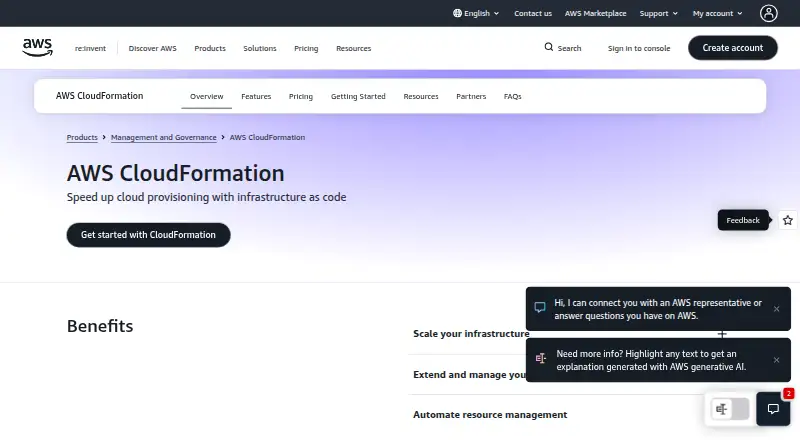
AWS CloudFormation is a managed infrastructure-as-code service for defining, provisioning, updating, and deleting AWS resources as stacks. Teams author declarative templates in YAML or JSON and manage deployments through the AWS Management Console, CLI, or API. It is designed for organizations that standardize on AWS and want stack-based lifecycle management with AWS-native integrations such as IAM, Amazon S3, CloudTrail, the AWS CLI, and AWS SDKs.
The published pricing model is free, and native AWS resource providers have no additional CloudFormation charge. That makes CloudFormation a practical fit for AWS teams that want managed state without a separate product subscription. The service also covers important operational workflows: change sets preview proposed updates, drift detection identifies configuration differences for supported resources, and rollback follows failed stack creation or updates. Template parameters and outputs support reusable deployment patterns, while resource import helps bring existing AWS infrastructure under stack management.
CloudFormation's strongest ecosystem fit is AWS itself. StackSets extend deployments across multiple accounts and Regions, and the CloudFormation Registry supports AWS and third-party resource types. Customers can invoke the service from local tooling, but provisioning operations run in AWS, so it does not suit teams that require self-hosted execution. CloudFormation also supports policy as code, although the listed feature set is most focused on provisioning and lifecycle management rather than a broader multicloud workflow. Choose it for AWS-centered infrastructure teams seeking a free, managed service with mature deployment controls; consider an alternative if AWS-only support or AWS-hosted execution conflicts with your operating model.
Your product? Our editors can test AWS CloudFormation in depth and publish a review, labelled as paid · from $149/mo →
AWS CloudFormation pricing
AWS CloudFormation fact sheet
| Free plan | Yes |
|---|---|
| Paid from | Not verified |
| Configuration language | Yaml/json |
| Supported clouds | AWS |
| State management | Managed |
| Policy as code | Yes |
| Drift detection | Yes |
| Import existing resources | Yes |
| Self-hosted execution | Yes |
| Deployment | Cloud |
| Platforms | Web, Windows, macOS, Linux |
| Support | Docs |
| Built for | Small business, Mid-market, Enterprise (editorial estimate) |
| Integrations | 7 integrations: AWS services, AWS CloudFormation Registry, AWS Cloud Development Kit, AWS CLI, AWS SDKs, AWS Tools for PowerShell … |
| Pricing | Free plan (source) |
| Website | aws.amazon.com |
| Facts checked | 22 Sep 2026 |
AWS CloudFormation integrations
AWS CloudFormation lists 7 integrations on its own site.
- AWS services
- AWS CloudFormation Registry
- AWS Cloud Development Kit
- AWS CLI
- AWS SDKs
- AWS Tools for PowerShell
- Git repositories
Alternatives to AWS CloudFormation
- TerraformA mature multi-cloud IaC platform with broad providers, state management, and governance.9.4
- PulumiA flexible, multi-cloud IaC platform for teams that prefer familiar programming languages.9.2
- OpenTofuA Terraform-compatible foundation for teams managing infrastructure across providers.9.1


See all AWS CloudFormation alternatives →
AWS CloudFormation vs the competition
- AWS CloudFormation vs Terraform
- AWS CloudFormation vs Pulumi
- AWS CloudFormation vs OpenTofu
- AWS CloudFormation vs env zero
- AWS CloudFormation vs Spacelift
- AWS CloudFormation vs Scalr



Compare AWS CloudFormation with any tool side by side →
Also Ranked In
AWS CloudFormation is ranked in 8 of our directories; the 6 strongest besides Infrastructure as Code Tools.
- #1Orchestration / Provisioning Software29 tools ranked
- #2Infrastructure Automation25 tools ranked
- #6Infrastructure Testing Tools28 tools ranked
- #8IT Configuration Management Software26 tools ranked
- #12Infrastructure Policy as Code Tools25 tools ranked
- #12Infrastructure as Code Security Software22 tools ranked
Used AWS CloudFormation? Be the first to review it
The editor score above is our own research. What this page doesn't have yet is a reader's view — what you used AWS CloudFormation for, what worked and what didn't. No stars are seeded and no review is paid for; an editor reads every one before it appears.
Write a reviewTwo minutes · verified accounts only · read by an editor before it appears
Featured on iTechGuides

AWS CloudFormation is listed in our Infrastructure as Code Tools directory. Add the badge to your site — it links back to this page.
<a href="https://www.itechguides.com/products/aws-cloudformation/"><img src="https://www.itechguides.com/best/badge/aws-cloudformation.svg" alt="Featured on iTechGuides" width="230" height="46"></a>
Reviewed by iTechGuides Editors · Editorial team · Updated Oct 2026
Advertiser disclosure: iTechGuides is reader-supported. Vendors can pay for top positions in our rankings and for a place on other products' pages, and we may earn a commission when you click some links. Bought places stand at the number bought; this page and our disclosure say so. Paying vendors may get a fuller, more detailed review from our editors, and that review can change their score. How we rank.
Last updated · How we research and update