
Do these 3 things before closing this tab:
1Clear out junk files and repair common Windows errors2Fix the driver behind crashes, sound loss and screen glitches3Repair Windows errors before they cause bigger problemsA lunar crater is excavated by an impact; a lunar pit is a steep-walled opening or depression that may form when material above a subsurface void collapses. They can look similar in images, and some pits occur in impact settings, so shape alone cannot settle the difference. Look at formation clues, rim and ejecta, wall and floor visibility, and geologic setting together.
What is the difference between a lunar pit and a crater?
| Clue | Impact crater | Lunar pit |
|---|---|---|
| What the name describes | A feature formed by an asteroid, meteoroid, or comet striking the Moon and excavating material. The crater can be modified after the impact. | A steep-walled opening or depression; “pit” describes its shape, not a proven cause or cave connection. |
| Common visible clues | Often has a rim, a bowl-like or modified interior, and surrounding ejecta thrown out by the impact. Larger craters may be relatively wide and shallow. | May have steep walls, an overhang, or a dark opening where the floor is difficult to see. |
| What the clue establishes | A rim or ejecta can support an impact interpretation, but appearance and later modification matter. | A visible opening may suggest collapse or a void below, but an image alone may not establish how it formed or what lies beneath it. |
These are useful tendencies, not a strict either-or test. A pit can occur in an impact-related setting, and a feature’s lighting and scale can change how its walls and floor appear. NASA’s overview of lunar craters describes impact excavation and ejecta; NASA’s 2014 account of lunar pits describes their steep walls and the limits of interpreting images alone.
How do lunar pits form?
One proposed route is collapse: a roof over a subsurface void gives way, leaving a steep-sided opening. Some such openings may be skylights into former lava channels, but the label “pit” does not prove that origin. NASA planetary scientist David Kring describes skylights as holes broken into or punched through the roofs of subsurface channels of once-flowing lava, and calls pits related collapsed features in NASA’s Gravity Assist episode on lunar craters.
There is also an important complication: pit-like features occur in impact-cratering provinces where impact melt flowed. A pit in such a setting should not automatically be explained as volcanic or as a lava-tube entrance. NASA researcher Robert Wagner noted that images alone offered little evidence for the cause of an individual observed pit. The geological context and additional measurements matter.
Windows Errors? Fix Them Before They Spread
Repair common Windows errors and clear accumulated junk for a smoother, more stable PC - no reinstall needed.Free scan · no reinstallCrashes, No Sound, or Screen Glitches?
Random freezes, missing sound and display glitches usually trace back to one bad driver. Find and replace yours safely.Free scan · under a minute#1 Best Overall

- Globe diam. 20 cm (c. 7.9 inches), Base width 16.4 cm (c. 6.4 inches), Height 30 cm (c. 11.8 inches)
- Moon Globe Lamp
- Night Light, Touch Switch
Do Moon pits lead to caves?
Some may connect to subsurface spaces, but a dark opening or overhang in a photograph is not enough to confirm a cave. Radar evidence provides stronger support at one named site: in 2024, NASA reported that radar signals extended more than 200 feet from the base of the Mare Tranquillitatis pit. The full extent of the cave was unknown in that report. This finding supports a subsurface extension at that location; it does not establish that every lunar pit opens into a cave. See NASA’s report on the Mare Tranquillitatis pit.
What the measurements say—and what they do not
Size and count in NASA’s 2014 report
NASA’s 2014 account reported more than 200 pits, ranging from about 5 metres across to more than 900 metres in diameter. Its search covered only about 40% of the Moon under suitable lighting conditions at the time, so those figures describe a partial, historic inventory—not a complete census or a current 2026 count.
Rank #2

- Great way for students to learn about the moon and the Apollo 11 mission
- This special edition National Geographic Moon Globe has a rechargeable LED device with long lasting LED bulbs
- 750 Moon topographic locations
- Includes impact craters, mountain ranges, highlands, seas, rays
Temperature at Mare Tranquillitatis
NASA’s 2022 report found that shaded reaches within the studied Mare Tranquillitatis pit stayed around 63°F (about 17°C) in the reported observations and modelling. That result is specific to shaded areas of that pit; it is not a general temperature for lunar pits or caves. NASA explains the finding in its 2022 thermal study report.
Independent reader supportYour contribution helps us test, update, and keep practical guides available for everyone.A practical way to assess a lunar image
- Look for impact evidence. A raised rim, bowl-like interior, and ejecta around a depression support an impact-crater interpretation, though later modification can alter these features.
- Check for an opening. Steep walls, a visible overhang, or a floor hidden in shadow are clues to a pit-like morphology, not proof of a cave.
- Consider the setting. A feature in a maria or an impact-melt area may have different plausible explanations. Setting informs interpretation but does not diagnose the cause by itself.
- Ask what data support a subsurface void. Images can show surface shape; radar evidence, as reported at Mare Tranquillitatis, can support an extension below the surface.
- Account for lighting and scale. Shadows can conceal floors or exaggerate apparent wall steepness, so avoid classifying a feature from one silhouette alone.
For a casual lunar viewing note, NASA planetary scientist David Kring says Tycho and its rays are visible with binoculars. That observation concerns a prominent crater and its rays; it is not evidence that binoculars resolve lunar pits.
Quick wins for a faster PC:
Fix the driver behind crashes, sound loss and screen glitchesFind Drivers →Repair Windows errors before they cause bigger problemsFix Now →Scan for outdated or missing drivers - takes under a minuteDriver Scan →Quick Recap
Rank #4
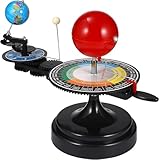
- 【Solar System】: DIY your own sun earth moon orbital rotation model with this creative kit. Seasonal plate that shows the names, order, and dates of the four seasons and the twenty-four solar terms in the traditional Chinese calendar. night, seasons, solar eclipse, lunar eclipse and moon phases .
- 【Usage Scenarios】: Great for Geology & Earth Sciences Teaching, School project also Great gift for your children over 6 years old, it cultivates children's interest in space science. Earth orbiting around the sun, and moon orbiting around the earth showing planetary orbit.
- 【To Demonstrate Seasons and Solar and Lunar Eclipses】: 1)Rotate the Earth to show how the Earth's rotation and orbit around the Sun create seasons; 2)To demonstrate a solar eclipse, move the Moon between the Earth and the Sun, blocking the Sun's light and casting a shadow on the Earth; 3)To demonstrate a lunar eclipse, move the Moon into the Earth's shadow, creating a tint on the Moon.
- 【Easy to Assemble 】: Updated Instruction 1)Wrench the connecting nut to the seasonal plate; 2) Insert the axe to the slot, put the two screws to the corresponding holes, then tighten the screws; 3) Get the “solar system” aligned correctly: Set the handle with the pointer on the summer solstice, adjust the position of the Earth so that the sun shines directly on its Tropic of Cancer; 4)Assemble the gears upper and underneath with the black peg;Put the sun’s metal wire in the hole on the lever.
- 【Size Information】100% brand new and high quality. Size(LxWxH): Approx. 38 x 20 x 28 cm / 15.20 x 7.87 x 11.02 inch.
Rank #3
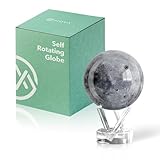
- Realistic Lunar Detail with Cratered Surface — A faithful recreation of the Moon’s rugged topography, this design shows lunar craters, valleys, and maria as seen from Earth’s orbit.
- Solar-Powered Motion – No Wires or Batteries — This MOVA Globe rotates continuously using only ambient light and the Earth’s magnetic field. No fuss, no noise, no cables.
- Compact Display Piece with Stunning Presence — At 4.5 inches across, it fits perfectly on desks, nightstands, or bookshelves. A small globe that sparks big conversation.
- Premium Build with Seamless Movement — A fluid-suspended inner globe rotates within a clear acrylic outer shell, offering a smooth, almost magical visual experience.
- Inspire Curiosity and Wonder — Perfect for stargazers, space buffs, students, and science enthusiasts. A gift that celebrates Earth’s constant lunar companion.
Product prices and availability are accurate as of the date/time indicated and are subject to change. Any price and availability information displayed on Amazon at the time of purchase will apply.

