
To control HVAC with weather data and avoid cloud APIs, collect observations from a weather station or sensors on your local network, process them with a local controller such as Home Assistant, and send commands through an HVAC interface that also works locally. A forecast service that needs no account can still depend on the cloud, so first decide whether you mean “no API key” or “no internet connection.”
What counts as local weather data?
There are two different setups that are often described as “local weather.” A weather station at your property measures current conditions and sends observations over your LAN. A forecast service downloads predictions from the internet, even if your controller later stores or uses them locally. Only the first avoids relying on a remote weather API.
Home Assistant’s WeatherFlow integration reads data directly from compatible Tempest stations over UDP on the local network. Its documented local setup requires Home Assistant and the station to be on the same subnet. The separate WeatherFlow Cloud integration is not the local option. Home Assistant WeatherFlow integration
By contrast, Home Assistant’s Open-Meteo integration provides current conditions and hourly and daily forecasts without an account or API key, but it polls the online service every 30 minutes. It requires internet access and may become unavailable if the service cannot be reached. That can satisfy “no credentials,” but not “no cloud APIs.” Home Assistant Open-Meteo integration
Free tools Windows power users keep installed
One-click scans. No signup required.
#1 Best Overall
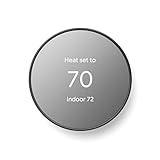
- ENERGY STAR certified smart thermostat for home that helps you save energy and stay comfortable.Connectivity : Wi-Fi - 802.11b/g/n 2.4 GHz, 802.11a/n 5 GHz Wi-Fi., Wireless interconnect : Bluetooth Low Energy Please refer to the product description section below for all applicable legal disclaimers.Product note: You can also check your system’s compatibility before purchasing a Nest thermostat with our online Nest Compatibility Checker on the Google Nest support page
- The Nest Thermostat is designed to work without a C wire in most homes, but for some systems, including heating only, cooling only, zone controlled, and heat pump systems, you’ll need a C wire or other compatible power accessory
- Nest Thermostat turns itself down when you leave, so you don’t waste energy heating or cooling an empty home. Lock feature: No
- Programmable thermostat that lets you create an energy efficient schedule in the Google Home app on your Android or iPhone
- Remote control lets family members change the thermostat temperature from anywhere on a phone, laptop, or tablet[1]
How do I control my thermostat with local weather data?
- Choose the data source. For local outdoor observations, use a compatible station such as a Tempest device supported by WeatherFlow’s local Home Assistant integration. You can also bring locally measured values into Home Assistant through its sensor integrations or MQTT. Treat these as observations, not forecasts.
- Verify the path into the controller. For WeatherFlow, confirm that the station and Home Assistant share a subnet and that local UDP traffic can pass between them. For MQTT, confirm that the sensor publishes the expected payloads and that the broker and devices are reachable locally.
- Verify the local HVAC command path. Home Assistant climate actions can set a target temperature or HVAC mode, but the available controls depend on the thermostat. Check the specific device’s supported modes and actions before building an automation around them. Home Assistant Climate documentation
- Make weather a bounded input. Use a modest adjustment or enable/disable condition rather than letting an outdoor reading override the thermostat without limits. Set boundaries and a deadband or hysteresis so small sensor fluctuations do not repeatedly change the target. These are prudent design choices, not a universal safe setpoint rule.
- Define a fallback and test it. Decide what happens if the sensor is missing or stale, MQTT stops, the station loses network access, or an HVAC command is not acknowledged. A sensible fallback is to return to the thermostat’s ordinary schedule rather than continue acting on old data.
Which Home Assistant components can stay local?
| Component | Role | Local behavior and constraint |
|---|---|---|
| WeatherFlow integration | Reads observations from compatible Tempest stations | Documented local-only integration using UDP; the station and Home Assistant need to share a subnet. Source |
| MQTT sensor | Turns published message payloads into sensor values | Can operate over a local broker. A retained message supplies the last value immediately, but that value may be old; without retention, the initial state is undefined. Track availability and freshness as well as the reading. Source |
| Climate actions | Sets a supported thermostat target or mode | Available state and actions depend on the thermostat integration and device. Source |
| MQTT Climate | Sends HVAC commands and reads state through MQTT | Marked Local Polling, but the HVAC device or a local gateway must support the configured command and state topics. It does not make an arbitrary thermostat MQTT-compatible. Source |
| Template weather | Represents supplied values as a Home Assistant weather entity | Can structure template-provided values, including temperature and forecast fields; it does not generate a forecast from current sensor readings. Source |
| Home Assistant REST API | Provides an interface to Home Assistant, including weather forecast retrieval | It exposes data available in Home Assistant; it does not supply weather data itself. Source |
Does Open-Meteo work without an API key, and is it really local?
It works without an account or API key in the Home Assistant integration, but it is not local-only: Home Assistant polls Open-Meteo online every 30 minutes. Use it when avoiding credentials is enough. If your requirement is that weather control continue without internet access, choose a local station or local sensors instead.
Can MQTT control my HVAC if the internet is down?
It can, provided the MQTT broker, controller, and HVAC device or gateway remain reachable on the local network and the equipment supports the required command and state topics. Home Assistant’s MQTT Climate integration is a local-polling option, but topic names, payloads, and supported features depend on the device and configuration. Test the actual local command and state path; MQTT alone does not add local control to equipment that lacks it.
Rank #2

- An Alexa thermostat - Amazon Smart Thermostat is an easy way to switch from a traditional thermostats for homes and help reduce energy usage.
- Create comfort zones throughout your home by connecting to select Alexa devices to automatically adjust heating and cooling based on temperature readings or presence detection.
- Save money and energy - After purchase, Amazon will send you an email with details about home thermostat rebates that may be available from energy providers in your area.
- Save energy - According to EPA estimates, ENERGY STAR certified thermostats save an average of $90 on yearly energy bills.
- Programmable thermostat and automatic control - Create your own home, away and sleep schedules, or have Alexa automatically control the temperature with Alexa+ advanced features.
What happens when a weather sensor is unavailable?
Do not assume a displayed value is current just because it exists. An MQTT sensor configured to retain the last message can start with that value, while a non-retained sensor has an undefined initial state. Record or expose update time and availability, then prevent automation from changing HVAC settings when the value is unavailable or older than your chosen freshness limit. Test that behavior by disconnecting the sensor or broker and confirming that normal thermostat control resumes.
Quick Recap
Rank #4

- EASY DIY INSTALLATION: Do it yourself fast with a built-in level and simple step-by-step instructions. Works with the HVAC equipment found in most homes
- COMMON WIRE REQUIREMENTS: Common wire(C-Wire) required for heat pump and heat/cool only systems. C-wire not required on most systems
- SAVE ABOUT 23% ON HVAC ENERGY: ENERGY STAR-certified and packed with features that help you save money, including flexible scheduling, geofencing, remote access and usage reports
- PRIVACY PROTECTION: Sensi won’t sell your personal information to third parties or leverage your thermostat activity data for targeting or advertising purposes
- CONTROL FROM ANYWHERE: The top-rated mobile app for Android and iOS devices makes it easy to control your comfort from a smartphone or tablet
Rank #3

- Save up to 23% every year on heating and cooling costs, adjusts to your set schedule to save energy when you’re gone and optimize comfort when you’re home. Compared to a hold of 72
- Compatible with 85% of systems, check your system’s compatibility with our online ecobee Compatibility Checker on the ecobee support page
- Change your temperature by easily tapping the color touchscreen or using the ecobee app. Plus, free software upgrades ensure you get the best out of your Smart Thermostat Essential, for years to come
- Automatically adjusts to your set schedule to save energy when you’re gone and optimize comfort when you’re home. Keep track of your energy consumption when you're on the go on the ecobee app
- Easy DIY install. No C Wire, no problem. Get the ecobee Power Extender Kit (PEK) for homes without a C-Wire and keep your walls looking nice with our trim kit – both sold separately
What to check before relying on weather-based HVAC control
- Are you avoiding API credentials, or all internet dependency?
- Is the input a measured observation or an actual forecast?
- Can the controller reach the weather source and HVAC interface locally?
- Does the sensor report freshness and availability, not just a temperature value?
- Does the thermostat support the precise mode or setpoint action you plan to use?
- Has the automation been tested for stale data, lost network access, and failed commands?
Product prices and availability are accurate as of the date/time indicated and are subject to change. Any price and availability information displayed on Amazon at the time of purchase will apply.
Recommended Free Tools

