
Quick wins for a faster PC:
Repair Windows errors before they cause bigger problemsFix Now →Fix the driver behind crashes, sound loss and screen glitchesFind Drivers →Set up an AI data loss prevention (DLP) policy by first deciding which information must be protected and where people use AI, then choosing detection and response rules for those workflows. Start with audit or simulation, review real matches, pilot the tuned policy, and expand enforcement only when the operational impact is understood. Microsoft Purview provides one implementation path; its features and prerequisites depend on your tenant, supported apps, integrations, permissions, and licensing.
1. Define the policy’s purpose and scope
Write down the risk you want to reduce before creating a product policy. For example, you may want to prevent customer records, credentials, regulated personal information, or confidential business content from being submitted to an AI service that is not approved to receive it.


For each data class, decide what handling is acceptable. A data type might be permitted in an approved enterprise AI service but prohibited in an unmanaged public tool. Involve security, privacy, legal, compliance, and the business teams whose work could be affected. Microsoft’s DLP overview recommends identifying stakeholders, sensitive information categories, and policy goals before implementation: Learn about data loss prevention.
2. Map AI applications and data paths
Build an inventory of the AI services people use and how they reach them. Include sanctioned enterprise services, third-party AI websites, custom applications, browser use, endpoint workflows, and tools used by higher-risk teams. Classify each service as allowed, allowed with restrictions, monitored, or blocked for the relevant data types.
#1 Best Overall
Do not assume one policy location covers every route. In Microsoft Purview, enterprise application and device policies are distinct from inline web-traffic controls. The unmanaged-AI network scenario requires an integrated, supported SASE or secure browser provider; endpoint visibility alone should not be treated as proof that every network path or application is covered. See Microsoft’s overview of DLP locations and its guidance for Network Data Security and unmanaged AI.
Record the intended users, devices, locations, applications, and data classes for each policy. This makes gaps visible before enforcement and helps keep an otherwise broad policy from affecting unrelated teams or workflows.
3. Choose detection criteria and responses
Decide how the policy will recognize protected information. Depending on your environment, that may involve sensitive information types, sensitivity labels, or custom rules. Define a response for each meaningful risk level rather than making every detected match an automatic block.
- Audit: record activity for review without interrupting the workflow.
- Notify or show a policy tip: explain the applicable handling rule to the user where supported.
- Warn or restrict: give users a chance to reconsider or limit the risky action, if the platform and location support it.
- Block: prevent the action when the data and destination combination warrants it and the likely business impact is acceptable.
Exact actions vary by platform, policy location, and deployment. Microsoft’s DLP policy reference describes policy templates, scope, rules, and platform constraints. It lists a limit of 600 DLP rules per tenant; that is a platform limit, not a recommended target for policy design.
Rank #3
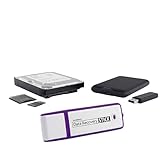
- The Data Recovery Stick requires no technical skills — simply plug it into your Windows computer, click Start, and the software automatically begins scanning and recovering lost files within minutes. Compatible with Windows Vista, 7, 8, 10, & 11, it's designed to be a reliable first step when accidental deletion occurs.
- Recover photos (JPG, BMP, PNG, TIFF), Microsoft Office documents (Word, Excel, PowerPoint, Publisher, Access), Open Office files, MP3 music files, PDFs, RTF documents, AutoCAD files, and HTML web pages. Whether it's personal memories or critical business files, the Data Recovery Stick covers the file types that matter most.
- Works with hard drives, USB drives, SD cards, memory sticks, and other common storage formats that use FAT or NTFS file systems — making it a single solution for hard drive recovery, USB drive recovery, SD card recovery, and more. Note: a media reader is required for micro SD cards and some mass storage devices.
- No Installation Required - The Data Recovery Stick runs entirely from the USB drive with no software installation on your computer — helping prevent new data from overwriting the files you're trying to recover. This also makes it ideal for use across multiple computers or in emergency situations where installation isn't practical.
- Use the Data Recovery Stick on as many computers as often as needed — simply clear the recovered data between uses to free up storage space. Software updates keep the tool compatible with newer systems and devices, backed by 25+ years of data software expertise from Paraben Consumer Software.
4. Check prerequisites and confirm what will be visible
Before relying on a policy or its investigation data, verify the required roles and permissions, audit configuration, device onboarding, label setup, and any network or browser-provider integration. Confirm the licensing and supported locations for your tenant in current vendor documentation; availability can differ by solution and deployment.
If investigators need AI prompts and responses, verify that the relevant collection configuration and content-capture setting are enabled. Collection requirements vary, and captured content may not appear if the necessary setting is not selected. Microsoft documents setup considerations for Data Security Posture Management, including configuration-dependent AI interaction visibility. Test the specific events and content your team expects to investigate before treating them as available evidence.
Rank #4
5. Start in audit or simulation and tune the policy
Choose a low-impact initial state that still provides evidence about how the rules behave. In Microsoft Purview, simulation can help estimate impact before you apply actions that interrupt work. Review matches, affected users, legitimate business tasks, and false positives, then adjust data conditions, exclusions, scope, notifications, or actions.
Make tuning decisions with the teams that own the workflows. A match may indicate a genuine disclosure risk, a rule that is too broad, or a legitimate use that needs a defined exception. Keep the rule understandable enough that policy owners can explain why it matched and what the user should do next. Microsoft’s policy deployment guidance recommends simulation and incremental adjustments to scope, state, and actions.
Do these 3 things before closing this tab:
1Fix the driver behind crashes, sound loss and screen glitches2Clear out junk files and repair common Windows errors3Scan for outdated or missing drivers - takes under a minuteBest Value
![Express Rip Free CD Ripper Software - Extract Audio in Perfect Digital Quality [PC Download]](https://m.media-amazon.com/images/I/41xx28xHa+L._SL160_.jpg)
- Perfect quality CD digital audio extraction (ripping)
- Fastest CD Ripper available
- Extract audio from CDs to wav or Mp3
- Extract many other file formats including wma, m4q, aac, aiff, cda and more
- Extract many other file formats including wma, m4q, aac, aiff, cda and more
6. Pilot with users before broader enforcement
Apply the tuned policy to a representative pilot group that includes relevant roles and workflows. Tell participants what is monitored, what a policy tip or warning means, and how to report a legitimate task that is blocked or flagged. Use the pilot to test whether users understand the guidance and whether exceptions are being handled consistently.
After reviewing the pilot, expand coverage in stages to the intended users and locations. Move to more restrictive actions only when policy owners accept the expected operational impact. Maintain an exception and review process so that business needs can be addressed without silently weakening the policy for everyone.
7. Monitor outcomes and keep the policy current
Set a regular review cadence for policy matches, alerts, audit data, incidents, overrides, and user feedback. Check both sides of the outcome: whether the policy detects the intended risky activity and whether it disrupts legitimate work. Adjust the policy when evidence shows that detection, scope, or user guidance needs improvement.
In Purview, Microsoft describes Activity Explorer and DSPM reporting paths for relevant AI and network activity, but the events and content available depend on product configuration. Confirm which views are populated in your environment before relying on them for incident response. Revisit the inventory and rules when teams adopt new AI tools or workflows.
What’s actually slowing this PC down?
Pick the symptom - the matching free tool is one click away.
How to place AI DLP in a broader risk program
An AI DLP policy is one operational control, not a complete AI governance program. NIST’s AI Risk Management Framework is voluntary guidance for managing AI risks, not a turnkey DLP configuration. NIST released AI RMF 1.0 on January 26, 2023, and published its Generative AI Profile on July 26, 2024. These resources can help frame broader risk-management work alongside the specific data-handling controls your organization chooses: NIST AI Risk Management Framework and NIST Generative AI Profile publication record.
Quick Recap
Product prices and availability are accurate as of the date/time indicated and are subject to change. Any price and availability information displayed on Amazon at the time of purchase will apply.

