
The Tool Desk
Outbyte PC Repair FREERepair Windows errors before they cause bigger problemsFix Now →Outbyte Driver Updater FREEScan for outdated or missing drivers - takes under a minuteDriver Scan →iTechGuides is reader-supported. When you buy through links on our site, we may earn an affiliate commission. As an Amazon Associate I earn from qualifying purchases. Learn more
Build one traceable record set for every GSTIN and financial year, then connect each filed return to its tax ledgers, invoices, payment evidence, stock records, and reconciliation notes. Under India’s Central Goods and Services Tax (CGST) framework, your records must let an auditor verify turnover, tax paid, refunds, input tax credit (ITC), and compliance. This guide gives a practical filing system based on the CGST Act and Rules, while distinguishing legal requirements from recommended office procedures. State GST provisions, your registration category, business activity, and the wording of an audit notice can add requirements, so check amendments in force for the tax period under review.
What does a GST audit actually verify?
Indian GST audit work is fundamentally a verification exercise, not a request for a particular brand of accounting software or a single prescribed folder layout. The CGST Act defines audit as examination of records, returns, and other documents to verify the correctness of turnover declared, taxes paid, refunds claimed, ITC availed, and compliance with the Act and Rules.
That definition means an auditor should be able to move in both directions: from a figure on a return to the underlying ledger and source document, and from an invoice, receipt, credit note, or stock movement to the return in which it was reported. Your filing system should make that trail possible without reconstructing it from emails or personal memory.
Why organization matters
- Completeness: all required account categories and source documents are present.
- Accuracy: return totals agree with sales, purchase, tax, and payment ledgers.
- Traceability: every material number can be tied to a document, transaction, and tax period.
- Availability: records can be produced in readable form when requested.
- Integrity: original documents and later corrections are distinguishable, with an explanation for each adjustment.
Which GST records must a registered person maintain?
Section 35 of the CGST Act requires true and correct accounts. The core account set covers production or manufacture, inward and outward supplies, stock, ITC availed, and output tax payable and paid, along with prescribed particulars. Accounts for each registered place of business are addressed in the section, and electronic records are permitted subject to the Rules.
#1 Best Overall

- AN EASY & EFFICIENT WAY TO CONTROL YOUR FINANCES: Created for both small business and personal use, this horizontal accounting ledger book has spacious pages to log payments and deposits, so that you can monitor your finances and spot errors easily.
- LARGE FORMAT LEDGER WITH PLENTY OF WRITING SPACE: This accounting book ledger comes in a large format, measures 10 by 7 inches, and has 129 pages with 3,100 entry lines total.
- TRACK ACTIVITY IN MULTIPLE ACCOUNTS WITH JUST ONE BOOK: This accounting log book will be perfect if you want to track activity in multiple accounts. To do so, use the dedicated column to add the bank account number every time you make a record.
- PREMIUM DESIGN FOR COMFORTABLE DAILY USE: This accounting journal book has a durable eco-leather hardcover, thick 120gsm paper, sturdy elastic closure, pen loop, ribbon bookmark, and back pocket for extra notes, checks, and receipts.
- 60-DAY MONEY-BACK GUARANTEE: We will exchange or refund your small business log book if you aren’t satisfied with your business bookkeeping ledger for any reason. Reach out to us via message to refund your monthly accounting ledger book.
| Record area | What to retain or be able to explain | Typical audit link |
|---|---|---|
| Outward supplies | Sales invoices, bills of supply where applicable, exports, delivery evidence, credit and debit notes, and the sales ledger | Reported turnover, output tax, and amendments in returns |
| Inward supplies and ITC | Purchase invoices, import documents, reverse-charge records, supplier details, receipt evidence, and ITC workings | Eligibility and amount of ITC claimed |
| Stock | Opening balance, receipts, issues or sales, closing balance, and records of losses, write-offs, gifts, or free samples where relevant | Quantity and value movements compared with supplies and purchases |
| Tax control | Tax payable, tax collected, tax paid, electronic liability and cash/credit ledger evidence, and payment references | Whether the liability declared was paid correctly and on time |
| Documents and adjustments | Registers of tax invoices, credit notes, debit notes, delivery challans, advances, refunds, and adjustment explanations | Document sequence, corrections, and timing of reported transactions |
| Locations and custodians | Records for the principal place and additional places of business, plus details of premises where goods are stored | Whether records and stock can be accessed for each relevant location |
Rule 56 of the CGST Rules expands the practical detail. It refers to invoices and bills of supply, delivery challans, credit and debit notes, relevant receipt, payment and refund vouchers, tax details, and registers for invoices and other prescribed documents. It also addresses imports and exports, reverse-charge supplies, advances, stock details, tax payable or collected or paid, ITC and credit, supplier and customer identities, and goods-storage premises where applicable.
How long must GST records be kept?
Section 36 sets the baseline at 72 months from the due date for furnishing the annual return for the year to which the records relate. This is not automatically six calendar years from an invoice date. Calculate the period by reference to the relevant annual-return due date and the tax year.
When the period can be longer
If an appeal, revision, proceeding, or investigation concerning the records is pending, section 36 extends retention for the relevant subject matter until one year after final disposal or the ordinary 72-month period, whichever is later. Preserve the affected files until the matter is formally closed and the later date has passed.
A retention register you can use
Maintain a small schedule with the financial year, annual-return due date, ordinary destruction date, any notice or proceeding reference, final-disposal date, and revised destruction date. This prevents automatic deletion while a dispute or investigation is still open. Confirm amendments and the exact annual-return due date applicable to the tax period before applying the schedule.
How should I structure folders and ledgers for an audit?
A consistent hierarchy is a practical recommendation, not a government-mandated naming convention. The following layout keeps statutory records together while making retrieval predictable.
- Create a top-level folder for each GSTIN. Do not combine records for different registrations merely because the legal entity is the same.
- Inside each GSTIN, create one folder for each financial year. Use an unambiguous year format, and retain a short text file identifying the legal entity, registration state, principal place, and additional places.
- Inside the year, create one folder per tax period. Store the filed return, portal acknowledgement, tax-payment evidence, return calculation, and reconciliation notes together.
- Create separate transaction areas or ledgers. Use outward supplies, inward supplies and ITC, stock, tax payable/collected/paid, and adjustments as the minimum categories.
- Keep source documents beside a searchable index. The index should point to the exact file name or ledger entry rather than relying on a person who remembers where a document was saved.
- Link adjustments to their origin. A credit or debit note should reference the original invoice or transaction where available, explain the reason, and identify the return period in which the adjustment was reported.
- Preserve an exceptions log. Record missing invoices, mismatches, amended documents, duplicate numbers, and unresolved differences, then add the eventual resolution and supporting evidence without overwriting the original entry.
Suggested year-and-period tree
GSTIN-XXYYYYYYYYYYYYZ5/2025-26/
  01_Returns-and-Acknowledgements/
    2025-04/
    2025-05/
  02_Outward-Supplies/
  03_Inward-Supplies-and-ITC/
  04_Stock-and-Movements/
  05_Tax-Ledgers-and-Payments/
  06_Credit-Debit-Notes-and-Adjustments/
  07_Refunds-Imports-Exports-Reverse-Charge/
  08_Reconciliations-and-Exceptions/
  09_Annual-Return-and-Audit-Correspondence/
The labels above are an operational choice. The legal test is whether the required records are true, correct, complete, and accessible for each registered place and relevant activity.
Rank #2

- Refined Financial Management: Our ledger books for bookkeeping can be used to track personal bills and budgets and serve as book keeping log for small business.Helps you keep track of your expenses and income for effective financial planning.
- Adequate Ledger Entries: Dimensions are 8.4 x 6.1 inches, making it easy for you to take anywhere. This accounting ledger comes with 3304 entry spaces (120 pages) so you can record all your financial information in one place, with easier access to track transaction types and dates.
- Elegant & Exquisite Design: Our ledger notebook adopts a classic waterproof material cover, which is not easy to wear. Gold double spiral binding makes flipping through easy. This bookkeeping book is also designed with practical inner pockets and bookmark elastic bands.
- Flexible & Thick Paper: Our accounting book is made of 100gsm non-bleeding paper, perfect for fountain pens, ballpoint pens and other pen types. Convenient to write on, so you no longer have to worry about bleeding ink.
- Perfect For Gift Giving: As you would expect, the cover of the book keeping book is beautifully designed with gold foil lettering and floral patterns. Perfect as a gift for parents and friends, or as a business ledger for small business.
What fields should an invoice index contain?
Use the fields appearing in the invoice rules as retrieval keys, while checking the precise rule and exceptions for the transaction. A useful index captures:
Do these 3 things before closing this tab:
1Scan for outdated or missing drivers - takes under a minute2Clear out junk files and repair common Windows errors3Fix the driver behind crashes, sound loss and screen glitches- supplier name and GSTIN;
- invoice number and issue date;
- the financial year and a unique serial sequence for the invoice;
- recipient details where applicable;
- HSN or service accounting code;
- description of goods or services;
- quantity where relevant;
- taxable value, tax amounts, and total value;
- tax period, return line or ledger reference, and file location as internal cross-references.
Do not assume every field applies in exactly the same way to every recipient or transaction. For example, recipient particulars and quantity treatment can depend on the document and supply. Validate the applicable invoice rule, exemptions, and transaction type before treating a missing field as an error.
Numbering and document registers
Maintain a register for tax invoices, credit notes, debit notes, and delivery challans. Review sequence gaps, cancellations, and duplicate numbers each period. A gap is not automatically a tax error, but an auditor will expect an explanation and evidence of cancellation or non-use.
How do I organize outward-supply records?
Start with the sales register used to prepare the relevant return, then attach or link each source document and adjustment.
For each outward transaction
- Assign the invoice or bill-of-supply number and date according to the applicable rule.
- Record customer identity and GSTIN where relevant, place-of-supply information used for tax treatment, HSN/SAC, description, value, and tax amounts.
- Link delivery challans, transport or export evidence, receipt records, and payment information when those documents support the transaction.
- Mark the return period and the exact ledger or calculation row where the amount was included.
- For a later correction, retain the original document, the credit or debit note, the reason, and the return period of the adjustment.
Exports, supplies covered by reverse charge, advances, refunds, and other special transactions deserve separate subfolders or report filters so they are not lost in a general sales dump. Rule 56 specifically refers to import/export and reverse-charge records and to advances.
What’s actually slowing this PC down?
Pick the symptom - the matching free tool is one click away.
How do I organize purchases and input tax credit?
Keep the purchase document, receipt evidence, supplier identity, tax amount, and ITC decision together. The aim is to show not only that tax appears on an invoice, but how the amount was treated in your books and return.
Rank #3

- Easy To Track Your Finances: HAUTOCO accounting ledger book keeps you on top of your expenses and income! Help you keep your money organized, spend well, and set and achieve financial goals
- Premium Material: The A5 accounting ledger book has a total of 120 pages and 2040 lines of entries. It is made of 100gsm thick paper to reduce ink leakage; it is equipped with a waterproof and sturdy PP cover to protect the inner pages
- Practical Design: Compact 8.3 x 6.2'' expense tracker notebook is easy to carry and features information pages, 2025 calendar, yearly financial goals page, and PVC pocket for storing important tickets and loose items
- Manage Your Finances Effectively: Undated accounting books with number, date, description, account, payment or deposit amount, and total balance. You will be able to easily analyze your financial activities and quickly prepare accurate financial statements
- Ideal For Small Business or Personal Use: An accounting log journal can track your business or personal financial status. With a clear record of transactions, you can find unnecessary expenses or fraudulent charges
Recommended ITC record
- supplier name and GSTIN;
- invoice number and date;
- goods or services received and the receiving location;
- taxable value and tax components;
- date and evidence of receipt or import clearance where relevant;
- ITC claimed, deferred, reversed, or marked ineligible, with the reason;
- return period and ledger reference;
- follow-up status for supplier mismatches or missing documents.
Keep import documents and reverse-charge calculations in distinct sections. If an invoice is amended, retain both versions and the note explaining which amount was used in the return. Never replace a source file in a way that removes the original trail.
What stock and movement records should I keep?
If your business deals in goods, maintain records that explain opening stock, receipts, outward movement, adjustments, and closing stock. Rule 56 addresses stock details, including losses, write-offs, gifts, and free samples for relevant registered persons.
Make the quantity trail understandable
- Use consistent units of measure and product identifiers.
- Separate purchases, sales, transfers, returns, samples, gifts, damage, theft, and write-offs.
- Attach delivery challans or other movement documents to non-sale transfers where applicable.
- Document the approval and accounting treatment for losses and write-offs.
- Reconcile closing quantities to the general ledger or inventory report used in return work.
Where goods are stored at more than one premises, identify the location in the stock record. The records should allow an auditor to understand where goods were held and how movements affected the reported supplies.
Windows Errors? Fix Them Before They Spread
Repair common Windows errors and clear accumulated junk for a smoother, more stable PC - no reinstall needed.Free scan · no reinstallOutdated Drivers Are Slowing You Down
One free scan finds every outdated or missing driver and matches the right update for your exact hardware.Free scan · exact hardware matchHow should digital GST records be backed up and produced?
Rule 57 requires proper electronic backups that can restore records within a reasonable period. Electronic records must be producible on demand in readable form, with the access details needed to use them. The rule does not prescribe a particular vendor, technology, or fixed recovery-time target.
Practical digital-control checklist
- Keep at least one backup separate from the working copy so a device failure or ransomware event does not destroy both.
- Test restoration periodically by opening sample invoices, ledgers, returns, and reconciliation files.
- Export data in a readable format that an auditor can use without proprietary access if your system permits it.
- Document who controls passwords, encryption keys, file codes, and administrator access.
- Restrict deletion and editing rights; preserve an audit log or version history where available.
- Record the backup date, coverage period, and result of the last restoration test.
- Keep the software or export version information needed to interpret older files.
A backup that cannot be restored or read is not a useful compliance control. Store the retrieval instructions with the year’s records so a substitute administrator can produce files if the usual bookkeeper is unavailable.
How do I reconcile returns, ledgers, and source documents before an audit?
Reconciliation is the control that turns a collection of files into an audit trail. Perform it for each tax period and then roll the results into an annual review.
Rank #4

- PU Leather Cover with Gold Foil: Ledger book features a finely textured black pebbled PU leather cover with exquisite gold foil stamping. This not only provides a non-slip, wear-resistant feel but also exudes a luxurious and sophisticated look. The durable material protects the inner pages from damage and is suitable for various scenarios, including business office work and personal finance.
- Portable Size: Columnar book 7 x 9.25 inches, is compact and space-saving, easily fitting into a briefcase, tote bag, or backpack. Whether for business trips, field reconciliation, or everyday carry, it allows for recording income and expenses anytime.
- Large Capacity: Record per book contains 50 sheets of 80g double-sided offset paper. Each page features 30 clear lines of writing and a 3-column categorization layout. Double-sided color printing ensures clear and smudge-proof text. The notebook includes a marker bar for quickly marking important items or reconciliation points. With a total of 1500 writing positions, it meets daily, monthly, and even annual accounting needs, eliminating the need for frequent notebook replacements.
- Eye-friendly Inner Pages: Budget book's inner pages feature a soft, eye-friendly green background with double-sided color printing, effectively reducing visual stimulation from strong light reflection. This minimizes eye fatigue even during extended writing sessions, reflecting a healthy and thoughtful design consideration, making it suitable for those who frequently keep track of their expenses.
- Comfortable Writing Experience: Logs book's spacious line spacing provides ample space for writing, allowing for clear categorization of income, expenses, and balances, resulting in more organized budgeting. It also ensures clear and neat handwriting, enhancing writing fluency and overall page neatness.
- Freeze a working copy. Preserve the filed return and acknowledgement exactly as submitted; perform corrections in a separate working file.
- Agree outward totals. Compare the return’s taxable turnover and tax with the sales register, invoice register, credit/debit notes, advances, exports, and other special-supply schedules.
- Agree inward and ITC totals. Compare purchase and import records with the ITC ledger, reversals, ineligible amounts, and the supporting document index.
- Agree tax payment. Match output tax and other liabilities to payment challans and the relevant electronic ledgers.
- Explain timing differences. List invoices recorded in one period but reported in another, amendments, reversals, and pending supplier or document issues.
- Clear exceptions. Attach evidence for each resolution; leave unresolved items visible with an owner and next action rather than deleting them.
- Review unusual movements. Investigate large month-to-month changes, negative tax, unusual credit notes, stock losses, refunds, and round-number journal entries.
- Sign off. Date the reconciliation, identify the preparer and reviewer, and state which exceptions remain open.
Cross-reference convention
Use a stable reference such as 2025-26-M05-OUT-INV-004821 in the sales ledger, invoice index, return calculation, and exception log. The code is your internal control, not a statutory number; its value is that one search reaches every related record.
What should I do when an audit notice arrives?
First identify the GSTIN, tax periods, records requested, response deadline, and officer or authority named in the notice. Do not assume a general year-end file answers a narrowly worded request.
Response workflow
- Save the notice and proof of receipt in the audit-correspondence folder.
- Translate each request into a document list: returns, ledgers, invoices, stock reports, payment evidence, reconciliations, or explanations.
- Assign an owner and due date for every item, including records held by another branch or service provider.
- Prepare a read-only response set and keep the working papers separately.
- Use an index that names the file, period, description, and relationship to the requested point.
- Review for confidential information unrelated to the request and for accidental disclosure of another taxpayer’s data.
- Have the authorized person or tax professional check the response before submission.
- Record what was supplied, when, how, and any follow-up questions.
The Act’s audit definition covers records and documents maintained or furnished under the Act, Rules, or another applicable law. Keep your response factual, identify assumptions, and do not create a replacement document that obscures the original record.
Independent reader supportYour contribution helps us test, update, and keep practical guides available for everyone.What are the most common organization failures?
| Failure | Why it creates risk | Repair |
|---|---|---|
| Files grouped only by vendor or customer | A tax-period request requires a slow manual rebuild | Add financial-year and tax-period indexes with invoice and return references |
| Only the filed return is saved | Totals cannot be traced to ledgers, source documents, or payment proof | Store calculations, acknowledgements, ledgers, and reconciliation notes together |
| Credit notes replace original invoices | The reason and timing of the adjustment disappear | Keep both documents and link the adjustment to the original transaction |
| Unexplained register gaps | Missing, cancelled, or unused document numbers look like incomplete records | Maintain a cancellation and gap explanation in the document register |
| Backups are never tested | A backup may be corrupt, unreadable, or missing passwords | Perform and document restoration tests and access procedures |
| Automatic deletion after six years from invoice date | The statutory clock runs from the annual-return due date and may be extended | Use a retention schedule based on section 36 and suspend deletion for proceedings |
| One folder for every GST registration | State-wise records and return trails become mixed | Separate the top level by GSTIN and identify each place of business |
Should I use paper registers, electronic records, or both?
Both can work if the result is true, correct, complete, retrievable, and readable. The CGST framework permits electronic records subject to the Rules; a paper invoice or credit-note register is a convenience for manual workflows, not a universal legal requirement.
| Consideration | Paper-led workflow | Electronic-led workflow |
|---|---|---|
| Retrieval by period or invoice | Depends on accurate indexing and physical filing | Fast when filenames, metadata, and search are consistent |
| Linking invoice, ledger, and return | Requires cross-reference stamps or handwritten codes | Can use hyperlinks, IDs, and report filters |
| Backup and disaster recovery | Needs secure physical duplicates or scans | Needs tested, separate backups and readable exports |
| Access control | Controlled cabinets and sign-out logs | Permissions, passwords, and version history |
| On-demand production | Scanning may be needed for remote review | Exports can be delivered quickly if readable |
| Retention and deletion | Calendar labels and destruction approvals | Automated holds, retention dates, and deletion controls |
Choose the method that your staff can maintain consistently. A sophisticated system with incomplete data is weaker than a simple register whose documents, references, backups, and exceptions are kept current.
Quick wins for a faster PC:
Scan for outdated or missing drivers - takes under a minuteDriver Scan →Clear out junk files and repair common Windows errorsFree Scan →Fix the driver behind crashes, sound loss and screen glitchesFind Drivers →What should I check before closing each financial year?
- Every tax period has a filed return, acknowledgement, calculation, and payment evidence.
- Sales, purchases, ITC, stock, tax, and adjustment ledgers are locked for the year after review.
- Invoice, credit-note, debit-note, and delivery-challan sequences have documented gaps or cancellations.
- Import, export, reverse-charge, advance, refund, and stock-loss records are separately identifiable where relevant.
- Each GSTIN and place of business has an identified records custodian.
- Open mismatches and missing documents have an owner, explanation, and follow-up date.
- The 72-month retention date is calculated from the applicable annual-return due date.
- Any appeal, revision, proceeding, or investigation has a documented hold that overrides routine deletion.
- A sample restoration test confirms that electronic records open in readable form and that access details work.
Finally, check the tax-period-specific CGST and state GST provisions and amendments before relying on an old checklist. The statutory framework and your notice control what must be produced; your folder hierarchy and cross-reference codes simply make that obligation manageable.
Best Value
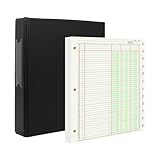
- [A Value Set]: Our Accounting Ledger Paper notebook comes with 100 sheets/200 pages ledger papers and a PU leather 3 ring binder. Extra Movable Monthly Tabs
- Thick Paper: These 3 column ledger paper are 100 gsm, Can be written smoothly to prevent ink bleeding. Both sides can be used
- [Size]: The size of the columnar pad paper is 8.5" X 11". The black 3-ring binder can be used for 8.5X11 refill paper
- [3-Ring Binder & Movable Monthly Tabs]: Binder accounting ledger notebook can be added, deleted, and re-arranged pages easily. The month tabs make it easy to organize the same months from different years
- Application: The ledger paper notebook is perfect for bookkeeping, accounting or other numeric data. it can be used by accountants, teachers, student
Frequently Asked Questions
Do GST records have to be kept at the registered principal place of business?
Section 35 addresses accounts for each registered place of business. Keep records accessible for the principal place and additional places, and identify where goods and supporting files are stored so they can be produced when required.
Can scanned invoices be used instead of paper originals?
Electronic records are permitted subject to the CGST Rules, including backup and readable production requirements. Scan at a quality that preserves all invoice fields, keep the original file naming and index, and confirm whether another law or a notice requires a physical original for a particular document.
What if a supplier invoice is missing when I prepare the return?
Put the item on the exceptions log, record the amount and period, and retain purchase or receipt evidence while you seek a corrected document. Do not silently delete the transaction or alter the source register; document whether ITC was deferred, reversed, or otherwise treated until the issue is resolved.
How should records be handled when a business changes its accounting software?
Export the historical ledgers, invoice registers, attachments, and audit trails in readable formats before closing the old system. Preserve the old access information and a mapping between old and new account or document IDs so an auditor can follow transactions across the migration.
Does the 72-month rule apply to every GST document in the same way?
It is the baseline for records relating to the relevant financial year, measured from that year’s annual-return due date. Records connected with a specified appeal, revision, proceeding, or investigation may need to be retained longer under section 36, so apply a subject-matter hold rather than deleting an entire year indiscriminately.
Quick Recap
Product prices and availability are accurate as of the date/time indicated and are subject to change. Any price and availability information displayed on Amazon at the time of purchase will apply.

