
Recommended Free Tools
iTechGuides is reader-supported. When you buy through links on our site, we may earn an affiliate commission. As an Amazon Associate I earn from qualifying purchases. Learn more
For a non-safety-critical car-interior part exposed to both heat and sunlight, start by evaluating a UV-stabilized ASA filament with a published heat-deflection value. Then match the exact grade to the part’s location, load, geometry and exposure, print it with controlled thermal conditions, and validate the finished component in its real mounting position. FormFutura’s Premium ASA datasheet, issued May 21, 2025, reports UV/weather resistance and an 86°C heat-deflection temperature (HDT) at 1.82 MPa under ASTM D648. That figure describes a specified test specimen and load, not a guaranteed service temperature for every printed part.
What filament can withstand a hot, sunny car interior?
ASA is a strong starting candidate when a part needs both sunlight resistance and heat performance, but no filament is automatically suitable for every dashboard, console or trim component. Select the material by the part’s actual location and job, then verify the printed assembly rather than treating a resin datasheet as a vehicle approval.
Why ASA is often the first material to evaluate
FormFutura describes its Premium ASA as UV-stable and weather-resistant, with applications that include automotive interior and exterior parts. Its May 21, 2025 technical datasheet lists an HDT of 86°C at 1.82 MPa, a Vicat softening temperature of 95°C and UL 94 HB for the stated specimen thicknesses.
Those values are manufacturer-reported typical results for that formulation. FormFutura notes that results can change with print conditions, model complexity and the environment, and asks users to assess suitability for the intended application. A printed part can therefore perform differently from a flat laboratory specimen because of layer bonding, orientation, wall geometry, mounting and applied load.
#1 Best Overall
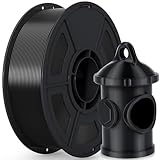
- 🌞【Excellent UV & Weather Resistance】- iSANMATE ASA filament is a highly durable material that offers exceptional UV, weather, mechanical, and thermal resistance, ensuring stability and durability in different temperature environments
- 🌞【Wide Compatibility and Outdoor Use for Long】- iSANMATE ASA filaments compatible with most consumer and industrial 3D printers. providing effective protection against breakage and color degradation when used outdoors for long-term purposes
- 🌞【Recommended Printing Conditions】- The Printing Temp is 240°C - 270°C (depending on the printer model)which is wider than typical PLA, Printing speed: 30-100mm/s. Hot bed temperature: 80°C - 100°C; ❗❗Printing Tips: 1. When you use ASA filament to print models, it is better to print in a closed environment. 2. It is recommended to apply glue to the bed before printing
- 🌞【Vacuum-sealed packaging】-iSANMATE 3D priting filament is carefully vacuum packed with desiccant to maintain the performance of PLA filament and prevent dust and foreign matter from entering
- 🌞【Technical Solutions】- Provide fast and efficient technical solutions when you have any printing problems with 24 hours guaranteed reply
What the published numbers actually tell you
| Property | Published value | How to interpret it |
|---|---|---|
| Heat-deflection temperature | 86°C at 1.82 MPa | ASTM D648 result for a 6.4 mm unannealed specimen; not a universal operating-temperature limit. |
| Vicat softening temperature | 95°C | A separate penetration-based softening test; it does not predict the exact temperature at which your installed part will deform. |
| Flammability classification | UL 94 HB for 1.5 mm and 3.0 mm specimens | A laboratory classification for the tested specimens, not certification of a vehicle component or compliance with FMVSS No. 302. |
| UV/weatherability | Claimed by the manufacturer | Supports ASA as a candidate for sunlight exposure, but does not establish a guaranteed color or strength life in a particular vehicle. |
HDT is especially easy to misuse. The 86°C result includes the test load, specimen dimensions, conditioning and method. A lightly loaded trim bezel may tolerate a different temperature than a clip that is continuously stressed. Treat HDT as one comparison point, not as permission to install a part anywhere that cabin temperatures might approach it.
How should you choose a material for the part’s exact location?
Start with the component’s failure modes, not with a favorite filament. Automotive material guidance identifies different priorities for consoles, handles, instrument clusters, panel structures and trim.
| Part or location | Questions to answer | Properties to prioritize |
|---|---|---|
| Center-console accessory or tray | Will it carry weight, see repeated impacts or contact cleaners and sunscreen? | Heat resistance, creep resistance, toughness, scratch and chemical resistance. |
| Dashboard or instrument-panel trim | Will it remain in direct sun and be visible beside molded surfaces? | UV stability, color retention, dimensional stability, surface finish and low warping. |
| Door handle or frequently touched trim | Will users pull on it thousands of times or abrade it with rings and tools? | Toughness, fatigue behavior, wear resistance, grip geometry and secure mounting. |
| Vent surround or small bezel | Will clips be flexed during installation and removal? | Layer adhesion, impact resistance, clip strain, dimensional accuracy and creep. |
| Hidden bracket or cable guide | Is appearance irrelevant, and is the part exposed to heat or vibration? | Thermal stability, stiffness, vibration resistance and reliable fastening. |
Also record chemical exposure (cleaners, oils, beverages), expected vibration, contact with sharp edges, and whether the part is loaded continuously or only occasionally. The automotive guide and Stratasys’ FDM guidance both emphasize that thermal, mechanical, chemical, aging and environmental requirements must be considered together.
Free tools Windows power users keep installed
One-click scans. No signup required.
Is ASA better than PETG or PLA for dashboard trim?
There is no universal winner without the exact filament grades and the part requirements. ASA is the most defensible first comparison when both UV exposure and elevated temperature matter, while PETG or PLA may still be considered for locations with different demands. Compare each candidate’s published thermal test, UV or weathering information, stiffness, toughness, creep behavior, chemical resistance and print-process requirements.
Do not compare a generic “ASA,” “PETG” or “PLA” label as though it were a standardized performance class. Formulations differ, and a manufacturer’s test may use different loads, specimen sizes or conditioning. If a part is important, print coupons in the same orientation and settings you will use for production and compare deformation and retention of fit after representative exposure.
Rank #2

- 🌞【Excellent UV & Weather Resistance】- iSANMATE ASA filament is a highly durable material that offers exceptional UV, weather, mechanical, and thermal resistance, ensuring stability and durability in different temperature environments
- 🌞【Wide Compatibility and Outdoor Use for Long】- iSANMATE ASA filaments compatible with most consumer and industrial 3D printers. providing effective protection against breakage and color degradation when used outdoors for long-term purposes
- 🌞【Recommended Printing Conditions】- The Printing Temp is 240°C - 270°C (depending on the printer model)which is wider than typical PLA, Printing speed: 30-100mm/s. Hot bed temperature: 80°C - 100°C; ❗❗Printing Tips: 1. When you use ASA filament to print models, it is better to print in a closed environment. 2. It is recommended to apply glue to the bed before printing
- 🌞【Vacuum-sealed packaging】-iSANMATE 3D priting filament is carefully vacuum packed with desiccant to maintain the performance of PLA filament and prevent dust and foreign matter from entering
- 🌞【Technical Solutions】- Provide fast and efficient technical solutions when you have any printing problems with 24 hours guaranteed reply
A practical material-selection scorecard
- Thermal data: record the test method, applied load, specimen condition and whether the result is HDT, Vicat or another measurement.
- Sunlight data: look for a stated UV/weathering claim and identify whether it concerns color, strength, dimensional retention or all three.
- Mechanical behavior: consider stiffness, impact toughness, fatigue and creep under the actual load.
- Surface durability: check scratch, wear and chemical resistance when the part is visible or handled.
- Process window: verify that your printer can maintain the nozzle, bed, enclosure and drying conditions required by the exact grade.
- Safety role: exclude any part that could affect a restraint, airbag, seat belt or other safety function unless it is engineered and verified for that purpose.
How do you print ASA so heat does not ruin the part?
Use the filament maker’s process window as a starting point, then tune it for your printer, geometry and enclosure. For FormFutura Premium ASA, the datasheet recommends a 275–290°C nozzle, a 90–110°C bed, an enclosure, and drying for at least approximately 12 hours at 70°C. It preferably should be printed from a dry box.
- Confirm the printer can hold the required temperatures. Check that the hot end, bed, chamber or enclosure and build surface are suitable for the grade. A printer that cannot maintain stable chamber conditions is more likely to produce warping or weak interlayer bonding.
- Dry the spool. Dry it for approximately 12 hours at 70°C as specified for this product, allow it to cool in a moisture-controlled container, and feed it from a dry box when possible. Moisture can create inconsistent extrusion and surface defects.
- Use the recommended thermal range as a tuning envelope. Begin within 275–290°C at the nozzle and 90–110°C at the bed, then adjust in small steps while checking layer bonding, overhangs, stringing and dimensional accuracy.
- Control drafts and temperature gradients. Keep the enclosure closed during printing and avoid sudden cooling. Large flat panels and sharp corners need particular attention because uneven contraction can lift the edges.
- Print a representative coupon. Match the production part’s layer height, wall count, infill strategy and orientation. A small tensile or bend sample made with different settings cannot reliably predict the installed component.
- Inspect before installation. Reject parts with delamination, voids near mounting holes, warped interfaces or brittle clips. These defects can become failure points during heat cycles and vibration.
The datasheet’s UL 94 HB result does not tell you how a complex printed shape will burn, and it does not replace vehicle-specific flammability requirements. Process control improves consistency, but it cannot turn a material datasheet into a certification.
Do these 3 things before closing this tab:
1Scan for outdated or missing drivers - takes under a minute2Clear out junk files and repair common Windows errors3Fix the driver behind crashes, sound loss and screen glitchesHow should the part be designed for heat, sunlight and long-term load?
Material selection cannot compensate for a geometry that concentrates stress or traps heat. Design the printed component and its mounting together.
Reduce stress concentrations
- Use generous fillets where arms, clips and walls meet.
- Avoid abrupt thickness changes that create local warping or weak layer transitions.
- Keep screw holes and snap-fit roots away from thin edges and place them where the print orientation gives useful layer strength.
Account for creep
A part that holds a load continuously can slowly deform even when it never reaches its softening temperature. Review the load path, support the part close to fasteners and avoid relying on a thin printed cantilever for permanent force. If the geometry is load-bearing, test it while warm rather than evaluating it only at room temperature.
Design for sunlight and appearance
Direct sun can heat a dark surface more than a shaded interior location, and color or gloss changes may appear before a part visibly warps. Use a finish and color that fit the application, but do not assume that a pigment or clear coat makes an unqualified filament UV-proof. Any coating should be evaluated for adhesion, thermal cycling, cleaner exposure and long-term discoloration on the actual printed surface.
Rank #3

- 【Weather resistance & Heat resistance】OVERTURE ASA filament is specially formulated to provide excellent protection against UV rays. It also exhibits excellent temperature resistance, ensuring stability and durability in different temperature environments
- 【Clog-Free & Bubble-Free】 Designed and manufactured with our patented clog-free formula to guarantee a smooth and seamless printing experience. All spools undergo thorough drying for 24 hours before packaging and are vacuum-sealed in resealable foil packaging
- 【Dimensional Accuracy & Consistency】Advanced CCD diameter measuring and self-adaptive control system in the manufacturing guarantee these ASA filaments to be strict tolerances. Diameter 1.75mm, dimensional accuracy (98%) + / - 0.02 mm without any exaggeration
- 【Wide Compatibility and Color Selection】 Overture filaments seamlessly integrates with most consumer and industrial 3D printers. Explore your creative side with our extensive selection of vibrant colors, ensuring a spectrum of possibilities for your unique creations
- 【Supported & Smooth Printing】 Print with confidence. Overture filament comes with dedicated support and a 1-year shelf life for unopened spools (proper storage required). We're committed to timely solutions for a seamless printing experience. Your reliable 3D printing partner
Make installation reversible during development
Use removable fasteners or a replaceable interface for early prototypes. This lets you inspect the part after heat and sunlight exposure without damaging the vehicle and makes it easier to revise clips, tolerances and contact surfaces.
How much do sunlight and heat change interior plastics?
Heat and sunlight act together rather than as isolated hazards. A five-year SAE study by Tonja Sutton and Cheryl Wurst, published March 1, 1993, measured color change at 30 vehicle locations in Arizona and Texas and included 11 polymers. Temperature’s contribution to color change was significant in the studied conditions.
In the study’s severe 95th- and 99th-percentile solar environments, the most stable tested polymers—PP, PE, ABS, AES and ASA—had reported color change below ΔE 6 after five years. Acetal and PVC reached color changes as high as ΔE 40. These results describe the study’s molded material specimens, locations and exposure conditions; they are not a lifetime prediction for an FDM-printed part or a particular vehicle.
The useful lesson is methodological: evaluate color, gloss, fit and mechanical retention after combined heat and light exposure. A filament marketed as weather-resistant may retain color better than another formulation, but the printed surface, pigment, orientation and vehicle location still affect the result.
How do you validate a finished printed part before installing it?
Validation should reproduce the part’s real constraints without pretending that one universal temperature or duration exists. The available evidence does not establish a single safe maximum cabin temperature, guaranteed service life or universal wall-thickness and infill recipe.
Windows Errors? Fix Them Before They Spread
Repair common Windows errors and clear accumulated junk for a smoother, more stable PC - no reinstall needed.Free scan · no reinstallOutdated Drivers Are Slowing You Down
One free scan finds every outdated or missing driver and matches the right update for your exact hardware.Free scan · exact hardware matchRank #4

- 【UV & Weather Resistant】: Polymaker ASA 3D printer filament combines the properties of ABS with added weather resistance. UV-resistant and less prone to environmental stress cracking, it’s suitable for outdoor applications like RC planes and car accessories.
- 【High Heat Resistance & Mechanical Properties】: Polymaker ASA filament can withstand temperatures up to 100˚C (212°F) and offers high toughness and impact resistance, making it suitable for functional applications. It shares the same properties as ABS 3D printer filament.
- 【Strong & Durable】: Polymaker ASA 3D printer filament combines strength, rigidity and reliable layer adhesion for real-world applications. Suitable for functional prototypes, mechanical parts, brackets, housings, replacement parts, tools and other projects that require durable performance.
- 【Printing Settings】: Nozzle Temperature: 250˚C; Bed Temperature: 90˚C; Speed: 50mm/s. (Adjust as needed per your 3D printer; refer to standard ABS filament settings). For large parts, use an enclosed printer to prevent warping.
- 【Risk-Free & Lifetime Technical Support】: We're here to assist you in achieving flawless, beautiful prints. Feel free to reach out to us on Amazon anytime you need help!
- Define the exposure. Identify whether the part is shaded, behind glass, in direct sun, near a vent or adjacent to a heat source. Record expected loading, vibration, cleaners and mounting stresses.
- Measure the installed fit at room temperature. Photograph reference gaps, clip engagement, screw alignment, movement and surface appearance. These are your baseline observations.
- Run heat-soak checks. Expose a production-equivalent part or coupon to representative elevated temperatures while it is mounted or loaded as it will be in use. Watch for sagging, creep, clip release, loss of clearance and changes in texture.
- Run light-exposure checks. Use a controlled sunlight or weathering program appropriate to the material and document color, gloss, cracking and dimensional change. Do not convert an accelerated-weathering duration into a claimed number of vehicle years without supporting correlation.
- Cycle the part. Alternate heating and cooling and inspect after each cycle for cracks, delamination, fastener loosening and permanent deformation. Include handling and installation cycles if the part is removable.
- Decide using the function, not appearance alone. A part can look acceptable while losing clip strength or dimensional accuracy. Define pass criteria for fit, load retention, movement and safety before testing.
For a production or safety-relevant application, have an appropriately qualified engineer select the test plan and review the results. The manufacturer’s request that customers assess suitability is particularly important because printed geometry and process conditions can materially change performance.
Are 3D-printed interior parts covered by vehicle flammability rules?
Potentially, depending on the component and how it is used. US Federal Motor Vehicle Safety Standard No. 302 applies to listed occupant-compartment materials and specifies a maximum burn-rate criterion of 102 mm per minute under its prescribed test. The regulation is a test requirement, not a general prediction of fire behavior in every installation.
A filament’s UL 94 classification does not establish compliance of a printed vehicle part with FMVSS No. 302. FormFutura reports UL 94 HB for 1.5 mm and 3.0 mm specimens but says a UL Yellow Card is unavailable because of proprietary composition information. Neither statement is vehicle-part certification.
Keep experimental printed parts away from airbag deployment paths, seat belts, restraint components and any other safety function unless the design is engineered and verified for that function. Do not place a homemade component where its failure could obstruct deployment, alter restraint behavior or create a projectile.
What causes ASA parts to fail, and how do you fix it?
| Symptom | Likely contributors | Corrective action |
|---|---|---|
| Edges lift or corners warp | Drafts, insufficient enclosure control, a cold bed or a large flat geometry. | Improve enclosure stability, verify the bed temperature, increase first-layer reliability and redesign sharp corners or unsupported spans. |
| Layers split after installation | Low interlayer bonding, moisture, excessive cooling or an orientation that loads the layer lines. | Dry the filament, stabilize chamber conditions, tune nozzle temperature within the stated range and reorient the part or add mechanical support. |
| Part sags in service | Continuous load, insufficient section stiffness, heat near the material’s tested range or poor mounting. | Reduce the load path, add ribs or supports, improve fastening and validate the revised geometry while warm. |
| Clips snap during assembly | Thin roots, sharp transitions, brittle processing or repeated over-flexing. | Add fillets, increase compliant length, adjust orientation and test installation cycles before finalizing. |
| Color or gloss changes | Solar exposure, temperature cycling, pigment behavior or surface contamination. | Document the change, compare a UV-stabilized grade and test the actual color and finish under representative exposure. |
| Surface shows bubbles or rough extrusion | Moisture or inconsistent feeding. | Redry the spool, use a dry box and inspect the filament path and nozzle. |
When should you choose a different approach?
Choose another material, a different print process or a non-printed component when the part is safety-critical, continuously highly loaded, exposed to chemicals that the filament has not been tested against, or required to meet a vehicle specification that you cannot verify. A molded or engineered production material may have documented automotive testing that an FDM part does not.
Best Value

- High UV Resistance - FLASHFORGE ASA UV filament combines the properties of traditional ABS filament with enhanced high-temperature resistance. It is UV stable, meaning it doesn’t suffer from significant shrinking.
- Excellent Temperature Resistance - FLASHFORGE ASA maintains its shape and integrity up to temperatures near 93°C. This makes it particularly suitable for printing objects intended for long-term outdoor use, such as RC planes or car accessories.
- Chemical Resistance - ASA exhibits good resistance to many chemicals, including oils and solvents, making it an excellent choice for applications that require chemical stability.
- Clog-Free, Bubble-Free: The filament is designed to be clog-free and bubble-free, ensuring a smooth and stable printing experience. It is dried for 24 hours, vacuum-sealed, and undergoes quality checks before leaving the factory.
- Precision and Consistency: Advanced CCD diameter measurement and adaptive control systems ensure that 99% of the filament has a diameter of 1.75 mm with a tolerance of +/- 0.02 mm. Each spool contains 1 kg (2.2 lbs) of filament.
For non-critical prototypes and accessories, ASA can be a sensible balance of UV resistance and heat capability when the printer can maintain the required process conditions. Make the decision from the exact grade’s technical data and your validation results, not from the material name alone.
Pre-installation checklist
- Have you identified the part’s direct-sun, heat, load, vibration and chemical exposure?
- Does the exact filament grade publish thermal and weathering information relevant to that exposure?
- Did you carry the HDT test method, load and specimen qualification with the number?
- Was the spool dried and printed in a controlled enclosure using settings appropriate to that grade?
- Does the design avoid stress concentrations and account for creep and installation loads?
- Did you test a production-equivalent part in its actual mounting orientation?
- Have you excluded airbag, restraint and other safety functions unless formally engineered and verified?
- Have you documented fit, deformation, color, clip strength and chemical effects before approving the part?
Frequently Asked Questions
Can I print ASA without an enclosure?
The cited Premium ASA datasheet recommends an enclosure because stable thermal conditions help control warping and layer bonding. An unenclosed printer may work for small geometries, but that is a machine- and design-specific result that should be demonstrated with representative coupons rather than assumed.
What does the 1.82 MPa in an HDT result mean?
It is the flexural stress applied during the ASTM D648 heat-deflection test. Because changing the applied load changes the measured deflection temperature, an HDT reported at 1.82 MPa should not be compared directly with a value measured under a different stress without noting the test conditions.
What’s actually slowing this PC down?
Pick the symptom - the matching free tool is one click away.
Should I anneal a printed ASA car part?
There is no universal annealing recipe or guaranteed benefit established here for every ASA grade and geometry. Annealing can change dimensions and fit, so only use it when the filament maker provides a validated procedure and you recheck the finished part’s mounting tolerances.
How can I prove that a printed trim piece will last five years?
You cannot infer a five-year service life from the SAE color study or from a single HDT value. Define the vehicle exposure and loads, run controlled heat, light and cycling tests on production-equivalent parts, and use qualified engineering review if the result matters.
Quick Recap
Product prices and availability are accurate as of the date/time indicated and are subject to change. Any price and availability information displayed on Amazon at the time of purchase will apply.

