
Free tools Windows power users keep installed
One-click scans. No signup required.
To fly a drone safely in the United States, first determine whether the flight is recreational or subject to Part 107, then confirm your pilot, registration, Remote ID, and airspace requirements. Before each flight, assess weather and ground hazards, inspect the aircraft and control link, brief anyone helping, and be ready to land if conditions change. The right rules depend on the purpose of the flight—not simply whether you are paid.
Choose the right FAA operating path first
U.S. FAA rules distinguish recreational flying from operations under Part 107. A flight’s purpose determines which path applies; a flight does not become recreational just because no money changes hands at that moment. Business, government, and other non-recreational operations generally fall under Part 107, which requires a certificated remote pilot or direct supervision by one.
| What to check | Recreational exception | Part 107 |
|---|---|---|
| Purpose | Fly only for recreation and follow the limited recreational exception. | Generally applies to business, government, or other non-recreational purposes. |
| Pilot qualification | Pass the FAA’s TRUST test and follow community-based safety guidance. | A certificated remote pilot must conduct or directly supervise the operation. |
| Aircraft and registration | Registration exception may apply to drones weighing 0.55 pounds (250 grams) or less when flown under the recreational exception; check registration and Remote ID requirements for your aircraft and operation. | Follow applicable registration and Remote ID requirements. The cited FAA overview covers small UAS weighing less than 55 pounds. |
| Airspace | Obtain FAA authorization before flying in controlled airspace where required. | Obtain applicable authorization for controlled airspace; LAANC may be available, or use the FAA process for the operation. |
| Night flights | Follow your community-based organization’s safety guidance, including its night procedures. | Use anti-collision lighting visible for three statute miles when flying at night. |
These summaries do not replace the rules for a particular operation. Check the FAA’s recreational flyer requirements, beginner guidance, and Part 107 overview before you fly.
Complete a preflight check before every launch
Use a consistent sequence. FAA guidance does not prescribe one universal checklist template, but Part 107 requires a preflight inspection that includes checking the communications link. A checklist helps make the inspection repeatable: as Rebekah Waters, associate editor of FAA Safety Briefing, puts it, “Developing and consistently using a good preflight checklist helps prevent accidents and is an important part of successful drone operations.”
Recommended Free Tools
#1 Best Overall

- Waterproof & Easy to Clean: The landing pad is made of high-quality double-sided PU leather, waterproof and dustproof, strong and durable, soiled with dust and mud, just rinse with water and then shake dry
- Portable & Safer: Drone landing pad fits most different size drones. The foldable design makes this drone landing pad easy to carry and can be easily stored in most protective cases or backpacks
- Foldable & Easy to Carry: Drones landing mat for Dji mini5 pro can be quickly folded and opened, easy and fast to use. After folding ,the small portable size can fit most drone case ,easy to carry
- Stable & Protection: The suitable weight also makes the drone landing pad more stable and can't be moved away even under the strong wind. It can easily build smooth takeoff and landing surface in mud, gravel and other bumpy and complex ground environment. So it is a ideal landing pad for your drone
- Two Brightly Color Option: One side is blue and the other red ,make it fashionable and easy to improve visibility outdoors. Even in a dense fog, you can easily land the drone and no need to install reflective tape
- Confirm the flight and pilot requirements. Decide whether the flight is recreational or Part 107. Verify any required training or certificate, registration, and Remote ID compliance for your aircraft and operation. The FAA explains recreational requirements and getting started; its registration guidance says drones required to be registered or already registered must comply with Remote ID.
- Check airspace and restrictions for the site and time. Review current airspace information and temporary restrictions; do not assume a familiar location is still unrestricted. Get authorization where required. Part 107 pilots may use LAANC where available or the relevant FAA process. Consult the FAA’s where-can-I-fly guidance and temporary flight restriction information.
- Assess weather and the operating area. Consider local weather, visibility, nearby airspace restrictions, people and moving vehicles not involved in the operation, surface property, possible entrants, open-air assemblies, and other ground hazards. Do not launch if the aircraft or conditions make safe operation uncertain. FAA advisory guidance covers these considerations in its UAS advisory circular.
- Inspect the aircraft and control station. Check the aircraft’s physical condition, propellers and other systems, battery readiness, controller, and communications link. Follow the aircraft manufacturer’s procedures as well as applicable FAA requirements; do not launch with a fault that could affect safe control.
- Brief everyone directly involved. Explain operating conditions, roles, communications, and emergency procedures. Make sure participants know what to do if the aircraft or site becomes unsafe.
- Set a conservative flight plan. Maintain visual line of sight, keep clear of manned aircraft and hazards, and plan to land if conditions change. Under Part 107, do not operate carelessly or recklessly, and do not fly over people except as permitted by the applicable rule.
Manage the hazards most likely to change a flight
Manned aircraft
Give way to manned aircraft and keep the drone clear. If an aircraft approaches, move clear or land as needed; never expect its pilot to see or avoid your drone. Both recreational and Part 107 flyers must yield to manned aircraft. See the FAA’s recreational rules and Part 107 guidance.
People, vehicles, and property
Look beyond the planned takeoff and landing spots. Account for people or moving vehicles that are not part of the operation, property below the route, open-air assemblies, and anyone who could enter the operating area. Do not fly over people unless the applicable rule permits it. If you cannot keep the operation safe as people or traffic move, delay, change the route, or land.
Rank #2

- Easy set up. Rugged vinyl landing pad springs into shape when released from folded state; just throw and go
- No stakes required.1.9 pound weighted patented design landing pad conforms to the turf and stays in place throughout takeoff and landing
- Keeps drone clean. Takeoff and landing drone thrust can sand blast camera lens, motor bearings and rotors
- Protects rotors. Tall grass and pebble strikes are eliminated
- Quick Clean up. Use a wet towel; vinyl coated pad bottom seals out morning dew
Airspace and temporary restrictions
Airspace status can vary by location and time. Recheck controlled-airspace requirements and temporary flight restrictions before each flight. Obtain authorization where required; for Part 107 operations, LAANC is one option where available. Start with the FAA’s airspace guidance and verify current restrictions rather than relying on memory or a previous visit.
Weather, visibility, and loss of control
Assess conditions against your aircraft’s capabilities and your ability to maintain visual line of sight and safe control. FAA guidance calls for a local weather assessment, but the cited material does not establish one universal weather threshold suitable for every aircraft. Delay or cancel when you cannot confidently operate safely. Before takeoff, know the aircraft’s emergency procedures; if the control link or aircraft condition becomes unsafe in flight, follow those procedures and land as soon as safely possible.
Rank #3
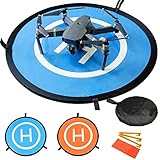
- 【Waterproof Premium Material】: Made of Waterproof Nylon Material with high precision printing with Outdoor Type Print ink make it waterproof and sun-resistant and don't fade.
- 【Extensive Applicability】: The 30”(75 cm) double sides portable landing pad perfectly fits the RC Drones Helicopter, PVB Drones, DJI Mavic Pro Phantom 2/3/4/ Pro, Antel Robotic, Holy Stone Gopro Kama, Parrot, 3DR Solo drone, etc.
- 【Fast folding and portability】: It is light and portable, easy to storage it in the zipper bag with hand strap, convenient to carry it outdoor. Enjoy your drone any time and any occasion.
- 【Design security】: 8 reflective strips are used for night flying, pasting them to the outer of the printing circle.They will provide clear location for drone in darkness. 3 land nails fixed to the landing pad on the ground firmly, helping the landing pad work perfectly in windy environments.
- 【Returns and guarantee】: If you have any questions, do not hesitate to contact us by email. You can return the product (not damaged) to the package within 30 days of the purchase for return or replacement.
Night operations
Recreational flyers must follow their community-based organization’s safety guidance, including its night procedures. Part 107 pilots flying at night must use anti-collision lighting visible for three statute miles. Check the FAA’s beginner guidance and Part 107 information for the applicable requirements.
Independent reader supportYour contribution helps us test, update, and keep practical guides available for everyone.Know the figures that affect your flight
These are U.S. FAA figures in the cited guidance accessed in 2026, except where a publication date is specified. They are regulatory thresholds or listed fees, not safety guarantees. Verify the FAA pages before flying because rules and fees can change.
Rank #4
- Waterproof & Easy to Clean: The landing pad is made of high-quality double-sided PU leather, waterproof and dustproof, strong and durable, soiled with dust and mud, just rinse with water and then shake dry
- Portable & Safer: Drone landing pad fits most different size drones. The foldable design makes this drone landing pad easy to carry and can be easily stored in most protective cases or backpacks
- Foldable & Easy to Carry: Drones landing mat for Dji mini5 pro can be quickly folded and opened, easy and fast to use. After folding ,the small portable size can fit most drone case ,easy to carry
- Stable & Protection: The suitable weight also makes the drone landing pad more stable and can't be moved away even under the strong wind. It can easily build smooth takeoff and landing surface in mud, gravel and other bumpy and complex ground environment. So it is a ideal landing pad for your drone
- Two Brightly Color Option: One side is blue and the other red ,make it fashionable and easy to improve visibility outdoors. Even in a dense fog, you can easily land the drone and no need to install reflective tape
- 0.55 pounds (250 grams): The FAA’s recreational registration exception applies to drones at or below this weight when flown under the limited recreational exception. It does not remove other applicable operating requirements.
- Less than 55 pounds: The FAA’s cited Part 107 overview addresses small UAS below this weight.
- Below 400 feet: FAA beginner guidance states that drone pilots must stay below 400 feet, subject to applicable rules and exceptions.
- Three statute miles: Part 107 night anti-collision lighting must be visible at this distance.
- $5 and three years: The FAA registration page lists a $5 fee and three-year validity for both the described Part 107 registration and recreational-exception registration, which have different coverage. Confirm the current fee and terms on the FAA registration page.
- 10 days and $500: Under the Part 107 guidance dated July 6, 2026, an operation resulting in serious injury, loss of consciousness, or property damage of at least $500 must be reported within 10 days. See the FAA Part 107 guidance for the applicable reporting rules.
What to do when conditions change
A safe plan includes a reason to stop. If weather worsens, visibility is lost, a person or vehicle enters the area, an aircraft approaches, a restriction applies, or the control link behaves unexpectedly, prioritize people and manned aircraft: pause the operation, move clear or land using the aircraft’s emergency procedures, and do not resume until the hazard is resolved and the flight remains within applicable rules.
Quick Recap
Product prices and availability are accurate as of the date/time indicated and are subject to change. Any price and availability information displayed on Amazon at the time of purchase will apply.
What’s actually slowing this PC down?
Pick the symptom - the matching free tool is one click away.

