
Quick wins for a faster PC:
Scan for outdated or missing drivers - takes under a minuteDriver Scan →Repair Windows errors before they cause bigger problemsFix Now →To see what is using space on your Windows C: drive, start at Settings > System > Storage for a category breakdown. Then use File Explorer’s Details view, sorted by Size, to find large individual files. These built-in tools are available in Windows 10 and Windows 11; check what an item is before deleting or moving it.
Check how much space is free
-
Open File Explorer and select This PC.
-
Check the C: drive’s available space. This gives you a baseline to compare against after any cleanup.
Use Storage settings to identify the main categories
-
Open Settings > System > Storage. Menu wording and layout can vary somewhat between Windows versions.
-
Review categories such as Installed apps, Temporary files, and System & reserved. Select a category or choose to show more categories for further detail.
Special offer. See more information about Outbyte and uninstall instructions. Please review EULA and Privacy policy.#1 Best Overall
Sale Seagate 2TB Portable Hard Drive | USB 3.0 (STGX2000400)
- Easily store and access 2TB to content on the go with the Seagate Portable Drive, a USB external hard drive
- Designed to work with Windows or Mac computers, this external hard drive makes backup a snap just drag and drop
- To get set up, connect the portable hard drive to a computer for automatic recognition no software required
- This USB drive provides plug and play simplicity with the included 18 inch USB 3.0 cable
- The available storage capacity may vary.
-
If Windows offers Cleanup recommendations, inspect the categories and items it lists, along with the space Windows expects each action to recover. Review the selection before choosing Clean up.
Storage settings shows what kind of data is using space, but it does not establish which category will be largest on every PC. The breakdown on your device is the useful one to follow.
Find large personal files in File Explorer
For individual files, check folders that commonly hold large personal or downloaded content, including Videos, Music, Pictures, and Downloads.
Rank #2

- High capacity in a small enclosure – The small, lightweight design offers up to 6TB* capacity, making WD Elements portable hard drives the ideal companion for consumers on the go.
- Plug-and-play expandability
- Vast capacities up to 6TB[1] to store your photos, videos, music, important documents and more
- SuperSpeed USB 3.2 Gen 1 (5Gbps)
-
Open a likely folder in File Explorer.
-
Switch to View > Details (or the equivalent View control in your Windows version).
Special offer. See more information about Outbyte and uninstall instructions. Please review EULA and Privacy policy. -
Select the Size column heading to sort by size. Select it again if needed to put the largest files first.
-
Review the largest items. Delete files you no longer need, or move files you want to keep to another storage location.
Rank #3
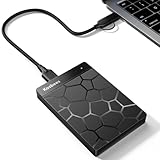 Kosbees 500 GB External Hard Drives,Portable Hard Drive for Windows,Ultra Slim External HDD Store Compatible with PC, MAC,Laptop,PS4, Xbox one, Xbox 360;Plug and Play Ready
- 【Plug-and-Play Expandability】 With no software to install, just plug it in and the drive is ready to use in Windows(For Mac,first format the drive and select the ExFat format.
- 【Fast Data Transfers 】The external hard drives with the USB 3.0 cable to provide super fast transfer speed. The theoretical read speed is as high as 110MB/s-133MB/s, and the write speed is as high as 103MB/s.
- 【High capacity in a small enclosure 】The small, lightweight design offers up to 500GB capacity, offering ample space for storing large files, multimedia content, and backups with ease. Weighing only 0.35 Lbs, it's easy to carry "
- 【Wide Compatibility】Supports PS4 5/xbox one/Windows/Linux/Mac and other operating systems, ensuring seamless integration with game consoles,various laptops and desktops .
- Important Notes for PS/Xbox Gaming Devices: You can play last-gen games (PS4 / Xbox One) directly from an external hard drive. However, to play current-gen games (PS5 / Xbox Series X|S), you must copy them to the console's internal SSD first. The external drive is great for keeping your library on hand, but it can't run the new games.
Deleted files may continue to occupy space in the Recycle Bin. Empty it if you have decided you no longer need those files and want to reclaim that space.
Choose a recovery action that fits the item
| What you found | Possible next step | What to check |
|---|---|---|
| Large personal files | Delete files you do not need, or move wanted files to external storage such as a USB drive or SD card. | Confirm the files are no longer needed before deleting. External storage is optional; it is not required to find what is using space. |
| An app you no longer use | Review it in Storage settings or Cleanup recommendations before removing it. | Make sure you recognize the app and are comfortable losing access to it. |
| Temporary files or a cleanup recommendation | Review the listed items and select only those you intend to remove. | Do not manually delete unfamiliar system files. |
| System & reserved storage | Use Windows’ Storage tools to understand available cleanup options. | Do not assume every item in this category is safe to remove manually. |
| Previous Windows installation | Remove it only if you accept losing the option to return to the previous Windows version. | Microsoft says the prior version is automatically deleted 10 days after an upgrade. Removing it sooner means you cannot use those files to roll back. |
Windows also lets you review connected drives under Settings > System > Storage > Advanced storage settings > Storage used on other drives. The labels or path can differ by Windows release. To change where future files are saved, look for the option to choose where new content is saved in Storage settings.
Do these 3 things before closing this tab:
1Scan for outdated or missing drivers - takes under a minute2Clear out junk files and repair common Windows errors3Fix the driver behind crashes, sound loss and screen glitchesUnderstand what Storage Sense will manage
Storage Sense can automatically remove some unnecessary temporary files and manage Recycle Bin contents according to its settings. Microsoft says it works on the system drive, usually C:, rather than other drives. With default settings, when enabled, it runs when the device is low on disk space. Check its options before relying on it: Downloads and cloud content are not managed by default unless you configure those settings.
Rank #4
- Easily store and access 1TB to content on the go with the Seagate Portable Drive, a USB external hard drive.Specific uses: Personal
- Designed to work with Windows or Mac computers, this external hard drive makes backup a snap just drag and drop. Reformatting may be required for Mac
- To get set up, connect the portable hard drive to a computer for automatic recognition no software required
- This USB drive provides plug and play simplicity with the included 18 inch USB 3.0 cable
- The available storage capacity may vary.
For OneDrive files, Storage Sense can make unopened local copies online-only according to the configured setting. Microsoft notes a 30-day default for unopened files in Windows 11 version 22H2 and later; the interval depends on the setting. Online-only status does not permanently delete the cloud file, and you can make it locally available again when connectivity and disk space permit. Files marked Always keep on this device are exempt from Storage Sense management.
Independent reader supportYour contribution helps us test, update, and keep practical guides available for everyone.Keep files but reduce what stays on C:
If you want to retain large personal files without keeping them on the PC, move them to external storage such as a USB drive or SD card. For future files, you can choose another drive as the save location where Windows provides that option. OneDrive Files On-Demand is another option for reducing local copies if it suits how you access your files. These approaches change where or how files are stored; they are not the same as deleting them.
How much free space does Windows need for updates?
Microsoft’s update guidance says a feature update typically needs 6–11 GB or more of free space, while a quality update typically needs 2–3 GB or more. These are general estimates, not guarantees: actual requirements vary by device and update. If an update is your reason for checking C:, use the space estimate as context rather than a promise that a particular amount will be sufficient.
Quick Recap
Product prices and availability are accurate as of the date/time indicated and are subject to change. Any price and availability information displayed on Amazon at the time of purchase will apply.

