
iTechGuides is reader-supported. When you buy through links on our site, we may earn an affiliate commission. As an Amazon Associate I earn from qualifying purchases. Learn more
An AI-generated fraud detector is not deployment-ready merely because its code runs or its test accuracy looks high. Treat it as a proposed statistical model and software supply chain. Before it can influence transactions, define the decisions and risks, freeze and inspect the generated implementation, test it on representative time-based data, measure calibration and segment-level errors, red-team its security, establish human escalation and accountable approval, then release it in a controlled stage with rollback and continuous monitoring.
This process determines whether the system is valid for a specific population and operating point—not whether it is universally accurate. A model can perform well in development and still fail when fraud patterns, customer mix, labels, upstream feeds, or attack tactics change.
What does it mean to validate an AI-generated fraud detection setup?
Validation means producing independent evidence that the complete setup—data, features, model, thresholds, software, controls and operating process—performs its intended fraud decision safely under stated conditions. The Federal Reserve describes model testing as a core part of development that evaluates whether a model performs as intended; its supervisory guidance also expects out-of-sample and out-of-time testing, outcome analysis, monitoring, documentation and, where relevant, third-party validation.
For fraud use cases, validate more than a score. A score may block a payment, trigger step-up authentication, send an alert to investigators or merely create a lead. Each action has a different tolerance for false positives, missed fraud, delay and customer harm. NIST’s validity and reliability principle is conditional: document where the system generalizes and where it does not. NIST also treats bias evaluation as socio-technical testing, evaluation, verification and validation (TEVV), not as a single mathematical fairness check.
#1 Best Overall

- AI Motion Detection 2.0 – Driving AI to the next level, human&vehicle detection and flexible detection area are more accurate than before. For quicker locating in crucial moments, human&vehicle smart searching in recordings offers you great help.
- Tried-and-True Safe Guard – This one-stop security solution can work with TVI, AHD, CVI, CVBS & IP cameras, the kit includes 1080P cams. The 8CH 3K lite DVR can hook up with 1080P@30fps or 3K/5MP@20fps cams. Therefore, you can also DIY it with other cameras in your home.
- Reliable 24/7 Continuous Recording – With a pre-installed 1TB HDD(Support up to 10TB HDD), providing 24/7 surveillance recording for you. Upgraded H.265+ saves more storage space and uses less bandwidth, recording videos longer and smoother viewing.
- Remote Access Anytime, Anywhere – Stay connected through the ANNKE Vision app. View live footage, play back recordings remotely, and check in on your property anytime, anywhere for convenient home security and greater peace of mind.
- Clear Night Vision and IP67 Weatherproof Protection – Built-in IR LEDs provide black-and-white night vision up to 100ft. With an IP67-rated design, these wired security cameras are built to withstand rain, dust, and changing weather conditions for reliable outdoor surveillance.
Readiness therefore requires an evidence trail and an accountable decision. The Australian National AI Centre says pre-deployment testing should use clear methods, documented results, alignment with intended use and risks, and authorization by an accountable person. The UK National Cyber Security Centre (NCSC) says models, applications and systems should be released only after effective security evaluation such as benchmarking and red teaming, with limitations and failure modes communicated.
What must be defined before any test is run?
Write a short purpose-and-scope specification first. Test results are uninterpretable if the team has not agreed what the system is allowed to decide and what failure costs are acceptable.
Define the population and operating boundary
- List the transaction types, account products, channels, countries or regions, currencies and time window covered.
- Specify whether the model is for new-account screening, payment authorization, account takeover, claims, transfers or investigation triage.
- State excluded populations, unavailable data conditions and circumstances in which the model must not be used.
- Record assumptions about identity, merchant, device, network and behavioral data, including retention and latency.
Define the action behind a positive signal
- Block or decline: requires the strongest evidence because an error directly interrupts a legitimate transaction.
- Step-up authentication: trades customer friction for additional evidence and needs a reliable recovery path.
- Manual review: depends on queue capacity, reason codes, reviewer quality and service-level targets.
- Investigation lead: may tolerate lower precision if analysts can prioritize and dismiss alerts safely.
Write acceptance criteria and failure costs
Set target ranges before looking at results for false-positive burden, missed-fraud cost, latency, alert volume, review capacity, customer remediation and availability. There is no universal accuracy number that proves readiness. A threshold suitable for a high-value transfer may be unacceptable for everyday card payments, even in the same organization.
Recommended Free Tools
Document the fraud definition and label source, how long outcomes take to become known, who can override a decision, and how customers appeal or recover from an error. Include known failure modes and the person with authority to pause or roll back the system.
How should you inspect code and configuration produced by an AI?
Freeze the exact artifact before testing. Otherwise a generated prompt, dependency, threshold or model can change while evidence is being collected.
- Create an immutable release record. Preserve the source code, generation prompts or configuration, model and tokenizer versions, feature definitions, thresholds, deployment image, environment variables and dependency lockfile. Record build time, commit identifiers and the approval status of each component.
- Trace data and labels. Map every feature to its source, owner, timestamp and transformation. Record label definitions, adjudication rules, training and test splits, retention periods, data licenses and provider terms. Mark fields that are available only after the decision time; those fields can create target leakage.
- Verify integrity. Generate cryptographic hashes or signatures for models, datasets, images and critical configuration. Restrict who can write to repositories, pipelines, feature stores and deployment targets. NCSC guidance specifically recommends hashes or signatures and controls against tampering or exfiltration.
- Review generated code line by line. Look for train/test contamination, leakage through future timestamps, insecure defaults, hard-coded credentials, unbounded queries, unsafe deserialization, unvalidated input, excessive permissions, undocumented fallbacks and silent human-override behavior.
- Reproduce the build. A second engineer should be able to build the same artifact from the recorded inputs and obtain identical hashes or an explained, controlled difference. If a hosted model or API is involved, record the provider version, endpoint behavior, rate limits, data-use terms and change-notification policy.
- Check failure handling. Force missing, stale, duplicated, malformed and delayed records. Confirm that the system fails closed or safely degrades according to the approved policy, emits an observable error and does not silently convert an unavailable feature into a low-risk score.
Independent effective challenge is essential. Federal Reserve model-risk guidance describes it as objective, critical analysis by qualified experts across the model lifecycle; the person who generated or tuned the setup should not be the only reviewer.
How do you test data validity and generalization?
Use data that mirrors the decisions the system will make, including time and prevalence. Randomly shuffling records can hide temporal leakage and make a model look stronger than it will be after launch.
Build a time-aware evaluation design
- Separate development, holdout and out-of-time periods. Keep a representative holdout untouched during feature and threshold selection. Reserve a later period to test whether the model works on future-like data. This directly addresses the Federal Reserve expectation for out-of-sample and out-of-time testing.
- Match production prevalence and mix. Include the expected proportions of legitimate and fraudulent transactions, products, channels, geographies, devices, merchants and customer tenures. If sampling changes prevalence, report the sampling method and adjust interpretation of precision and alert volume.
- Account for label delay. Separate mature outcomes from transactions whose fraud status is still unknown. Quantify chargeback, investigation and customer-reporting delays, and report how many observations are censored rather than treating them as legitimate.
- Measure disagreement. Compare model outcomes with confirmed fraud, investigator adjudication and independent review. Investigate ambiguous cases instead of forcing every disagreement into a binary label.
- Test data quality extremes. Inject missing, stale, duplicated, out-of-order and contradictory records. Test degraded upstream feeds, outages, schema changes and backfills.
Stress conditions that change after launch
Evaluate seasonality, promotions, new merchants, new devices, geographic expansion and shifts in customer behavior. Simulate new attack patterns, account farms, synthetic identities and coordinated bursts. UK risk guidance asks whether performance is tested under adverse conditions and natural drift; include those scenarios in the release evidence and state where results are unknown.
Rank #2

- One Unified Security System, Powered by 1st-Gen aosuBase: 32GB of local storage comes ready to use, holding about 120 days of loop recording. No subscription required. Connect up to 4 cameras to one base with a stable wireless connection and centralized local storage. Recordings saved to aosuBase are event-based, triggered by detected activity.
- Multi-Cam Live View for All-at-Once Monitoring: Watch up to four live camera feeds simultaneously in the aosu app and monitor multiple areas on one screen without opening each camera individually. Live View is available through the aosu app only; the base does not support HDMI or TV output.
- 360° Coverage with Pan, Tilt, and Smart Auto Tracking: Pan and tilt to see all around your property. When activity is detected, the camera automatically follows people and other movement to keep the action in view while recording, giving you a more complete view of what happens around your home.
- 2K (3MP) Clarity with Full-Color Night Vision: Capture clear details in 2K and zoom in up to 6x for a closer look. Built-in spotlights enable full-color night vision, helping you see important color details like clothing and vehicles after dark. For more discreet monitoring, switch to infrared mode for black-and-white night vision without visible lighting.
- Quick Setup with a Pre-Paired System: Connect aosuBase to your router's LAN port with the included Ethernet cable. Cameras connect wirelessly to aosuBase instead of your home Wi-Fi. The system comes pre-paired, so simply power on the cameras and complete setup in the app without pairing each camera one by one. The cameras are designed to work with the included aosuBase, and add-on cameras connect through the base as well.
For every test, record the conditions under which the result holds. NIST’s guidance on validity and reliability cautions against generalizing beyond the development conditions. If a simpler or more interpretable model performs adequately under the same conditions, document why the added complexity is justified.
Which performance metrics should a fraud model pass?
Report a complete operating picture rather than a single accuracy score. Fraud is usually rare, so accuracy can remain high while the system misses most fraud or floods reviewers with legitimate alerts.
| Measure | What it tells you | Decision use |
|---|---|---|
| Precision (positive predictive value) | Share of flagged transactions that are confirmed fraud. | Estimates investigation yield and customer friction from alerts. |
| Recall (true-positive rate) | Share of confirmed fraud detected. | Shows exposure to missed fraud at a chosen threshold. |
| False-positive rate | Share of legitimate transactions incorrectly flagged. | Quantifies unnecessary blocks, challenges or reviews. |
| False-negative rate | Share of fraud allowed through. | Supports loss and remediation estimates. |
| PR-AUC or ROC-AUC | Ranking quality across thresholds; PR-AUC is often more informative for rare fraud. | Useful for comparing models, but not a substitute for an operating threshold. |
| Calibration | Whether predicted risk matches observed outcome frequency. | Determines whether a score of, for example, 0.8 has a consistent meaning and supports capacity planning. |
| Alert volume and review yield | Number of alerts and confirmed fraud per day, shift or analyst. | Tests whether the review operation can keep up. |
| Latency and availability | Time to score and service uptime under normal and degraded conditions. | Confirms the model fits authorization and review service levels. |
| Fraud dollars prevented | Estimated financial loss avoided after recovery, fees and customer impact. | Connects statistical performance to the approved business objective. |
Compare operating points, not just models
Evaluate several thresholds and show the resulting precision, recall, false-positive burden, alert volume, latency and estimated dollars prevented. Have operations review the queue each time. A threshold that maximizes recall may overwhelm investigators; one that protects review capacity may leave unacceptable exposure. Record the selected operating point and the reason it matches the declared action.
Free tools Windows power users keep installed
One-click scans. No signup required.
Check confidence and uncertainty
Use confidence intervals or repeated time windows where appropriate, and identify small slices in which estimates are unstable. Explain whether results come from confirmed outcomes, sampled reviews or assumptions about unresolved labels. Do not present a point estimate as a guarantee.
How do you evaluate fairness and disparate errors?
Fairness is context-dependent. NIST recommends socio-technical TEVV that examines the system, institution, users and consequences together, including financial-services decisions. Start with legally and operationally relevant groups, then examine how the workflow amplifies or mitigates model errors.
- Slice precision, recall, false-positive and false-negative rates, calibration, latency and review outcomes by protected or legally relevant groups where lawful and appropriate.
- Also slice by product, channel, geography, device type, customer tenure, language, accessibility needs and data availability. A group can experience harm through missing data even when protected attributes are not used.
- Investigate proxy features such as location, device reputation, merchant category or spending pattern. Removing a sensitive field does not remove proxy effects.
- Check whether investigators override scores at different rates across groups and whether reason codes support consistent decisions.
- Set escalation rules for statistically uncertain or materially disparate results. Require a human review of the construct being measured, label quality and the trade-off between fraud capture and customer burden.
Document which fairness criteria were chosen, why they fit the decision, what trade-offs they create and who accepted residual disparity. A mathematically equal rate is not automatically fair if the underlying harms, base rates or remediation options differ.
How should security and privacy be tested before release?
Security testing is part of release readiness, not a later infrastructure task. Threat-model both the model and the pipeline that supplies it.
Cover attacks against inputs and the model
- Evasion through manipulated transaction, device, network or behavioral features.
- Account farms, synthetic identities, replayed sessions and coordinated low-value probing.
- Data poisoning, label manipulation and feature-store corruption.
- Prompt or pipeline injection when generated code, natural-language rules or external documents influence processing.
- Model extraction, membership inference and leakage of sensitive training examples.
- Insider misuse, compromised service accounts and unauthorized human overrides.
Test the surrounding controls
- Use least privilege, separate development, test and production environments, manage secrets centrally and encrypt data in transit and at rest.
- Apply rate limits, abuse detection, dependency scanning and secure artifact handling. Validate signatures or hashes before deployment.
- Log model requests, scores, feature versions, user and administrator actions, data-pipeline changes and configuration edits. Logs must support reconstruction without exposing more personal data than necessary.
- Commission independent penetration testing or red teaming proportionate to the decision risk. Preserve findings, severity, owners, deadlines and evidence that fixes were retested.
The NCSC says systems should be released only after appropriate and effective security evaluation, such as benchmarking and red teaming, and that limitations and failure modes should be communicated. A security sign-off should therefore state residual attack paths and compensating controls, not just “no critical findings.”
Rank #3

- Outdoor 4 is our most affordable wireless smart security camera yet, offering up to two-year battery life for around-the-clock peace of mind. Local storage not included with Sync Module Core.
- See and speak from the Blink app — Experience 1080p HD live view, infrared night vision, and crisp two-way audio.
- Two-year battery life — Set up in minutes and get up to two years of power with the included AA Energizer lithium batteries and a Blink Sync Module Core.
- Enhanced motion detection — Be alerted to motion faster from your smartphone with dual-zone, enhanced motion detection.
- Person detection — Get alerts when a person is detected with embedded computer vision (CV) as part of an optional Blink Subscription Plan (sold separately).
What human controls and governance are required?
Name one accountable owner with authority to approve, pause and roll back the system. Governance is incomplete if responsibility is spread across an AI provider, engineering team and fraud operations without a final decision-maker.
Design the review workflow
- Define queues, priority rules, reason codes, reviewer permissions and service-level targets.
- Specify when a reviewer may override the model, what evidence is required and how overrides are audited.
- Provide customer appeal, remediation and escalation paths for blocked or challenged transactions.
- Define what happens when the model is unavailable, a feed is stale or the queue exceeds capacity.
Maintain a model record
Keep a model card or equivalent record covering purpose, scope, data lineage, labels, features, thresholds, tests, limitations, fairness results, security findings, version history, incident history and approval decision. Include the conditions under which the model must be revalidated or retired.
Require independent challenge
Reviewers should challenge the construct being measured, the quality and timing of labels, the chosen threshold, fairness trade-offs, security assumptions and the claimed benefit. Independence can be internal if the reviewers are objective and technically qualified; higher-risk systems may warrant external validation.
The Tool Desk
Outbyte PC Repair FREERepair Windows errors before they cause bigger problemsFix Now →Outbyte Driver Updater FREEFix the driver behind crashes, sound loss and screen glitchesFind Drivers →How should deployment be staged and monitored?
Do not switch directly from development to an irreversible production decision. Stage exposure and define monitoring and rollback before enabling enforcement.
- Shadow mode: score live traffic without changing customer outcomes. Compare the proposed decision with the existing process, inspect a sample of alerts and manually review a sample of suspected misses.
- Limited cohort: enable the approved action for a restricted product, channel, geography or percentage of traffic. Keep an unaffected comparison where lawful and operationally practical.
- Controlled expansion: increase exposure only after acceptance criteria, queue capacity, latency, security and fairness checks remain within limits across multiple operating periods.
- Full operation with safeguards: retain a kill switch, rollback artifact and documented incident commander. Keep the prior process available until stability is demonstrated.
Monitor the right signals
- Performance: precision, recall, false-positive and false-negative estimates as outcomes mature.
- Calibration and prevalence: score distributions, observed fraud rate, threshold movement and segment-specific calibration.
- Data: feature missingness, freshness, schema changes, distribution drift, new categories and upstream outages.
- Operations: alert volume, review backlog, yield, override rate, latency and availability.
- Fairness: segment disparities, appeals, remediation time and changes after policy or data updates.
- Security: authentication failures, unusual query patterns, pipeline changes, suspected poisoning, exfiltration and administrator actions.
The UK code of practice for the cyber security of AI calls for operators to analyze logs for anomalies, breaches, data drift and unexpected behavior and to monitor performance over time. Set an owner, alert threshold and response deadline for every monitored signal.
Define revalidation and rollback triggers
Revalidate after material changes to data, features, model weights, prompts, dependencies, vendors, policies, attack patterns or decision thresholds. Roll back or pause when performance, calibration, fairness, latency, security or queue health crosses the approved limit, or when an incident cannot be explained quickly enough to protect customers.
What should a go/no-go approval packet contain?
Use a gate that links each risk to evidence and a named decision-maker. The following structure can be adapted to your organization; the limits themselves must be set before testing.
Quick wins for a faster PC:
Scan for outdated or missing drivers - takes under a minuteDriver Scan →Clear out junk files and repair common Windows errorsFree Scan →| Gate | Evidence required | Approval question |
|---|---|---|
| Purpose and scope | Decision definition, population, exclusions, failure costs and acceptance ranges. | Is the intended use precise enough to test? |
| Artifact integrity | Frozen code, model, configuration, hashes, dependency lockfile and reproducible build. | Are we approving the artifact that was actually tested? |
| Data and validity | Lineage, label-delay analysis, representative holdout, out-of-time results and stress tests. | Does evidence cover future-like and adverse conditions? |
| Performance | Threshold comparison, calibration, error rates, review yield, latency and financial impact. | Is the chosen operating point acceptable for the action? |
| Fairness | Segment slices, proxy analysis, uncertainty and documented trade-offs. | Are disparate harms understood and controlled? |
| Security and privacy | Threat model, red-team or penetration findings, remediations, access controls and logging design. | Are residual attack and privacy risks acceptable? |
| Human operations | Queues, reason codes, overrides, appeals, staffing and outage procedures. | Can people supervise and recover from errors? |
| Staged release | Shadow or cohort results, monitoring dashboard, owners, rollback plan and incident contacts. | Can exposure be limited and reversed safely? |
The accountable owner should sign the decision, record conditions and state the next review date. “Approved with conditions” is useful only when each condition has an owner and deadline.
Rank #4
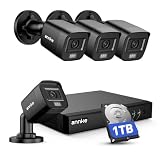
- 【AI Motion Detection 2.0】Driving AI to the next level, human&vehicle detection and flexible detection area are more accurate than before. For quicker locating in crucial moments, human&vehicle smart searching in recordings offers you great help.
- 【Tried-and-True Safe Guard】This one-stop security solution can work with TVI, AHD, CVI, CVBS & IP cameras, the kit includes 1080P cams. The 8CH 3K lite DVR can hook up with 1080P@30fps or 3K/5MP@20fps cams. Therefore, you can also DIY it with other cameras in your home.
- 【Reliable 24/7 Continuous Recording】With a pre-installed 1TB HDD(Support up to 10TB HDD), providing 24/7 surveillance recording for you. Upgraded H.265+ saves more storage space and uses less bandwidth, recording videos longer and smoother viewing.
- 【Remote Access Anytime, Anywhere】Stay connected to your home security system through your smartphone. View live footage and play back recordings remotely, keeping an eye on your property whenever and wherever you need.
- 【Clear Night Vision and IP67 Weatherproof Protection】Built-in IR LEDs provide black-and-white night vision up to 100ft. With an IP67-rated design, these wired security cameras are built to withstand rain, dust, and changing weather conditions for reliable outdoor surveillance.
What are common failure modes and how do you correct them?
High accuracy caused by class imbalance
Symptom: a headline accuracy figure looks excellent while recall or precision is poor. Fix: report precision-recall behavior, false-negative cost and the operating threshold using production-like prevalence.
Random splits leak the future
Symptom: validation scores collapse on later months or after a new attack wave. Fix: use time-based holdouts and out-of-time tests; remove post-decision fields and investigate backfilled features.
Labels are immature or inconsistent
Symptom: recent transactions are treated as legitimate and investigators disagree frequently. Fix: model label delay, quarantine unresolved outcomes, measure adjudicator agreement and repeat evaluation as outcomes mature.
The review queue is operationally impossible
Symptom: a threshold catches more fraud but creates more alerts than staff can examine. Fix: include alert volume, review yield and service levels in threshold selection; stage exposure and add prioritization or capacity before expanding.
Generated code fails silently
Symptom: missing features, API errors or human overrides produce plausible scores without an alert. Fix: inject failures, require explicit error states and alerts, and test the approved fallback behavior.
Fairness review checks only one metric
Symptom: one parity statistic passes while a group experiences more blocks, longer appeals or worse calibration. Fix: examine multiple error, calibration and workflow outcomes, then document the socio-technical trade-off.
Security is postponed until after launch
Symptom: the system has no red-team evidence, weak artifact integrity or incomplete audit logs. Fix: make security evaluation a release gate, remediate findings and preserve evidence before enabling enforcement.
Do these 3 things before closing this tab:
1Repair Windows errors before they cause bigger problems2Scan for outdated or missing drivers - takes under a minute3Clear out junk files and repair common Windows errorsA vendor or model changes without notice
Symptom: score distributions or latency shift even though your code is unchanged. Fix: pin versions where possible, require change notification, monitor fingerprints and trigger revalidation for material changes.
Best Value

- Video Doorbell is our second-generation smart security doorbell with up to two years of battery life, an expanded field of view, and improved security features for more peace of mind, no matter where you are.
- Last longer with two-year battery life — Experience up to two years of smart security coverage on both devices with included AA Energizer lithium batteries and a Blink Sync Module (included with Outdoor 4).
- See and speak from the Blink app — Experience head-to-toe HD viewing from Video Doorbell and 1080p HD live view from Outdoor 4 as well as infrared night vision and crisp two-way audio.
- See more at your door with Blink Video Doorbell — Greet guests and watch packages get delivered, day and night, with head-to-toe HD view and infrared night vision. Use two-way talk to hear and speak through the Blink app.
- Enhanced motion detection with Outdoor 4 — With our all-new Outdoor 4, enjoy a wider field of view and be alerted to motion faster with dual-zone, enhanced motion detection.
How should two candidate fraud setups be compared?
Compare complete operating systems, not isolated model scores. Use the same holdout periods, slices, threshold options and operational assumptions for both candidates.
| Comparison axis | Questions to answer |
|---|---|
| Fraud capture and customer burden | How do measured fraud dollars prevented, recall, precision and false-positive volume differ at comparable operating points? |
| Calibration and workload | Which score is more reliable for prioritization, and which creates a queue the team can actually review? |
| Robustness | How do the systems behave under drift, missing feeds, new merchants, seasonality and adversarial manipulation? |
| Fairness | Which has smaller or more explainable disparities across relevant groups and workflows? |
| Explainability and override quality | Can reviewers understand reason codes, challenge a decision and document an override? |
| Latency and availability | Does either setup violate authorization or investigation service levels under peak load or degraded dependencies? |
| Provenance and privacy | Are data rights, feature lineage, retention, access and provider terms clear? |
| Monitoring and rollback | Can operators detect drift, investigate incidents and restore a known-good artifact quickly? |
| Transparency and lifecycle cost | Will the provider disclose changes, support validation and cover the ongoing cost of testing and incident response? |
A less complex setup can be the safer choice when its performance is adequate and its behavior, lineage and failure modes are easier to validate. Make that trade-off explicit rather than treating model sophistication as a benefit by itself.
What is the practical release sequence?
- Approve the purpose, population, action, failure costs and acceptance criteria.
- Freeze and hash the generated code, model, data definitions, dependencies and deployment image.
- Complete lineage, label-delay, leakage, contamination and data-quality reviews.
- Run representative holdout, out-of-time, adverse-condition and drift tests.
- Compare thresholds using performance, calibration, workload, latency and financial impact.
- Run fairness TEVV and independent challenge; document unresolved limitations.
- Threat-model, red-team and remediate security and privacy findings.
- Approve human review, appeals, overrides, logging, incident response and rollback.
- Operate in shadow mode, then a limited cohort, with predefined expansion and stop criteria.
- Monitor continuously, revalidate after material change and retire the setup when its assumptions no longer hold.
This sequence turns an AI-generated proposal into a controlled, auditable decision system. Passing one test does not authorize deployment; release is justified only when the evidence, controls and accountable approval all match the intended use.
Windows Errors? Fix Them Before They Spread
Repair common Windows errors and clear accumulated junk for a smoother, more stable PC - no reinstall needed.Free scan · no reinstallCrashes, No Sound, or Screen Glitches?
Random freezes, missing sound and display glitches usually trace back to one bad driver. Find and replace yours safely.Free scan · under a minuteFrequently Asked Questions
Can a fraud model be validated if confirmed labels arrive months later?
Yes, but separate mature outcomes from unresolved cases and report the censoring explicitly. Use interim review samples and survival or delay analysis where appropriate, then refresh the evaluation as chargebacks, investigations and customer reports mature; never count unknown outcomes as legitimate by default.
Should a small fraud team choose an interpretable model over a more complex one?
Often, if the simpler option meets the required operating point and is easier to monitor, explain and roll back. The decision should account for validation effort, reviewer comprehension, data dependencies and incident-response capability, not model sophistication alone.
How can we estimate whether investigators can handle the alert volume?
Estimate alerts per period at each threshold, multiply by the median handling time, and compare the result with staffed review minutes after breaks, leave and service-level obligations. Validate the estimate in shadow or limited-cohort operation because handling time and escalation rates usually change once reviewers see live cases.
What should the contract require when an external model provider changes its system?
Require version identification, advance change notice, a description of material behavior changes, access to evaluation evidence and a right to pause or roll back. Treat an undisclosed change in model, data, endpoint, dependency or policy as a revalidation trigger.
What’s actually slowing this PC down?
Pick the symptom - the matching free tool is one click away.
Quick Recap
Product prices and availability are accurate as of the date/time indicated and are subject to change. Any price and availability information displayed on Amazon at the time of purchase will apply.

