
Free tools Windows power users keep installed
One-click scans. No signup required.
At line level, the simplest derived center channel is a scaled sum of the left and right channels: C = (L + R) / 2. This produces the stereo mix’s common, or “mid,” content—not necessarily an original discrete center track. Use a resistor or active summing circuit for ordinary stereo, a matrix decoder only for known matrix-encoded material, and center-extraction DSP when you need dialogue or vocals isolated.
Four different things called a “center channel”
- Discrete center: a separately produced channel in a 5.1 or other multichannel mix.
- Phantom center: a sound perceived between matched left and right speakers.
- Summed center: a mono signal physically created from L and R.
- Extracted center: an algorithmic estimate of centrally localized or correlated content.
A speaker fed with L+R is playing a derived mono signal. It is not automatically reproducing the original discrete center channel.
The signal math: mid and side
A normalized mid/side transform is:
M = (L + R) / 2
S = (L − R) / 2
The inverse is L = M + S and R = M − S. Some equipment uses unscaled L+R and L−R; scaling changes level, not the underlying decomposition. SPL describes mid as L+R and side as L−R in its M/S documentation.
Equal, in-phase signals in both channels can rise by up to 6 dB when simply added. A common equal-power convention attenuates each input by about 3 dB before summing. Apple’s Logic Pro downmix controls and Dolby’s downmix guidance show this type of coefficient. For a dedicated center speaker, provide a trim and leave enough headroom rather than assuming one universal gain.
Crashes, No Sound, or Screen Glitches?
Random freezes, missing sound and display glitches usually trace back to one bad driver. Find and replace yours safely.Free scan · under a minuteWindows Errors? Fix Them Before They Spread
Repair common Windows errors and clear accumulated junk for a smoother, more stable PC - no reinstall needed.Free scan · no reinstall#1 Best Overall
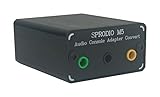
- >This is an Audio Splitter Adapter, supports 1 IN 3 OUT: converts stereo RCA analog to 3 x 3.5mm AUX (1/8 inch) stereo plugs. (for example laptop to headphone and active speaker, and 5.1 speaker)
- >Use direction is reversible, it also supports 3 IN 1 OUT: 3 kinds of 3.5mm input sources (example computer,and smartphone and laptop), to a speaker.
- >Compatible with 5.1 multimedia speaker systems etc.
- >Design with isolate of common ground loop,there is no current hum or noise.
- >Passive box. Plug and play. No need external power supply. No need driver. Small compact size in aluminum case.
Safe analog line-level circuits
Passive resistor summer
L line output ── R1 ──┐
                      ├── center line input
R line output ── R2 ──┘
Use equal resistors for equal contributions. Never tie two source outputs directly together: different voltages can force current through one output stage, causing distortion or damage. The resistors isolate the outputs. Their values must suit the source output impedance, receiving-input impedance, noise target, and desired attenuation; no single value is universally correct. Feed a high-impedance input, or follow the node with a buffer.
Active summing stage
An op-amp summer gives predictable gain, low output impedance, level trim, filtering, muting, and better isolation. With equal input and feedback resistors, an inverting design produces approximately Vout = −(VL + VR); a second stage or polarity correction can restore positive polarity. Select the topology and op-amp for the supply voltage, signal level, bandwidth, noise, and balanced or unbalanced wiring. For balanced TRS or XLR sources, use a proper differential/balanced circuit rather than joining conductors casually.
Rank #2

- Amplify and enjoy your home audio experience in the comfort of your home.Frequency band : 2,400 MHz – 2,483.5 MHz, Maximum output power : ≤ 5.0 dBm..Connector Type: Bluetooth
- 100 watts x 2 (8 ohms, 1 Kilo Hertz). Speaker impedance - 6–16 ohms
- Phono input, 4 stereo RCA audio inputs, 3.5 millimeter input, stereo RCA output
- Built in Bluetooth lets you wirelessly stream your favorite music service, podcasts, and more from other Bluetooth devices.
- Connect up to 4 speakers; A/B switching to play all at once, or in separate zones
A line-level processor cannot drive a passive speaker. Its output must feed a center-channel power amplifier or a multichannel amplifier with a suitable input. Check RCA or 3.5 mm consumer levels versus balanced professional levels, input impedance, grounding, polarity, and available headroom.
Digital and DAW implementation
center = 0.5 * (left + right)
Route the result to a center output, then add gain trim, optional EQ, delay, dynamics, or bass management. Monitor summed peaks: two correlated full-scale signals can clip an unattenuated sum. Passive summing has effectively negligible latency; ordinary digital M/S processing is usually low latency, while adaptive or frequency-domain extraction may buffer audio or add look-ahead.
Quick wins for a faster PC:
Scan for outdated or missing drivers - takes under a minuteDriver Scan →Clear out junk files and repair common Windows errorsFree Scan →Rank #3

- HIGHER POWER, LOWER NOISE: 5.1 channels amplifier supports 5 speakers and 1 subwoofer ( L/R speaker RMS: 60W/ 4R; L/R surround & center speakers: 25W * 3 ) to enhance stereo sounds. ( Note: Only supports PCM decoding; Dolby and DTS decoding are not supported. ) In addition, the noise problem has been optimized. The relays have been added in the receiver, so the noise in standby mode is almost gone
- MULTIFUNCTION REMOTE: Without the limitation of a single function, our amplifier home audio comes with an upgraded remote control that can use the setting functions of treble/ midrange/ bass/ echo/Talkover in any input mode ( battery is not included)
- MULTI-INPUT MODES: The audio receiver supports various sound source inputs, including Bluetooth 5.3, USB (up to 64 GB), 1 RCA, 1 AC-3, 2 mic inputs, AUX IN, and FM radio. In addition, digital Optical fiber and coaxial interfaces have been added to fit most smart TVs (NOTE: No HDMI input)
- UPGRADED FM FUNCTION: You can quickly select the FM frequency you prefer by entering the numbers, making FM searching more convenient
- CUSTOMIZED EQ CONTROL: Both the amplifier and the remote can independently control the treble, midrange, and bass adjustment, so you can set the sound as you like. Donner MAMP4 can automatically save the mode selection, volume, and EQ settings you set, so you don’t need to adjust again after the next startup
What an L+R center actually contains
- Centered vocals or dialogue.
- Bass, kick, snare, and other instruments mixed equally to both sides.
- Mono material duplicated into both channels.
- Correlated reverberation and ambience.
- Some material panned left or right: a plain sum is a mono mix of both channels, not a pan-position classifier.
Consequently, L+R is not dialogue-only or vocal-only extraction. A small center speaker may need a high-pass filter; a full-range music or theater feed may instead require normal bass management. A speech band-pass is appropriate only when intelligibility, rather than faithful reproduction, is the goal.
M/S processing and center extraction
M/S processing lets you process the common and difference components separately: EQ or compress the mid, widen or reduce the side, or create a controllable center feed before decoding back to stereo. It still does not reveal a hidden discrete track. Hardware examples include SPL Gemini and Dangerous Music S&M; Voxengo MSED provides a free software implementation.
Rank #4

- ➤ IMMERSIVE SOUND: BlueRigger digital audio cable uses precision technology with fiber optics to transmit crystal-clear surround sound with zero electrical interference. Supports uncompressed PCM audio, compressed 5.1 to 7.1 surround sound systems (Dolby Digital Plus, DTS-HD, ADAT & LPCM)
- ➤ TOSLINK OPTICAL CABLE: Designed for home theatre and professional AV installations. BlueRigger toslink cables transfer the signal using light, thus completely eliminating RFI, EMI & ground loop interference
- ➤ SOLID CONSTRUCTION: Flexible yet durable PVC jacket can withstand 25,000+ bend cycles. This fiber cable comes with 24K Gold plated connectors for optimal signal transfer. Removable rubber tips protect the connectors from dust & prevents oxidation. ➤ NOTE: Please remove the protective cover before use
- ➤ UNIVERSAL COMPATIBILITY: BlueRigger digital optical cable is compatible with Soundbar, Home Theatre,TV, Xbox 360/One, PS4, Blu-Ray, DAC, Audio Processor, Receiver/Preamp & other devices with a standard Toslink port (s/PDIF, optical, optic)
- ➤ LIFETIME WARRANTY: BlueRigger Lifetime Warranty and US-based Customer Support
For selective vocal or dialogue work, center-extraction processors analyze more than a fixed sum. iZotope’s RX Center Extract can keep center or keep sides; Leapwing CenterOne offers center/side and L/C/R controls. Such tools estimate or manipulate phantom-center content and can leave reverb, chorus, doubled vocals, or shared instruments behind. They require stereo information; a mono file has no left/right field to analyze.
Why L−R can remove a vocal—and why it fails
If a vocal is identical and in phase in both channels, subtraction cancels much of it:
Best Value

- PROZOR Optical to RCA Converter: This digital to analog audio converter transforms SPDIF digital audio signals into analog L/R RCA audio, ensuring high-quality sound output ——⚠️Set TV audio output format to PCM | 📌Adjust TV volume via settings | 📌Optical output not supported
- Built-in Audio Amplifier Chip: Equipped with a professional audio amplifier chipset and dual-channel operational amplifier, addresses the common issue of low RCA output volume, resulting in pure and crisp sound quality. (For extra gain, check out our upgraded DAC with volume knob.)
- Supports High-Resolution Audio: 192kHz Sampling Rate achieved, Supports Sampling Rate at 32, 44.1, 48, 96 and 192kHz, and 24-bit SPDIF Incoming Bit Stream on Left and Right Channels, ensuring that your audio experience is rich in detail and accuracy
- Compact and Lightweight Design: Built-in 1.1m RCA cable (Non-pluggable), simplifying installation by eliminating the need for extra cables. Its small form factor saves space
- Supports PCM Digital Audio: Outputs uncompressed 2-channel LPCM or PCM audio for clear, high-fidelity sound (Note: It is incompatible with 5.1 channel signals such as Dolby AC3. Please set the Audio Output to PCM before using.)
S = L − R
This is the basis of center-removal or karaoke techniques. Stereo reverb, delay, chorus, level imbalance, panning offsets, and other processing prevent complete cancellation. Instruments sharing the center disappear too. Correct channel balance and polarity first; iZotope documents this limitation in its Center Extract guide.
Independent reader supportYour contribution helps us test, update, and keep practical guides available for everyone.When a matrix decoder is the right tool
Dolby Pro Logic and related systems are not generic L+R splitters. They decode intentional phase and level relationships in a matrix-encoded stereo signal, commonly called Lt/Rt. Ordinary playback stereo is generally Lo/Ro. Dolby describes Pro Logic II as deriving left, center, right, and surround outputs from compatible stereo material in its Pro Logic II overview and distinguishes Lt/Rt from Lo/Ro in its metadata guide.
Use a compatible decoder when the source is known or strongly suspected to be matrix encoded. Feeding arbitrary music into one can cause steering, pumping, unexpected surround routing, or unstable imaging; it does not reconstruct original discrete tracks from ordinary stereo. Dolby’s DP564 guide and DAM Audio’s matrix-surround explanation provide implementation context.
System integration and calibration
- Set the source to a known nominal level and verify left/right balance.
- Sum with normalized coefficients or controlled attenuation.
- Watch the center output for clipping.
- Connect a suitable center amplifier and speaker; do not connect a passive speaker to line level.
- Match center level by measurement or listening at the intended seat.
- Align speaker delay and polarity. A center speaker playing the same correlated content while L/R remain unchanged can cause comb filtering, excessive loudness, or a diffuse image.
- Test centered speech, hard-panned material, bass, and stereo ambience.
Ground loops may require balanced connections or appropriate isolation. A polarity reversal in one source channel weakens the L+R center and changes L−R behavior. Stereo widening, Haas delays, chorus, phase rotation, and wide reverb can make center placement unstable.
Choose the approach by the goal
| Goal | Best starting point | Reason |
|---|---|---|
| Feed a center amplifier from ordinary stereo | Passive resistor sum or active summer | Simple, predictable, low latency |
| Mono-compatible center feed | Scaled L+R | Retains correlated content with headroom |
| Mastering width and center control | M/S processor | Independent mid and side processing |
| Known Dolby Surround/Lt/Rt source | Compatible matrix decoder | Uses intentional encoding cues |
| Isolate vocals or dialogue | Center-extraction or source-separation DSP | More selective than a fixed sum, but may artifact |
| Automotive multi-seat center stage | Dedicated automotive DSP | Can address frequency, phase, delay, and seat position |
For advanced automotive processing, Riven describes its SRP as a frequency-domain three-channel processor; performance statements there are manufacturer claims, not independent measurements. Software products such as Waves Center target DAW-based center/side control, while Reason’s SU-27 is intended for matrix-decoding experiments.
Quick Recap
Troubleshooting
- Center too loud: reduce the center trim or use approximately −3 dB per input before summing.
- Clipping: lower input gain, normalize the sum, and leave downstream headroom.
- Hollow or phasey sound: check polarity, speaker delay, tonal matching, and three-speaker overlap.
- Vocals disappear: you are likely monitoring L−R or have a polarity/phase error; verify with a mono test signal.
- Hard-panned instruments appear in center: expected with a raw mono sum; use M/S control or selective extraction.
- No output: confirm the receiving device accepts line-level mono and that the center amplifier is enabled.
- Hum: investigate ground loops and use balanced wiring or suitable isolation.
- Strange surround movement: ordinary Lo/Ro stereo may be unsuitable for a matrix decoder.
Product prices and availability are accurate as of the date/time indicated and are subject to change. Any price and availability information displayed on Amazon at the time of purchase will apply.

