
iTechGuides is reader-supported. When you buy through links on our site, we may earn an affiliate commission. As an Amazon Associate I earn from qualifying purchases. Learn more
To convert inches to centimeters, multiply the inch value by 2.54:
centimeters = inches × 2.54
The factor is exact: 1 inch = 2.54 centimeters. For example, 12 inches is 12 × 2.54 = 30.48 centimeters.
Inches-to-centimeters conversion formula
Use this formula for any whole number, decimal, or fraction:
Free tools Windows power users keep installed
One-click scans. No signup required.
cm = in × 2.54
Written as a unit conversion, the calculation is:
inches × (2.54 cm ÷ 1 in) = centimeters
The in units cancel, leaving the answer in centimeters. The inch-to-centimeter factor is exact, not a rounded estimate. NIST defines one inch as exactly 2.54 centimeters, or 25.4 millimeters.
Popular on Amazon

- Versatile Acrylic Ruler for All Needs - This 12 inch ruler is perfect for students and teachers. An essential measuring tool, its transparent design allows for precise measurements and easy page viewing
- Easy-To-Read Markings for Accuracy - Our straight edge ruler features clear metric and imperial markings, ensuring every measurement is readable, ideal for kids and precise drawing, enhancing your schoolwork
- Enhanced Drawing Experience - With raised beveled edges, this ruler minimizes smudging and enhances precision. Perfect for school projects, this acrylic ruler ensures every line is crisp and accurate for students
- Convenient Design for Everyday Use - This ruler features extra end margins for clear starts and stops and includes a storage hang hole. The transparent ruler is ideal for both classroom and office use
- Premium Quality from Westcott - Known for quality measuring tools, this Westcott ruler combines durability with functionality. Ideal for the classroom or office, this clear ruler ensures accuracy in every project
Examples
| Inches | Calculation | Centimeters |
|---|---|---|
| 1 in | 1 × 2.54 |
2.54 cm |
| 5 in | 5 × 2.54 |
12.7 cm |
| 12 in | 12 × 2.54 |
30.48 cm |
| 36 in | 36 × 2.54 |
91.44 cm |
How to convert inches to centimeters
- Write down the measurement in inches.
- Multiply it by
2.54. - Label the result in centimeters.
- Round the result only if the measurement or the intended use requires it.
For example, to convert 7.5 inches:
7.5 × 2.54 = 19.05 cm
Therefore, 7.5 inches equals 19.05 centimeters.
Converting fractions of an inch
Convert the fraction to a decimal first, then multiply by 2.54. For example:
¼ inch = 0.25 inch
0.25 × 2.54 = 0.635 cm
So, ¼ inch equals 0.635 centimeters. The same method works for measurements such as ⅜, ½, or 1¾ inches.
| Fraction | Decimal inches | Centimeters |
|---|---|---|
| ¼ in | 0.25 | 0.635 cm |
| ½ in | 0.5 | 1.27 cm |
| ¾ in | 0.75 | 1.905 cm |
| 1¾ in | 1.75 | 4.445 cm |
Converting feet and inches
Do not multiply a notation such as 5 ft 6 in directly by 2.54. Convert the feet to inches first:
Quick wins for a faster PC:
Repair Windows errors before they cause bigger problemsFix Now →Fix the driver behind crashes, sound loss and screen glitchesFind Drivers →Also popular on Amazon
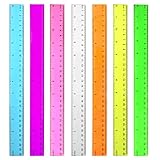
- 7 Color Plastic Rulers: Pink, Orange, Blue, Transparent, Purple, Green, Yellow, The ruler size is 30.8 * 3 cm, measure of 12 inch/ 30 cm, Made with transparent clear plastic
- Two Sides Measuring Ruler: It has metric and english measurement functions, Centimeter scale is on one edge of the ruler and inch scale is on the other edge; Precision measure dimensions, Ideal for bazic scaled measurement tasks, Easy marking and convenient to use
- Durable And Sturdy: Our standard rulers are hard and not easy to shatter, Translucent color allows for a clear of numbers and letters on the page, You can measure an object easily, Each ruler is durable, Shatterproof design, You can use it for a long time.
- Kids School Rulers: Ruler in assorted colors, Smooth edges and standard dimensions, Perfect for kids and students, It is a useful measuring tool for students, Suitable for math education, Classroom teaching, Class, School, Office, Home etc.
- Wide Application: Our rulers are suitable for many craft and school related, If you are not satisfied with our ruler, You can return it at any time, We will improve it in time until you are satisfied.
- Multiply the feet by 12, because
1 ft = 12 in. - Add the remaining inches.
- Multiply the total by 2.54.
For 5 ft 6 in:
(5 × 12) + 6 = 66 in
66 × 2.54 = 167.64 cm
Thus, 5 feet 6 inches equals 167.64 centimeters.
Reverse conversion: centimeters to inches
To convert centimeters to inches, divide by 2.54:
inches = centimeters ÷ 2.54
For example:
30.48 ÷ 2.54 = 12 in
You can also multiply by the repeating decimal 0.3937007874…, but dividing by 2.54 is usually clearer. The commonly repeated instruction to “divide inches by 2.54” is backwards: division converts centimeters to inches, while inches-to-centimeters conversion requires multiplication.
Using Google Sheets
Google Sheets has a built-in CONVERT function. Its syntax is:
=CONVERT(value,"in","cm")
To convert 12 inches, enter:
=CONVERT(12,"in","cm")
The result is 30.48.
If cell A1 contains the inch measurement, use:
=CONVERT(A1,"in","cm")
Both "in" and "cm" are distance units, so Sheets can convert between them. The function returns an error when the starting and ending units belong to incompatible categories, such as converting feet to Celsius.
Also popular on Amazon

- EASY-TO-READ MEASUREMENTS: Large, high-contrast markings in both standard and metric scales make measurements easier to see at a glance, helping improve accuracy across drafting, classroom activities, and everyday projects.
- DUAL-COLOR READING: Blue standard scale and black metric scale sit side by side for quick, accurate reading — ideal for projects where switching between units matters.
- NON-GLARE PLASTIC EDGE: Matte plastic surface helps reduce reflections and provides a lightweight straight edge for drawing, marking, spacing and everyday layout work.
- DESIGNED FOR SCHOOL, OFFICE, AND CREATIVE PROJECTS: A versatile measuring tool for students, teachers, artists and designers who need a reliable ruler for accurate measuring across any project.
- THOUGHTFUL WORKSPACE SOLUTIONS: Victor Technology Brands creates practical products built around the way people work, learn and organize every day. Across our growing portfolio, Thoughtful Innovation means useful improvements that make spaces easier, clearer and more efficient.
Length, area, and volume are different conversions
The factor 2.54 applies to a linear measurement only. Do not use it unchanged for square inches or cubic inches.
Outdated Drivers Are Slowing You Down
One free scan finds every outdated or missing driver and matches the right update for your exact hardware.Free scan · exact hardware matchWindows Errors? Fix Them Before They Spread
Repair common Windows errors and clear accumulated junk for a smoother, more stable PC - no reinstall needed.Free scan · no reinstallSquare inches
For area, square the linear conversion factor:
1 in² = (2.54 cm)² = 6.4516 cm²
Therefore, 10 in² equals 64.516 cm², not 25.4 cm².
Cubic inches
For volume, cube the factor:
1 in³ = (2.54 cm)³ = 16.387064 cm³
Therefore, 5 in³ equals 81.93532 cm³.
In Google Sheets, area and volume use separate unit codes, such as "in^2" and "in^3". Use the unit that matches the measurement rather than "in" for every type of result.
Also popular on Amazon

- Clear color rulers: Ruler allows for a clear view of numbers and letters on the page; with the clear Mathematics ruler, you can measure an object easily
- 2 Measuring scales: centimeter scale is on one edge of the ruler and inch scale is on the other edge; Can meet your different measuring needs
- Long Lasting and sturdy: the plastic straight ruler is made of good quality plastic, flexible, and shatter-resistant plastic that won't break when bent, but avoid put too much force on the straight ruler
- Wide application: a useful measuring tool for artists, designers, architects, engineers, students and so on; Suitable for classroom, school, office, home, etc
- 2 Pack plastic clear ruler: the size of this ruler is 30.9 x 3.2 cm (L x W), 0.25 cm in thickness; 2 Pack plastic ruler, measures range is 12 inches/ 30 cm
How much should you round?
The conversion factor is exact, but the displayed answer does not always need every decimal place. Your rounding should reflect the precision of the original measurement and the purpose of the result.
| Use case | Possible reporting |
|---|---|
| Exact calculation or technical drawing | Keep the required decimal places, such as 30.48 cm |
| General size description | Round to a practical value, such as 30.5 cm |
| Rough mental estimate | Use approximately 2.5 cm per inch |
For a quick estimate, multiply inches by 2.5. For example, 12 inches is roughly 30 centimeters. This shortcut is useful for mental math, but it is not the exact conversion and should not replace 2.54 when accuracy matters.
Recommended Free Tools
Common conversion mistakes
- Using division instead of multiplication:
12 ÷ 2.54gives approximately 4.72, which is inches from centimeters—not centimeters from inches. - Using 2.5 as the exact factor: 2.5 is only a convenient estimate. The exact factor is 2.54.
- Ignoring feet: Convert every foot to 12 inches before converting the combined measurement.
- Confusing length with area: Square the factor for square inches and cube it for cubic inches.
- Rounding too early: Keep the full result until the final step, especially when converting several measurements or calculating an area.
- Entering units as part of a calculator number: In many calculators, enter the numeric value separately and attach the unit to the result. For example, calculate
5 × 2.54, then label it12.7 cm.
Reference values
These values are useful for common measurements:
| Inches | Centimeters |
|---|---|
| ⅛ | 0.3175 |
| ¼ | 0.635 |
| ½ | 1.27 |
| 1 | 2.54 |
| 2 | 5.08 |
| 5 | 12.7 |
| 10 | 25.4 |
| 12 | 30.48 |
| 24 | 60.96 |
| 36 | 91.44 |
For the exact definition and conversion-factor guidance, see NIST SP 811, Appendix B. NIST’s approximate-conversion guidance is suitable for quick estimates, while exact work should use the 2.54 factor.
Also popular on Amazon
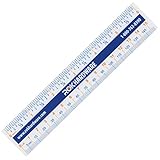
- CLEAR AND EASY-READ MARKINGS: Designed with bold inch, cm, and mm lines plus 1/16" fractions, so anyone can measure accurately without guesswork. Great for school, office, home repairs, and precision projects.
- FLEXIBLE 1MM PLASTIC DESIGN: Ultra-thin bendable body slips into tight spaces and wraps around curved surfaces, making tricky cabinet, woodworking, and craft measurements effortless and frustration-free.
- BUILT-IN CONVERSION CHART: Each ruler includes a cheat-sheet style inch, fraction, mm, and cm converter, helping students, DIYers, and pros quickly calculate measurements with confidence and zero math stress.
- COMPACT AND PORTABLE SIZE: At only 6" (15 cm), the ruler fits perfectly in pockets, tool pouches, pencil cases, backpacks, and desk drawers—always ready when you need a fast and accurate measurement.
- VERSATILE FOR ALL USERS: Ideal for carpenters, contractors, artists, engineers, teachers, and kids learning fractions. A reliable measuring tool for classrooms, workshops, home improvement, and everyday DIY tasks.
FAQ
What is the exact formula for converting inches to centimeters?
Multiply the inch measurement by 2.54: centimeters = inches × 2.54.
How many centimeters are in one inch?
One inch is exactly 2.54 centimeters.
How many centimeters are in 12 inches?
12 inches equals 30.48 centimeters, calculated as 12 × 2.54.
Do I multiply or divide to convert inches to centimeters?
Multiply by 2.54. Divide by 2.54 when converting centimeters to inches.
What’s actually slowing this PC down?
Pick the symptom - the matching free tool is one click away.
Is 1 inch equal to 2.5 centimeters?
Only approximately. The exact value is 2.54 centimeters; 2.5 is a rough mental-conversion shortcut.
How do I convert square inches to square centimeters?
Square the conversion factor: 1 in² = 6.4516 cm². Do not multiply square inches by 2.54.
The Bottom Line
For a linear measurement, multiply inches by 2.54. Thus, cm = in × 2.54. Use division for the reverse conversion, convert feet-and-inches to total inches first, and square or cube the factor for area or volume.

