
Recommended Free Tools
iTechGuides is reader-supported. When you buy through links on our site, we may earn an affiliate commission. As an Amazon Associate I earn from qualifying purchases. Learn more
No—you usually cannot deploy the same AI model unchanged on every edge device and expect the same latency, energy use, accuracy, or reliability. Edge AI works best when the neural network, processor, memory system, compiler, and runtime are designed as one stack. That approach is called algorithm–architecture co-design: the model is shaped around the hardware, while the hardware and software are selected to execute the model efficiently.
Co-design matters because parameter count alone does not predict performance. Operator support, tensor shapes, numerical precision, sparsity, memory traffic, thermal limits, and compiler maturity can make a smaller model slower—or a powerful accelerator mostly idle. The practical goal is to meet a defined accuracy target within the deployment device’s latency, energy, memory, cost, and reliability limits.
What does hardware-aware model co-design mean?
Hardware-aware model co-design is the simultaneous optimization of a model and the platform that runs it. Instead of training a network first and choosing hardware later, the team defines the workload and constraints, selects a compatible model family, tunes the graph and numerical format, maps operators to the target accelerator, and benchmarks the complete stack.
The 2026 Embedded AI survey describes the idea as jointly optimizing “neural network models and their hardware substrates.” In practice, that means treating four layers as connected:
Popular on Amazon
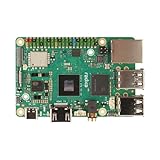
- POWERFUL COMPUTING: Advanced single board computer featuring high-speed LPDDR5 memory for superior processing capabilities and edge AI computing performance
- CONNECTIVITY: Multiple USB ports, HDMI output, and Ethernet connectivity provide versatile interface options for various applications
- COMPACT DESIGN: Space-efficient circuit board layout integrates powerful computing components in a single compact form factor
- DEVELOPMENT READY: Ideal platform for edge AI development, programming, and prototyping with comprehensive hardware interfaces
- EXPANDABILITY: Features multiple GPIO pins and standard connectors enabling extensive hardware expansion possibilities
- Algorithm: architecture, precision, pruning, sparsity, and training strategy.
- Hardware: instruction sets, compute units, dataflow, on-chip SRAM, external memory, and thermal design.
- Compiler: operator fusion, tiling, scheduling, layout conversion, and code generation.
- Runtime: dynamic precision, frequency, batching, admission control, and workload scheduling.
Success is measured across accuracy, latency, energy per inference, memory footprint, and reliability—not by a single score. A 2026 ScienceDirect survey mapped 122 publications: 103 (84.4%) used a broad cross-layer classification, but only 34 (27.9%) reported explicit cross-layer analysis. Those percentages describe research coverage, not the performance of any particular deployment.
Why can’t I deploy the same model everywhere?
A model’s graph interacts differently with every processor. A network with fewer parameters may still be slow if its operators trigger unsupported kernels, require repeated layout conversions, or move activations between external memory and compute units. Conversely, an expensive accelerator can be underused when the model has incompatible operators, unfavorable tensor dimensions, or a precision format the device cannot execute efficiently.
Operator coverage changes the result
Edge accelerators commonly support a limited set of convolutions, matrix operations, activation functions, and tensor layouts. If one layer is unsupported, the compiler may send it to a general-purpose CPU. That fallback can add synchronization, memory copies, and queue overhead that outweigh the savings from accelerating the rest of the graph.
Precision is a platform decision
Floating-point, 16-bit, 8-bit, and lower-precision arithmetic have different speed, memory, and accuracy characteristics. A quantized model only saves energy when the target hardware and compiler execute that precision natively. If unsupported operations are silently promoted to a wider format, expected gains may disappear.
Tensor shapes and memory movement matter
Parallel hardware is most efficient when tensor dimensions fit its processing tiles. Odd channel counts, small batches, or frequent reshapes can leave compute units idle. Memory-centric studies identify movement through the hierarchy—from external DRAM to caches, SRAM, and local buffers—as a dominant bandwidth and energy cost. Reusing data on-chip, compressing it, or processing it near memory can matter more than reducing parameters.
Which layers must be co-designed?
1. Algorithm optimization
Quantization lowers numerical precision; pruning removes weights or connections; and architecture search selects operators that deliver useful accuracy with less computation. Structured sparsity, such as removing complete channels or blocks, is easier for many accelerators to exploit than irregular zero patterns. The correct choice depends on whether the deployment stack has kernels that recognize the pattern.
2. Hardware specialization
Designers can add instruction-set extensions, fixed-function units, systolic arrays, vector engines, or specialized dataflows. A dataflow determines when weights, activations, and partial sums are reused and where they are stored. More on-chip SRAM can reduce expensive external-memory transfers, but it increases silicon area, leakage, and development cost.
3. Compiler transformation
Compilers bridge a model graph and the accelerator’s dataflow. Fusion combines adjacent operations to avoid writing intermediate tensors; tiling breaks large tensors into cache- or SRAM-sized pieces; and scheduling orders work to maximize reuse and parallelism. Layout planning is equally important because repeated transposes can consume substantial time and bandwidth.
Also popular on Amazon

- [High performance] Quad-core ARM SoC up to 1. 8GHz with 3GB RAM- The Tinker Edge R features the Rockchip RK3399Pro SoC and Mali - T764 GPU along with 2GB of Dual Channel LPDDR4 memory for system, 1 GB LPDDR3 memory for NPU and 16GB eMMC flash
- [Gigabit Class networking]Tinker Edge R features a high speed GB LAN port for true Gigabit Class networking throughput along with 3x USB3.2 Gen1 Type-A. It also features onboard Wi-Fi & Bluetooth for robust IoT & Network connectivity
- [Open-source]The board will come with fully open-source kernel and support for multiple APIs, including OpenGL, Vulkan, OpenCL, OpenVX, TensorFlow Lite, Android NN, and Caffe
- [HD Audio & UHD video support] It supports 192/24bit HD Audio playback with automatic Audio jack detection as well as accelerated HD & UHD ( 4K ) video playback and supports HDMI CEC for seamless power on & off configurations
- [WiKi]For more information please refer to the product description, any technical issues after purchase please contact with our tech-support team: click "WayPonDEV" and ask a question. Package Content: 1x Tinker Edge R (3GB+16G eMMC); 2x Wi-FiVBT antenna cable; 1x Stand offset(4xScrew+4xHex); 2x Camera MIPI Convert cable (22P to 15P); 1 x Shielding bag; 1 x Quick start guide
4. Runtime adaptation
An edge system may face changing temperature, battery state, sensor rates, or latency budgets. Runtime policies can select a lower precision, reduce frequency, change scheduling, or choose a smaller model when conditions tighten. Adaptation must be bounded and observable: an emergency power-saving mode that causes missed deadlines is not a successful optimization.
Which edge AI hardware should I choose?
Choose the platform that covers your operators and precision, fits the memory and thermal envelope, and has a compiler and profiling toolchain your team can use. There is no universally best edge processor; the right choice depends on the workload, volume, update schedule, and required reliability.
| Platform class | Typical advantages | Constraints to check | Good fit |
|---|---|---|---|
| Microcontroller | Very low power, low cost, fast wake-up, deterministic control | Small SRAM and flash; limited operators and numerical formats | Simple audio, vibration, sensor classification, and always-on detection |
| Mobile or embedded SoC | CPU, GPU, and often an NPU in one thermal envelope; broad software support | Shared memory contention, heat limits, and vendor-specific toolchains | Vision, speech, and multimodal workloads in products with a moderate power budget |
| Dedicated accelerator module | High efficiency for a defined operator set and precision | Unsupported layers may fall back to the host; compiler coverage is decisive | Stable inference graphs deployed at scale |
| RISC-V platform | Configurable instruction set and potential for domain-specific extensions | Toolchain, kernel, and ecosystem maturity vary by implementation | Research, custom products, and teams needing architectural control |
| GPU | High parallel throughput and mature development tools | Power draw, memory bandwidth, and poor efficiency for tiny or intermittent jobs | Large models, high-rate streams, and applications with an adequate thermal budget |
| FPGA | Reconfigurable pipelines, deterministic timing, and custom data paths | Longer development cycles and specialized hardware skills | Fixed-function vision or signal pipelines with strict latency requirements |
| Neuromorphic or memory-centric system | Potentially low data-movement energy and event-driven execution | Specialized programming models, limited operator coverage, and less mature tooling | Event-based sensing or research workloads designed for the architecture |
Representative discussions in the literature include Edge TPU, Jetson Orin, and neuromorphic chips, but those examples are not universal recommendations. Compare model and platform together rather than ranking devices by peak operations per second.
What’s actually slowing this PC down?
Pick the symptom - the matching free tool is one click away.
How do I reduce latency and power without losing accuracy?
Use a measured, five-stage workflow. Each stage produces information needed by the next; skipping the workload definition usually leads to optimizing the wrong metric.
- Define the workload and limits. Record input resolution, sensor rate, concurrency, deadline, allowable energy per inference, memory ceiling, minimum accuracy, thermal conditions, and reliability requirements. Specify whether latency means model execution only or end-to-end capture, preprocessing, inference, and postprocessing.
- Select a model family. Start with architectures whose operators are supported by candidate devices. MobileNet-style depthwise and pointwise convolutions can reduce computation; EfficientNet-style compound scaling can trade resolution, depth, and width; lightweight transformers may suit workloads where attention is efficient on the chosen accelerator. These are starting points, not guarantees.
- Optimize precision and structure. Apply calibration-aware quantization, pruning, or structured sparsity, then retrain or fine-tune as needed. Measure accuracy on representative data, including rare classes and difficult lighting or noise conditions. Confirm that the resulting format and sparse pattern have native kernels.
- Align the graph with dataflow. Fuse compatible operators, choose tile sizes that fit local SRAM, eliminate unnecessary reshapes, and keep tensors in the layout expected by the accelerator. Inspect compiler reports for CPU fallbacks, inserted copies, and un-fused nodes.
- Deploy and benchmark the complete stack. Test the compiled model on the actual device under realistic temperature, input rate, and background-load conditions. Record accuracy, p50 and tail latency, energy per inference, peak memory, accelerator utilization, and failures. Repeat after firmware, compiler, or model updates.
What should a fair model comparison measure?
A model comparison is useful only when every candidate is evaluated with the same dataset, preprocessing, postprocessing, device, compiler settings, and measurement window. The reviewed sources do not establish universal latency or energy numbers; those values are workload- and hardware-specific.
| Candidate | Precision | Operator set | Memory footprint | Accelerator utilization | Latency | Energy | Accuracy |
|---|---|---|---|---|---|---|---|
| MobileNet variant | Not stated; measure on target | Not stated; verify depthwise and pointwise kernels | Not stated; measure peak activation and weight memory | Not stated; profile compiled graph | Not stated; measure end to end | Not stated; measure per inference | Not stated; evaluate on deployment data |
| EfficientNet variant | Not stated; measure on target | Not stated; check compound-scaling operators | Not stated; measure peak activation and weight memory | Not stated; profile compiled graph | Not stated; measure end to end | Not stated; measure per inference | Not stated; evaluate on deployment data |
| Lightweight transformer | Not stated; measure on target | Not stated; verify attention and projection kernels | Not stated; measure key/value and activation memory | Not stated; profile compiled graph | Not stated; measure end to end | Not stated; measure per inference | Not stated; evaluate on deployment data |
Report median and tail latency, not just an average. A camera application that misses one frame every few seconds may be unacceptable even when its mean is low. Likewise, a battery-powered node should report energy per inference or per hour, with the measurement method and duty cycle.
Independent reader supportYour contribution helps us test, update, and keep practical guides available for everyone.When do quantization and pruning actually help?
Quantization helps when lower-precision arithmetic reduces memory traffic and compute cost without unacceptable accuracy loss, and when the target accelerator executes that precision directly. Post-training quantization is quick to try; quantization-aware training can recover accuracy when calibration alone is insufficient. Always test sensitivity by layer because first and last layers, normalization, and detection heads may need wider precision.
Pruning helps when removed work translates into a smaller executable graph. Unstructured zeros may reduce model storage yet deliver little speedup if the hardware performs dense matrix operations. Structured channel or block pruning is generally easier to schedule, but it can change tensor shapes and require fine-tuning. The useful result is measured latency and energy, not a headline sparsity percentage.
Also popular on Amazon

- Supports access to online large model platforms and includes Edge Impulse object detection demo for real-time multi-object recognition
- Equipped with Xtensa dual-core LX7 processor (up to 240MHz), 8MB PSRAM, 16MB Flash, and dual-mode WF + BT LE
- Dual-microphone array with noise reduction and echo cancellation for high-quality voice processing
- Integrated audio input and output module, supporting AI speech interaction and voice recognition applications
- Onboard camera interface (DVP) and SPI / QSPI display interface for image capture, recognition, and external display connection
How do memory and thermal limits change the design?
Weights are only part of memory use. Intermediate activations, compiler workspaces, camera buffers, operating-system reservations, and duplicated tensors can dominate peak consumption. Estimate peak live tensors during the worst operator sequence, then verify with the runtime allocator on the device.
Thermal throttling can invalidate a short benchmark. Run long enough to reach the product’s steady-state temperature and include realistic enclosure and airflow conditions. If frequency drops, a model that wins in a one-minute test may lose over an hour. Co-design options include smaller tiles, lower refresh rates, dynamic frequency, model switching, and scheduling inference around other workloads.
What are common co-design failures and their fixes?
- Optimizing parameter count only: Profile memory transfers and operator kernels; replace unsupported or bandwidth-heavy layers.
- Assuming INT8 always wins: Verify native INT8 kernels, calibration quality, and fallback nodes on the chosen compiler.
- Using irregular sparsity on dense hardware: Prefer structured patterns the accelerator and compiler can skip.
- Benchmarking the model on a workstation: Measure the compiled graph on the production device, including preprocessing and postprocessing.
- Ignoring tail latency: Capture percentile latency under concurrent tasks and realistic sensor timing.
- Overlooking reliability: Test thermal variation, memory errors, dropped inputs, watchdog recovery, and model-output validation.
- Changing the compiler without retesting: Treat compiler, firmware, and kernel updates as performance-affecting releases.
What remains unresolved in edge AI co-design?
Research still lacks standardized holistic benchmarks that report accuracy, latency, energy, memory, utilization, and reliability under comparable conditions. Verification-aware workflows are also needed: an optimization that saves energy but changes safety-critical behavior requires traceable validation, not only a top-line accuracy score.
Quick wins for a faster PC:
Fix the driver behind crashes, sound loss and screen glitchesFind Drivers →Repair Windows errors before they cause bigger problemsFix Now →Scan for outdated or missing drivers - takes under a minuteDriver Scan →Teams can make progress now by publishing complete measurement conditions, separating model execution from end-to-end latency, and preserving a reproducible record of model version, compiler flags, firmware, temperature, and power instrumentation. Those practices make results transferable without pretending that one device or architecture is best for every workload.
Frequently Asked Questions
Do I need custom silicon to use hardware-aware model design?
No. Co-design can begin with an off-the-shelf SoC, accelerator module, GPU, FPGA, or microcontroller. Custom silicon becomes attractive only when the workload is stable, deployment volume justifies nonrecurring engineering, and existing platforms cannot meet the combined power, latency, and cost targets.
How much accuracy loss is acceptable after edge optimization?
There is no universal percentage. Set an application-level error budget by class, operating condition, and consequence of failure; a small average drop can hide a severe regression in a rare but important class. Validate the optimized model against the same acceptance tests used for the uncompressed model.
Should preprocessing and postprocessing be included in edge latency?
For product decisions, yes. Report model-only timing separately for diagnosis, but use end-to-end timing for deadlines because image conversion, sensor transfer, decoding, filtering, and result handling can consume a substantial share of the budget.
How often should an edge model be reprofiled?
Reprofile whenever the model, compiler, runtime, firmware, driver, precision format, or hardware configuration changes. Also rerun thermal and reliability tests after enclosure, clock, or power-management changes, since steady-state behavior can shift without any model edit.

