
The Tool Desk
Outbyte Driver Updater FREEScan for outdated or missing drivers - takes under a minuteDriver Scan →Outbyte PC Repair FREERepair Windows errors before they cause bigger problemsFix Now →iTechGuides is reader-supported. When you buy through links on our site, we may earn an affiliate commission. As an Amazon Associate I earn from qualifying purchases. Learn more
Choose NVIDIA Blackwell when your models and team already depend on CUDA, you need a validated NVIDIA software stack, or a turnkey NVLink system reduces integration risk. Choose AMD Instinct when ROCm is proven for your exact models and its HBM capacity or bandwidth fits better. The family names alone are not enough to make the decision: compare the specific GPU, server topology, memory, interconnect, cooling, software versions and support package. Run a representative training and inference bake-off before signing a purchase or cloud commitment. A lower accelerator price can disappear once you include networking, power, cooling, porting work, support and engineering time.
What are you actually comparing when you say “Blackwell Ultra” and “Instinct”?
“Blackwell Ultra” is a family-level label, not one fixed specification. A meaningful comparison names the NVIDIA SKU, number of GPUs, HBM configuration, host CPUs, NVLink or other fabric topology, cooling method, server vendor and software image. The same discipline applies to AMD Instinct: MI300X and MI325X have different memory capacities and bandwidth, and the surrounding server determines how effectively those resources can be used.
For scale-up reference, NVIDIA describes the GB200 NVL72 as a liquid-cooled rack connecting 36 Grace CPUs and 72 Blackwell GPUs. NVIDIA lists 13.4 TB of HBM3E and 130 TB/s of NVLink bandwidth for that rack-scale design. Those figures describe the complete NVL72 configuration, not a single accelerator. AMD’s published accelerator figures are per device: MI300X has 192 GB of HBM3 and 5.3 TB/s peak bandwidth, while MI325X has 256 GB of HBM3E and 6 TB/s peak bandwidth.
| Option | What the published figure covers | HBM capacity | Peak HBM bandwidth | Important qualification |
|---|---|---|---|---|
| GB200 NVL72 (Blackwell rack) | Rack-scale system | 13.4 TB HBM3E | 130 TB/s NVLink bandwidth | 36 Grace CPUs and 72 Blackwell GPUs in a liquid-cooled rack; not a per-GPU specification |
| AMD Instinct MI300X | Individual accelerator | 192 GB HBM3 | 5.3 TB/s | AMD figure for the accelerator; server topology and software still determine realized performance |
| AMD Instinct MI325X | Individual accelerator | 256 GB HBM3E | 6 TB/s | AMD figure for the accelerator; confirm the exact host and interconnect configuration |
Do not compare the 13.4 TB rack total directly with 192 GB or 256 GB per-device values. First define the unit of comparison: one accelerator, one eight-GPU node, a rack, or a cluster sized to a target workload. Then document how many devices participate in a model-parallel job and how memory is divided among weights, activations, optimizer states and key-value cache.
#1 Best Overall

- HIGH PERFORMANCE GPU: The PNY Quadro RTX PRO 4500 Blackwell Server Edition offers professional graphics performance for demanding server applications.
- 32 GB GDDR7 MEMORY: Generous video memory allows you to process complex datasets, AI workloads and compute-intensive visualizations.
- BLACKWELL ARCHITECTURE: Based on NVIDIA's latest Blackwell architecture for maximum computing power and efficiency in professional environments.
- SERVER EDITION: Optimized for use in server environments and supports stable, long-term data center workloads.
- PROFESSIONAL APPLICATIONS: Ideal for AI training, scientific simulations, 3D rendering and other computationally intensive tasks in the professional field.
Which should you choose at a glance?
Use this decision map as a starting point, then validate it with measurements from your own model and software image.
| Your strongest constraint | Usually the better starting point | Why | What could overturn the choice |
|---|---|---|---|
| Existing CUDA code, libraries, containers and staff | Blackwell | Migration effort and integration risk are lower when the application already targets NVIDIA’s stack. | A proven ROCm port that delivers materially better memory fit or cost at your required scale. |
| Need for a validated NVIDIA-certified software stack or turnkey NVLink scale-up | Blackwell | The GB200 NVL72 packages CPUs, GPUs, liquid cooling and NVLink in a rack-scale design. | Your workload does not scale across the NVLink domain, making the premium topology underused. |
| Model exceeds the practical memory of competing devices | Instinct MI325X or MI300X, depending on the validated system | MI325X offers 256 GB HBM3E per accelerator; MI300X offers 192 GB HBM3. | Framework, kernel or collective-communication gaps force slower execution or extra engineering. |
| Long-context inference constrained by memory bandwidth | The SKU with the best measured fit and bandwidth for your model | Large weights and key-value cache can make HBM capacity and bandwidth more important than peak arithmetic. | Latency targets, batching behavior or interconnect traffic dominate instead. |
| ROCm support already demonstrated for every critical model component | Instinct | A validated port can avoid paying for unused CUDA-specific capacity. | Custom kernels, inference engines or multi-node collectives remain unvalidated. |
| Unclear workload behavior or mixed model portfolio | Run a bake-off before selecting either family | Published peak specifications cannot predict application throughput, latency or operator effort. | Only a very narrow workload with a known, stable software stack should skip testing. |
How does CUDA versus ROCm affect the real decision?
Software compatibility often determines realized performance more than a headline FLOPS number. NVIDIA’s CUDA Toolkit is a development environment for GPU-accelerated applications and includes the runtime, libraries, compiler and debugging and optimization tools used by many AI frameworks and production systems. AMD Instinct uses ROCm. You should treat ROCm as a workload-specific validation project, not as a binary “supported” label.
Inventory the software layers
Make a matrix for every model and service you intend to run. Record the framework and version, precision mode, tokenizer and preprocessing path, custom CUDA or HIP kernels, attention and quantization implementations, inference engine, container image, collective-communication library, monitoring agents and job scheduler integration. Mark each item as vendor-supported, community-supported, internally patched or untested.
- Framework: Confirm that the exact release supports your target GPU architecture and the operators used by the model.
- Custom kernels: Identify CUDA extensions that require a HIP port, replacement kernel or removal. Measure the replacement rather than assuming functional compatibility equals performance parity.
- Inference engine: Verify graph compilation, continuous batching, quantization, speculative decoding and paged key-value-cache behavior on the intended stack.
- Collectives: Test all-reduce, all-gather and reduce-scatter at the message sizes generated by your model. Single-device results do not prove multi-GPU scaling.
- Containers and operations: Rebuild images with the correct driver, runtime and kernel libraries, then test health checks, telemetry, checkpointing and upgrades.
Estimate migration work before choosing ROCm
For a CUDA-first application, migration is more than changing an environment variable. Count the kernels that must be ported, numerical differences that require retuning, unsupported operators, image rebuilds, CI changes and the time needed to reproduce accuracy and latency targets. A port that passes a small test can still fail at production sequence lengths or distributed batch sizes. Conversely, if your team already maintains portable kernels and the model uses well-supported operators, the migration burden may be modest; measure it rather than applying a blanket assumption.
Check support boundaries in writing
Ask the system vendor and your framework maintainers which GPU, driver, runtime, compiler and container combinations are supported together. Record the support window, escalation path and responsibility for custom kernels. “Runs” is not the same as “supported for a production incident.”
How much HBM do you need for training and inference?
Start with a memory budget, not the accelerator name. Determine whether the model fits on one device. If it does not, decide whether tensor parallelism, pipeline parallelism, sharding or a larger-memory accelerator is the least complex solution.
Training budget
Training memory includes model weights, gradients, optimizer states, activations, temporary workspaces and communication buffers. Mixed precision reduces some terms but does not eliminate optimizer or activation costs. Sequence length, microbatch size, checkpointing strategy and optimizer choice can change the budget substantially. Calculate the peak allocation during forward, backward and optimizer steps; the static weight size alone is not sufficient.
Inference budget
Inference adds a key-value cache that grows with concurrent requests and sequence length. Long-context serving can therefore be limited by HBM capacity even when arithmetic utilization is low. Include tokenizer buffers, runtime workspaces, quantization metadata and fragmentation headroom. For a production target, reserve memory for traffic bursts instead of sizing to a single best-case request.
What the AMD figures imply
MI300X provides 192 GB of HBM3 and 5.3 TB/s peak bandwidth per accelerator. MI325X raises the stated capacity to 256 GB of HBM3E and peak bandwidth to 6 TB/s. Those differences can reduce the number of devices required for a model or permit a larger batch or context, but only if the framework and kernels use the memory efficiently. Verify usable capacity after the runtime and system-reserved allocations.
What the Blackwell rack figure implies
The GB200 NVL72 specification of 13.4 TB HBM3E and 130 TB/s NVLink bandwidth is a rack-level aggregate across 72 Blackwell GPUs. It is useful when evaluating a rack-scale model-parallel design, not when estimating the memory available on one GPU. Ask for the per-device capacity, the NVLink domain, and the topology exposed to your job scheduler for the exact system you are buying.
Rank #2
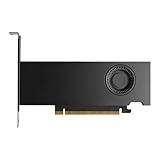
- API Supported: DirectX 12 for advanced graphics rendering and gaming performance
- API Supported: OpenGL 4.6 for professional graphics applications and cross-platform compatibility
- API Supported: Vulkan 1.4 for high-efficiency graphics and compute operations
- API Supported: OpenCL 3.0 for parallel computing and heterogeneous system programming
- Number of Monitors Supported: 4 displays simultaneously for enhanced productivity and multitasking
How should you compare NVLink, Infinity Fabric and cluster networking?
Interconnect behavior determines whether additional GPUs accelerate a job or merely add synchronization time. Compare the size and topology of the high-speed scale-up domain, the paths between GPU and host memory, and the network used between nodes. For AMD systems, document the Infinity Fabric arrangement and host-network design; for NVIDIA systems, document the NVLink and switch topology. Do not infer equivalence from the fabric names.
What’s actually slowing this PC down?
Pick the symptom - the matching free tool is one click away.
Test the communication patterns your model generates
- Tensor parallelism: stresses frequent all-reduce or all-gather operations and is sensitive to latency as well as bandwidth.
- Pipeline parallelism: depends on stage-to-stage transfers and can expose bubbles when microbatches are too small.
- Data parallelism: stresses gradient synchronization and cross-node networking at the end of each step.
- Inference serving: may require continuous synchronization for distributed attention, routing or expert layers, while request scheduling adds variable traffic.
Measure collective latency and bandwidth at realistic tensor sizes, then run the complete model. A microbenchmark can identify a fabric problem, but only an end-to-end test reveals overlap between communication and computation, synchronization stalls and the effect of topology placement.
Include cross-node networking in the quote
A high-bandwidth scale-up fabric does not remove the need for a capable network between nodes or racks. Price and test the network adapters, switches, cables, topology, congestion controls and storage path used for checkpoints. Confirm that the proposed system can place communicating ranks on the intended links instead of silently routing traffic through a slower path.
How do you measure performance fairly?
Use MLPerf results as a reproducible reference, not as a promise for your application. MLCommons describes MLPerf as a way to enable fair comparison while encouraging innovation and to enforce reproducibility. Published results are meaningful only when the model, dataset, precision, batch or sequence length, target quality, software versions and scale match your decision.
Define the acceptance test
- Freeze the workload: Select representative training data or inference prompts, model revision, tokenizer, precision, quantization, sequence-length distribution and target quality.
- Set service objectives: Specify training time to target quality, inference tokens per second, time to first token, inter-token latency, p95 or p99 latency, concurrency and failure-rate limits.
- Match the scale: Test one device, one node and the planned multi-node configuration. Use the same number of ranks, parallelism strategy and checkpoint cadence.
- Standardize the software image: Record GPU driver, CUDA or ROCm release, framework, compiler, collective library, container digest and kernel flags.
- Warm up and repeat: Separate compilation and cache-building time from steady-state measurements. Repeat enough runs to expose variance, throttling and intermittent failures.
- Capture operational data: Log power, temperature, clock behavior, memory use, network traffic, job retries, checkpoint time and operator interventions.
- Record quality: For training, report time to the same validation target. For inference, verify output quality and numerical behavior at the tested precision.
Metrics that belong in the decision sheet
| Area | Record | Why it matters |
|---|---|---|
| Training | Time to target quality, samples or tokens per second, scaling efficiency | A faster step rate is irrelevant if convergence takes longer or quality changes. |
| Inference | Prefill and decode throughput, time to first token, p95 latency, concurrency | Average throughput can hide poor tail latency for interactive users. |
| Reliability | Job failure rate, retries, checkpoint and restart time | Unplanned recovery consumes capacity and staff time. |
| Efficiency | Energy per training step or generated token, sustained power and cooling load | Power and facility limits can cap usable throughput. |
| Operations | Porting hours, debugging hours, deployment time and on-call effort | Engineering labor is part of the platform cost. |
Which option is better for training?
For training, choose the platform that reaches your quality target fastest and most predictably at the required scale. Blackwell is the safer first candidate when your training code, distributed libraries and monitoring are already CUDA-based or when an NVIDIA-certified, rack-scale NVLink design removes topology work. Instinct can be the better fit when ROCm support is validated and MI300X or MI325X memory allows a simpler parallelism plan.
PC Slower Than It Used to Be?
A free scan shows the junk files, broken settings and background clutter dragging Windows down - then fixes them in one click.Free scan · Windows 10 & 11Crashes, No Sound, or Screen Glitches?
Random freezes, missing sound and display glitches usually trace back to one bad driver. Find and replace yours safely.Free scan · under a minuteCompare optimizer-state memory, activation checkpointing, gradient accumulation and checkpoint throughput. A device that fits a larger microbatch may reduce communication or improve hardware utilization, while a device that forces more tensor-parallel shards may spend more time synchronizing. Measure time to the same quality target rather than comparing a single iteration.
Which option is better for inference?
Inference decisions depend on the model’s memory footprint, context length, concurrency and latency objective. MI325X’s 256 GB HBM3E or MI300X’s 192 GB HBM3 may allow a model and key-value cache to remain on fewer devices. Blackwell may be preferable when your inference engine, quantization path, batching scheduler and observability tools are already optimized for CUDA and when NVLink scale-up is needed.
Run separate tests for prefill-heavy and decode-heavy traffic. Report tokens per second together with time to first token and p95 latency at the concurrency your service actually expects. Test context-length extremes and cache growth; a configuration that wins on short prompts may fail once long-context requests consume the available HBM.
Independent reader supportYour contribution helps us test, update, and keep practical guides available for everyone.How do power, cooling and support change total cost?
Compare complete systems, not bare accelerator prices. The bill of materials should include host CPUs, memory, GPUs, high-speed fabrics, network adapters, switches, storage, racks, power distribution, liquid or air cooling, installation, software support and warranty coverage. The available data does not establish a current like-for-like street price, so any precise price comparison would be misleading.
Recommended Free Tools
Facility and deployment questions
- Can the data center supply the sustained power and circuit density of the proposed node or rack?
- Is liquid cooling available, and who supplies leak detection, maintenance and heat rejection?
- What network topology and cabling are required for the intended scale-up and cross-node traffic?
- Does the scheduler understand GPU partitioning, topology-aware placement and health evacuation?
- What is the replacement process for a failed accelerator, switch or cooling component?
Software and staffing costs
Include migration and validation work, CI maintenance, kernel ownership, performance tuning, telemetry integration and incident response. A lower acquisition quote can be offset by porting unsupported operators, buying additional devices to compensate for memory limits, or requiring specialists to maintain a less familiar stack. Conversely, an expensive turnkey system may be wasteful if your jobs use only a small fraction of its scale-up domain.
Rank #3

- COMPATIBILITY: EXCLUSIVELY DESIGNED for NVIDIA RTX PRO 6000 Blackwell Server Edition, NVIDIA RTX PRO 6000 Blackwell Max-Q, NVIDIA RTX 6000D 84G, and NVIDIA RTX PRO 5000 Blackwell, ensuring a perfect fit and optimal performance. Comes complete with MOUNTING HARDWARE and THERMAL GREASE for straightforward setup.
- OPTIMIZED FOR CONTINUOUS USE: Designed specifically for sustained performance in demanding environments.
- SUPERIOR BUILD MATERIALS: Features a combination of NICKEL ELECTROPLATED HIGH PURITY COPPER, STAINLESS STEEL, and POM for enhanced durability.
- ULTRA-SLIM PROFILE: The stainless steel panel design ensures a sleek, LOW-PROFILE FIT for your GPU setup. Engineered to support MULTIPLE BLOCKS IN SERIES, maximizing cooling efficiency.
- USA SUPPORT FRIENDLY AND EXPERIENCED: Tyler Direct provides friendly and knowledgeable customer support in the USA, assisting with troubleshooting and compatibility issues. You'll benefit from a comprehensive 1-year warranty covering defects.
What is a practical selection process?
- Write the workload contract: List models, training objectives, inference traffic, precision, context lengths, concurrency, quality thresholds and deployment dates.
- Build the memory and parallelism plan: Estimate peak training and inference allocations, then map tensor, pipeline or data parallelism to the candidate topology.
- Audit software readiness: Create the CUDA and ROCm support matrix, identify custom kernels and obtain written support boundaries.
- Specify complete systems: Quote the exact GPU SKU, host, HBM, fabric, network, storage, cooling, power and support configuration.
- Run the bake-off: Use identical workload definitions and report throughput, quality, tail latency, energy, failures and operator effort.
- Stress failure and recovery: Interrupt jobs, replace a node in the test plan, restore checkpoints and measure time to resume service.
- Model three-year operating cost: Combine purchase or rental, electricity, cooling, support, networking, software migration and staffing. Use your measured utilization rather than a vendor peak.
- Choose with a risk register: Document unresolved operators, supply or support dependencies, topology assumptions and the owner and deadline for each mitigation.
What common mistakes lead to a bad GPU decision?
Comparing family names instead of SKUs
A rack-level Blackwell specification and a per-accelerator Instinct specification answer different questions. Put both proposals on the same unit basis and expose every host, fabric and cooling assumption.
Using peak bandwidth as application throughput
Peak HBM or interconnect bandwidth is a ceiling under specific conditions. Kernel efficiency, access patterns, synchronization and software scheduling determine the sustained result.
Declaring ROCm or CUDA “compatible” after one successful run
A small inference test can miss custom kernels, long contexts, distributed collectives, checkpointing and production telemetry. Validate the complete pipeline and keep the tested versions pinned.
Do these 3 things before closing this tab:
1Fix the driver behind crashes, sound loss and screen glitches2Repair Windows errors before they cause bigger problems3Scan for outdated or missing drivers - takes under a minuteIgnoring tail latency and failures
Average tokens per second can look excellent while p95 latency, retries or recovery time violate the service objective. Put reliability and operator effort in the scorecard.
Buying a rack before proving utilization
The GB200 NVL72 is designed for rack-scale workloads. If your jobs cannot fill its NVLink domain or facility cannot support liquid cooling, a smaller validated configuration may deliver better economics.
Decision checklist before you sign
- Exact NVIDIA or AMD SKU and per-device HBM capacity are documented.
- GPU count, host CPUs, topology, switch layout and cross-node network are documented.
- Training and inference memory budgets include activations, optimizer states, key-value cache and runtime headroom.
- Framework, compiler, driver, runtime, container and collective-library versions are pinned.
- Every custom kernel and inference component has an owner and a measured result.
- Acceptance tests cover target quality, throughput, p95 latency, concurrency, energy and failure recovery.
- Power, cooling, rack space, cabling, support and replacement procedures are costed.
- Porting, tuning, observability and on-call labor are included in total cost.
- Unresolved assumptions have mitigation dates before production commitment.
Frequently Asked Questions
Can I run the same AI model on Blackwell and Instinct without changing it?
The model architecture may be portable, but the production implementation can still require different kernels, containers, compiler settings and collective libraries. Treat portability as demonstrated only after the exact model, precision, sequence lengths and distributed configuration pass your acceptance tests on both stacks.
Does more HBM always mean faster inference?
More HBM can prevent out-of-memory failures or reduce sharding, yet it does not guarantee lower latency. Kernel efficiency, batching, cache management and interconnect traffic can outweigh capacity once the model already fits.
Should a small team buy a full rack-scale system?
Only if its workload can keep the rack-scale topology busy and the facility can operate it. A hosted or smaller validated node may reduce deployment and cooling obligations, but compare the service’s measured performance and support terms rather than assuming a smaller system is cheaper.
How often should a GPU bake-off be repeated?
Repeat it whenever you change the model, precision, framework, driver, runtime, inference engine or parallelism strategy in a way that could affect performance. Keep the workload definition and software manifest with each result so later numbers remain comparable.
Quick Recap
Product prices and availability are accurate as of the date/time indicated and are subject to change. Any price and availability information displayed on Amazon at the time of purchase will apply.

