
Choose a development laptop by checking operating-system and processor compatibility first, then sizing memory and CPU for the heaviest tools you run together. Prefer an SSD, and pick a display that meets your IDE’s resolution guidance while giving you enough readable workspace. There is no single specification that fits every developer: a lightweight editor, a professional IDE, and an IDE running emulators or virtual machines impose very different demands.
1. Check operating system and processor compatibility first
A fast laptop is not useful if it cannot run a required IDE, SDK, emulator, or native dependency. Make a list of the tools and target platforms you need, then check support for the laptop’s operating system and processor architecture.
For example, Microsoft’s Visual Studio 2026 requirements support 64-bit Windows 11 editions, including ARM64, but list exclusions for some ARM64 workloads. By contrast, Google’s Android Studio Windows requirements say Windows machines with ARM-based CPUs are not currently supported. These are tool-specific policies, so verify your own full toolchain rather than assuming support for one product means support for all of it.
2. Match the CPU to builds and virtualization
CPU needs depend on how often you compile, how much work you run in parallel, and whether you use emulators or virtual machines. A laptop used mainly for editing code has a different workload from one compiling large projects while running multiple virtual devices.
Windows Errors? Fix Them Before They Spread
Repair common Windows errors and clear accumulated junk for a smoother, more stable PC - no reinstall needed.Free scan · no reinstallOutdated Drivers Are Slowing You Down
One free scan finds every outdated or missing driver and matches the right update for your exact hardware.Free scan · exact hardware match#1 Best Overall

- FAST RUNS IN THE FAMILY — The 14-inch MacBook Pro with the M5 Pro or M5 Max chip brings next-generation speed and powerful on-device AI to personal, professional, and creative tasks. With all-day battery life, double the starting storage,* and a breathtaking Liquid Retina XDR display, it’s pro in every way.*
- BUCKLE UP — Along with a next-generation CPU, faster unified memory, and up to 2x faster SSD storage,* M5 Pro and M5 Max feature a more powerful GPU with a Neural Accelerator built into each core, delivering faster AI performance and on-device training capabilities. So you can blaze through demanding workloads at mind-bending speeds.
- BUILT FOR AI — Apple silicon, and every major component that powers it, is designed to run demanding on-device AI workloads like LLM inference and training. And Apple Intelligence helps you write, express yourself, and get things done effortlessly with groundbreaking privacy protections at every step.*
- ALL-DAY BATTERY LIFE — MacBook Pro delivers the same exceptional performance whether it’s running on battery or plugged in.*
- MACOS RUNS APPS FAST — All your go-to apps run lightning fast in macOS, including built-in apps like FaceTime and Messages. Plus, built-in virus protection and free software updates help keep your Mac running smoothly and securely.
Microsoft recommends a quad-core-or-better processor for Visual Studio and says it works best with 16 cores or more. Google recommends a recent CPU microarchitecture for Android Studio and requires virtualization support for emulator use. Treat these as recommendations for those products—not as a universal CPU tier or a promise of equivalent performance across laptops.
Before buying, confirm that the processor supports the virtualization features your emulator or VM needs and that they can be enabled in the laptop’s firmware. If you compile frequently, favor a stronger CPU; if your work is mostly lightweight editing, a high core count may matter less than compatibility, memory, and portability.
3. Size RAM for the busiest workload you run at once
Memory should reflect the IDE, emulator, VM, browser, containers, and other tools open simultaneously—not just the editor’s minimum. Official recommendations provide useful anchors, but they vary by tool and workload:
Rank #2

- FULL HD IPS DISPLAY - Enjoy vibrant, crystal-clear images with 178-degree wide-viewing angles
- AMD RYZEN 3 30 PROCESSOR - Everyday performance you can count on; Multitask, stream, game casually, and edit photos smoothly with responsive power and vibrant HDR visuals
- ENJOY UP TO 14 HOURS AND 15 MINUTES OF BATTERY LIFE - HP Fast Charge restores battery from 0 to 50% in approximately 45 minutes
- AMD RADEON 610M GRAPHICS - Experience smooth entertainment; Built for streaming and multitasking, enjoy realistic visuals and efficient performance for work and play
- STORAGE AND MEMORY - 512 GB PCIe NVMe M.2 SSD offers fast speed and efficient storage; and 8 GB LPDDR5 RAM memory boosts performance with higher bandwidth
| Workload | Published memory guidance | What it means for a buyer |
|---|---|---|
| VS Code | Visual Studio Code recommends 1 GB RAM on its requirements page, accessed in 2026. | This illustrates how light an editor can be; it does not size a laptop for a larger IDE or emulator workflow. |
| Typical professional Visual Studio solution | Microsoft recommends 16 GB RAM; Visual Studio 2026 lists a 4 GB minimum and says it works best with 64 GB. | Use 16 GB as a published starting point for typical professional solutions. Microsoft’s 64 GB guidance describes its best-working configuration, not a universal minimum. |
| Android Studio and Emulator | Google’s Windows requirements list 16 GB for Studio and Emulator and recommend 32 GB. | If Android development with an emulator is a regular workload, plan around Google’s higher recommendation where budget allows. |
| Multiple Android virtual devices | Google estimates approximately 4 GB of memory for each AVD running simultaneously. | Account for the number of virtual devices you actually run at once, in addition to the IDE and operating system. |
The numbers above are software-publisher requirements and recommendations, not results from comparative laptop testing. Larger projects may need more resources; Google specifically notes that larger projects require higher RAM and CPU specifications for compilation and loading.
4. Choose an SSD and plan capacity around your tools
An SSD is the sound default for a development laptop: Microsoft recommends one for Windows and Visual Studio, and Google recommends an SSD for Android Studio. The official requirements do not establish one universal installed capacity, so estimate from your operating system, IDEs, SDKs, source trees, datasets, virtual machines, and build artifacts.
Google’s Android Studio requirements call for 32 GB or more of free storage and note that each additional AVD may require up to 6 GB of additional storage. These are free-space and per-device planning figures, not a total laptop capacity prescription. Leave room for updates and project growth. External storage can supplement a laptop if its speed and connection suit your build and file-access workflow.
Rank #3

- BUILT FOR COLLEGE. AND BEYOND — MacBook Air with the M5 chip packs blazing speed and powerful AI capabilities into an incredibly portable design. And with up to 18 hours of battery life,* this thin and light powerhouse is ready to take on almost any major, just about anywhere.
- TEAR THROUGH TOUGH ASSIGNMENTS — With its faster CPU and unified memory, the M5 chip delivers even more performance and fluidity across apps, making multitasking and creative workflows smooth and responsive. A powerful Neural Engine and next-generation GPU with Neural Accelerators give you a powerful platform for AI.
- MAKE QUICK WORK OF YOUR TO-DO LIST — Apple Intelligence helps you write, express yourself, and get things done effortlessly — whether it’s for school or everyday life. With groundbreaking privacy protections, it gives you peace of mind that no one else can access your data — not even Apple.*
- UP TO 18 HOURS OF BATTERY LIFE — MacBook Air delivers incredible battery life with amazing performance, so you can power through a full day of classes without worrying about plugging in.
- A BRILLIANT 13.6-INCH DISPLAY* — The gorgeous Liquid Retina display on MacBook Air supports 1 billion colors, making photos and videos pop with rich contrast and sharp detail, and text appears supercrisp. So everything — from class presentations to movies to games — looks truly stunning.
5. Pick a display that is both supported and comfortable
Meet the IDE’s resolution guidance, then consider how much usable workspace the physical screen provides at your chosen scaling. Microsoft says Visual Studio works best at 1920 × 1080 or higher; Google recommends 1920 × 1080 for Android Studio. Those are software recommendations, not guarantees that a particular screen size or scaling setting will feel comfortable.
For code-heavy work, clarity and vertical space can make it easier to keep more lines visible. Compare panel size, resolution, scaling, and legibility rather than focusing on resolution alone. A desk-based developer may prefer a laptop that works well with an external monitor; someone who moves between locations may value a smaller, lighter screen more.
Recommended Free Tools
6. Balance performance against mobility
Development work happens in different settings. If you regularly work away from a desk, portability and battery life may outweigh a larger built-in display. If your laptop mostly stays in one place, you may prefer more screen area or an external monitor. These are personal trade-offs, not universal hardware requirements.
Rank #4
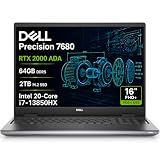
- POWERFUL FOR CREATIVITY - The Dell Precision 7000 series, positioned at the apex of the Precision lineup, surpasses the 3000 and 5000 series and aligns closely with the evolving direction of the Dell Pro Max series. This top-tier 7680 features the NVIDIA RTX 2000 Ada 8GB GPU to deliver robust performance for professionals in design, architecture, photography, video editing, and engineering. Furthermore, the series' intelligent design for data science leverages AI to optimize system performance for key applications, enabling accelerated workflow efficiency
- HIGH PERFORMANCE - Powered by Intel Core i7-13850HX vPro Processor for superior efficiency and speed, 64GB DDR5 CAMM RAM and 2TB PCIe NVMe M.2 SSD for seamless multitasking and fast storage. CAMM was designed specifically to overcome the performance limits of SODIMM while reducing both Z height and routing traces on the PCB to ultimately allow for laptops with both faster RAM and thinner profiles
- CRISP DISPLAY - 16" FHD+ (1920 x 1200) Anti-Glare 45% NTSC display delivers crisp visuals, supported by the ability to connect 4 external monitors via HDMI, USB-C and Thunderbolt ports at 4K (3840x2160) @60Hz (without docking station). 1080p FHD RGB webcam for crystal-clear video calls and meetings
- VERSATILE CONNECTIVITY - Equipped with 2x Thunderbolt 4, USB-C, 2x USB-A, HDMI, Ethernet (RJ-45), and an Audio combo jack. With Wi-Fi 6E and Bluetooth 5.2, ensuring fast wireless connectivity and compatibility with a wide range of peripherals. A full-size keyboard with a dedicated numeric keypad boosts productivity.
- OPERATING SYSTEM - Windows 11 Pro 64‑bit, with AI‑powered Copilot, offers intelligent assistance to streamline complex professional workflows, enhance productivity, and support advanced multitasking across demanding applications. Built for workstation‑class computing, it delivers enterprise‑grade security and IT manageability
When comparing models, check the exact operating-system edition and processor architecture, RAM configuration, SSD, display resolution, and the ports or connections needed for your desk setup. Do not assume that a model with a faster advertised CPU will suit your toolchain if it lacks required software compatibility.
7. Use this workload-based buying checklist
- Light editor and small projects: VS Code’s low published minimum shows that basic editing can run on modest hardware. Do not use that minimum to size a machine for a professional IDE, emulator, or VM.
- Professional IDE and typical solutions: Use the relevant IDE’s recommendations as your baseline; Microsoft recommends 16 GB RAM for typical professional Visual Studio solutions.
- IDE plus Android emulator: Follow Google’s Android Studio and Emulator guidance, including its 32 GB recommendation, and budget additional memory and storage for the number of AVDs you run.
- Frequent builds or virtual machines: Prioritize a capable CPU, sufficient memory for concurrent workloads, and confirmed virtualization support.
- Every workload: Confirm OS and architecture compatibility, choose an SSD, meet display-resolution guidance, and select capacity based on the tools and projects you actually keep installed.
These vendor specifications help set a baseline, but they do not compare current laptop models or guarantee build speed. Choose among compatible laptops by matching their configuration to your own busiest workload.
Quick Recap
Product prices and availability are accurate as of the date/time indicated and are subject to change. Any price and availability information displayed on Amazon at the time of purchase will apply.

