
Do these 3 things before closing this tab:
1Clear out junk files and repair common Windows errors2Scan for outdated or missing drivers - takes under a minute3Repair Windows errors before they cause bigger problemsSpaceX lists Starship’s payload capacity as 100+ metric tonnes, compared with Falcon Heavy’s 63.8 tonnes to low Earth orbit (LEO). But these are not equivalent proof points: Starship’s figure is a design capacity, while SpaceX describes its September 28, 2026 Flight 14 as the vehicle’s first orbital flight. For a real launch decision, compare the same destination, payload dimensions, launch site and mission profile—not just the headline LEO numbers.
How much can each rocket carry?
SpaceX’s published figures show Starship with a 100+ metric-tonne design capacity to orbit. Its Falcon Heavy page lists different capacities for different destinations:
| Vehicle and destination | Published capacity | What the figure represents |
|---|---|---|
| Starship, orbit | 100+ metric tonnes | SpaceX design capacity; not a demonstrated delivery of that mass |
| Falcon Heavy, LEO | 63,800 kg (63.8 tonnes) | SpaceX-listed capacity |
| Falcon Heavy, geostationary transfer orbit (GTO) | 26,700 kg (26.7 tonnes) | SpaceX-listed capacity |
| Falcon Heavy, Mars | 16,800 kg (16.8 tonnes) | SpaceX-listed capacity |
Sources: SpaceX Starship vehicle page and SpaceX Falcon Heavy vehicle page, accessed October 4, 2026.
The often-quoted comparison—100+ tonnes versus 63.8 tonnes—puts Starship’s design figure beside Falcon Heavy’s LEO figure. It does not establish that Starship has already launched a payload heavier than Falcon Heavy’s, nor does it compare performance to GTO or Mars. SpaceX’s current Starship page does not provide destination-matched numeric capacities for those missions.
Recommended Free Tools
#1 Best Overall
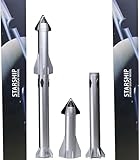
- Extremely exquisite SpaceX starship rocket model (For collection or display, not a toy! Children should not buy it)
- This model is a highly simulated SpaceX starship rocket model. The main body of the first-level super heavy booster is made of precision aluminum alloy tubes. The second-level starship is embedded with reinforced aluminum alloy tubes. The rest of the rocket materials are made of high-quality imported resin. Excellent laser forming ability and long-lasting storage
- The proportional model:1:375
- Actual height: 32cm (the core diameter is 24mm, the real rocket is 9 meters in diameter) This ratio is the best choice for desktop placement
- Note: This model is not a toy model, it is not recommended to buy for children, please buy with caution to avoid unnecessary trouble for your shopping
What has Starship demonstrated?
SpaceX’s account of Flight 14, dated September 28, 2026, calls it Starship’s first orbital flight and says it delivered 26 Starlink V3 satellites to orbit. That is evidence of an orbital payload deployment, not a demonstration of the 100-tonne design capacity.
SpaceX describes Starship as a two-stage system: the Starship spacecraft, which also serves as the upper stage, and the Super Heavy booster. Its vehicle page describes both stages as designed for full reuse. The Flight 14 account says development toward full and rapid reuse can continue after the first orbital flight; it does not establish routine reuse of the complete system.
Sources: SpaceX Starship vehicle page and SpaceX Flight 14 account, September 28, 2026.
Rank #2

- Extremely exquisite Falcon 9 STRONGBACK rocket model (For collection or display, not a toy! Children should not buy it)
- First-stage super heavy-duty booster is made of precise aluminum alloy tubes. Other parts constructed with High-quality imported laser-formed photosensitive resin-it rocket material
- The proportional model:1:233
- Actual height: 32cm (the core diameter is 24mm, the real rocket is 9 meters in diameter) This ratio is the best choice for desktop placement
- Note: This model is not a toy model, it is not recommended to buy for children, please buy with caution to avoid unnecessary trouble for your shopping
Falcon Heavy’s payload envelope and design
Falcon Heavy consists of three Falcon 9 first-stage cores powered by 27 Merlin engines. SpaceX says the two side boosters are designed for recovery and reuse. Its current vehicle page gives fairing dimensions of 13.1 metres high by 5.2 metres in diameter.
Free tools Windows power users keep installed
One-click scans. No signup required.
The Falcon Payload User’s Guide says Falcon Heavy uses the same second stage and payload fairing as Falcon 9. This shared design draws on Falcon hardware and flight heritage, but does not make every Falcon 9 launch option available to Falcon Heavy.
Sources: SpaceX Falcon Heavy vehicle page and Falcon Payload User’s Guide, May 9, 2025.
Rank #3
- Durable materials: This 1/400 scale SpaceX spaceship is lightweight and durable. The main body of the spaceship is made of pp and precision aluminum alloy. It is very suitable for desktop display
- Exquisite Details: The height of the rocket model is 4.9 inches and the diameter is 1.81 inches. It precisely reproduces the launch configuration of the rocket and captures every real detail of the authentic interstellar spacecraft
- Perfect Display or Gift: This complete rocket launch model brings the real space flight scene to life, making it an ideal choice for a desk or display stand. It creates a charming atmosphere for space enthusiasts and is the perfect gift for any space lover
- The Package Includes: This Starship model set includes a 1/400 scale Starship Rocket Model. Gift packaging is available. The complete kit vividly recreates the scene of the Starship
- Note: This model is suitable for desktop display and has fulfilled the dreams of every enthusiast. It is not applicable to children's toys
Why destination and launch site change the answer
A rocket’s payload capacity depends on where it must deliver the payload. Falcon Heavy’s published capacity drops from 63.8 tonnes to LEO to 26.7 tonnes to GTO and 16.8 tonnes to Mars. A comparison is meaningful only when both vehicles are assessed against the same destination and mission requirements.
SpaceX’s May 9, 2025 Falcon guide says Falcon Heavy is available only from Florida’s Eastern Range. It distinguishes launch vehicle, site and inclination, and notes that some orbit choices involve mission-specific performance considerations. Options described for Falcon 9—including Western Range trajectories—should not be assumed to apply to Falcon Heavy.
The Tool Desk
Outbyte Driver Updater FREEScan for outdated or missing drivers - takes under a minuteDriver Scan →Outbyte PC Repair FREEClear out junk files and repair common Windows errorsFree Scan →The guide is a customer-planning document, not a complete design specification: SpaceX says Falcon mass-to-orbit capabilities are available on request and detailed mission information is exchanged directly with customers. SpaceX’s current Starship page lists intended destinations including Earth orbit, the Moon and Mars, but does not give comparable numeric payload capacities for those destinations. The Starship Users Guide, Revision 1.0, dated March 2020, labels its mass-to-orbit information preliminary, so it should not be treated as a current operational guarantee.
Rank #4

- 1:200 Scale SpaceX Starship Model: This NikolaToy model offers a precise 1:200 scale replica of the SpaceX Starship, showcasing a realistic design for aviation and space enthusiasts.
- LED Lights & Misting Effect: Equipped with LED lights and a misting function, this model creates a dynamic and interactive experience, simulating rocket exhaust in a unique way.
- Durable PLA+ Construction: Made from PLA+, a strong and eco-friendly material, ensuring a sturdy, long-lasting model with fine detailing.
- Precision 3D Printing: Crafted with high-precision 3D printing technology to capture every detail of the SpaceX Starship, from its sleek body to the intricate features.
- Ideal Gift for Space Enthusiasts: A perfect gift for space lovers, engineers, or collectors, adding both a decorative touch and an engaging conversation piece to any home or office.
Sources: SpaceX Falcon Heavy vehicle page, Falcon Payload User’s Guide, May 9, 2025, SpaceX Starship vehicle page and Starship Users Guide, Revision 1.0, March 2020.
Independent reader supportYour contribution helps us test, update, and keep practical guides available for everyone.Reuse, price and availability are not interchangeable
Falcon Heavy is an existing launch vehicle, and SpaceX describes its side boosters as reusable. Its guide says the first stage is designed to survive atmospheric entry and be recovered. Starship aims for full, rapid reuse of both stages, but a reuse design goal is not the same as demonstrated operational cadence.
SpaceX says Starship is designed to deliver payloads farther and at lower marginal cost per launch than its current Falcon vehicles. That is a forward-looking company claim, not a published price comparison for matched missions. The Falcon guide points customers to separate capabilities-and-services pricing materials; the sources cited here do not establish equivalent current prices for Starship and Falcon Heavy carrying the same payload to the same destination with comparable services and recovery assumptions.
Quick wins for a faster PC:
Clear out junk files and repair common Windows errorsFree Scan →Scan for outdated or missing drivers - takes under a minuteDriver Scan →Best Value

- Name:1:233 Falcon 9 Block 5 Material::Alloy+resin
- Size:Approximately 22x7cm (8.6*2.7inch) Function: Static desktop display
- For collection or display, Not suitable for children to play with Handmade, there may be minor flaws
- Model is a highly Simulated SpaceX Falcon9 Dragon+F9 Starship Heavy Falcon Falcon 9 Biock 5 rocket model. The main body of the first-stage rocket is precision aluminum alloy tube, and the rest of the rocket materials are made of high-quality imported resin-with excellent laser forming ability and long-lasting preservation
How to make a useful comparison for a payload
For a specific satellite or spacecraft, the headline capacity is only a starting point. Check the mission parameters that determine whether the rocket can deliver it as required:
- Mass and dimensions: confirm both payload mass and the space available inside the vehicle’s fairing or compartment.
- Destination: specify orbit, inclination or deep-space destination; LEO capacity cannot stand in for GTO or Mars capacity.
- Launch site: confirm that the vehicle can launch from a site suitable for the desired trajectory.
- Configuration: clarify whether the mission is dedicated or shared and what deployment service is required.
- Evidence and timing: distinguish currently listed or flight-demonstrated performance from a design target, and confirm mission availability.
- Commercial terms: compare current quotes for the same mission and service scope rather than inferring price from payload capacity or a marginal-cost claim.
SpaceX’s guides and vehicle pages are primary sources for its published specifications and claims, but the published material cited here does not provide independent performance verification or a complete, like-for-like commercial comparison.
Quick Recap
Product prices and availability are accurate as of the date/time indicated and are subject to change. Any price and availability information displayed on Amazon at the time of purchase will apply.

