
Do these 3 things before closing this tab:
1Repair Windows errors before they cause bigger problems2Scan for outdated or missing drivers - takes under a minute3Clear out junk files and repair common Windows errorsThere is no single number of days that applies to every knee injury. For a minor soft-tissue injury, one NHS hospital advises using prescribed crutches for 48 hours before slowly starting to put weight through the leg. A fracture, ligament injury or operation can require a different plan, so follow the weight-bearing instructions from the clinician who assessed you.
What determines how long you need crutches?
Your crutch timeline depends on the injury and your clinician’s instructions—not just how much pain you feel. A soft-tissue injury, a broken kneecap and recovery after surgery follow different pathways.
- Injury type and severity: Soft-tissue injuries, ligament injuries and fractures have different recovery needs. A soft-tissue injury may take up to six weeks to recover overall, but that does not mean crutches are needed for six weeks. Gateshead Health NHS Foundation Trust gives this recovery context for soft-tissue injuries.
- Weight-bearing restrictions: Your clinician may specify non-weight-bearing, touch-down, partial weight-bearing or weight-bearing as tolerated. Keep to that category even if pain improves. General timelines do not override your personal instructions. See MedlinePlus crutch guidance and its broken kneecap guidance.
- Pain, swelling and control: These symptoms, along with strength and walking quality, help inform a gradual transition. If walking increases pain or swelling, reduce activity and ask your clinician for advice. Chelsea and Westminster Hospital advises gradually weaning from elbow crutches as pain and swelling subside.
- Surgery or fracture care: The procedure, any additional work on the knee, fracture stability and use of a brace can all change the plan. Follow the surgeon’s or treating clinician’s instructions.
What timelines do official care pathways give?
The examples below apply to particular injuries or care pathways. They are not interchangeable predictions for every person with knee pain.
| Situation | Guidance in the cited source | Important qualification |
|---|---|---|
| Soft-tissue knee injury | Use issued crutches for 48 hours, then slowly start putting weight through the leg. | This is Gateshead Health NHS Foundation Trust’s advice for a soft-tissue injury, not a universal instruction. It says overall recovery may take up to six weeks; that is not a crutch duration. Seek GP or physiotherapy advice if improvement has not started after 7–10 days. Source. |
| ACL reconstruction | Full weight-bearing without crutches may begin 2–3 weeks after surgery if the surgeon says it is appropriate. | MedlinePlus says regaining full use may take 4–8 weeks if additional work was done on the knee. Ask the surgeon for your plan. Source. |
| ACL reconstruction in another hospital pathway | Full weight-bearing as pain allows, with crutches for around 1–2 weeks to help avoid an unusual walking pattern. | This is Worcestershire Acute Hospitals NHS Trust’s protocol, not a promise for every ACL operation. Source. |
| Broken kneecap | A provider may advise avoiding weight on the leg for a week or longer. Later weight-bearing depends on pain and provider approval. | A splint or brace may still be needed, and crutches or a cane may help with balance. The guidance gives no universal date for stopping crutches. Source. |
| Knee replacement | NHS guidance describes starting with crutches or walking sticks, progressing to one crutch and then a stick when confident, and trying to walk unaided after about six weeks if ready. | This is advice for recovery after knee replacement, not an untreated knee injury. Source. |
How do you know when you can stop using crutches?
Only start reducing support if your clinician has allowed the relevant level of weight-bearing. A useful functional guide is whether you can walk safely and smoothly without increasing pain or swelling. One Plymouth ACL pathway describes weaning when muscular control has returned and the person can carry full weight and walk normally and safely; those criteria belong to that pathway and do not cancel other restrictions. Read the Plymouth ACL pathway.
#1 Best Overall

- STAY MOVING! BodyMed Aluminum Crutches are designed for people 5' 2" "–5' 10" tall to help support ankle, knee, and leg injuries, helping you to walk with less strain on your injured body part.
- SUPPORT & COMFORT. Lightweight and durable, these crutches offer balanced body weight support. Plus, the hand grips and underarm cushions are made with thick padding for extra comfort during use.
- DURABLE. These adult medical crutches are designed to support users with a variety of heights and builds. These lightweight aluminum crutches have a weight capacity of 300 lb.
- ADDED TRACTION. The durable, non-skid rubber tips provide good traction during use while absorbing shock for secure maneuvering on the go.
- ADJUSTABLE HEIGHT. BodyMed Aluminum Crutches are adjustable in 1 in. increments. To adjust, simply press the push-button height adjustment to set your desired height.
- Confirm your permitted weight-bearing level. Ask your treating clinician or physiotherapist, particularly after a fracture or operation.
- Reduce support gradually, if permitted. Pay attention to pain, swelling, limping and loss of control rather than pushing through them.
- Keep using the aid if your walking is not smooth and safe. Follow any instructions about braces, crutches or other supports.
- Ask for a review if recovery is not following the expected course or symptoms worsen. Gateshead Health advises seeking GP or physiotherapy advice if improvement has not begun after 7–10 days.
When should you contact a clinician?
MedlinePlus advises contacting a provider for increasing swelling or pain, no improvement with self-care, loss of feeling in the foot, a cold or discolored foot or leg, or a knee that suddenly locks and cannot straighten. Seek care appropriate to how severe or urgent the symptoms are. MedlinePlus: Using crutches.
Independent reader supportYour contribution helps us test, update, and keep practical guides available for everyone.How can you use crutches more safely?
Correct fit and technique matter. MedlinePlus gives these general fitting instructions for underarm crutches; have a provider or physiotherapist check your setup and show you how to move within your prescribed weight-bearing limits.
Rank #2
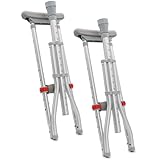
- Universal Height Adjustment - Crutches for adults that accommodate users from 4'6" to 6'6" with easy push-button adjustment in 1" increments, perfect for youth, adults, and tall adults.
- 300 lb Weight Capacity - Sturdy crutches for women and men with aluminum construction provides reliable support up to 300 pounds while remaining lightweight for comfortable daily use.
- 3-Position Underarm Adjustment - Features three adjustment holes in underarm tube for optimal fit: Kids crutches - Youth/short adults (#3), standard adults (#2), and tall adults (#1).
- Enhanced Safety Features - Non-slip rubber crutch tips provide excellent traction and stability on various surfaces while protecting indoor flooring from damage.
- Comfort & Convenience - Cushioned underarm pads and ergonomic hand grips reduce pressure points; foldable crutches perfect for compact storage and transport.
- Place the top of each crutch 1–1½ inches (2.5–4 cm) below the armpit.
- Set the handles around hip level so your elbows are slightly bent.
- Support your weight through your hands, not by leaning on the underarm pads.
- Keep the crutch tips roughly 3 inches (7.5 cm) from your feet.
- Check the tips daily and replace them if worn; check that replacements fit your crutches.
These measurements and safety notes come from MedlinePlus crutch instructions.
Quick Recap
Best Value

- Adjustable Height: These adjustable crutches feature 9 height settings in 1" increments to accommodate adults and kids .The crutches is equipped with a secure push-button locking system. Simply press the pushbutton in and slide the crutch up or down. Our crutches offer well-balance and proper posture for safer walking
- Support Up to 300 LBS: The crutch is made of lightweight and rust-resistant aluminum alloy , aluminum crutches is sturdy and durable enough to supports up to 300 lbs safely. The crutches can provide reliable stability, ideal for relieve weight and pressure of a leg for post operation or surgery and after injury use. The crutch is perfect medical mobility aid for rehabilitation use
- Comfortable & Support: Soft padded underarm cushions help reduce pressure and irritation, while ergonomic hand grips minimize hand and wrist fatigue during extended use. The hand grips are washable and perspiration-resistant. Besides, these crutches for adults provide balanced body weight support
- Safe & Stable: Non-slip rubber tips provide better traction during use and shock absorption. It delivers excellent grip and balance on wood, tile, stair, indoor floors and outdoor surfaces, keeping every step steady and secure
- Portability with Crutch Bag: The portable crutches come with a crutch bag for easy travel and compact storage
Rank #4

- Adult Crutches: Made of aluminum, lightweight crutches provide great support without the heaviness of wood; capable of supporting up to 300 lbs
- Comfortable Underarm Crutches: Feature comfortable and durable crutch pads for armpits and hand grips
- Quality Construction: Large non-skid vinyl contoured crutch tips provide exceptional traction
- Adjustable Crutches: The walking crutch features Euro-style clips and a pushpin that supports users of all ages and makes handgrip height adjustments easy. Height: 38.5 inch - 62.5 inch
- Easy-to-Assemble Universal Crutches: Crutch can be easily assembled and taken down for convenient storage
Rank #3
- STAY MOVING! BodyMed Aluminum Crutches are designed for people 5' 10" "–6' 6" tall to help support ankle, knee, and leg injuries, helping you to walk with less strain on your injured body part.
- SUPPORT & COMFORT. Lightweight and durable, these crutches offer balanced body weight support. Plus, the hand grips and underarm cushions are made with thick padding for extra comfort during use.
- DURABLE. These adult medical crutches are designed to support users with a variety of heights and builds. These lightweight aluminum crutches have a weight capacity of 300 lb.
- ADDED TRACTION. The durable, non-skid rubber tips provide good traction during use while absorbing shock for secure maneuvering on the go.
- ADJUSTABLE HEIGHT. BodyMed Aluminum Crutches are adjustable in 1 in. increments. To adjust, simply press the push-button height adjustment to set your desired height.
Product prices and availability are accurate as of the date/time indicated and are subject to change. Any price and availability information displayed on Amazon at the time of purchase will apply.

