
iTechGuides is reader-supported. When you buy through links on our site, we may earn an affiliate commission. As an Amazon Associate I earn from qualifying purchases. Learn more
Data centers use electricity for two broad purposes: running information-technology equipment and operating the facility that keeps that equipment powered and cool. Servers perform calculations, storage systems retain data, and networking gear moves it. Cooling, power conversion, distribution, and other infrastructure consume the rest. In the United States, data centers used an estimated 192 terawatt-hours (TWh) in 2024, equal to 4.7% of national electricity consumption, according to the 2025 U.S. Department of Energy (DOE) and Lawrence Berkeley National Laboratory (LBNL) update.
AI has made the issue more visible because AI services rely on rapidly deployed, high-power servers. More electricity goes into computation, while the concentrated heat from dense equipment requires additional cooling and power-delivery capacity. The result is a facility and grid-planning challenge—not evidence that every data-center watt is used for AI.
What uses electricity in a data center?
A data center’s electricity bill combines IT load with facility load. IT load is the energy consumed by equipment that computes, stores, and transmits digital information. Facility load is the energy needed to deliver power safely and remove the heat produced by that equipment.
Servers perform the computing
Servers contain processors, memory, accelerators, and other components that execute applications. Traditional web, business, and cloud workloads use general-purpose processors; AI services increasingly add specialized servers designed for model training and inference. The electricity attributed to servers changes with the number of machines, their utilization, and the intensity of the workload.
#1 Best Overall

- Versatile and Space-Saving: This 1U Rack mount PDU features a compact design that allows for efficient use of space in standard 19-inch racks. 16 rear-facing plug outlets and three front-facing outlets provide ample connectivity for your devices
- Efficient USB Power: Featuring four USB ports, it enables simultaneous power supply to your favorite devices, ensuring convenience and productivity
- Built-in Circuit Breaker: The PDU is equipped with a built-in 12-Amp circuit breaker that protects against circuit overloads. This ensures reliable performance and helps prevent damage to your equipment
- Heavy-Duty Construction: The power distribution unit is designed with heavy-duty components and a sturdy metal housing for durability and long-lasting use
- Convenient Mounting: The PDU features mounting ears on the back panel for easy installation in a standard 19-inch rack
Storage retains data
Storage arrays and related hardware keep operating systems, databases, user files, model parameters, and backups. Storage electricity is not limited to the moment a file is read: equipment must remain available, and data may be copied across systems for resilience.
Networking moves data
Switches, routers, optical equipment, and network interfaces move information between servers, storage systems, and outside networks. Networking represented 3.4% of total U.S. data-center electricity in 2018 and 4.5% in 2024 in the 2025 DOE/LBNL analysis, so its share increased even as the overall infrastructure share fell.
Cooling and power systems support the IT load
Facility infrastructure includes chillers, pumps, fans, air handlers, liquid-cooling equipment where installed, and controls that carry heat away. Electrical systems also consume energy through transformers, switchgear, uninterruptible power equipment, power distribution, and distribution losses. These systems allow servers to operate continuously within safe temperature and power limits.
Quick wins for a faster PC:
Repair Windows errors before they cause bigger problemsFix Now →Scan for outdated or missing drivers - takes under a minuteDriver Scan →| Electricity category | What it does | Examples |
|---|---|---|
| Computing | Executes applications and AI workloads | Processors, memory, accelerators, servers |
| Storage | Retains and serves data | Disk and flash arrays, storage controllers |
| Networking | Moves data inside and outside the facility | Switches, routers, optical links |
| Cooling | Removes heat from IT equipment | Chillers, pumps, fans, heat exchangers |
| Power delivery | Converts, conditions, and distributes electricity | Transformers, switchgear, UPS equipment, wiring |
The 2025 update estimates that infrastructure accounted for 31% of total U.S. data-center electricity in 2024. That percentage is an average across the national data-center population, not a fixed rule for every building.
How much electricity do U.S. data centers use?
The latest DOE/LBNL estimate puts U.S. data-center consumption at 192 TWh in 2024, or 4.7% of total U.S. electricity use. This is an estimate of measured historical consumption for that year, covering servers, storage, networking, and supporting infrastructure.
An earlier DOE announcement, summarizing a prior LBNL report, estimated 176 TWh in 2023, about 4.4% of U.S. electricity. Because the reports use different publication dates and forecast horizons, the 2025 update’s 2024 baseline should be used for current comparisons rather than replacing it with the older figure.
Rank #2

- Rack mount 9-outlet power distribution unit (PDU) designed for standard 19-inch server racks, ideal for data centers, server rooms, and network closets
- Wide spacing for 2 outlets to accommodate larger plugs and adapters, improving cable management and reducing outlet overcrowding
- Individual on/off switches for each outlet, allowing convenient and independent control of connected devices
- 1u PDU includes 2 high-speed USB fast charging ports and 2 type C ports for simultaneous power supply and device charging
- Built-in overloading protection safeguards connected equipment from power surges and overloads, ensuring safe, reliable operation
| Figure | Year | Geography and scope | Status |
|---|---|---|---|
| 176 TWh; about 4.4% of U.S. electricity | 2023 | United States; data centers and their IT and infrastructure loads | Historical estimate in the earlier report, summarized by DOE in 2024 |
| 192 TWh; 4.7% of U.S. electricity | 2024 | United States; data centers and their IT and infrastructure loads | Historical estimate in the 2025 DOE/LBNL update |
| 649 TWh; 11.8% of forecast U.S. electricity | 2030 | United States; same broad data-center scope | Reference-case model, not a measurement |
Is 649 TWh in 2030 a measured prediction?
No. The 649 TWh figure is the 2030 reference-case forecast in the 2025 DOE/LBNL update. It represents 11.8% of forecast U.S. electricity use under that case’s assumptions; it is not a reading from future meters and should not be presented as a guaranteed outcome.
Recommended Free Tools
DOE’s resource summary gives a modeled 2030 range of 9.5% to 15.3% of U.S. electricity across scenarios. The spread reflects uncertainty about data-center construction, AI-server deployment, workload growth, efficiency, and the electricity system itself. Whenever estimates are compared, identify the year, country, report edition, equipment included, and whether the number is historical, a reference case, or a scenario result.
Why do AI data centers need so much power?
AI facilities draw attention because they deploy large numbers of specialized, high-power servers in a short period. Training and serving advanced models can require substantial computation, and that computation is concentrated in equipment designed to operate at high electrical power.
More computation raises the IT load
Adding AI servers increases the direct electricity used by processors, accelerators, memory, and associated server components. The DOE/LBNL estimates include these servers within the broader data-center total; they do not isolate a nationally measured “AI-only” electricity number.
Dense equipment concentrates heat
Almost all electricity entering a server ultimately becomes heat that the facility must remove. Higher-power equipment packed into a smaller area can exceed the capacity of a room designed for conventional racks. Operators may therefore need additional airflow, liquid-cooling loops, heat exchangers, pumps, or chillers as AI capacity expands.
Cooling and power delivery must scale with the IT load
It is not enough to purchase more servers. The electrical service, transformers, distribution equipment, backup systems, and cooling plant must be sized for the resulting load and operated reliably. Those supporting systems add facility electricity on top of the energy consumed by the AI hardware itself.
Rank #3

- 1U 8-OUTLET RACK MOUNT PDU: Built-in 8ft. (2.4m) NEMA 5-15P Power Cord; 8x NEMA 5-15R Outlets; 125V Max. Input/Output; 15A Circuit Breaker; Ideal power supply for server rooms, server closets, small data centers and recording studios
- ON/OFF OUTLET SWITCHES: Each outlet features an individual illuminated rocker switch for controlled power management; Enumerated switch labels clearly identify the corresponding outlet; Safety covers prevent accidental power cycling
- 15 AMP CIRCUIT BREAKER: This 8-port rackmount power distribution unit features a self-tripping and resettable circuit breaker with 15A trip-point to protect connected equipment
- 1U RACK DESIGN: This horizontal power distribution unit installs in 1U of rack space on network racks and is compatible with all 19-inch server racks 4" or deeper; Compatible with ANSI/EIA RS-310-D standards
- OPTIMIZED DESIGN: Heavy-duty steel housing with rear facing outlets; Attached 8 ft. (2.4m) long power cord
Consequently, “AI uses all the data-center power” is an inaccurate shortcut. AI is a significant driver of recent demand growth, but the national totals also include cloud applications, enterprise systems, storage, networking, and non-AI computing.
What is PUE, and what does it say about efficiency?
Power usage effectiveness (PUE) is the ratio of total facility energy to IT-equipment energy:
PUE = total data-center facility energy ÷ IT-equipment energy
What’s actually slowing this PC down?
Pick the symptom - the matching free tool is one click away.
A lower PUE means fewer overhead watts for each watt delivered to IT equipment. It does not, by itself, measure how efficiently an AI model is computed, how much useful work a server performs, or how much electricity an entire facility uses. A large facility with a lower PUE can still consume more total electricity than a small facility with a higher PUE if its IT load is much larger.
How U.S. averages changed
The 2025 DOE/LBNL update reports that the national average PUE improved from 1.55 in 2018 to 1.45 in 2024. Over the same period, infrastructure’s share of total U.S. data-center electricity declined from 36% to 31%. The figures indicate less facility overhead per unit of IT energy on average, while total demand still grew.
Why AI-serving PUE needs a separate label
The report estimates an average PUE of 1.145 in 2024 for facilities serving AI equipment. That population is different from the national average, which covers a broad mix of facilities and workloads. The two values should not be treated as a like-for-like ranking or as proof that every AI site has the same efficiency.
Rank #4
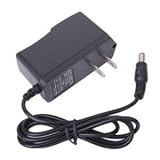
- 2-flat-pin plug
- 110V input voltage / 9VDC 1A output voltage
- For use with Arduino Uno, Mega and MB102 Power supply boards
- Connector size: 5.5 x 2.1mm with Center Tip positive, sleeve is negative
- These adapters do not work for guitar pedals or label makers which require negative tip power adapters
How does data-center growth affect the electric grid?
Data centers are large, concentrated loads that generally require dependable service around the clock. A utility serving a new campus may need substations, transmission or distribution upgrades, generation capacity, and new operating arrangements. The effects are local even when the national percentage is reported for the entire United States.
Free tools Windows power users keep installed
One-click scans. No signup required.
Who pays for new infrastructure?
DOE’s large-load rate-design brief identifies cost allocation as a central issue. Regulators and utilities must decide how much of an upgrade should be assigned to the data center, how much should be shared across customers, and how contracts handle changing demand. If a facility closes, scales back, or never reaches its planned load, infrastructure built for it could become underused—a stranded-investment risk.
Why reliability matters
Interruptions can disrupt online services and computation, so data centers typically plan for continuous power and backup capability. At the grid level, adding many large loads can affect resource adequacy, congestion, and the timing of peak demand. These are system-planning questions, not simply questions about a building’s monthly bill.
What supply arrangements are being discussed?
DOE identifies options such as matching consumption with carbon-free resources and using onsite generation. These are policy and engineering arrangements under discussion; they do not demonstrate that a particular facility is fully powered by a specific source. A claim about “clean” supply must specify whether it refers to annual accounting, real-time matching, contracted resources, or onsite production.
In a December 20, 2024 DOE announcement, then-Secretary of Energy Jennifer M. Granholm said, “We can meet this growth with clean energy.” The statement expresses a policy expectation; it is not evidence that every existing data center currently operates on clean energy.
Can geothermal energy or underground thermal storage reduce the impact?
DOE describes geothermal energy and cold underground thermal energy storage as potential contributors to reliable power or to shifting peak cooling demand. Geothermal generation could support supply where local geology and project economics allow. Cold thermal storage could produce or store cooling at one time and reduce chiller electricity during a later peak.
Best Value

- 10-Outlets Power Distribution Units - This PDU provides 10 AC outlets (110V/15A), features 10 individual on/off power switch, you can use to shut off electronics when not in use for power/energy saving, with 10ft power extension cord(14AWG)for plug your devices in while leaving the rack mobile
- Rack Mount Surge Protector - The power supply PDU strip provides surge protection to prevent excess voltage from reaching electronics with LED indicators, and built with PSD surge protection, Further ensuring the safety of electronic devices
- 1U Rack Mountable Design - The rackmount power strip compatible with all 19” server racks, and 1u power supply fits many network racks, data centers, network closets, and VoIP Phone systems
- ETL Listed & Overload protection - Reliable ETL safety certification with the rack power strip, with Overload protection, built-in circuit breaker and reset switch, ensuring a dependable performance of your networking equipment,Protects your equipment professonally
- Versatile Rackmount Options - Our rackmount power strip is made of industrial-grade metal housing, which is high quality and heavy duty, and allows for the PDU to be installed vertically or horizontally
Both approaches remain options being explored rather than universal, already-deployed solutions. Their value depends on site conditions, interconnection rules, reliability requirements, and whether the problem is insufficient electricity supply, a short peak period, or a cooling constraint.
How should you compare data-center electricity figures?
Numbers that look similar can describe different things. Use this checklist before drawing a conclusion:
- Year: distinguish a historical estimate from a future forecast.
- Geography: confirm that a percentage refers to the United States rather than a region or the world.
- Report edition: later updates may revise the baseline and assumptions.
- Scope: check whether servers only, all IT equipment, or cooling and power infrastructure are included.
- Forecast type: label a reference case separately from a high or low scenario.
- Efficiency metric: interpret PUE as facility overhead relative to IT energy, not as a measure of computing performance.
- Population: do not compare an AI-serving-facility average directly with a national average without noting the different facility mix.
What does this mean for communities and electricity customers?
New data-center demand can bring construction, jobs, and investment, but it can also require expensive grid work and compete for constrained capacity. The outcome depends on the site’s location, load profile, interconnection terms, efficiency, and the way costs are assigned. A national percentage cannot determine the effect on a particular town or utility territory.
The Tool Desk
Outbyte Driver Updater FREEScan for outdated or missing drivers - takes under a minuteDriver Scan →Outbyte PC Repair FREEClear out junk files and repair common Windows errorsFree Scan →For readers evaluating a claim, ask whether it refers to the facility’s IT load or its total load, whether the number is measured or modeled, and who is responsible for the associated grid upgrades. Those distinctions prevent an AI-specific headline from being mistaken for a complete account of data-center electricity use.
Frequently Asked Questions
Does a lower PUE always mean a data center uses less electricity overall?
No. PUE measures overhead relative to IT energy, so it says how much supporting energy accompanies the computing load. Total consumption also depends on the facility’s size and the amount of computing, storage, and networking it performs.
Are the U.S. electricity figures global totals?
No. The 192 TWh estimate and the 2030 scenarios describe the United States. Applying those percentages to worldwide electricity demand would be a different calculation and is not supported by these figures.
Why can a forecast range be so wide?
Long-term scenarios must assume how quickly facilities are built, how many AI servers are deployed, how workloads change, and how efficiently equipment operates. Different assumptions produce different modeled shares, so a range communicates uncertainty rather than a measurement error in a single meter reading.
Do these 3 things before closing this tab:
1Clear out junk files and repair common Windows errors2Scan for outdated or missing drivers - takes under a minute3Repair Windows errors before they cause bigger problemsDoes buying renewable electricity make a data center carbon-free at every hour?
Not necessarily. A contract or matching claim must specify its accounting method and timing, while the grid still has to supply dependable power when local renewable output is unavailable. The cited DOE options describe possible arrangements, not a guarantee for every facility.
Quick Recap
Product prices and availability are accurate as of the date/time indicated and are subject to change. Any price and availability information displayed on Amazon at the time of purchase will apply.

