
The Tool Desk
Outbyte Driver Updater FREEScan for outdated or missing drivers - takes under a minuteDriver Scan →Outbyte PC Repair FREEClear out junk files and repair common Windows errorsFree Scan →iTechGuides is reader-supported. When you buy through links on our site, we may earn an affiliate commission. As an Amazon Associate I earn from qualifying purchases. Learn more
Advanced substrates and high-density interconnects can improve AI-server performance by bringing compute dies and high-bandwidth memory (HBM) closer together and connecting them with more, shorter, faster paths. That can increase usable memory and chip-to-chip bandwidth while reducing communication latency and energy per bit. The gains are not automatic: heat, power delivery, manufacturing yield, reliability and cost can become the limiting factors, so package capabilities must be assessed in the context of the complete server and its workload.
What do advanced substrates and high-density interconnects do?
An AI accelerator is not just a processor die. A package may combine multiple logic dies, HBM stacks, an interposer or redistribution-layer substrate, and the connections that carry data and power between them. Advanced substrates provide a dense wiring layer for those components; high-density interconnects add many fine-pitch electrical or vertical connections within a compact area.
This matters because AI workloads move large amounts of data among compute units and memory. If data cannot reach the compute engines quickly enough, the engines may wait rather than perform useful operations. Placing memory closer and providing more parallel data paths can reduce that bottleneck. The package does not make the compute die itself faster, but it can help keep the die supplied with data and let multiple dies exchange information more efficiently.
TSMC describes its CoWoS platform as integrating multiple system-on-chips (SoCs) and HBM stacks on a silicon interposer, with high-density routing for HPC and AI products. A silicon interposer or fine-line redistribution-layer (RDL) substrate can route signals among dies at a much finer pitch than a conventional circuit board. Embedded capacitors and carefully designed power-distribution networks can also help stabilize voltage when compute activity changes rapidly.
#1 Best Overall
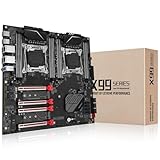
- Intel dual CPU sockets: This C612 server chip motherboard is designed with dual CPU sockets, which can support Intel Core i7 5th/6th generation processors and Xeon E5 V3/V4 series processors on LGA 2011-3 socket. (Note: If only one CPU is installed, please install it in the right slot, and the graphics card needs to be installed in the bottom two slots.)
- DDR4 4-channel memory slot: The memory slot of the LGA 2011-3 motherboard is designed with four channels, which can install 8 memory. It supports effective frequencies of 2133/2400MHz, and the maximum capacity is 256GB. (Non-ECC memory is not compatible when using E5 V4 series processors)
- PCIe 3.0 protocol standard: Equipped with 4 PCIe 3.0 X16 graphics card slots (with steel case). The transfer rate can reach 15.754 GB/s using one graphics card, and the performance can be improved by at least 50% by using two graphics cards. Equipped with dual M.2 hard disk slots, it can achieve fast reading even if multiple programs are running
- Stable power supply: use 24+8+8pin standard power supply interface (need to use a dedicated power supply for dual server motherboards), 12 (CPU) + 4 (memory) + 1 (C612 chip) phase power supply. Precise modularization provides good heat dissipation and makes the program run more stably
- Strong expandability: The X99 motherboard is equipped with multiple expansion interfaces to ensure that the motherboard has more room for improvement. These include 4*USB 3.0 ports, 4*USB 2.0 ports, 10*SATA 3.0 ports, 4*3pin sys fan, 2*4pin CPU fan. Besides, dual network ports allow your computer to do more things
These are package capabilities, not an end-to-end server benchmark. The performance a buyer sees depends on the accelerator architecture, memory configuration, software, workload, cooling and the rest of the system.
How can an advanced substrate increase memory bandwidth?
A substrate or interposer can put HBM stacks beside compute dies and connect them through many short, parallel traces. This gives the processor a wider route to nearby memory than relying only on connections that leave the package, while reducing the electrical distance signals must travel.
Shorter traces generally reduce parasitic resistance and capacitance, which makes high-speed signaling easier to manage. High-density routing can support a larger number of connections in the same package area. Together, proximity and parallelism can increase the memory bandwidth available to feed matrix engines and other accelerator units.
TSMC’s CoWoS-S uses a silicon interposer with high-density interconnects and embedded deep-trench capacitors. Its CoWoS-R uses an RDL interposer; TSMC lists a minimum 4μm pitch and describes signal- and power-integrity features. TSMC also says larger interposers can accommodate more advanced nodes and HBM, with enhanced routing and shielding intended to support signal integrity and memory bandwidth. These vendor-stated design capabilities do not establish a particular percentage improvement in application performance.
Rank #2

- Rigorously Tested for Perfect Performance Every product is 100% tested before shipping to ensure stable operation and flawless performance, so you can start using it immediately without any concerns.
Memory capacity and bandwidth are related but different considerations. HBM capacity and the number of stacks affect how much model state can remain close to compute. The interposer and package determine whether the available links can deliver that memory bandwidth reliably. A design can offer high peak bandwidth yet still be a poor fit if it lacks sufficient capacity for the target model or cannot sustain its advertised transfer rate under the workload.
How do fine-pitch die-to-die links affect latency and power?
Fine-pitch links connect chiplets over short distances inside a package. TSMC says its SoIC bonding pitch starts below 10μm and describes short die-to-die connections as supporting higher bandwidth, improved signal and power integrity, and lower power consumption. A smaller pitch can allow more connections in a given area, but the real benefit depends on the link design and how the dies use it.
In a chiplet system, communication between compute dies can matter as much as communication between a compute die and memory. If a workload distributes work across multiple dies, high-throughput links can help exchange data without sending it through a slower, longer path. Lower communication latency and energy per bit are valuable, but they do not by themselves guarantee lower total server power: the full system’s compute, memory, networking and cooling loads still count.
There is also a hierarchy of links. Connections inside a package are typically optimized for short-distance communication among dies and HBM. Board- and rack-level connections carry traffic between packages or servers, where distance, connector density and signal integrity become central. Molex describes its Impress co-packaged copper system for AI data centers as supporting up to 224Gbps PAM-4. That is a supported data-rate figure for the interconnect solution, not a measure of application speed or a claim that an entire server sustains that rate.
Rank #3

- AMD socket sTR5 supports up to 96-core CPUs: Ready for AMD Ryzen Threadripper PRO 9000 & 7000 WX-Series Processors and AMD Ryzen Threadripper 9000 & 7000 Series Processors.
- Ready for Advanced AI PC: Designed for the future of AI computing, with the power and connectivity needed for demanding AI applications
- CPU and memory overclocking: Support for up to 1TB ECC R-DIMM DDR5 memory modules (1DPC)
- Robust Power & Thermal Design: 20 power stages with two 8-pin power connectors for the CPU, massive VRM cooling, chipset and M.2 heatsinks, and M.2 thermal pad.
- Ultrafast Connectivity: Three PCIe 5.0 x16 slots, one PCIe 4.0 x16 slot, two USB4 (40Gbps) ports, 10 Gb & 2.5 Gb LAN ports, four M.2 slots, front USB 20Gbps Type-C ports, and SlimSAS NVMe support.
How do HBM stacks and vertical connections fit into the package?
HBM stacks use vertically connected memory dies to provide substantial memory capacity and bandwidth in a compact footprint near the accelerator. Advanced packaging brings those stacks and logic dies together, while vertical interconnects carry signals and power through or between package layers. The package therefore has to coordinate memory access, die-to-die traffic, power delivery and heat removal.
SK hynix identifies high-speed die stacking, logic-memory proximity and high-density vertical interconnects as important advanced-memory-package directions. It also points to package-level signal and power integrity and thermal bottlenecks. Samsung describes HBM-capable 3D packaging using micro-bump chip-on-wafer (CoW) assembly and through-silicon vias (TSVs), emphasizing density, scalability, latency and bandwidth.
ASE’s FOCoS-Bridge is another approach: in a May 28, 2025 announcement, ASE said it uses TSVs to create a shorter delivery path, enable higher I/O density and improve thermal dissipation. The announcement describes the intended design benefits; it does not provide a standardized server benchmark or prove that every implementation will reach the same results.
Windows Errors? Fix Them Before They Spread
Repair common Windows errors and clear accumulated junk for a smoother, more stable PC - no reinstall needed.Free scan · no reinstallCrashes, No Sound, or Screen Glitches?
Random freezes, missing sound and display glitches usually trace back to one bad driver. Find and replace yours safely.Free scan · under a minuteWhat performance tradeoffs can erase the gains?
More bandwidth and denser integration shift attention to constraints that are less visible in a headline link-speed figure. The same compact package that shortens data paths also packs hot components together and raises demands on power integrity, manufacturing and mechanical reliability.
Rank #4

- Ready for advanced AI PCs: Designed for the future of AI computing, with the power and connectivity needed for demanding AI applications
- Intel LGA1851 socket: Ready for Intel Core Ultra 9, 7, and 5 desktop processors
- Robust performance: 16+2+1+2 teamed power stages, ProCool II power connectors, high-quality alloy chokes and durable capacitors
- Future-proofed connectivity: Thunderbolt 4, 10Gb & 2.5Gb Ethernet, two PCIe 5.0 PCIe slots with full support for next-gen graphics cards, one PCIe 5.0 M.2 and three PCIe 4.0 M.2 slots and a USB 20Gbps front-panel header
- Exclusive AI and overclocking technologies: AI Overclocking, AI Cooling II, AI Advisor and NPU boost
Thermals and sustained performance
Compute dies and HBM stacks concentrate heat in a small area, and dense stacking can restrict cooling paths. If the cooling system cannot remove heat quickly enough, the accelerator may throttle. A high peak bandwidth figure is not useful if thermal limits prevent the system from sustaining the workload’s operating point. Compare thermal resistance, cooling requirements and throttle headroom along with bandwidth.
Power delivery and signal integrity
More links and faster signal edges can increase sensitivity to crosstalk, simultaneous-switching noise and voltage transients. Ground shielding, decoupling capacitors and low-loss routing are among the package design measures used to protect signal and power integrity. Buyers should look for measured operating margins, error behavior and power-delivery droop under relevant conditions rather than assuming that a high connection count guarantees a clean signal.
Mechanical reliability
Materials in a package can expand at different rates as temperatures change. Differences in coefficient of thermal expansion (CTE), large interposers, molding and underfill processes can contribute to warpage or stress on C4 solder joints. TSMC describes RDL and underfill as buffers for CTE mismatch, but design measures do not replace qualification. Reliability evidence should cover the actual package and its intended thermal and operating conditions.
Quick wins for a faster PC:
Fix the driver behind crashes, sound loss and screen glitchesFind Drivers →Repair Windows errors before they cause bigger problemsFix Now →Yield, test and supply
Large multi-die packages require good dies, accurate alignment and bonding, inspection and effective testing at chiplet and package levels. Intel identifies manufacturability and effective testing as active areas of work for advanced packaging. If any component or assembly step has a low yield, a design’s theoretical performance may not translate into affordable, available systems. Larger interposers, HBM and advanced bonding can also consume constrained manufacturing capacity and increase package cost.
Best Value
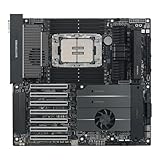
- Ready for Advanced AI PC: Designed for the future of AI computing, with the power and connectivity needed for demanding AI applications
- Intel LGA 4710-2 socket: Ready for Intel Xeon? 600 Processors for Workstation
- CPU and memory overclocking: The performance of ECC R-DIMM DDR5 memory (1DPC) is further enhanced by the exclusive NitroPath DRAM technology
- Ultrafast connectivity: 7 PCIe 5.0 x16 slots, Dual Intel E610-XAT2 10Gb LAN, 4 M.2, MCIO, 2 SlimSAS, and USB4? and USB 20Gbps Type-C
- Server-grade IPMI remote management: Hardware and software-level with a dedicated LAN port link to AST2600 BMC controller, plus a real-time monitoring and management software – ASUS Control Center Express
Which AI-server package metrics should I compare?
Compare sustained system behavior rather than a single maximum link rate. Ask vendors to state the workload, test conditions and measurement boundary behind each figure, and distinguish package-level capability from server-level results.
| Metric | Why it matters | What to ask |
|---|---|---|
| Sustained HBM bandwidth and capacity | Indicates how much nearby memory is available and how quickly it can feed the accelerator during the target workload. | Is the bandwidth sustained under the workload, and is capacity sufficient for the model state that needs to remain close to compute? |
| Die-to-die, scale-up and scale-out bandwidth and latency | Shows how well dies within a package, accelerators within a system, and systems across a network can exchange data. | Which boundary does the figure describe, and what latency and traffic conditions were measured? |
| Energy per bit and total power | Captures communication efficiency as well as its effect on accelerator and server power budgets. | Is energy per bit measured for the link itself or a broader system boundary, and what is total server power under load? |
| Signal-integrity margin, power droop and error rate | Shows whether dense, fast links operate reliably rather than merely reaching a nominal rate. | What margin, droop and error behavior are observed under simultaneous traffic and changing workloads? |
| Thermal resistance and throttle headroom | Determines whether memory and compute can sustain their intended performance without excessive temperature limits. | What cooling is required, and how much headroom remains at the target operating conditions? |
| Package area, yield, test coverage and field reliability | Affects integration feasibility, service life and the number of usable systems that manufacturing can deliver. | What package dimensions, qualification conditions and test coverage apply to the offered configuration? |
| Total cost, supply and upgrade path | Connects technical gains to deployment scale, availability and long-term system ownership. | Can the package and HBM configuration be supplied at the required volume, and what changes are possible in a later system generation? |
For comparable approaches, use the same workload and system boundary wherever possible. Record whether figures describe a single link, a package, an accelerator, or a complete server. If the conditions differ, label the difference instead of treating the values as directly comparable.
What do the published figures establish—and what do they not?
Several useful figures describe package or link capabilities rather than AI application results. TSMC lists a 4μm minimum RDL pitch for CoWoS-R and says SoIC bonding pitch starts below 10μm. TSMC also says 3nm SoIC stacking entered volume production in 2025. Molex lists support for up to 224Gbps PAM-4 for its Impress co-packaged copper solution, and ASE announced FOCoS-Bridge on May 28, 2025. Each figure is specific to the named technology and should not be generalized to every package or AI server.
Do these 3 things before closing this tab:
1Repair Windows errors before they cause bigger problems2Scan for outdated or missing drivers - takes under a minute3Clear out junk files and repair common Windows errorsThe cited primary-source material does not establish an independent, end-to-end percentage improvement in AI-server performance from advanced substrates or high-density interconnects. Treat pitch, supported data rate and design claims as evidence of engineering capability—not as substitutes for workload benchmarks, sustained power measurements or reliability data.
Frequently Asked Questions
What is the difference between scale-up and scale-out bandwidth in an AI server?
Scale-up bandwidth describes communication among accelerators within a server or tightly coupled system; scale-out bandwidth describes communication across networked systems. A package’s internal links can help one part of the scale-up path, but they do not establish the performance of the server fabric or data-center network.
Can an existing AI server be upgraded to use a newer interposer or HBM package?
Usually, a package architecture is part of the accelerator’s silicon and system design, not a field-swappable component. Whether a later accelerator can fit an existing server depends on the board, socket or module, power delivery, firmware, cooling and system qualification—not simply on whether the new package has compatible dimensions.
Does a smaller interconnect pitch always mean a faster AI accelerator?
No. Pitch describes connection spacing, not the complete link protocol, usable bandwidth, latency or workload performance. The design also needs enough functional links, sound signal and power integrity, and sufficient cooling to sustain operation.
Quick Recap
Product prices and availability are accurate as of the date/time indicated and are subject to change. Any price and availability information displayed on Amazon at the time of purchase will apply.

