
Google introduced the Coral Dev Board on March 6, 2019, as a public-beta development platform for running machine-learning inference locally. Unlike an accelerator that plugs into an existing computer, the Dev Board is a complete Linux development computer built around Google’s Edge TPU.
What Google introduced with the Coral Dev Board
Google described the Coral Dev Board as a system-on-module attached to a carrier board. Its combination of a general-purpose processor and Edge TPU was intended to let developers prototype applications that analyze data on the device rather than sending every inference to a remote service. Google associated local processing with lower latency, privacy, and power efficiency. The announcement also presented the Dev Board as a prototyping product, with a Coral system-on-module, custom carrier-board schematics, and PCIe products as paths for production integration. Google’s March 6, 2019 announcement
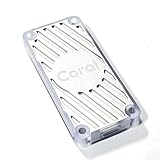
What hardware and software are on the board?
The official datasheet describes the Coral Dev Board as a single-board computer with an Edge TPU system-on-module. Its main processor is an NXP i.MX 8M with a quad-core Arm Cortex-A53 and a Cortex-M4F. The board also includes the Google Edge TPU and a cryptographic coprocessor. The Coral Dev Board datasheet
| Area | Published details |
|---|---|
| Memory and storage | 1 or 4 GB LPDDR4 RAM; 8 or 16 GB eMMC storage |
| Networking | Wi-Fi 2×2 MIMO, Bluetooth 4.2, and Gigabit Ethernet |
| Ports and expansion | USB Type-C power, USB 3.0 host/OTG, serial console, microSD, and a 40-pin GPIO header |
| Display and camera | HDMI 2.0a, MIPI DSI display, and MIPI CSI-2 camera interfaces |
| Operating system | Mendel Linux, a Debian derivative |
These components make the Dev Board a small Linux computer as well as an AI development platform: it has its own storage, networking, display and camera connections, and hardware expansion pins.
Outdated Drivers Are Slowing You Down
One free scan finds every outdated or missing driver and matches the right update for your exact hardware.Free scan · exact hardware matchWindows Errors? Fix Them Before They Spread
Repair common Windows errors and clear accumulated junk for a smoother, more stable PC - no reinstall needed.Free scan · no reinstall#1 Best Overall

- A development board to quickly prototype on-device ML products. Scale from prototype to production with a removable system-on-module (som)
- Performs high-speed ML inferencing: the on-board edge TPU Coprocessor is capable of performing 4 trillion operations (tera-operations) per second (tops), using 0.5 watts for each tops (2 tops per watt). For example, it can execute state-of-the-art mobile vision models such as mobilenet V2 AT 400 FPS, in a power efficient manner
- Provides a complete system: a Single-board computer with SoC plus ML plus wireless connectivity, all on the board running a derivative of Debian Linux We call Mendel, so you can run your favorite Linux tools with this board
- Supports tensorflow Lite: no need to build models from the ground up. Tensorflow Lite models can be compiled to run on the edge TPE
- Supports automl vision edge: easily build and deploy Fast, high-accuracy custom image Classification models to your device with automl vision edge
What the Edge TPU does—and what 4 TOPS means
The Edge TPU is a Google-designed application-specific integrated circuit (ASIC) for machine-learning inference on low-power devices. Google’s datasheet revision 1.7, dated December 2022, lists performance of 4 trillion operations per second (4 TOPS) at 2 W for the board’s Edge TPU implementation. That is a published accelerator specification, not a guarantee that every model will achieve a particular frame rate or use exactly that much power in every workload.
At launch, Google said the Edge TPU could execute MobileNet V2 at more than 100 frames per second in a power-efficient manner. That figure is Google’s launch claim for the stated model; it should not be treated as a general performance result for other models or applications. Google’s March 6, 2019 announcement
Rank #2

- The Coral Dev Board Mini is a single-board computer that enables you to quickly prototype and deploy an embedded system with on-device ML inferencing.
- The board includes the Edge TPU coprocessor, which is a small ASIC designed by Google that accelerates TensorFlow Lite models in a power efficient manner. It's capable of performing 4 trillion operations (tera-operations) per second (tops), using 0.5 watts for each tops (2 tops per watt).
- Provides a complete system: a single-board computer with SoC + ML + wireless connectivity, all on the board running a derivative of Debian Linux we call Mendel, so you can run your favorite Linux tools with this board.
- Supports TensorFlow Lite: no need to build models from the ground up. Tensorflow Lite models can be compiled to run on the Edge TPU.
- Supports AutoML Vision Edge: easily build and deploy fast, high-accuracy custom image classification models to your device..MediaTek 8167s SoC (Quad-core Arm Cortex-A35).2 GB LPDDR3 and 8 GB eMMC memory
Can the Coral Dev Board run TensorFlow Lite models locally?
Yes, but a standard TensorFlow Lite model is not automatically ready to run directly on the Edge TPU. Google’s toolchain requires models to be quantized and compiled for the accelerator. Google also offered pretrained, precompiled models and tools for retraining, giving developers a route to adapt supported models for their own applications. Google’s March 6, 2019 announcement
This makes model preparation a core project requirement: check that the model’s operations and configuration are compatible with Edge TPU compilation, then test the compiled model on the target workload. Local inference keeps processing on the device, but the board’s ability to run Linux does not remove the accelerator’s model-format and compilation requirements.
Rank #3

- G650-03324-01 Coral Mini ARM The Coral Dev Board Mini is a single-board computer that provides machine learning (ML) inferencing
Dev Board, USB Accelerator, or Mini PCIe Accelerator?
The right Coral product depends on whether the project needs a whole computer or only an inference accelerator, and on the host’s available connections.
| Product | Best fit | What to check |
|---|---|---|
| Coral Dev Board | A complete Linux development system with an integrated Edge TPU, storage, wireless, Ethernet, display and camera interfaces, and GPIO | Choose it when you need the host computer and accelerator together, or need its built-in connectivity and interfaces for prototyping. |
| Coral USB Accelerator | An existing Linux computer or Raspberry Pi that needs Edge TPU acceleration over USB | Confirm the host and project can use USB and that the existing computer can handle the rest of the application. |
| Coral Mini PCIe Accelerator | A host computer with a compatible half-size Mini PCIe slot | Check the physical slot and host compatibility before choosing this accelerator-only option. |
Before selecting a product, check whether a host computer is already available, whether its bus or slot matches the accelerator, and whether the design needs a complete Linux system. Camera connections, GPIO, power requirements, and plans for production integration can also affect the choice. Google’s launch post describes the USB and PCIe accelerator products alongside the Dev Board. Coral launch announcement Product details for the accelerators are available from Coral’s accelerator page and the Coral Mini PCIe product page.
Quick Recap
Best Value
Rank #4

- PREMIUM HOUSING: Exclusively for the Google Coral Dev Board, our cooling experts in Sweden have developed the cooling housing, which is made of aluminum. It's a two-piece case that's easy to assemble. With a modern black and white combination, our case ensures stunning aesthetics.
- SILENT EFFICIENT COOLING: During the development of the Google Coral Dev Board case, special emphasis was placed on optimal cooling efficiency and compatibility. The case body acts as an effective heat sink and perfectly protects your single-board computer from thermal problems in difficult temperature environments or when the CPU is overclocked.
- 100% COMPATIBILITY: All connections of the Google Coral Dev Board are freely accessible and can be reached without any problems. Good WiFi and Bluetooth reception.
- VERY EASY TO ASSEMBLE: Thanks to the snap-on assembly of the lid and base, assembly is very easy. 4 non-slip rubber feet ensure a secure grip on any surface. 2 mounting holes (compatible with VESA 75 mm) can be used to attach the housing to the wall or other surface.
- SCOPE OF DELIVERY & SUPPORT: You will receive a Google Coral Dev Board case black/white. If you have any questions or need help, our KKSB team is always at your side. Just write to us through the Amazon messaging system and one of our staff will be there for you personally.
Product prices and availability are accurate as of the date/time indicated and are subject to change. Any price and availability information displayed on Amazon at the time of purchase will apply.

