
What’s actually slowing this PC down?
Pick the symptom - the matching free tool is one click away.
Google used Trillium to train Gemini 2.0, but Trillium is not the company’s newest TPU in 2026. It is Google’s sixth-generation accelerator, sold on Google Cloud as Cloud TPU v6e. Its combination of higher compute, more memory, and faster chip-to-chip links helped Google scale training and inference; whether it is a good choice for another team depends just as much on software fit, available capacity, and workload as on the chip specifications.
What is Google Trillium?
Trillium is the product name for Google’s sixth-generation Tensor Processing Unit (TPU). On Google Cloud APIs, logs, and technical documentation, it is identified as Cloud TPU v6e. Google announced it on May 14, 2024, and made it generally available on December 11, 2024. Google says it used Trillium to train Gemini 2.0. (announcement; general availability and Gemini 2.0; v6e documentation)
A TPU is a Google-designed accelerator for machine-learning operations, particularly the large tensor and matrix calculations used in neural networks. Trillium was built for training and inference across transformer and mixture-of-experts models, text-to-image systems, convolutional neural networks, and embedding workloads. It is not simply a Google-branded GPU: its practical performance depends on the custom chip, compiler and runtime stack, memory, interchip networking, and how the model is distributed across a cluster. It will not automatically outperform a GPU on every workload.
Why Google built Trillium
Scaling AI puts pressure on more than raw compute. Training needs the chips to process large operations quickly, memory to hold model parameters and intermediate data, and fast communication when work is spread across many accelerators. Inference adds another memory challenge: a model’s key-value cache can grow as requests and context lengths increase.
Recommended Free Tools
#1 Best Overall

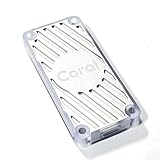
- A USB accessory that brings machine learning inferencing to existing systems. Works with Raspberry Pi and other Linux systems
- Performs high-speed ML inferencing: the on-board edge TPU Coprocessor is capable of performing 4 trillion operations (tera-operations) per second (tops), using 0.5 watts for each tops (2 tops per watt). For example, it can execute state-of-the-art mobile vision models such as mobilenet V2 AT 400 FPS, in a power efficient manner
- Works with Debian Linux: connects to any debian-based Linux system with an included USB 3.0 Type-C cable
- Supports tensorflow Lite: no need to build models from the ground up. Tensorflow Lite models can be compiled to run on the edge TPE
- Supports automl vision edge: easily build and deploy fast, high-accuracy custom image classification models to your device with automl vision edge
Trillium addresses those pressures with more per-chip compute, twice the HBM capacity and twice the interchip-interconnect bandwidth of TPU v5e, according to Google. The design also targets a broader set of Google Cloud workloads—including dense language models, mixture-of-experts models, embeddings, ranking, recommendation, multimodal systems, and serving—not just chatbot-style transformer training. (Google’s Trillium specifications and comparisons)
SparseCore for embedding-heavy work
Trillium includes third-generation SparseCore, a specialized accelerator for large embedding workloads. Embeddings turn items such as users, products, or words into vectors, often stored in large tables. Looking up and processing those vectors can be a major part of ranking, retrieval, recommendation, and personalization systems. That makes SparseCore relevant to workloads such as search and recommendations as well as generative AI.
Trillium specifications
The following specifications are from Google’s Cloud TPU v6e documentation, last updated July 22, 2026. Peak figures describe hardware capability, not guaranteed application performance. (Cloud TPU v6e specifications)
Rank #2

- High-Performance ML Accelerator: Integrates Edge TPU, delivering 4 TOPS (int8) peak performance for machine learning inference tasks.
- Strong Compatibility: Supports M.2 A+E key interface for easy integration into existing systems.
- Low Power Design: Provides 2 TOPS per watt, ideal for embedded and energy-efficient applications.
- Wide OS Support: Compatible with Linux (Debian 10/Ubuntu 16.04+) and Windows 10 (64-bit).
- Industrial-Grade Reliability: Operating temperature range of -20°C to +85°C, suitable for harsh environments.
| Specification | Cloud TPU v6e / Trillium |
|---|---|
| Peak compute per chip, BF16 | 918 TFLOPs |
| Peak compute per chip, Int8 | 1,836 TOPS |
| HBM per chip | 32 GB |
| HBM bandwidth per chip | 1,638 GB/s |
| Bidirectional ICI bandwidth per chip | 800 GB/s |
| ICI ports per chip | 4 |
| Chips per host | 8 |
| Maximum listed pod size | 256 chips |
| Pod topology | 2D torus |
| BF16 peak compute per pod | 234.9 PFLOPs |
| All-reduce bandwidth per pod | 102.4 TB/s |
| Data-center network bandwidth per pod | 25.6 Tbps |
HBM capacity limits how much model state or inference cache can stay close to the processor; HBM bandwidth affects how quickly that data can be read and written. ICI—the interchip interconnect—carries data between TPUs when a workload is distributed across them. At larger scales, communication bandwidth affects synchronization and serving as well as arithmetic.
Quick wins for a faster PC:
Fix the driver behind crashes, sound loss and screen glitchesFind Drivers →Repair Windows errors before they cause bigger problemsFix Now →Peak FLOPs alone do not predict end-to-end speed. Model architecture, batch size, sequence length, precision, compiler support, parallelism strategy, and input/output shape all affect realized performance. A single-chip test also cannot stand in for a multi-host training or inference run.
What Google’s performance claims mean
Google’s comparisons with TPU v5e include more than 4× training-performance improvement, up to 3× higher inference throughput, 67% greater energy efficiency, and 4.7× higher peak compute performance per chip. Google also says v6e has twice the HBM capacity and twice the interchip bandwidth. These are vendor-reported comparisons, not independent guarantees that a customer’s workload will run at those multiples. The 4.7× figure is a peak-compute comparison, not a claim that all models train 4.7× faster. (Google’s comparison with TPU v5e)
Scaling results
Google reported 99% scaling efficiency for a 12-pod deployment totaling 3,072 Trillium chips. In a GPT-3-175B pretraining comparison across 24 pods and 6,144 chips, Google reported 94% scaling efficiency. It also said more than 100,000 Trillium chips were connected through its Jupiter network fabric. These are results and deployment figures reported by Google; they do not establish how efficiently a different customer’s model will scale. (Google’s scaling results)
Inference results
In Google’s JetStream reference comparisons against TPU v5e, it reported 2.9× the throughput for Llama 2 70B and 2.8× for Mixtral 8×7B. For Llama 3.1 405B, Google reported 1,703 tokens per second using multi-host inference and Pathways, and three times more inference per dollar than the cited TPU v5e comparison. These results came from specified sequence lengths, chip configurations, and Google reference implementations; they are not universal price-performance rankings. (Google’s TPU and GPU inference updates)
Which models used Trillium?
The clearest model-specific public claim is that Google used Trillium to train Gemini 2.0. Google’s original Trillium announcement also said Gemini 1.5 Flash, Imagen 3, and Gemma 2 had been trained and served using Google TPUs. That broader statement does not establish that those models specifically used Trillium. Nor does public information about Gemini 2.0 establish the accelerator used for every current Gemini model or serving deployment. (Gemini 2.0 claim; models trained and served on Google TPUs)
Rank #4

- Performs high-speed ML inferencing: The on-board Edge TPU coprocessor is capable of performing 4 trillion operations (tera-operations) per second (TOPS), using 0.5 watts for each TOPS (2 TOPS per watt). For example, it can execute state-of-the-art mobile vision models such as MobileNet v2 at 400 FPS, in a power efficient manner. Works with Debian Linux: Integrates with any Debian-based Linux system with a compatible card module slot. Supports TensorFlow Lite: No need to build models from the ground up. TensorFlow Lite models can be compiled to run on the Edge TPU.
The software stack is part of the product
Trillium’s usefulness depends on software as well as silicon. Google’s TPU ecosystem includes the XLA compiler, JAX, TensorFlow, PyTorch support, and OpenXLA. For training and serving, the surrounding tools include MaxText, JetStream, vLLM on TPU, Pathways for multi-host and disaggregated inference, and Google Kubernetes Engine (GKE) for container orchestration. Google presents Trillium as part of its broader AI Hypercomputer architecture. (Trillium and AI Hypercomputer; inference software and results)
PyTorch support does not mean that a CUDA-focused PyTorch project will run unchanged or perform equally well. Teams may need to adapt kernels, compilation, and parallelism, then tune the model for the TPU runtime. A project already built around JAX and XLA may have a more direct path than one that relies on custom CUDA code or Nvidia-specific libraries.
How Trillium compares with Google’s newer TPUs
As of August 18, 2026, Trillium remains generally available but is no longer Google’s newest TPU. Google lists Ironwood, its seventh-generation TPU, as generally available and lists TPU 8t and TPU 8i as coming soon. The product page describes TPU 8t as training-focused and TPU 8i as inference-focused. The available status information does not, by itself, establish which accelerator generation is used for every Google model in production. (Google Cloud TPU lineup)
The Tool Desk
Outbyte PC Repair FREEClear out junk files and repair common Windows errorsFree Scan →Outbyte Driver Updater FREEScan for outdated or missing drivers - takes under a minuteDriver Scan →Best Value

- Performs high-speed ML inferencing: The on-board Edge TPU coprocessor is capable of performing 4 trillion operations (tera-operations) per second (TOPS), using 0.5 watts for each TOPS (2 TOPS per watt). For example, it can execute state-of-the-art mobile vision models such as MobileNet v2 at 400 FPS, in a power efficient manner.
- Works with Debian Linux: Integrates with any Debian-based Linux system with a compatible card module slot.
- Supports TensorFlow Lite: No need to build models from the ground up. TensorFlow Lite models can be compiled to run on the Edge TPU.
- Supports AutoML Vision Edge: Easily build and deploy fast, high-accuracy custom image classification models to your device with AutoML Vision Edge.
| TPU generation or product | Status as of August 18, 2026 | What the status means |
|---|---|---|
| Trillium (Cloud TPU v6e), sixth generation | Generally available | Available through Google Cloud, subject to region, quota, and capacity. |
| Ironwood, seventh generation | Generally available | A newer Google TPU generation; it is not Trillium. |
| TPU 8t | Coming soon | Listed by Google as training-focused. |
| TPU 8i | Coming soon | Listed by Google as inference-focused. |
How to access Trillium on Google Cloud
Cloud TPU v6e is offered in single-VM configurations and larger multi-host slices. Google lists v6e-1 for one-chip testing, v6e-4 for a four-chip VM, and v6e-8 for a full eight-chip host optimized for inference. Larger listed slices include 16, 32, 64, 128, and 256 chips. A v6e-8 single-VM inference configuration is not interchangeable with a multi-host training slice; larger inference jobs can use Pathways. (v6e configurations)
Google’s v6e documentation lists these zones: us-central1-b, us-east1-d, us-east5-a, us-east5-b, us-south1-ai1b, europe-west4-a, asia-northeast1-b, and southamerica-west1-a. A listed zone is not a guarantee that every slice size is available there: quota and capacity can constrain provisioning, especially for larger requests. Check the live regions-and-zones guidance before designing a deployment. (TPU regions and zones)
Choose an access model
- TPU VMs: Direct infrastructure access gives engineers control over containers, runtimes, distributed execution, and serving engines. It also leaves them responsible for model compilation and provisioning.
- GKE: Use Google Kubernetes Engine when container orchestration, scheduling, repeatable deployments, or multi-host serving are central to the project. It may be unnecessary overhead for a one-off benchmark.
- Managed custom-model serving: Google documents TPU-backed custom model serving for v5e, v6e, and TPU7x. The documentation warns that TPU quota for custom model serving may be zero by default in many regions, so account-level quota planning can be necessary. (custom model serving with TPUs)
Understand pricing and interruptions
Google publishes TPU prices per chip-hour, while Cloud Console billing can display VM-hours. Compare like with like: convert the VM configuration to its chip count and normalize the billing period before comparing it with a per-chip quote or another accelerator instance. Prices vary by region and consumption model, and should be checked on Google’s current pricing page rather than treated as a fixed global rate. (Cloud TPU pricing)
Google lists on-demand use, Spot capacity, Flex-start, and longer-term commitment options. Spot prices can change, and Spot VMs may be preempted, so they suit interruption-tolerant batch jobs better than work that cannot tolerate a restart. A lower quoted hourly rate is not automatically a lower cost per completed job if interruptions, low utilization, software work, or capacity delays change how long the job takes. (TPU pricing and consumption options)
Is Trillium the right accelerator for your workload?
Trillium is a stronger candidate when
- Your training or serving workload is compatible with the TPU software stack and benefits from JAX, XLA, Pathways, or TPU-optimized serving tools.
- You are scaling transformer, mixture-of-experts, text-to-image, or embedding-heavy workloads across multiple chips.
- Your organization already runs on Google Cloud, Vertex AI, GKE, or Google’s AI Hypercomputer infrastructure.
- You can plan around regional capacity, quota, and the slice size your workload needs.
A GPU may be a better fit when
- Your project depends heavily on CUDA, custom GPU kernels, or Nvidia-specific libraries.
- You need to experiment quickly across many third-party models and depend on broad GPU ecosystem support.
- Your workload is small enough that porting and compiler tuning could outweigh any infrastructure benefit.
- Portability across cloud providers and accelerator vendors is more important than tuning for Google’s platform.
For an apples-to-apples decision, compare total cost per useful token, training step, or completed job—not just peak FLOPs or a headline hourly price. Include software migration, utilization, networking, storage, host-side bottlenecks, quota, and the likelihood of obtaining capacity. A model that is not optimized for TPU can erase the apparent advantage of a faster accelerator.
Common planning mistakes
- Requesting the wrong zone or slice: Verify that the zone and chip count you need are listed and confirm actual capacity and quota before building a schedule around them.
- Treating configurations as interchangeable: A one-chip test VM, an eight-chip inference host, and a multi-host training slice serve different purposes.
- Assuming PyTorch support means drop-in compatibility: Test the actual model and operations; custom CUDA dependencies and kernels may need adaptation or replacement.
- Benchmarking an untuned implementation: Performance depends on the compiled model, batch and sequence lengths, precision, data pipeline, and parallelism.
- Comparing inconsistent prices: Normalize chip counts and billing units, and account for utilization and interruptions.
- Ignoring the rest of the system: Host CPU, storage, input pipeline, and networking can become bottlenecks even when the accelerator has headroom.
- Inferring production hardware from model branding: Google’s public statements do not disclose the exact TPU generation behind every current model or serving path.
Why Trillium matters
Trillium’s significance is not that it made GPUs obsolete. It showed how Google could co-design accelerator silicon, memory, networking, compilers, model software, and cloud deployment for its own AI workloads at large scale. For Cloud customers, it remains a relevant option for TPU-compatible work, but it is a previous generation: evaluate it against current alternatives using the model you actually plan to run and the capacity you can actually obtain.
Quick Recap
Product prices and availability are accurate as of the date/time indicated and are subject to change. Any price and availability information displayed on Amazon at the time of purchase will apply.

