
Recommended Free Tools
iTechGuides is reader-supported. When you buy through links on our site, we may earn an affiliate commission. As an Amazon Associate I earn from qualifying purchases. Learn more
Edge AI is the umbrella term for running AI inference on or near the place where data is created. TinyML is the highly constrained end of that umbrella: machine-learning models running on ultra-low-power microcontrollers and embedded devices. The terms are not competing kinds of intelligence. TinyML describes a particular resource envelope inside the wider Edge AI field. That distinction determines which models you can run, how quickly a device can respond, what data it must transmit, and how you operate it for years.
Edge AI and TinyML in one sentence
Edge AI places inference close to sensors, cameras, machines, vehicles, or people instead of sending every input to a distant cloud service. TinyML does the same job on especially small devices, commonly microcontrollers with very limited flash, RAM, processing capacity, and energy. Arm’s overview uses microcontrollers with less than 1 MB of flash and a few hundred kilobytes of RAM as examples of this device class; those figures illustrate the constraint rather than defining a universal TinyML threshold. Arm’s TinyML and edge-device overview describes TinyML as a subset of Edge AI, while IEEE’s broader definition includes hardware ranging from microcontrollers and phones to industrial gateways, cameras, and vehicle computers. IEEE Technology Navigator’s Edge AI overview
A useful mental model is a set of nested circles:
- Cloud AI: raw or preprocessed data travels to centralized servers for inference.
- Edge AI: inference runs on or near the data source, including phones, cameras, gateways, vehicles, and embedded Linux systems.
- TinyML: a particularly constrained Edge AI deployment, usually on a microcontroller that must operate with very little power, memory, storage, and heat.
A battery-powered sensor that recognizes a vibration pattern is a TinyML system and therefore an Edge AI system. A camera gateway running a larger vision model is Edge AI but is not normally called TinyML.
Quick wins for a faster PC:
Fix the driver behind crashes, sound loss and screen glitchesFind Drivers →Repair Windows errors before they cause bigger problemsFix Now →What makes a deployment “edge”?
Inference location, not a chip brand
Edge AI is defined primarily by where inference happens. If a device or a nearby gateway turns sensor readings into a prediction before sending information to a remote service, the inference is at the edge. The hardware can be a microcontroller, smartphone, industrial computer, camera, vehicle module, or other embedded platform. The exact boundary varies by architecture: some designs infer directly on a sensor node, some use a local gateway, and some split work between a device and a nearby or central service.
#1 Best Overall

- The ESP32-C3 is a 32-bit RISC-V CPU that contains the FPU (floating point unit) for 32-bit single-precision operations with powerful computing power. It has excellent RF performance and supports IEEE 802.11b/g/n WiFi and Bluetooth 5(LE) protocols
- It is equipped with a wealth of interfaces, with 11 digital I / 0s that can be used as PWM pins and 4 analog 1/0s that can be used as ADC pins
- It supports four serial interfaces: UART, 12C and SPI. The board also has a small reset button and a boot loader mode button
- The ESP32C3SuperMini is positioned as a high-performance, low-power, cost-effective iot mini development board for low-power iot applications and wireless wearable applications
- ESP32C3SuperMini is a loT mini development board based on the ESP32-C3 WiFi/Bluetooth dual-mode chip, ESP32-C3 32-bit RISC-V single-core processor,running up to 160 MHz
Why moving inference changes the design
Keeping a prediction near its source can reduce round-trip latency, network traffic, and dependence on a continuous connection. A machine may need to stop immediately when a fault is detected; a wearable may have no reliable link; a remote sensor may run on a small battery. Local inference can address those constraints, but it is not an automatic guarantee of lower cost, privacy, or security. The Canadian Centre for Cyber Security notes that edge systems still require protection for devices, models, and data, plus patching and operational oversight. Canadian Centre for Cyber Security guidance on securely deploying AI at the network edge
What TinyML adds to the definition
An extreme resource envelope
TinyML targets devices designed to spend very little energy and provide only modest compute and memory. A microcontroller may have no operating system, limited persistent storage, and strict real-time requirements. The model must coexist with firmware, sensor drivers, communication stacks, and application code. A model that is small enough to load may still be too slow, too inaccurate, or too power-hungry for the product.
Always-on operation is a common pattern
TinyML often performs a small amount of local classification continuously, waking a more capable processor or radio only when an event is detected. Wake-word detection is a familiar example: the microcontroller listens locally and sends audio or activates a larger model only after recognizing a trigger. Similar patterns apply to gesture detection, acoustic event recognition, vibration monitoring, and simple environmental classification.
Do these 3 things before closing this tab:
1Fix the driver behind crashes, sound loss and screen glitches2Clear out junk files and repair common Windows errors3Scan for outdated or missing drivers - takes under a minuteHow TinyML differs from merely “small AI”
A compact model running on a laptop is not automatically TinyML. The term implies deployment on highly constrained embedded hardware, with power, memory, latency, and firmware integration treated as first-class requirements. TinyML is therefore a systems discipline as much as a model-size label.
Edge AI vs. TinyML: practical differences
| Dimension | Broader Edge AI | TinyML |
|---|---|---|
| Typical hardware | Phones, cameras, gateways, industrial computers, vehicle modules, embedded Linux devices, and microcontrollers | Low-power microcontrollers and similarly constrained embedded devices |
| Resource budget | Can range from modest to substantial CPU, GPU, NPU, memory, and storage | Very limited flash, RAM, compute, and energy; Arm uses less than 1 MB flash and a few hundred kilobytes of RAM as example constraints |
| Typical inputs | Images, video, audio, telemetry, multimodal streams, and sensor data | Low-rate sensor streams, short audio windows, inertial data, vibration, and simple environmental signals |
| Model complexity | Can support demanding vision, speech, and industrial models when hardware permits | Usually compact classifiers or detectors optimized for a narrow task |
| Power profile | From mains-powered equipment to phone batteries and vehicle power systems | Often battery-powered, energy-harvesting, or highly size- and heat-constrained |
| Connectivity | May use local networks, cellular links, or intermittent cloud connectivity | Designed to keep core detection working with little or no network access |
| Operations | May support containers, remote management, richer logs, and frequent model updates | Firmware-like releases, careful memory planning, signed updates, and fleet-level power management |
These are tendencies, not hard boundaries. A microcontroller can be part of a larger Edge AI pipeline, and a TinyML product may forward selected events to a gateway or cloud service.
Use cases that fit TinyML
Environmental monitoring
Small nodes can classify temperature, humidity, air-quality, soil, or acoustic conditions and transmit only readings or detected events. Local classification reduces radio duty cycle, which can matter more to battery life than the model’s arithmetic cost.
Wearables and health-adjacent sensing
Accelerometers and other low-power sensors can identify activity, gestures, posture changes, or unusual motion. A wearable can respond immediately while limiting the amount of raw motion data that leaves the device. Any medical or safety claim still requires domain validation and regulatory review; TinyML by itself does not make a device a medical diagnostic.
The Tool Desk
Outbyte Driver Updater FREEFix the driver behind crashes, sound loss and screen glitchesFind Drivers →Outbyte PC Repair FREERepair Windows errors before they cause bigger problemsFix Now →Audio and wake-word detection
A microcontroller can classify a small vocabulary, machine sound, or acoustic event. Local processing avoids streaming a microphone continuously and allows a trigger to work when a network is unavailable.
Gesture and interaction sensing
Inertial sensors, capacitive inputs, or short-range radar can feed compact classifiers for touchless controls, appliance interfaces, or industrial commands. The model must tolerate variation in users, mounting position, and movement speed.
Anomaly detection on machines
Vibration, current, pressure, or temperature patterns can be reduced to a local anomaly score. The node can alert a controller or gateway when behavior departs from a learned baseline, while retaining raw samples only when an investigation is needed.
Arm lists environmental monitoring, wearables, smart homes, audio classification, gesture detection, and anomaly detection among TinyML and constrained-edge examples. Arm’s examples of TinyML applications
Use cases for larger Edge AI systems
Embedded vision
Image classification, object detection, inspection, and camera analytics often need more memory and compute than a tiny microcontroller can provide, especially when processing high-resolution frames or several streams. A capable embedded Linux board, camera module, or industrial computer can run the model locally and send metadata rather than continuous video.
Industrial automation
Factories can place inference beside robots, programmable controllers, and machine sensors to meet predictable latency requirements. A local system may continue operating during a wide-area network outage, while a central service receives health data, model updates, and selected evidence.
Vehicles and mobile robots
Autonomous or assisted systems need rapid perception and control decisions. Vehicle compute modules and robot platforms can combine cameras, lidar, radar, and telemetry locally; the appropriate model size depends on safety targets, sensor load, and available accelerators.
Rank #2

- 【ESP32S】Powerful Performance – Features a 1 core chip running at up to 240 MHz, supports low-power modes, Bluetooth 4.2, and Wi-Fi. Widely used in smart home IoT, DIY, robotics, drones, STEAM, AI edge computing, LEDs, and more. Quickly get started with Wi-Fi and Bluetooth modes via sample codes, and control the chip using a mobile app or the cloud — simple and convenient.
- 【Rich Peripherals】 – Offers extensive peripheral capabilities, including up to 34 GPIOs, I2C, SPI, UART, I2S, PWM, and many other interfaces. Compatible with almost all common peripherals such as cameras, LCDs, sensors, LEDs, batteries, and motors — bringing your creative ideas to life.
- 【Platform Compatibility】 – Strong platform compatibility with ESP-IDF, Arduino, VSCode, MicroPython, LVGL, TinyML, and more. Suitable not only for conventional programming control but also for AI data processing and recognition. Supports FreeRTOS and Zephyr operating systems.
- 【Development Resources】 – As professional developers, we provide abundant learning code accompanying the product, including source code (IDF, Arduino, MicroPython, LVGL), chip/component datasheets, development tools, and more for study and reference github.com/yezeganghelei/ESP32
- 【AI Edge Computing】 – Low‑cost AI learning and exploration chip. Easily connect to large language models via Wi-Fi, and use I2S for voice input/output to implement AI chat and similar functions. Through TinyML and third‑party trained model deployment, it supports voice wake‑up and recognition, gesture recognition, and image/person recognition.
Healthcare monitoring infrastructure
Hospitals and care facilities may analyze device telemetry or video near the source to reduce delay and limit unnecessary transmission. Sensitive information still needs access control, encryption, retention rules, and a clear explanation of what is processed locally and what leaves the site.
AWS describes edge inference examples in industrial automation, autonomous vehicles, and healthcare monitoring, while Arm’s developer guide demonstrates both microcontroller-class image classification and higher-performance Embedded Linux development. AWS: What is Edge Inference? Arm Get Started with Edge AI Development
How to choose between TinyML, larger Edge AI, and a hybrid
1. Define the decision the model must make
Write the input, output, acceptable error, and response deadline in measurable terms. “Detect a bearing problem within one second” is more useful than “apply AI to maintenance.” Identify whether the output is a binary event, a few classes, a continuous estimate, or a rich perception result.
2. Measure the model’s real resource needs
- RAM: include weights, activation buffers, sensor buffers, operating code, and communication stacks.
- Flash or storage: include the model, firmware, bootloader, two update images if rollback is required, and logs.
- Compute: test worst-case inference time, not only an average benchmark.
- Accelerators: determine whether the target has a DSP, GPU, or NPU and whether your runtime supports it.
- Data movement: account for sensor sampling, preprocessing, and copies between buffers.
A model that fits weights but exhausts activation memory will fail at runtime. Profile on the intended board with production sensor rates and compiler settings.
3. Establish the power budget
For a battery device, calculate energy per inference, idle current, sensor current, radio transmit cost, and wake-up frequency. An always-on classifier may save energy by avoiding radio transmission, but a complex model that runs continuously can consume more than a simpler threshold detector. Measure battery life under realistic event rates rather than quoting a single idle figure.
Free tools Windows power users keep installed
One-click scans. No signup required.
4. Set latency and connectivity requirements
If the device must respond while offline or within a few milliseconds, place the critical inference path locally. If occasional delay is acceptable, a gateway or cloud service may support a larger model. AWS distinguishes on-device, gateway, and fog placements, which can be combined in one system. AWS edge-inference placement overview
5. Decide what data may leave the device
Map each signal: raw sensor data, derived features, predictions, diagnostics, and update telemetry. Local inference can reduce transmission of raw inputs, but a compromised device may expose stored data or model parameters. Define encryption, authentication, retention, and deletion requirements before selecting hardware.
6. Plan the operating lifetime
Ask how devices will be enrolled, monitored, patched, replaced, and retired. TinyML deployments can involve thousands of unattended nodes, making signed firmware, staged rollout, rollback, health metrics, and battery status essential. A larger gateway may be easier to update but introduces another computer and attack surface.
7. Choose a split when neither endpoint is sufficient
A hybrid design can run a low-power detector on the sensor, send an event to a gateway for richer analysis, and synchronize aggregate data or model updates with the cloud. This preserves immediate response while reserving expensive computation for cases that need it. The Canadian Centre for Cyber Security describes practical Edge AI as often hybrid, combining local inference with cloud updates, orchestration, telemetry, or fallback. Canadian Centre for Cyber Security edge-architecture guidance
Optimizing a model for TinyML hardware
Quantization
Quantization represents weights and, where supported, activations with lower-precision numbers. This can reduce flash and RAM use and speed inference on compatible hardware. Validate accuracy with the actual sensor distribution; a small numerical change can matter for a narrow detection threshold.
Pruning
Pruning removes less useful parameters or connections. The resulting model may require a runtime and kernel that exploit sparsity; deleting weights without changing execution may save little time. Measure both size and latency after conversion.
Knowledge distillation
Distillation trains a compact “student” model to reproduce useful behavior from a larger “teacher.” It can preserve more accuracy than simply shrinking layers, but it adds a training step and still requires representative data.
Feature and sampling design
Reducing sensor bandwidth before inference can save more energy than model compression alone. Choose a sampling rate that captures the event, use fixed-size windows where possible, and avoid unnecessary copies. Keep preprocessing identical between training and firmware.
Arm lists quantization, pruning, and knowledge distillation as common optimization techniques for constrained deployment. Arm optimization guidance for TinyML
Rank #3
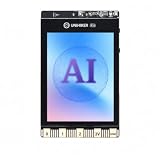
- All-in-One AI Learning Platform: Combines vision AI, offline voice recognition, and TinyML machine learning in one compact device – ideal for STEM education and beginners exploring AI, IoT, and coding.
- Pre-Loaded AI Models & Offline Voice Control: Comes with 4 pre-installed vision AI models (face, pet, QR code, motion) and supports offline speech recognition – no internet needed to start building smart projects.
- Train Your Own AI Models with TinyML: Go beyond built-in features and create custom vision or sensor models for personalized AI projects, enhancing learning and creativity.
- Rich Sensors & Wireless Connectivity: Features a 2MP camera, microphone, speaker, environmental sensors, and dual Wi-Fi/Bluetooth for IoT applications, remote control, and real-time data monitoring.
- User-Friendly with Graphical & MicroPython Coding: Supports drag-and-drop graphical programming (Mind+) and MicroPython, perfect for all skill levels. Includes 2.8" color screen for instant data visualization.
Security, privacy, and reliability trade-offs
Local does not mean private by default
Processing data locally may reduce exposure in transit, but the device can still collect sensitive information, retain buffers, emit telemetry, or send updates. Threat-model physical access, debug ports, boot code, model files, credentials, and the gateway or cloud services connected to the node.
Protect the model and update path
- Use secure boot and signed firmware or model packages where the platform supports them.
- Authenticate devices and servers, and rotate credentials over the device lifetime.
- Encrypt sensitive data in transit and at rest.
- Disable or lock production debug interfaces.
- Stage updates, monitor failures, and retain a rollback image when storage permits.
Expect offline failure modes
An offline device may keep making predictions but lose time synchronization, alert delivery, policy updates, or centralized monitoring. Define how it buffers events, handles a full queue, signals stale models, and recovers after reconnecting. Test sensor failure, corrupted storage, brownouts, clock drift, and repeated reboot cycles.
Development boards and a practical proof of concept
Arm names the Arduino Nano 33 BLE Sense, STM32 microcontrollers, Raspberry Pi Pico, and Arduino Nano RP2040 Connect as example development hardware for Edge AI and TinyML experimentation. Arm overview of example TinyML boards Board availability, prices, and compatibility with a particular tutorial vary, so verify the current hardware documentation before purchasing.
What’s actually slowing this PC down?
Pick the symptom - the matching free tool is one click away.
- Capture representative data: record the same sensor placement, users, environments, and event frequencies expected in the product.
- Train a baseline: start with a model small enough to understand and establish accuracy before compression.
- Convert and profile: measure flash, peak RAM, inference time, and energy on the target board.
- Test edge cases: include noise, missing samples, temperature changes, battery sag, and “none of the above” inputs.
- Integrate firmware: verify sensor drivers, buffering, scheduling, watchdog behavior, and communications together.
- Instrument the fleet path: add version reporting, health telemetry, secure update checks, and a recovery procedure before field trials.
Common mistakes and how to correct them
Treating TinyML as a universal RAM or flash cutoff
No single memory number defines TinyML. Use the target device, runtime, model, and application together; cite figures such as “under 1 MB flash” only as examples of a class of constrained microcontrollers.
Choosing hardware from a demo benchmark
A vendor demo may omit preprocessing, communications, logging, or worst-case inputs. Re-run the complete pipeline at production sampling rates and measure peak memory and energy.
Assuming compression preserves accuracy
Quantization, pruning, and distillation can change predictions. Compare confusion matrices, false positives, false negatives, and performance across environments after every optimization.
Sending raw data “just in case”
Continuous uploads can erase the bandwidth, privacy, and power advantages of edge inference. Define an evidence policy: transmit events, summaries, or short windows only when operationally justified, with retention and access controls.
Windows Errors? Fix Them Before They Spread
Repair common Windows errors and clear accumulated junk for a smoother, more stable PC - no reinstall needed.Free scan · no reinstallCrashes, No Sound, or Screen Glitches?
Random freezes, missing sound and display glitches usually trace back to one bad driver. Find and replace yours safely.Free scan · under a minuteIgnoring lifecycle operations
A model that works in the lab can become unsafe or ineffective as sensors age, environments change, or threats evolve. Budget for monitoring, recalibration, signed updates, rollback, and device replacement from the beginning.
A decision checklist
- Is the required output simple enough for a compact classifier, or does it need rich vision, speech, or multimodal reasoning?
- What are the measured RAM, flash, compute, latency, and energy limits on the final hardware?
- Must the critical decision work without a network?
- What raw data is allowed to leave the device, and for how long may it be retained?
- Can the organization securely enroll, update, monitor, and retire every device?
- Would a gateway provide a better balance between endpoint power and model capability?
- What accuracy, false-alarm rate, and recovery behavior are acceptable in the real environment?
If the workload is a narrow, always-on sensor or audio task and the product has severe power and memory limits, start by evaluating TinyML. If it needs heavier vision, speech, or sensor fusion, evaluate a more capable Edge AI device. If the endpoint must stay tiny but occasional decisions are complex, use a hybrid sensor-plus-gateway architecture.
Frequently Asked Questions
Is TinyML the same as Edge AI?
No. Edge AI is the broad practice of running inference on or near the data source. TinyML is generally a subset focused on ultra-low-power microcontrollers and similarly constrained embedded devices.
Can TinyML run without an internet connection?
Yes. Core inference can run locally and continue during an outage, although alerts, telemetry, time synchronization, and model updates may be delayed until connectivity returns.
Does Edge AI guarantee better privacy?
No. Local processing can reduce transmission of raw data, but devices, stored buffers, models, update channels, and connected services still require security and privacy controls.
Which is better for computer vision: TinyML or Edge AI?
It depends on the image size, frame rate, model, and accuracy target. Simple, low-rate classification may fit a microcontroller; high-resolution detection or multiple streams usually need a more capable edge processor or gateway.
What should I measure before selecting a board?
Measure peak RAM and flash use, worst-case inference latency, energy per inference, sensor and radio costs, accuracy on representative data, update storage, and behavior during offline and fault conditions.
Quick Recap
Product prices and availability are accurate as of the date/time indicated and are subject to change. Any price and availability information displayed on Amazon at the time of purchase will apply.

