
Recommended Free Tools
iTechGuides is reader-supported. When you buy through links on our site, we may earn an affiliate commission. As an Amazon Associate I earn from qualifying purchases. Learn more
Yes, Linux can run on RISC-V, and community reports show that PyTorch has been built and run on the architecture. But that does not make every RISC-V server a turnkey Linux or AI platform: support depends on the specific hardware, firmware, Linux image, framework build, and any accelerator you intend to use. RISC-V’s server standards are becoming more concrete, but standards compliance alone does not guarantee that a particular machine has a supported operating system, working device drivers, or useful AI performance.
What does it mean to run Linux on a RISC-V server?
RISC-V is an open-standard instruction set architecture (ISA): it defines the instructions a processor can execute. Linux can be built for the RISC-V 64-bit architecture, commonly identified as riscv64. Whether it runs reliably on a particular server is a separate question. The system also needs compatible firmware, boot and runtime services, kernel support, device drivers, and a Linux image prepared for that hardware.
RISC-V International’s Server Platform specification is intended to make systems more interoperable by defining shared requirements across processors, system-on-chips, peripherals, firmware, boot and runtime behavior, and security capabilities. Among its goals is making it more practical to distribute one operating-system binary across conforming platforms. That is a platform contract—not a guarantee that every system claiming to use RISC-V implements the same features or is supported by every Linux distribution.
Free tools Windows power users keep installed
One-click scans. No signup required.
The standards library lists Server Platform v1.0, dated May 2026, and Server SoC v1.0, ratified on February 21, 2025. These specifications make the server-platform effort tangible, but buyers still need to verify a specific machine’s conformance, firmware, components, and operating-system support.
#1 Best Overall

- Flexible MCU Board: Incorporate the ESP32-C3 32-bit RISC-V chip, operating up to 160 MHz, mounted multiple development ports,
- Developer Friendly: Compatible with Arduino IDE, MicroPython, CircuitPython, PlatformIO, ESP IDF, Zephyr, Matter, ESPNow, Meshtastic, WLED, ESPHome, Home Assistant, Ubidots
- Outstanding RF performance: Complete Wi-Fi functions and Bluetooth Low Energy, while supporting communication over 100m with anFL antenna
- Elaborate Power Design: 4 working modes as low as 44 μA in deep sleep mode, while supporting lithium battery charge management
- Thumb-sized Design: 21 x 17.5mm, Seeed Studio XIAO series classic form factor
Which Linux distributions support RISC-V servers?
Support is distribution- and machine-specific. For example, Fedora’s RISC-V installation documentation says that riscv64 is currently not an officially supported Fedora architecture.
Canonical documents Ubuntu installation routes for particular RISC-V boards, but those guides do not establish support for every RISC-V server.
That distinction matters operationally. A distribution may have many packages built for an architecture without offering the same support commitments, installation experience, or testing coverage it provides for an officially supported platform. Fedora describes its RISC-V environment as primarily intended for headless build-host and server use, and notes that most packages are built from Fedora sources, with some architecture-specific patches. Read the support status for the exact distribution release and system you plan to deploy, rather than treating “Linux runs on RISC-V” as a universal image-compatibility promise.
| Example | What the available documentation establishes | What it does not establish |
|---|---|---|
| Fedora riscv64 | Fedora’s RISC-V documentation says the architecture is not currently officially supported and describes a primarily headless build-host/server environment. | Official Fedora support or a production-ready image for every RISC-V server. |
| Ubuntu on selected RISC-V boards | Canonical provides installation instructions for named boards, including StarFive VisionFive 2 and SiFive HiFive Unmatched. | Ubuntu support for all RISC-V boards, server platforms, or configurations. |
Before installing, identify the exact system model and revision, then check whether the vendor or distribution provides an image and installation path for it. Confirm which kernel and firmware versions are expected, and whether the system’s storage, networking, and other devices work with that combination. A successful boot is a useful milestone, but it does not by itself prove that the machine is supported for long-term operation.
Are RISC-V servers available for cloud or data-center use?
There are signs of commercial adoption, but historical announcements should not be confused with a current list of purchasable systems. RISC-V International’s 2025 Annual Report, published in January 2026, says 2025 saw the introduction of the first RISC-V-based cloud instances by Scaleway and the start of public RISC-V hosting services. The report describes server-platform standardization and high-end RVA23-based server hardware as emerging building blocks, with data-center hardware targeting RVA23 expected in 2026.
Rank #2
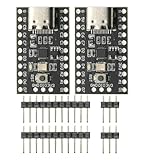
- CH32V003 Development Minimum System Board for Nano RISC-V CH32V003F4U6 Chip TYPE-C USB 22Pin
- on-board 24MHz Crystal oscillator
- Power by TYPE-C USB
That report is an adoption snapshot, not a live catalog. It does not establish which instances are available today, in which regions, with which Linux images, or whether they can run a particular AI framework. Availability, instance specifications, and support terms can change; check the provider’s current documentation before basing a deployment on an announced service.
Does PyTorch support RISC-V?
PyTorch has been built and run in community-reported RISC-V configurations, but the evidence supports build feasibility—not a blanket claim of official, optimized, production-grade support. A PyTorch forum contributor reported building PyTorch 2.4.0 on Ubuntu under QEMU and running models; later messages in the same discussion reported native builds without patches.
Those reports are useful proof that the software can be made to work in specific environments. They do not establish an official PyTorch binary package for all RISC-V systems, comprehensive test coverage, a maintained production support path, or competitive performance. The discussion also records uncertainty about optimized use of RISC-V vector instructions.
Quick wins for a faster PC:
Clear out junk files and repair common Windows errorsFree Scan →Fix the driver behind crashes, sound loss and screen glitchesFind Drivers →A January 2026 PyTorch community post proposed work on RISC-V continuous integration and validation, optimized microkernels, a torch.compile backend, Triton support, and later LLM-serving frameworks. These were proposed work areas, not evidence that the features were accepted, shipped, or supported on a production server. In particular, a roadmap proposal is not proof that Triton, vLLM, SGLang, or an accelerator backend works on a given machine.
Rank #3

- The ESP32-C3 SUPERMINI is positioned as a high-performance, low-power, cost-effective IoT mini development board, suitable for low-power IoT applications and wireless wearable applications
- It is equipped with a rich set of interfaces, including 11 digital I/Os that can be used as PWM pins and 4 analog I/Os that can be used as ADC pins.
- It supports four serial interfaces, including UART, I2C, and SPI.
- The ESP32-C3 features a 32-bit RISC-V CPU, including an FPU (Floating Point Unit) capable of 32-bit single-precision
- Package: 2PCS ESP32-C3 MINI Development Board ESP32 SuperMini ESP32 C3 WiFi Module
The available information does not establish a comparable official TensorFlow-on-RISC-V status or a comprehensive compatibility matrix for popular AI frameworks. For any framework, check the exact version, installation method, required compiler and libraries, test coverage, and backend on the intended hardware. A source build that runs one model is not equivalent to an upstream-supported release.
Why does the processor’s feature list not settle framework compatibility?
A processor may advertise an instruction-set extension without the full software stack exposing or using it. Linux kernel RISC-V ABI documentation cautions that the presence of a hardware extension alone does not establish that the kernel supports it or makes it available to userspace.
That distinction is particularly important for vector features and specialized acceleration. A framework’s ability to use them may depend on the processor profile, firmware, kernel configuration, compiler and toolchain, runtime libraries, and framework kernels all agreeing. If one layer is missing, an advertised capability may not translate into usable acceleration.
The Tool Desk
Outbyte PC Repair FREERepair Windows errors before they cause bigger problemsFix Now →Outbyte Driver Updater FREEScan for outdated or missing drivers - takes under a minuteDriver Scan →Ask the system vendor or cloud provider which CPU profile and extensions are present, and which firmware and kernel versions enable them. Then verify that the compiler and userspace libraries used for your framework support those features. Do not infer GPU or other accelerator support from the CPU’s RISC-V status: the available information does not establish a universal accelerator stack for RISC-V servers.
Rank #4

- ESP32-C6 WiFi 6 microcontroller development board adopts ESP32-C6-WROOM-1-N8 module, which is equipped with RISC-V 32-bit single-core processor, up to 160MHz main frequency, built-in 8MB Flash
- Integrates WiFi 6, Bluetooth 5 and and IEEE 802.15.4 (Zigbee 3.0 and Thread) wireless communication, with superior RF performance
- Integrates rich peripherals including SPI, UART, I2C, I2S, LED PWM, SDIO and other interfaces, compatible with the pinout of ESP32-C6-DevKitC-1-N8 development board, more convenient to use and expand a variety of peripheral modules
- Onboard CH343 and CH334 USB HUB chips, supports USB and UART development at the same time via a USB-C port
- Comes with online examples and tutorials for ESP-IDF development environment
How should you evaluate a RISC-V server for AI work?
Evaluate a specific system against the workload you intend to run. A successful Linux installation or a framework build on a different RISC-V machine does not validate the complete stack on your candidate server.
- Check platform compliance. Ask whether the vendor states conformance to the applicable RVA profile and Server Platform requirements. Confirm the firmware and boot/runtime services the system implements; a standards document does not certify an individual product.
- Confirm the Linux path. Find out whether the exact server has a vendor-supported distribution image, a community image, or only a custom build. Check the relevant kernel, board revision, and support terms.
- Inventory devices and accelerators. Verify support for storage, networking, PCIe devices, management features, and any accelerator you need. Request the relevant drivers and runtime support for that exact hardware.
- Verify the framework configuration. Check whether the desired framework version is available as a maintained upstream package or requires a source build or community patches. Confirm the backend and dependencies against the target system, not just the architecture name.
- Demand workload-specific performance evidence. Look for benchmarks run on the exact hardware with a relevant model, precision, batch size, and software stack. The available evidence here contains no comparable benchmarks for named RISC-V servers, so it cannot establish performance against other server architectures.
- Review operational readiness. For production, check firmware update procedures, security maintenance, reliability features, and the vendor’s support commitments. Platform standards address some of these concerns, but implementation and service remain system-specific.
For learning or software-porting experiments, a documented development board can be a reasonable starting point. Canonical lists installation paths for the VisionFive 2 and HiFive Unmatched. Treat such a board as an exploratory platform, not as proof that a server-class machine will be a suitable AI system.
Independent reader supportYour contribution helps us test, update, and keep practical guides available for everyone.What is the practical verdict for Linux and AI on RISC-V?
Linux on RISC-V is real, and the server standards provide a clearer foundation for interoperability than an architecture label alone. Distribution support remains uneven: Fedora does not currently classify riscv64 as officially supported, while Ubuntu installation documentation applies to specified boards. PyTorch has community-reported builds and model runs, but that evidence does not demonstrate a broadly supported or optimized AI stack.
What’s actually slowing this PC down?
Pick the symptom - the matching free tool is one click away.
For experimentation, choose hardware with a documented Linux path and expect to validate software components yourself. For production AI, make the decision only after confirming platform and firmware support, a maintained operating-system image, the exact framework and accelerator stack, and measured results on the target workload.
Best Value

- Ample PSRAM Storage – The development board offers 8MB PSRAM, providing substantial extra memory for handling more complex tasks, large data buffers, and advanced processing.
- Enhanced Multi-Tasking Capability – With the additional 8MB PSRAM, the ESP32-C5-WIFI6-KIT can efficiently manage multiple protocol stacks simultaneously, ensuring smooth operation in multi-tasking IoT environments.
- Support for Medium-Load Applications – The 8MB PSRAM allows the ESP32-C5 to handle medium-load applications more effectively, making it ideal for scenarios requiring real-time data processing or continuous communication.
- Seamless Performance – The increased memory improves the overall performance and responsiveness of the device, particularly when running applications with larger memory footprints or more demanding computations.
- Future-Proof for Complex Projects – With 8MB of PSRAM, developers are better equipped to build scalable, high-performance solutions that support both current and future IoT use cases, offering flexibility for future-proofing designs.
Frequently Asked Questions
Can I use the same Linux image on every RISC-V server?
No. A shared server-platform standard is meant to improve interoperability, but it does not ensure that every system has identical firmware, device support, or distribution coverage. Use an image documented for the exact platform, or confirm that the vendor supports the image you plan to install.
Does a PyTorch build on QEMU prove it will run well on physical hardware?
No. The community report of PyTorch 2.4.0 under Ubuntu QEMU establishes that a build and model run were reported in that environment. It does not establish performance, device-driver behavior, or accelerator support on a physical server.
Are RISC-V cloud instances available in my region right now?
The January 2026 RISC-V International annual report recorded public RISC-V cloud services during 2025, but it is not a current regional inventory. Check providers directly for present availability, image options, and instance specifications.
What does riscv64 mean in Linux documentation?
It is the common name for the 64-bit RISC-V architecture used by operating-system and software builds. Matching that architecture is necessary, but it does not by itself guarantee compatibility with a server’s firmware or components.
Quick Recap
Product prices and availability are accurate as of the date/time indicated and are subject to change. Any price and availability information displayed on Amazon at the time of purchase will apply.

