
Yes. You can connect multiple Raspberry Pi Zero-family boards and coordinate them as a cluster, but they remain separate computers: each has its own operating system, memory and storage. A cluster does not combine their RAM or make every program run faster automatically. It is most useful for workloads that divide into independent tasks, distributed services, or learning how networked systems work.
What a Raspberry Pi Zero cluster can—and cannot—do
Cluster software can distribute suitable work among several boards. For example, independent jobs can be assigned to different nodes, or nodes can host separate services. The benefit depends on the workload and the coordination overhead.
| # | Preview | Product | Price | |
|---|---|---|---|---|
| 1 |
|
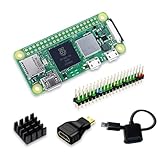
SANOOV Raspberry Pi Zero 2W Kit | $111.99 | Buy on Amazon |
| 2 |

|
CanaKit Raspberry Pi 4 4GB Starter PRO Kit - 4GB RAM | $159.99 | Buy on Amazon |
Ordinary applications do not see one larger computer just because the boards are connected. A program must be designed or configured to distribute work, and each node still has only its own memory. If a task cannot be split effectively, adding boards may increase setup and network overhead without improving its completion time.
There is no established general speedup figure for a multi-Zero cluster. Measure the specific workload on the intended number of nodes and network instead of extrapolating from a board’s processor specifications.
Free tools Windows power users keep installed
One-click scans. No signup required.
#1 Best Overall
- Powerful Performance: Equipped with a quad-core 64-bit ARM Cortex-A53 processor, the Raspberry Pi Zero 2 W delivers a significant performance boost compared to its predecessor. And built-in Wi-Fi and Bluetooth support enable easy wireless communication and Internet access for your projects, five Times Faster.
- SANOOV Basic Starter Kit for Pi Zero 2 W Include: 1. Raspberry Pi Zero 2 W Board 2.Mini HDMI to Standard HDMI adapter 3.Micro-USB to Standard USB OTG Adapter 4.Aluminum Heatsink 5.40 Pin Header.NOTICE: The kit does NOT include , supply power, case, SD card, keyboard, mouse or monitor.
- SANOOV for Raspberry Pi Zero 2 W features: 1GHz quad-core, 64-bit ARM Cortex-A53 CPU VideoCore IV GPU 512MB LPDDR2 DRAM 802.11b/g/n wireless LAN Bluetooth 4.2 / Bluetooth Low Energy (BLE) MicroSD card slot Mini HDMI and USB 2.0 OTG ports Micro USB power HAT-compatible 40-pin header Composite video and reset pins via solder test points CSI camera connector.
- Video Output & Efficient Cooling: Supports 1080p30 video output via the mini HDMI port, making it ideal for multimedia applications and streaming.The aluminum heatsink helps dissipate heat, ensuring stable performance even under heavy workloads.
- Compact Size: The tiny size of the Raspberry Pi Zero 2 W makes it perfect for space-constrained projects and embedded applications.Ideal for a variety of uses, including IoT projects, home automation, media centers, educational tools, and more.
Which Raspberry Pi Zero should you use?
| Model | What it offers | Main constraints | Best fit |
|---|---|---|---|
| Raspberry Pi Zero | Compact board with a 1 GHz single-core CPU and 512 MB RAM. | No built-in wireless connectivity; wired networking requires additional hardware. Raspberry Pi hardware documentation. | Very light experiments where the software supports the board and you are prepared to add networking. |
| Raspberry Pi Zero W | Adds 2.4 GHz, single-band 802.11n Wi-Fi to the original single-core Zero. | Still has a 1 GHz single-core CPU and 512 MB RAM; Wi-Fi is shared network capacity. Raspberry Pi hardware documentation. | Light workloads where wireless convenience matters more than high or predictable inter-node bandwidth. |
| Raspberry Pi Zero 2 W | Quad-core 64-bit Arm Cortex-A53 processor at 1 GHz, 512 MB LPDDR2, 2.4 GHz Wi-Fi, USB OTG and a microSD slot. Raspberry Pi hardware documentation; Zero 2 W product brief. | Still only 512 MB RAM per board, with no built-in Ethernet. Raspberry Pi hardware documentation. | New experiments that can use more CPU cores per node and whose software supports the board. |
Raspberry Pi Ltd says the Zero 2 W offers 40% more single-threaded performance and five times more multi-threaded performance than the original single-core Raspberry Pi Zero. These are manufacturer comparisons between individual boards, not benchmarks of a cluster or a promise of equivalent gains for a particular application. Raspberry Pi Zero 2 W product brief.
Plan the workload and software before buying boards
- Identify the work. Decide whether you need parallel computing, separate distributed services, or a teaching cluster. Determine whether the work can be divided and how much data nodes must exchange.
- Check each node’s model and memory. Choose an operating system and software that support the exact boards. The Zero 2 W has four CPU cores, but its 512 MB of RAM remains a per-node limit.
- Validate the software stack on one node. Keep orchestration and monitoring lightweight; they consume resources too. Confirm that the specific software release fits the available memory rather than assuming a popular cluster platform will.
- Scale up and measure. Add nodes only after confirming that the workload can use them. Record the board models, operating-system image, node count, workload, network topology, storage and power arrangement so results are meaningful and repeatable.
Choose a network that matches the traffic
Zero W and Zero 2 W have 2.4 GHz single-band 802.11n Wi-Fi. The original non-W Zero has no wireless connectivity, and Zero-family boards have no built-in Ethernet. Raspberry Pi hardware documentation.
Wi-Fi is the simplest option when traffic is light and the radio environment is suitable. For sustained transfers between nodes, consider whether a USB/OTG adapter arrangement or purpose-built interconnect fits the project. Compatibility and performance depend on the exact hardware; adding an adapter does not establish Ethernet-like throughput. Test the topology under the workload you intend to run. The published specifications cited here do not establish actual cluster throughput.
Arrange storage, boot and power per node
Storage and boot
Plan storage separately for every board: Zero-family boards have microSD slots, so a microSD card per node is the straightforward boot arrangement. The Zero 2 W also supports USB mass-storage boot out of the box, but it does not support network boot. USB drives can need additional power, particularly when multiple drives are attached. Zero 2 W product brief; Raspberry Pi hardware documentation.
Rank #2
- Includes Raspberry Pi 4 4GB Model B with 1.5GHz 64-bit quad-core CPU (4GB RAM)
- Includes Pre-Loaded 32GB EVO+ Micro SD Card (Class 10), USB MicroSD Card Reader
- CanaKit Premium High-Gloss Raspberry Pi 4 Case with Integrated Fan Mount, CanaKit Low Noise Bearing System Fan
- CanaKit 3.5A USB-C Raspberry Pi 4 Power Supply (US Plug) with Noise Filter, Set of Heat Sinks, Display Cable - 6 foot (Supports up to 4K60p)
- CanaKit USB-C PiSwitch (On/Off Power Switch for Raspberry Pi 4)
Power and physical layout
The Zero 2 W product brief specifies a 5 V DC, 2.5 A input. That is the board’s input specification, not a measured consumption figure. Peripheral use affects power needs; Raspberry Pi documentation advises an externally powered USB hub for devices that exceed the available power budget. Size supplies, cables and any hub for the actual boards and attached devices rather than treating one board’s rating as the draw of an entire cluster. Zero 2 W product brief; Raspberry Pi hardware documentation.
The product brief also says to operate the Zero 2 W in a well-ventilated environment. Leave airflow around boards in a dense arrangement, and check the assembled system for stable boot and operating behavior rather than assuming a particular result from the specifications alone. Zero 2 W product brief.
Independent reader supportYour contribution helps us test, update, and keep practical guides available for everyone.What to verify on the finished cluster
- Every node boots reliably with its selected storage and power arrangement.
- The operating system and cluster software support each board model and fit within each node’s memory.
- The network can handle the workload’s communication needs under the actual physical setup.
- Adding nodes improves the chosen task enough to justify the extra power, cabling, storage and management.
- Temperature and stability are acceptable in the final enclosure or mounting arrangement.
These checks are build-specific: the cited Raspberry Pi specifications do not provide a multi-Zero cluster benchmark or establish throughput, boot stability, or thermal performance for a particular assembly.
Quick Recap
Product prices and availability are accurate as of the date/time indicated and are subject to change. Any price and availability information displayed on Amazon at the time of purchase will apply.
Quick wins for a faster PC:
Fix the driver behind crashes, sound loss and screen glitchesFind Drivers →Repair Windows errors before they cause bigger problemsFix Now →
