
Free tools Windows power users keep installed
One-click scans. No signup required.
iTechGuides is reader-supported. When you buy through links on our site, we may earn an affiliate commission. As an Amazon Associate I earn from qualifying purchases. Learn more
Yes—antivirus can detect malware written or modified with generative AI, but detection is probabilistic, not guaranteed. Security software evaluates a file’s code and structure, reputation, scripts, process relationships, and behavior after launch; it does not need to identify the human or model that produced it. AI can help an attacker create variants faster or alter code, which may weaken an exact signature match, but those changes can still trigger heuristic, machine-learning, cloud, script, memory, or behavior-based detections. Results depend on the sample, product configuration, update state, cloud connectivity, and whether the protection layers can observe the activity.
How does antivirus detect malware that was generated with AI?
Modern antivirus is a layered system rather than a single database of file fingerprints. A product may inspect the file before execution, consult cloud services, analyze scripts and memory, and watch what the program does at runtime. Microsoft describes this hybrid approach for its own Defender architecture; other products can differ in coverage, implementation, and effectiveness.
| Detection layer | What it examines | Why AI authorship does not defeat it automatically |
|---|---|---|
| Signatures | Known byte patterns, hashes, or other indicators associated with previously analyzed threats | A new sample may not match, but other layers can still identify suspicious features or actions. |
| Heuristics and emulation | Code structure and how a file is likely to behave, sometimes in an emulated environment | The decision can be based on characteristics rather than an exact copy of an older file. |
| Machine-learning file models | Features in executables, PowerShell, Office macros, JavaScript, PDFs, and other file types | The model assesses the sample itself, not whether a person or an AI wrote it. |
| Cloud classification and reputation | Signals collected from a provider’s service, prevalence, publisher reputation, and related intelligence | A previously unseen file can receive a risk assessment when connectivity and the relevant service are available. |
| Script inspection | Script content and interfaces such as the Antimalware Scan Interface (AMSI) | Malicious commands can be examined even when they are delivered through a script instead of a conventional executable. |
| Behavior and process monitoring | Child processes, process trees, file and registry changes, memory activity, persistence, and other actions | Malware must eventually perform actions; those actions can provide evidence after execution begins. |
| Memory scanning and sandbox detonation | Code loaded in memory or behavior observed in an isolated environment | Some indicators appear only when the program runs, unpacks, or contacts other components. |
Microsoft says its lightweight machine-learning models can make a verdict within milliseconds, while its Windows overview describes anomaly detection and blocking based on behaviors and process trees. Those statements describe Microsoft’s products, not a universal specification for every antivirus application.
Does AI-written malware bypass antivirus?
Not by virtue of being AI-written. AI assistance can produce code that is unfamiliar to a signature database, but unfamiliarity is only one part of a detection decision. A file can still look suspicious to a classifier, have a poor reputation, invoke risky scripting interfaces, or create a process chain associated with credential theft, persistence, or destructive activity.
#1 Best Overall

- SPEED-OPTIMIZED, CROSS-PLATFORM PROTECTION: World-class antivirus security and cyber protection for Windows (Windows 7 with Service Pack 1, Windows 8, Windows 8.1, Windows 10, and Windows 11), Mac OS (Yosemite 10.10 or later), iOS (11.2 or later), and Android (5.0 or later). Organize and keep your digital life safe from hackers
- SAFE ONLINE BANKING: A unique, dedicated browser secures your online transactions; Our Total Security product also includes 200MB per day of our new and improved Bitdefender VPN
- ADVANCED THREAT DEFENSE: Real-Time Data Protection, Multi-Layer Malware and Ransomware Protection, Social Network Protection, Game/Movie/Work Modes, Microphone Monitor, Webcam Protection, Anti-Tracker, Phishing, Fraud, and Spam Protection, File Shredder, Parental Controls, and more
- ECO-FRIENDLY PACKAGING: Your product-specific code is printed on a card and shipped inside a protective cardboard sleeve. Simply open packaging and scratch off security ink on the card to reveal your activation code. No more bulky box or hard-to-recycle discs. PLEASE NOTE: Product packaging may vary from the images shown, however the product is the same.
Why changing the code can matter
Exact signatures are strongest when a threat reuses recognizable content. An attacker who changes names, ordering, packaging, or other implementation details may reduce the value of a signature tied to an earlier sample. This is a practical reason to combine signatures with behavior and anomaly analysis.
Polymorphic and metamorphic techniques
The Centre for Emerging Technology and Security at the Alan Turing Institute’s June 2024 briefing discusses polymorphic code that changes during execution and metamorphic code that rewrites itself. The briefing presents more advanced autonomous generation and evasion as potential developments; it does not establish that ordinary AI-generated malware reliably defeats antivirus today. Even changing code has to execute, access resources, and interact with the operating system, creating opportunities for runtime monitoring.
Can antivirus detect new malware without a signature?
Often, yes, if other signals are available. Anomaly detection, heuristics, machine-learning models, cloud analysis, emulation, and behavior monitoring are designed to identify suspicious properties that do not depend on a previously cataloged hash. Microsoft describes anomaly detection as protection for malware that does not fit a predefined pattern.
Recommended Free Tools
Rank #2
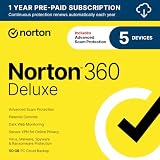
- ONGOING PROTECTION Download instantly & install protection for 5 PCs, Macs, iOS or Android devices in minutes!
- TOP-PERFORMING VPN Faster speeds, more server locations, and greater connection control to protect your privacy across all your devices, including Smart TVs.
- ADVANCED SCAM PROTECTION Help spot hidden scams online. With the built-in Genie AI assistant, you’ll never wonder if a message or email is suspicious again.
- REAL-TIME PROTECTION Advanced security protects against existing and emerging malware threats, including ransomware and viruses, and it won’t slow down your device performance.
- DARK WEB MONITORING Identity thieves can buy or sell your information on websites and forums. We search the dark web and notify you should your information be found.
“New” does not mean “invisible.” A never-before-seen executable might still request an unusual privilege, inject code into another process, launch a suspicious script interpreter, create persistence, encrypt many files, or establish a process tree associated with malicious activity. Detection can occur before launch, during emulation, or after execution begins. Conversely, a low-noise sample that does not perform observable actions may remain difficult to classify until more evidence becomes available.
What are the main limitations of detecting AI-generated malware?
| Limitation | Practical effect |
|---|---|
| No single layer is complete | A sample can evade a signature, confuse a heuristic, or avoid a behavior rule while another sample triggers one of those layers. A miss by one mechanism is not proof that all mechanisms failed. |
| Obfuscation and packing | Wrapped or encrypted code can make static analysis harder until the program unpacks or decrypts itself. |
| Limited observation | Behavior detections need activity to observe. A dormant payload, delayed trigger, or action outside the monitored host may provide fewer signals. |
| Offline operation | Cloud classification, reputation, and some current intelligence may be unavailable without connectivity. Local scanning can continue, but the available evidence may be narrower. |
| Configuration | Disabled behavior monitoring, script interfaces, cloud-delivered protection, or other controls reduce the layers that can make a decision. |
| Stale intelligence | Out-of-date engines and definitions may lack newer indicators or model improvements. |
| False positives and uncertainty | A suspicious tool can be blocked incorrectly, while a carefully staged attack can avoid a rule. Security teams must investigate context rather than treat one alert as infallible. |
These limits mean a detection result is conditional: it depends on the product, settings, update status, sample, and environment. NIST’s January 2024 summary of adversarial-machine-learning guidance states, “No foolproof method exists as yet for protecting AI from misdirection, and AI developers and users should be wary of any who claim otherwise.” That statement concerns AI and machine-learning systems generally, so it is context about the limits of automated defenses, not a measured antivirus miss rate.
What does generative AI change for attackers and defenders?
Faster variation and lower development effort
Generative tools can help an attacker draft scripts, modify an existing payload, or produce multiple implementations. More variants can shorten the time between a defensive rule and the next sample. That increases the value of detections based on behavior, process relationships, and infrastructure rather than a single static fingerprint.
Rank #3

- ONGOING PROTECTION Download instantly & install protection for 10 PCs, Macs, iOS or Android devices in minutes!
- TOP-PERFORMING VPN Faster speeds, more server locations, and greater connection control to protect your privacy across all your devices, including Smart TVs.
- ADVANCED SCAM PROTECTION Help spot hidden scams online. With the built-in Genie AI assistant, you’ll never wonder if a message or email is suspicious again.
- REAL-TIME PROTECTION Advanced security protects against existing and emerging malware threats, including ransomware and viruses, and it won’t slow down your device performance.
- DARK WEB MONITORING Identity thieves can buy or sell your information on websites and forums. We search the dark web and notify you should your information be found.
AI does not remove operational constraints
Malware still needs an execution path, permissions, persistence, command-and-control or local objectives, and an opportunity to affect data. Those requirements expose activity to controls such as script inspection, memory scanning, process-tree analysis, reputation checks, and endpoint response. AI-generated code can also contain errors, unsafe assumptions, or conspicuous behavior that makes it easier to flag.
Do these 3 things before closing this tab:
1Scan for outdated or missing drivers - takes under a minute2Repair Windows errors before they cause bigger problems3Fix the driver behind crashes, sound loss and screen glitchesDo not confuse a prototype with an antivirus benchmark
Microsoft’s Project Ire announcement in August 2025 reported precision of 0.98 and recall of 0.83 on public Windows-driver datasets. Those figures describe a Microsoft malware-classification research prototype, not a consumer antivirus detection rate, not a result specifically for AI-generated malware, and not a neutral industry benchmark. The same announcement reported that Defender scans more than one billion monthly active devices; that is a company-reported scale figure, not independent evidence of detection effectiveness.
How can you configure protection to improve the chances of detection?
Configuration cannot guarantee a block, but it determines which signals are available. On Windows, labels vary by edition and policy management, so verify the exact controls shown on the device.
Rank #4

- THREAT DETECTION – Stay one step ahead. Suspicious links, risky sites, viruses, and scams, caught automatically before they reach you.
- PERSONAL INFO PROTECTION – Keep your personal info safer. Identity monitoring watches for your exposed info and tells you what to do about it.
- SECURE CONNECTIONS – Just a few easy clicks, and we'll automatically protect your info on public Wi‑Fi, every time you connect.
- GUIDED ACTION – Know what matters and what to do next. Clear alerts and simple guidance make it easy to take action.
- MORE THAN ANTIVIRUS – Scam protection, identity monitoring, VPN, web protection, and antivirus work together to protect you, all in one place.
- Keep the engine and intelligence current. Allow automatic security-intelligence and platform updates. A static installation loses access to newer indicators and model changes.
- Leave real-time protection enabled. Real-time scanning provides the pre-execution and on-access checks that a manual scan cannot provide continuously.
- Enable cloud-delivered protection when policy permits. Cloud classification and reputation add signals that are not present in a purely local scan. Connectivity is required for those services.
- Keep behavior monitoring and tamper protections on. These controls help detect suspicious process trees and changes after a file starts, and help prevent malware from disabling the scanner.
- Do not exclude broad folders or script interpreters without a documented reason. Exclusions remove inspection precisely where a malicious script or payload may appear.
- Use layered controls for scripts and macros. Restrict untrusted Office macros and review script policies so AMSI and related inspection paths can see activity.
- For organizations, centralize alerts and response. Endpoint protection that can block, contain, investigate, and remediate behavior is more useful than a product that only reports a file signature.
How should you compare antivirus or endpoint-protection options?
No neutral, current head-to-head rate for AI-generated malware is established here. Compare the capabilities that determine what evidence a product can collect and what it can do with an alert.
| Question to ask | What a meaningful answer covers |
|---|---|
| What does it inspect? | Signatures, heuristics, executable and document models, scripts, memory, and runtime behavior—not just downloaded files. |
| What works offline? | Local models and rules that remain available without cloud connectivity, and which reputation or classification features are deferred. |
| What happens after execution? | Whether the product can block a process, terminate related processes, isolate a host, undo changes, and present a process tree for investigation. |
| How is it maintained? | Update cadence, cloud intelligence, policy controls, and whether administrators can verify that protections are enabled. |
| How are uncertain detections handled? | Quarantine, rollback, analyst review, allow-listing with scope, and an audit trail rather than an irreversible delete by default. |
What should you do if a suspicious AI-generated file is not detected?
- Stop interacting with it. Do not repeatedly open or execute a sample to see whether it triggers an alert.
- Disconnect a potentially affected device from networks when practical. This can limit remote control or data theft while preserving the device for investigation; follow your organization’s incident policy.
- Record context. Note the file path, download source, timestamp, user account, alert status, and any visible process or network activity.
- Run an up-to-date scan from a trusted management interface. A second scan mode or offline scan can reveal activity that was not visible during the first execution.
- Escalate business incidents. Preserve logs and disk or memory evidence according to your response plan instead of deleting the file before specialists can analyze it.
A missed sample should be reported to the security vendor with the file and metadata handled safely. It demonstrates that one configuration and one observation did not produce a detection; it does not show that AI authorship caused the miss or that every variant will evade the product.
Quick wins for a faster PC:
Repair Windows errors before they cause bigger problemsFix Now →Scan for outdated or missing drivers - takes under a minuteDriver Scan →Clear out junk files and repair common Windows errorsFree Scan →Frequently Asked Questions
Does antivirus need to know that AI wrote the malware?
No. Detection engines generally score the file, script, reputation, and observed actions. Knowing the authoring method could be useful for threat intelligence, but it is not a prerequisite for blocking a suspicious sample.
Best Value

- POWERFUL, LIGHTNING-FAST ANTIVIRUS: Protects your computer from viruses and malware through the cloud; Webroot scans faster, uses fewer system resources and safeguards your devices in real-time by identifying and blocking new threats
- IDENTITY THEFT PROTECTION: Protects your usernames, account numbers and other personal information against keyloggers, spyware and other online threats targeting valuable personal data
- REAL-TIME ANTI-PHISHING: Proactively scans websites, emails and other communications and warns you of potential danger before you click to effectively stop malicious attempts to steal your personal information
- ALWAYS UP TO DATE: Webroot scours 95% of the Internet three times per day including billions of web pages, files and apps to determine what is safe online and enhances the software automatically without time-consuming updates
Can malware be detected after it has already started running?
Yes. Behavior monitoring, memory scanning, and process-tree analysis can produce a verdict after execution begins. The response may then involve terminating processes, isolating the host, or remediating changes, depending on the product and its configuration.
Is offline antivirus useless against new threats?
No. Local signatures, heuristics, and machine-learning models can still operate offline. What may be missing are cloud reputation, remote classification, and the latest intelligence, so offline coverage can be narrower.
Why might two antivirus products disagree about the same AI-generated file?
Vendors use different models, rules, cloud services, update timing, and default policies. They may also observe different stages of execution, so a disagreement reflects differing evidence and thresholds rather than a definitive test of which product is universally better.
PC Slower Than It Used to Be?
A free scan shows the junk files, broken settings and background clutter dragging Windows down - then fixes them in one click.Free scan · Windows 10 & 11Crashes, No Sound, or Screen Glitches?
Random freezes, missing sound and display glitches usually trace back to one bad driver. Find and replace yours safely.Free scan · under a minuteQuick Recap
Product prices and availability are accurate as of the date/time indicated and are subject to change. Any price and availability information displayed on Amazon at the time of purchase will apply.

