
Best mining rigs for maximum crypto profits in 2025 were modern SHA-256 ASICs, led by the Bitmain Antminer S21 XP for air-cooled mining and the S21 XP Hydro or XP+ Hydro for professional facilities. No machine guaranteed profit: electricity price, network difficulty, purchase cost, cooling, uptime, and infrastructure determined whether any rig made economic sense.
This is a historical 2025 buying guide. Profitability figures change with cryptocurrency prices, network difficulty, block rewards, transaction fees, pool fees, and electricity rates, so use the model specifications and calculation method below rather than treating any ranking as a permanent earnings forecast.

Key takeaways
- The Bitmain Antminer S21 XP was the strongest all-around 2025 air-cooled Bitcoin ASIC at a reported 270 TH/s, 3,645 W, and approximately 13.5 J/TH.
- The Bitmain Antminer S21 XP Hydro and S21 XP+ Hydro offered higher density and approximately 12 J/TH and 11 J/TH respectively, but required professional liquid-cooling and electrical infrastructure.
- The MicroBT WhatsMiner M60S++ was a credible air-cooled alternative at 200–226 TH/s, 3,230–3,570 W, and 15.5 J/TH.
- A miner consuming 3,500 W uses approximately 84 kWh per day, costing $4.20 at $0.05/kWh, $8.40 at $0.10/kWh, and $12.60 at $0.15/kWh before other expenses.
- GPU rigs offered algorithm flexibility and better repurposing potential, but flexibility did not automatically produce higher profit than a specialized ASIC.
- Maximum profit meant the best risk-adjusted margin after electricity, cooling, acquisition cost, downtime, maintenance, fees, taxes, and obsolescence—not the highest advertised hashrate.
What were the best mining rigs for maximum crypto profits in 2025?
The best mining rigs for maximum crypto profits in 2025 were primarily modern ASIC miners rather than generic GPU rigs. The Antminer S21 XP was the best general-purpose air-cooled choice for a buyer with inexpensive power and a suitable high-voltage circuit. The S21 XP Hydro and S21 XP+ Hydro were better for professional operators that already had liquid-cooling systems, three-phase service, and enough heat-rejection capacity.
The WhatsMiner M60S++ was the strongest competing air-cooled option in the supplied specifications. A discounted base S21, S21 Pro, M60S++, M60S+, or Avalon A15XP could still deliver a faster payback than a newer, more efficient model when the purchase-price difference was large.
Recommended Free Tools
#1 Best Overall

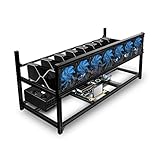
- 6/8 SLOTS - Support to 6/8 GPU . (GPU is not included).
- MATERIAL - The open air mining frame case is made up of the highest quality stainless steel material, strong, durable and available. Fully protecting your GPU and eectronic device.
- PERFECT DESIGN - Professional design for mining rig frame, accelerating the air convection, super cooling design for heat dissipation. Enough space reserved between the graphics cards.
- EASY TO INSTALL - This mining case is easy to install and is with strong structure. Keep all cables clean and organized, along with everything in your mining machine.For installation steps, please refer to the user manual
- NOTICE - This mining rig frame is the Frame Only, not includes Fans or other CPU, GPU, PSU, Motherboards, Cables. If you are not 100% satistifed with this Miner, please feel free to contact us, we will offer you a satisfactory soluiton within 24 hours.
That verdict is conditional. A miner that works at $0.05 per kilowatt-hour may lose money at $0.15 per kilowatt-hour. A hydro unit that is excellent inside an industrial facility can be an unusable purchase for a homeowner without liquid-cooling infrastructure.
Quick comparison: which 2025 mining rig fits each buyer?
| Buyer goal | Best candidate | Why | Main reason to reject it |
|---|---|---|---|
| Best overall air-cooled ASIC | Bitmain Antminer S21 XP | Strong efficiency and hashrate without a factory hydro loop | May not repay faster than a heavily discounted competitor |
| Maximum professional output | Bitmain Antminer S21 XP+ Hydro | Reported 500 TH/s and 11 J/TH | Requires specialized cooling and industrial infrastructure |
| Professional hydro deployment | Bitmain Antminer S21 XP Hydro | Reported 473 TH/s and 12 J/TH | High power draw, liquid-cooling cost, and three-phase requirements |
| Practical premium air cooling | Bitmain Antminer S21 Pro | Reported 234 TH/s, 3,510 W, and 15 J/TH | Less efficient than the S21 XP |
| Air-cooled Bitmain alternative | MicroBT WhatsMiner M60S++ | 200–226 TH/s and 15.5 J/TH in the manufacturer specification | Exact variant, price, warranty, and availability must be verified |
| Lower-capital ASIC entry | Bitmain Antminer S21 | Reported 200 TH/s at 3,500 W | 17.5 J/TH makes electricity more expensive than on newer models |
| Flexible experimentation | GPU mining rig | Can switch algorithms and retain gaming or workstation resale value | Returns are coin- and algorithm-dependent and may be negative after electricity |
| Most home users | Usually none of these large ASICs | Home constraints commonly include power, heat, noise, and electricity cost | Dedicated 220–240 V service, ventilation, and cheap power may be unavailable |
How were the best mining rigs evaluated?
Mining hardware should be evaluated by the margin it can produce at a specific site, not by hashrate alone. The relevant comparison starts with energy efficiency, measured in joules per terahash (J/TH), then adds electricity, acquisition cost, infrastructure, uptime, and resale risk.
- Energy efficiency: Lower J/TH means less electricity for each unit of SHA-256 hashrate.
- Electricity price: Electricity is usually the dominant recurring cost. Use the real all-in rate, including demand charges and tiered pricing where applicable.
- Acquisition cost: Include the miner, PSU if separate, shipping, customs, sales tax, hosting, electrical work, cooling equipment, and installation.
- Infrastructure fit: Confirm voltage, amperage, phase, connectors, cooling, exhaust, network access, and legal compliance.
- Expected uptime: A nominally efficient machine earns nothing while offline, overheated, awaiting repair, or disconnected from its pool.
- Liquidity and resale: ASICs can become obsolete quickly. GPUs generally have more non-mining uses.
- Risk-adjusted payback: Test bear, base, and bull cases rather than relying on a single daily-profit screenshot.
Manufacturer specifications are nominal specifications, not guaranteed field performance. Hashrate, power draw, temperature, fan behavior, and uptime can differ by firmware, ambient conditions, voltage, pool, hardware condition, and operating mode.
Which ASIC miners were the leading 2025 candidates?
ASIC miners were the leading candidates for maximum 2025 profit on SHA-256 networks because ASICs are purpose-built for a particular algorithm. The following figures come from manufacturer documentation or established comparison data and should be checked against the exact model and variant before purchase.
Bitmain Antminer S21 XP: best overall air-cooled ASIC
The Bitmain Antminer S21 XP was the best overall 2025 air-cooled candidate in this comparison because it combined strong efficiency with a simpler deployment model than hydro-cooled machines. The supplied NiceHash hardware table reports 270 TH/s, 3,645 W, and approximately 13.5 J/TH; Bitmain’s official S21 XP specification page should be used to verify the exact variant.
The S21 XP suits a small professional facility or a serious home miner with low-cost electricity, dedicated 220–240 V service, robust ventilation, and tolerance for continuous fan noise. Air cooling avoids pumps, coolant, heat exchangers, and leak management, but it does not eliminate the need to remove approximately 3.6 kW of continuous heat.
Buy it when: the delivered price is reasonable, electricity is inexpensive, and the site cannot justify a liquid-cooling installation.
Avoid it when: a substantially cheaper S21 Pro or M60S++ produces a shorter risk-adjusted payback, or when the site cannot legally and safely support its electrical and heat load.
What’s actually slowing this PC down?
Pick the symptom - the matching free tool is one click away.
Bitmain Antminer S21 XP Hydro: best high-density hydro candidate
The Bitmain Antminer S21 XP Hydro was listed at 473 TH/s, 5,676 W, and 12.0 J/TH in the supplied comparison data. The NiceHash Bitcoin Mining Review hardware table provides those comparison figures, while the manufacturer’s S21 Hyd specification illustrates why this product category requires industrial planning.
The S21 XP Hydro can be attractive where rack density, energy efficiency, and heat transfer matter more than installation simplicity. The machine is not a faster plug-in replacement for an air-cooled home miner. A hydro deployment adds pumps, plumbing, coolant, heat exchangers, filtration, leak management, maintenance procedures, and a method of rejecting heat from the facility.
Bitmain lists one S21 Hyd configuration at 380–415 V AC three-phase input. The exact voltage and phase requirements must be confirmed for the purchased model, and a licensed electrician should verify that the service, breaker, conductors, grounding, and connectors comply with local code.
Buy it when: a suitable liquid-cooling loop and three-phase electrical service already exist, or when the operator has budgeted the complete facility rather than only the miner.
Free tools Windows power users keep installed
One-click scans. No signup required.
Avoid it when: the buyer is a home miner, has only ordinary residential service, or is comparing the unit’s hashrate without including cooling capital and maintenance.
Bitmain Antminer S21 XP+ Hydro: highest-output premium candidate
The Bitmain Antminer S21 XP+ Hydro was listed in the supplied ASIC Miner Value data at 500 TH/s, 5,500 W, and 11 J/TH. The model was identified as a July 2025 entry in the comparison data, so the specification and availability should be treated as time-sensitive and checked against the exact seller listing.
Rank #2
- ✅Premium Aluminum Construction: Constructed from high-quality aluminum for enhanced durability and heat dissipation, ensuring longevity and optimal performance.
- ✅ Accommodates 8 GPUs: Designed to house up to 8 graphics cards, providing ample space for expanding your mining setup and maximizing efficiency.
- ✅ Superior Airflow and Cooling: Engineered with optimized airflow design to prevent overheating and maintain optimal operating temperatures for prolonged mining sessions.
- ✅ Easy Assembly: Simple and straightforward assembly process allows for quick setup, getting you up and running in no time.
- ✅ Sleek and Space-Saving Design: Compact and minimalist design saves space while adding a professional touch to your mining rig setup.
The XP+ Hydro is the strongest raw-output candidate in this shortlist, but “highest output” is not the same as “highest profit.” The unit’s approximately 5.5 kW load produces about 132 kWh per day before cooling overhead. At $0.10/kWh, that is approximately $13.20 per day in electricity alone. A high-density deployment can improve facility economics, but only if the facility already has the electrical and thermal systems to support it.
Buy it when: the operator is building or already owns a professional hydro-cooled mining site and values density and efficiency.
Avoid it when: the purchase would require an unbudgeted cooling retrofit, residential electrical upgrade, or improvised plumbing.
Bitmain Antminer S21 Pro: best practical premium air-cooled option
The Bitmain Antminer S21 Pro was reported at 234 TH/s, 3,510 W, and 15 J/TH in the supplied product data. Bitmain’s product listing is available through its official shop page, but buyers should verify whether a listing represents current inventory, a preorder, a particular regional version, or a delivered price.
The S21 Pro is a practical compromise between the base S21 and the more efficient S21 XP. It has less hashrate than the S21 XP but also a lower nominal power draw. Its economics depend heavily on the price gap: a discounted S21 Pro may beat a more efficient machine if the efficient machine costs much more and network difficulty rises before the payback point.
Buy it when: the price is materially below the S21 XP and electricity is low enough for 15 J/TH hardware to remain viable.
Outdated Drivers Are Slowing You Down
One free scan finds every outdated or missing driver and matches the right update for your exact hardware.Free scan · exact hardware matchPC Slower Than It Used to Be?
A free scan shows the junk files, broken settings and background clutter dragging Windows down - then fixes them in one click.Free scan · Windows 10 & 11Avoid it when: the price is close to an S21 XP, or the location cannot exhaust roughly 3.5 kW of continuous heat and tolerate ASIC noise.
MicroBT WhatsMiner M60S++: best competing air-cooled option
The MicroBT WhatsMiner M60S++ is a credible alternative to the S21 Pro. MicroBT’s official M60S++ specification PDF lists a 200–226 TH/s range, 3,230–3,570 W power-on-wall range, approximately 15.5 J/TH efficiency, air cooling, 220–240 V AC, and Ethernet connectivity.
The M60S++ should be compared using delivered price, exact hashrate variant, warranty, repair access, firmware, shipping terms, and seller reputation. The supplied evidence does not establish that Bitmain or MicroBT is universally more reliable, so a buyer should not treat brand preference as a substitute for inspection and warranty verification.
Buy it when: the exact unit is discounted, the power specification fits the site, and the seller provides clear ownership, warranty, and return documentation.
The Tool Desk
Outbyte PC Repair FREERepair Windows errors before they cause bigger problemsFix Now →Outbyte Driver Updater FREEFix the driver behind crashes, sound loss and screen glitchesFind Drivers →Avoid it when: the listing does not identify the variant, the seller cannot demonstrate stable hashrate, or the apparent bargain excludes shipping, taxes, repairs, or a usable warranty.
Bitmain Antminer S21: best lower-capital newer-generation entry
Bitmain lists the base Antminer S21 at 200 TH/s, 3,500 W, and 17.5 J/TH for SHA-256 mining. The official S21 specification identifies a 220–277 V input range and a 20 A input specification for the cited configuration.
The base S21 is a capital-cost decision rather than an efficiency winner. At 3,500 W, the machine consumes approximately 84 kWh per day. Its electricity cost is approximately $4.20 per day at $0.05/kWh, $8.40 at $0.10/kWh, and $12.60 at $0.15/kWh before pool fees, cooling overhead, downtime, and other costs.
Buy it when: the machine is substantially cheaper than newer models and the buyer has very low-cost power.
Avoid it when: electricity is expensive or the price difference from a more efficient S21 XP, S21 Pro, or M60S++ is small.
Other ASIC candidates: M60S+, Avalon A15XP, and M66S-series models
The MicroBT WhatsMiner M60S+ was described in the supplied manufacturer listing at approximately 188–200 TH/s depending on version, with one spot listing showing approximately 200 TH/s and 3,400 W. The M60S+ product page contains variant-specific figures, so the exact purchased version must be verified.
The Canaan Avalon A15XP was listed at approximately 206 TH/s, approximately 3,667 W, and approximately 17.8 J/TH. It can be a value-oriented alternative supplier, but the buyer should verify the precise specification, warranty, availability, and delivered cost before comparing it with a Bitmain or MicroBT unit.
MicroBT M66S and M66S++ models were listed around 286–356 TH/s, with power around 5 kW or more and efficiency around 15–18.5 J/TH depending on model. These higher-density models were associated with immersion or specialized cooling, placing them closer to professional-facility equipment than consumer hardware.
Do these 3 things before closing this tab:
1Fix the driver behind crashes, sound loss and screen glitches2Repair Windows errors before they cause bigger problems3Scan for outdated or missing drivers - takes under a minute| Model | Algorithm and coins | Nominal hashrate | Power | Efficiency | Cooling and infrastructure |
|---|---|---|---|---|---|
| Antminer S21 XP | SHA-256; BTC, BCH, BSV | 270 TH/s | 3,645 W | 13.5 J/TH | Air-cooled; dedicated high-voltage circuit |
| Antminer S21 XP Hydro | SHA-256; BTC, BCH, BSV | 473 TH/s | 5,676 W | 12.0 J/TH | Hydro-cooled; industrial infrastructure |
| Antminer S21 XP+ Hydro | SHA-256 | 500 TH/s | 5,500 W | 11 J/TH | Hydro-cooled; industrial infrastructure |
| Antminer S21 Pro | SHA-256; BTC, BCH, BSV | 234 TH/s | 3,510 W | 15 J/TH | Air-cooled |
| Antminer S21 | SHA-256; BTC, BCH, BSV | 200 TH/s | 3,500 W | 17.5 J/TH | Air-cooled |
| WhatsMiner M60S++ | SHA-256 | 200–226 TH/s | 3,230–3,570 W | 15.5 J/TH | Air-cooled; 220–240 V AC |
| WhatsMiner M60S+ | SHA-256 | Approximately 188–200 TH/s | Approximately 3,384–3,400 W | 17–18 J/TH | Air-cooled |
| Avalon A15XP | SHA-256 | Approximately 206 TH/s | Approximately 3,667 W | Approximately 17.8 J/TH | Air-cooled |
| WhatsMiner M66S/M66S++ | SHA-256 | Approximately 286–356 TH/s | Approximately 5 kW or more | Approximately 15–18.5 J/TH | Immersion or specialized cooling |
Are GPU mining rigs better than ASICs in 2025?
GPU mining rigs were better than ASICs when flexibility, experimentation, or resale value mattered more than maximum efficiency on a mature SHA-256 network. GPU rigs could switch between supported algorithms and coins, and the graphics cards could potentially be sold for gaming or workstation use. GPU mining was therefore a speculative, multi-algorithm strategy rather than the default choice for maximum 2025 profit.
ASICs offered higher algorithm-specific hashrate-per-watt, simpler deployment after the electrical and cooling systems were ready, and a more credible path for Bitcoin, Litecoin/Dogecoin, and other established ASIC-mined networks. ASIC disadvantages included algorithm lock-in, high noise and heat, specialized electrical requirements, fast obsolescence, and difficult resale.
A GPU rig included GPUs, motherboard, CPU, RAM, storage, risers, power supply, frame, cooling, and mining software. Each additional component introduced configuration and failure points. Used GPUs could reduce capital cost but carried uncertain wear, thermal history, and warranty status.
Do not label a particular GPU rig “the most profitable” without naming the coin and algorithm, software and settings, electricity rate, power-limit tuning, pool fees, date and time of calculation, and hardware cost. A useful overview of the distinction between flexible GPU rigs and specialized ASIC hardware appears in TechRadar’s mining-rig comparison.
How much electricity do mining rigs use?
Electricity consumption can be calculated directly from the miner’s wall power:
Daily electricity cost = (power in watts ÷ 1,000) × 24 × electricity price per kWhA 3,500 W miner consumes approximately 84 kWh per day. A 5,500 W hydro miner consumes approximately 132 kWh per day. These calculations exclude the additional electricity used by pumps, fans, ventilation, air conditioning, heat exchangers, networking equipment, and other facility systems.
| Miner load | Approximate daily consumption | Cost at $0.05/kWh | Cost at $0.08/kWh | Cost at $0.10/kWh | Cost at $0.15/kWh |
|---|---|---|---|---|---|
| 3,500 W | 84 kWh | $4.20 | $6.72 | $8.40 | $12.60 |
| 5,500 W | 132 kWh | $6.60 | $10.56 | $13.20 | $19.80 |
The electricity thresholds below are screening heuristics, not guarantees. Below $0.05/kWh, modern ASICs may merit serious investigation. Around $0.05–$0.08/kWh, efficient current-generation ASICs are the most plausible candidates. Around $0.10/kWh, only the most efficient machines or unusually favorable market conditions may work. Above approximately $0.12–$0.15/kWh, large-scale Bitcoin ASIC mining is often difficult to justify after overhead and capital costs.
How do you calculate mining profit and payback?
Mining profit begins with the revenue estimate for the chosen coin, algorithm, hashrate, pool, and network conditions, then subtracts every operating cost:
Quick wins for a faster PC:
Scan for outdated or missing drivers - takes under a minuteDriver Scan →Clear out junk files and repair common Windows errorsFree Scan →Net daily profit = mining revenue − electricity − pool fees − cooling overhead − hosting − maintenance reserve − financing costSimple payback can be estimated as:
Simple payback period = total delivered and installed cost ÷ expected net daily profitSimple payback is not a complete return-on-investment calculation. A serious estimate must also consider changing difficulty, the declining block subsidy, coin price, transaction fees, resale value, downtime, repairs, taxes, opportunity cost of capital, and hardware obsolescence.
Use a break-even electricity calculation when comparing machines:
Rank #4

- Hashrate: The MINI DOGE III HAS 700MH/S 400W , making it a high-performing miner for Dogecoin Litcoin
- Goldshell MINI DOGE Ⅲ is an upgraded version of MINI DOGE II with significantly improved hashrate
- Application Scenario: MINI DOGE III is an ideal choice for home mining with its whisper-quiet operation at just 35dB, resembling the sound of rustling leaves
- Specifications: Dimensions: 198×150×96(mm), Weight: 2.3KG, Algorithm: Scrypt, Cryptocurrency: LTC|DOGE Coin, Connection Port: Ethernet only, Operating Temperature: 0~35℃, Relative Humidity: ≤65%, Input Voltage: 100-240V, Power Cable: 10A, Fan Specifications: 4500rpm
- Competitive Advantages: Goldshell MINI DOGEⅢ offers high hashrate, low power consumption, and quiet operation, making it the best choice for home mining
Break-even electricity price = gross mining revenue per day ÷ daily kWh consumptionThe break-even result is a snapshot. It changes when the coin price, network difficulty, block subsidy, transaction fees, pool payout, or hashrate changes. Bitmain states that its mining calculator is for reference and that actual revenue may differ.
How should you run a three-scenario profitability test?
- Bear case: Use lower mining revenue and higher difficulty at the buyer’s actual electricity rate. This tests when the miner should be switched off.
- Base case: Use current or period-average network and market assumptions at the actual electricity rate.
- Bull case: Use higher coin-price revenue while still allowing difficulty to rise. Treat the result as upside, not expected return.
Before purchasing, enter the exact model, hashrate, power draw, pool fee, and electricity rate into a live tool such as WhatToMine’s ASIC calculator and compare it with ASIC Miner Value’s model rankings. Record the date and assumptions. Do not copy a live daily figure into a 12-month forecast.
What electricity rate makes an ASIC worth considering?
No universal electricity rate makes a miner profitable because the shutdown point depends on revenue and network conditions. Electricity price is nevertheless the first screening test because it recurs every day while hardware revenue fluctuates.
Calculate the machine’s gross revenue and divide it by daily kWh consumption. If the resulting break-even price is below the site’s true all-in electricity rate, the machine is operating at a loss before cooling, fees, repairs, taxes, and capital recovery.
Residential pricing deserves special caution. A quoted headline rate may exclude tiered pricing, demand charges, delivery charges, taxes, or a higher rate triggered by sustained consumption. Confirm the billable rate with the utility or hosting provider rather than assuming the cheapest advertised tariff applies.
What electrical, cooling, and noise requirements do ASIC miners have?
A 3.5 kW ASIC is not a normal plug-and-play household appliance. Many air-cooled units require 220–240 V service, a dedicated circuit, suitable breaker and conductor sizing, proper grounding, and compatible high-current cabling. A licensed electrician should verify continuous-load capacity and local code before installation.
Do not use household extension cords, power strips, improvised adapters, or undersized circuits. Confirm the connector and PSU requirements, often involving IEC C19-class cabling, against the exact model and power supply.
Bitmain lists the base S21 at 220–277 V with a 20 A input specification in the cited configuration. Bitmain lists a cited S21 Hyd configuration at 380–415 V AC three-phase. Those figures are model- and configuration-specific; they are not permission to connect a miner to an incompatible circuit.
How much heat does a mining rig produce?
Nearly all electricity consumed by a miner becomes heat. A 3.5 kW miner produces roughly 3.5 kW of continuous heat, equivalent to approximately 11,900 BTU per hour. A 5.5 kW unit produces approximately 18,800 BTU per hour before cooling-system losses.
Air-cooled installations need adequate intake filtration, unrestricted exhaust ducting, low back pressure, acceptable ambient temperature, dust control, humidity control, fire safety, and a plan for noise. Winter heat reuse can improve the practical value of the waste heat, but the heat still has to be distributed safely and consistently.
Recommended Free Tools
Air-cooled ASICs are generally unsuitable for bedrooms, apartments, and shared living spaces. Avoid relying on generic decibel claims because actual noise depends on model, fan speed, temperature, distance, enclosure, and operating mode.
Is hydro cooling better than air cooling?
Hydro cooling can improve density and heat transfer, but hydro cooling is not automatically cheaper or easier than air cooling. A hydro system requires pumps, plumbing, coolant, heat exchangers, filtration, leak management, technician skill, facility space, electrical compatibility, and maintenance downtime.
| Air cooling | Hydro cooling |
|---|---|
| Lower installation complexity | Better density and heat transfer |
| Easier for small operators | Better suited to industrial facilities |
| Loud and difficult to exhaust | Requires pumps, plumbing, and heat rejection |
| More affected by ambient temperature | Higher infrastructure cost |
| Easier resale in many markets | More specialized resale market |
Immersion cooling is different from hydro cooling: immersion places mining hardware in dielectric fluid, while hydro systems circulate coolant through a factory-designed liquid-cooling arrangement. Both approaches can solve heat-density problems, and both add equipment and operational risks.
Independent reader supportYour contribution helps us test, update, and keep practical guides available for everyone.Should you buy a new or used mining rig?
New miners usually offer better warranty prospects and easier specification verification, but they can cost more, arrive through preorders, and carry shipping or delivery risk. Used miners can offer faster potential payback because the purchase price is lower, but unknown operating history, damaged hashboards, worn fans, failing PSUs, expired warranties, fraud, and stolen-equipment risk are material concerns.
Best Value
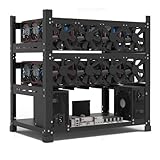
- SLOT - 6/8/12 GPU slots, support 2 ATX power supplies.
- MATERIAL - The open air mining frame case made up of the highest quality stainless steel material, strong, durable and available. Fully protecting your GPU and eectronic device.
- PERFECT DESIGN - Professional design for mining rig frame, accelerating the air convection, super cooling design for heat dissipation. Enough space reserved between the graphics cards.
- EASY TO INSTALL - Easy to install and strong structure. Keep all cables clean and organized, along with everything in your mining machine.
- NEED TO ASSEMBLE BY YOURSELF - For installation steps, please refer to the user manual. The Frame Only, Not includes Fans or other CPU, GPU, PSU, Motherboards, Cables. If you are not 100% satistifed with this Miner, please feel free to contact us, we will offer you a satisfactory soluiton within 24 hours.
Before buying a used ASIC, request:
- The serial number and original invoice.
- Proof of ownership and a seller identity that can be independently checked.
- A current operating screenshot showing hashrate, temperatures, fan speeds, and hashboard status.
- Evidence of stable hashrate over time rather than a single screenshot.
- Clear return terms and a written warranty position.
- Confirmation of the exact model, variant, PSU, voltage, and connector requirements.
Suspiciously cheap hardware should be treated as a risk signal, not an automatic bargain. Include shipping, customs, sales tax, repair, and installation in the comparison.
What should you avoid buying?
Reject a machine when the downside case fails or the site cannot legally and safely operate it. The following purchases are especially poor fits for most prospective miners:
- Old ASICs with poor efficiency unless electricity is nearly free and the purchase price is exceptionally low.
- Large hydro miners without an existing liquid-cooling loop, heat exchanger, pump system, and suitable electrical service.
- Suspiciously cheap used machines without ownership proof, operating evidence, or return terms.
- Cloud-mining contracts presented as though they were ownership of a physical ASIC.
- GPU rigs advertised with unverified daily-profit guarantees.
- Any machine whose voltage, phase, circuit, cooling, or noise requirements cannot be met legally at the intended site.
How do ASIC mining, GPU mining, and buying crypto compare?
ASIC mining maximizes algorithm-specific output but concentrates risk in one algorithm, one physical machine, the electricity contract, and the operating site. GPU mining sacrifices efficiency on many mature proof-of-work networks in exchange for coin and algorithm flexibility plus a possible resale fallback.
Buying Bitcoin or another asset avoids electricity, heat, hardware failure, pool configuration, and operating work, but it also removes the potential operational value of mining and exposes the buyer directly to asset-price risk. The correct comparison uses the same capital, time horizon, tax treatment, and downside assumptions for each option.
| Approach | Primary advantage | Primary risk | Best fit |
|---|---|---|---|
| Modern ASIC | High efficiency and output on its target algorithm | Algorithm lock-in, heat, noise, obsolescence, and power dependence | Operators with cheap power and suitable infrastructure |
| GPU rig | Algorithm flexibility and possible non-mining resale | Lower efficiency, more components, and volatile coin economics | Experimenters and users valuing flexibility |
| Hosted physical miner | Outsourced power, cooling, and facility operation | Provider, contract, downtime, payout, and ownership risk | Owners without a suitable operating site |
| Cloud-mining contract | No hardware installation | Counterparty and contract risk; not physical hardware ownership | Only after extensive contract and provider due diligence |
| Buy cryptocurrency directly | No mining infrastructure or operating cost | Direct market-price exposure without mining equipment value | Investors who do not want operational complexity |
How should different buyers choose a 2025 mining rig?
Hobbyist
Most hobbyists should not begin with a large Bitcoin ASIC unless they already have dedicated 220–240 V service, safe ventilation, a noise-tolerant location, and a low electricity rate. A small experiment or GPU system may be more practical, but only if the buyer accepts that the experiment may lose money.
Home miner with cheap electricity
A home miner with genuinely low-cost power should compare the S21 XP, S21 Pro, M60S++, and discounted S21 after calculating heat, noise, circuit capacity, and seasonal operating conditions. The best home choice may still be no large ASIC if the installation cost or household disruption exceeds the expected margin.
Small farm
A small farm should prioritize air-cooled efficiency, repairability, exhaust design, electrical expansion cost, and uptime. The S21 XP is the strongest starting candidate in this shortlist, while the S21 Pro and M60S++ can win when acquisition discounts are substantial.
Industrial operator
An industrial operator with three-phase power and liquid-cooling infrastructure can investigate the S21 XP Hydro, S21 XP+ Hydro, and other high-density models. The comparison must include the complete cooling system, pump energy, heat rejection, maintenance, and downtime rather than comparing miner specifications alone.
The Tool Desk
Outbyte Driver Updater FREEScan for outdated or missing drivers - takes under a minuteDriver Scan →Outbyte PC Repair FREERepair Windows errors before they cause bigger problemsFix Now →GPU experimenter
A GPU experimenter should choose hardware based on a specific algorithm, coin, software, power limit, resale plan, and electricity rate. GPU flexibility is valuable, but a flexible rig is not automatically more profitable than a specialized ASIC.
Buyer considering hosting
Hosting can be sensible when a buyer lacks suitable electricity, ventilation, or noise tolerance. Before transferring hardware or money, obtain the electricity rate, hosting and maintenance fees, minimum term, payout policy, machine ownership terms, downtime rules, withdrawal rules, repair liability, and termination conditions in writing.
What is the final buying checklist?
- Identify the exact coin and algorithm you intend to mine.
- Record the machine’s manufacturer-rated hashrate, wall power, efficiency, voltage, phase, cooling type, and PSU requirements.
- Calculate daily kWh and use the all-in electricity rate, including demand or tiered charges.
- Price the complete installation: miner, PSU, shipping, taxes, electrical work, ventilation, cooling, networking, hosting, and maintenance.
- Run bear, base, and bull scenarios using a live profitability calculator immediately before purchase.
- Calculate the break-even electricity rate and a shutdown price or shutdown condition.
- Check whether the site can remove the continuous heat and tolerate the noise.
- Confirm pool fees, wallet address, network reliability, firmware compatibility, and expected uptime.
- For used equipment, verify serial number, invoice, ownership, operating screenshots, hashboards, temperatures, fans, and return terms.
- Reject the deal if the downside case does not work without assuming a permanent coin price, difficulty, or uptime.
Frequently Asked Questions
Is the Antminer S21 XP the most profitable mining rig for everyone in 2025?
No. The Antminer S21 XP was the strongest all-around air-cooled candidate in this comparison, but profitability depended on electricity price, purchase cost, network conditions, cooling, pool fees, uptime, and the exact unit. A discounted S21 Pro or WhatsMiner M60S++ could produce a faster payback in some conditions.
Can you run a 3,500 W Bitcoin ASIC at home?
A 3,500 W Bitcoin ASIC can be operated at home only when the location has suitable dedicated electrical service, safe wiring, ventilation, heat removal, network connectivity, and tolerance for continuous noise. A licensed electrician should verify the circuit and local code; extension cords and power strips should not be used.
Are GPU mining rigs more profitable than ASIC miners in 2025?
GPU mining rigs were more flexible than ASIC miners, but GPU flexibility did not guarantee higher profit. GPU economics depended on the specific coin, algorithm, software, tuning, electricity rate, pool fees, hardware price, and resale value, while modern ASICs were generally more efficient on their target algorithms.
What electricity price is needed for Bitcoin ASIC mining to make sense?
There is no universal profitable electricity price because revenue and network difficulty change. As a screening heuristic, below $0.05/kWh is worth serious investigation, $0.05–$0.08/kWh favors efficient current-generation ASICs, and rates around $0.12–$0.15/kWh often make large-scale Bitcoin ASIC mining difficult after overhead.
Is cloud mining the same as owning a mining rig?
No. Cloud mining is a service or contract, not ownership of a physical mining rig. Cloud-mining buyers face provider, contract, payout, withdrawal, maintenance, downtime, and termination risks that must be evaluated separately from ASIC hardware economics.
The Bottom Line
Bottom line: For 2025, start with the Antminer S21 XP if you need an air-cooled SHA-256 ASIC, compare the WhatsMiner M60S++ and S21 Pro when their delivered prices are lower, and consider the S21 XP Hydro or XP+ Hydro only with professional liquid-cooling infrastructure. Enter your real electricity rate, calculate the bear case, include every installation and operating cost, and reject the purchase if the downside scenario does not work.
Free tools Windows power users keep installed
One-click scans. No signup required.
Quick Recap
Product prices and availability are accurate as of the date/time indicated and are subject to change. Any price and availability information displayed on Amazon at the time of purchase will apply.

