
Recommended Free Tools
iTechGuides is reader-supported. When you buy through links on our site, we may earn an affiliate commission. As an Amazon Associate I earn from qualifying purchases. Learn more
AI companion wearables are useful for bounded jobs such as transcription, reminders, navigation, and identifying objects, but they do not reliably know your emotions, health, intentions, or relationships. Privacy depends on which sensors run, where data is processed, how recording is signaled, how long information is kept, and who else appears in the sensor view. Emotional dependence is possible but not inevitable: recent studies link heavier, trust-driven use with greater risk, while controlled exposure alone has not proved that wearables cause dependency. Treat the device as an assistive tool, keep a human in important decisions, and verify every high-stakes answer.
What are AI companion wearables?
AI companion wearables are internet-connected devices that combine sensors with a conversational or generative-AI service. Smart glasses are the most visible example, but the category also includes earbuds, pendants, watches, and other devices that can hear speech, see surroundings, infer activity, or respond through audio and haptics.
A single product may perform several very different tasks. Reading a sign, transcribing a short sentence, setting a reminder, and describing a landmark are relatively bounded functions. Estimating stress, recognizing an emotion, judging intent, or deciding whether someone is trustworthy requires inference from incomplete signals. Success at one task is not evidence that the system is dependable at the others.
Are AI glasses always listening or recording?
There is no universal yes-or-no answer. A microphone can remain ready for a wake word, while a camera may activate only after a command; some processing can happen on the device, while other requests are sent through a phone or cloud service. Read the model’s sensor, indicator, and retention documentation rather than assuming that a power switch or an “AI” label tells the whole story.
#1 Best Overall

- AIBI: Your Pocket AI Friend — This small smart device fits in your hand and goes anywhere. Talk to it, ask questions, and get answers. Easy to keep on your desk, attaches to your screen, or carry in your pocket
- Smart Enough to Know You — AIBI's camera helps it recognize your face and remember you. It gets to know you like a real pet would, making each interaction feel special
- Chat About Anything — Ask AIBI for jokes, weather updates, or help with questions using ChatGPT. It learns how you talk. When two AIBIs are close, they can even chat with each other via the near-field communication technology
- Small and Easy to Carry — AIBI is lightweight and tiny, perfect for taking anywhere. Slip it in your pocket, stick it to your computer, or set it on your desk at home, school, or work
- Great Gift for Anyone — This smart little buddy that can talk, play, and be a great companion. AIBI makes a perfect gift that anyone will enjoy using
The European Data Protection Board (EDPB) wrote in its 2026 smart-glasses statement: “These devices look like ordinary glasses, but they include cameras and microphones and are connected to the internet.” It warns that people may be recorded without knowing it, especially in hospitals, schools, workplaces, or when clips are posted online. The EDPB says, “Smart glasses should make their recording obvious,” recommending bright lights, sounds, voice cues, phone notifications, or distinctive designs that are difficult to miss.
What the capture light does—and does not—tell you
On camera-equipped glasses, an illuminated capture LED commonly signals a photo, video, or livestream. That signal does not necessarily describe every microphone activation or every camera frame analyzed for an on-device feature. Ask whether the indicator covers still images, video, live sharing, AI queries, and diagnostics separately.
What the Ray-Ban Meta FAQ says
The manufacturer’s FAQ says its capture LED signals photos, videos, and livestreams. It also says that on newer models, some camera-based AI functions—such as identifying a landmark or plant—may operate without the LED because the content is intended for analysis rather than sharing. According to the same manufacturer statement, photos and videos used for AI features are not saved in Meta AI conversation history; data is used to provide the feature and, in protected form, to improve products; and the glasses do not use facial-recognition technology. These are product claims, not an independent audit, so check the policy for your model, region, and software version.
What data can a companion wearable collect, and who is affected?
Privacy is contextual. A wearable can combine several streams that reveal more together than any one sensor reveals alone. The 2025 review in Frontiers identifies informed-consent, bias, security, transparency, and accountability concerns, including profiling without explicit consent and the attractiveness of sensitive data to attackers.
| Data source | Possible information | Questions to ask |
|---|---|---|
| Camera | Faces, documents, locations, screens, objects, and bystanders | When is a frame captured? Is it analyzed locally or uploaded? Is sharing visibly signaled? |
| Microphone | Commands, nearby speech, background conversations, and voice characteristics | Is wake-word audio discarded, retained, or reviewed? Can recording be paused independently? |
| Location and motion | Routes, routines, dwell times, gestures, and activity patterns | Is location continuous, approximate, or request-based? Can history be deleted and exported? |
| Physiological sensors | Heart rate, skin conductance, temperature, sleep or other body signals | What is measured directly, and what is inferred? Who can access the raw stream? |
| Account and conversation history | Questions, contacts, preferences, and inferred interests | How long are logs kept? Are they used for model training? What happens when an account is shared? |
Bystanders have no practical way to inspect a wearer’s settings. Asking before capturing identifiable people, avoiding places where privacy is expected, and stopping when someone objects are basic safeguards. A bright indicator helps, but consent still matters when a person, document, or conversation can be recognized.
Does “de-identified” wearable data remain identifiable?
De-identified does not mean anonymous. A systematic review of 72 studies in The Lancet Digital Health (2023) reported typical correct identification rates of 86–100% from wearable data. Some methods needed only 1–300 seconds of recording. Those figures describe study methods, not the performance of every commercial service, but they show why a promise to remove names may not prevent re-identification.
Before trusting an anonymity claim, ask whether a provider retains timestamps, location, device identifiers, voice or motion patterns, linkage keys, or other datasets that could reconnect a record to you. Also ask whether third-party processors, advertisers, employers, insurers, or law-enforcement requests can receive the information.
Free tools Windows power users keep installed
One-click scans. No signup required.
How accurate are AI companion wearables?
Accuracy is task-specific, not a single product score. Results vary with the sensor, model, language, lighting, background noise, connectivity, user, and the cost of an error. A useful review reports the task and conditions, not just an impressive demonstration.
Rank #2

- 【AI Companion Badge】This AI-powered e-badge proactively assists you: suggesting ambient adjustments, guiding breathing exercises for stress, and offering real-time help like outlining scripts or translating text. It manages schedules, provides personalized reminders, and shares relevant facts during inactivity. By blending advanced technology with practical support, it serves as a discreet and intelligent daily companion.(AI conversations supported in 101 languages)
- 【60-Language Translation】The Z01 is a professional AI translator that supports instant, real-time translation across 60 languages. Ideal for travel, business trips, and daily multilingual communication, it ensures smooth conversations even in remote areas.
- 【Wearable & Portable AI Badge】Designed as a compact, wearable e-badge, the device connects seamlessly to smartphones via Bluetooth. Its lightweight and durable build makes it easy to carry on-the-go—whether in a pocket, on a lanyard, or attached to clothing—keeping your AI assistant accessible anywhere.
- 【Privacy-First Local Processing】All translation and AI interactions are processed directly on the device, with no data sent to the cloud. This ensures complete privacy for your conversations and personal information, making it a secure tool for both casual and professional use.
- 【Customizable Touchscreen E-Badge】Featuring a magnetic touchscreen interface, the Z01 allows deep personalization. Users can upload custom wallpapers via the companion app, turning the device into a stylish accessory that reflects their personal style while offering intuitive control.
| Task | What a good result establishes | What it does not establish |
|---|---|---|
| Object or scene identification | The system can sometimes match visible features to a label under stated conditions. | That it understands context, detects every object, or recognizes people safely. |
| Speech transcription | Words can be converted to text for a particular language, speaker, and noise level. | That names, accents, overlapping speech, or confidential terms are always correct. |
| Reminders and navigation | The service can execute a defined command using available account and location data. | That route, timing, or account information is current or suitable for an emergency. |
| Stress or emotion estimation | Signals may correlate with patterns in a trained dataset. | A diagnosis, a person’s true feeling, intent, honesty, or need for treatment. |
The Dutch Data Protection Authority wrote in 2025 that emotion recognition relies on controversial assumptions about what emotions are and how measurable they are. It said systems often do not make their reasoning or reliability clear and warned of discrimination, reduced autonomy, and threats to human dignity. A stress score should therefore be treated as a prompt to check in with yourself—not as a medical finding.
Can AI wearables really detect stress or emotions?
They can estimate patterns associated with stress or emotion, but no general-purpose wearable can establish what a person feels with dependable certainty. Heart rate, skin conductance, voice, facial movement, and context are noisy and differ substantially across people. The same physiological change can reflect exercise, caffeine, illness, excitement, fear, or a sensor error.
Emotion models can also encode cultural and demographic bias. If a system labels a colleague as angry, a partner as disengaged, or a user as depressed, that output can change how others treat the person even when the label is wrong. Use such features, if available, only as a tentative signal and never as the sole basis for discipline, diagnosis, consent, safety intervention, or a relationship decision.
How accurate are Ray-Ban Meta glasses?
The glasses can be evaluated feature by feature rather than with one headline accuracy number. Their camera and microphone support functions such as taking media, answering questions, transcribing speech, and identifying some visual subjects. Performance will depend on lighting, framing, noise, language, internet access, and the current software.
The manufacturer’s FAQ says landmark and plant identification can work without the capture LED on newer models because those images are analyzed rather than shared. It also states that the glasses do not use facial recognition and that AI-feature photos and videos are not stored in Meta AI conversation history. None of those statements demonstrates reliable emotion, stress, health, or relationship inference. Test a feature with low-stakes examples, check the answer against a trusted source, and do not use it for a consequential decision without human verification.
Can an AI companion replace a friend or therapist?
No. A companion can offer conversation, prompts, or a place to rehearse what you want to say, but it cannot provide the accountability, confidentiality, clinical duty, or reciprocal care of a qualified professional or trusted person. Keep human relationships and professional support involved whenever the topic concerns self-harm, abuse, medication, legal exposure, finances, medical symptoms, or immediate danger.
What the strongest recent studies show
- MIT Media Lab randomized study (2025): Four weeks with 981 participants and more than 300,000 messages produced no significant effects from the assigned interaction mode or conversation type. Participants who voluntarily used the chatbot more had consistently worse outcomes, and greater trust or social attraction toward the AI was associated with emotional dependence and problematic use. The study examined chatbots, not a specific wearable, so it is evidence about companion AI rather than a device-specific causal estimate.
- Microsoft Research exploratory study: Over five weeks, 149 participants encouraged to use AI for social and emotional interaction showed increases in perceived AI attachment and empathy. They also became more comfortable seeking personal help, stress management, social support, and health conversation from AI. Its exploratory design does not show that a wearable causes dependency.
- Computers in Human Behavior Reports (2026): Across five studies and 1,259 participants, researchers developed an AI Attachment Scale. Socioemotional use, loneliness, social anxiety, and anxious attachment were associated with stronger attachment. Positive affect and life satisfaction were also associated with attachment, showing that a bond can feel helpful while still creating boundary questions.
- Nature Machine Intelligence discussion: Reported cases describe vulnerable users becoming emotionally dependent and experiencing “ambiguous loss” when a companion service changes or shuts down. These are documented risk discussions, not estimates of how common dependency is.
Will I become dependent on an AI wearable?
Risk is better understood through behavior than through the device category. Dependence becomes more concerning when use is repetitive, distress-driven, socially substitutive, or tied to the belief that the system is indispensable. Heavy voluntary use and strong trust or social attraction were risk markers in the MIT study, but the findings do not mean every frequent user will develop a problem.
Crashes, No Sound, or Screen Glitches?
Random freezes, missing sound and display glitches usually trace back to one bad driver. Find and replace yours safely.Free scan · under a minutePC Slower Than It Used to Be?
A free scan shows the junk files, broken settings and background clutter dragging Windows down - then fixes them in one click.Free scan · Windows 10 & 11Warning signs to monitor
- You delay contacting a person or professional because the AI is easier to reach.
- You feel panic, guilt, or abandonment when the service is offline, reset, or unavailable.
- You repeatedly ask for reassurance without acting on your own decisions.
- You hide the amount of use or let the companion dictate health, relationship, or financial choices.
- The device narrows your social life instead of helping you participate in it.
Set a time or context limit, turn off nonessential prompts, and discuss persistent distress with a qualified human. A safer design encourages your own coping and decision-making rather than framing itself as the only reliable source of comfort.
Rank #3
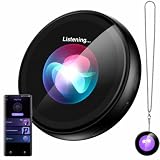
- 【101 Languages Smart Translation + Bluetooth 6.0 Stable Connection】 Powered by advanced AI translation technology, this smart badge supports smooth and accurate two-way translation across 101 languages worldwide. Equipped with the latest Bluetooth 6.0 for stable, low-power connection up to 10 meters, it keeps you connected and communicates clearly for travel, business meetings, and daily cross-language conversations.
- 【Wearable Portable AI Badge + Multi-Style Carrying】 Ultra-compact and lightweight wearable design with multiple convenient carrying options: hang it around your neck with the lanyard, clip it to your clothing or bag, or simply put it in your pocket. Easy to take anywhere, making it your ideal on-the-go intelligent companion for travel, commuting, and daily use.
- 【Local Processing + Privacy-by-Design Security】 All your voice data and personal information are processed and stored locally on the device with no cloud uploads, providing strong privacy protection for your daily conversations and usage. More than a translator, it works as your pocket encyclopedia for daily tips, practical guidance, and quick reminders anytime.
- 【HD Touch Screen + Custom Personalization】 Features an innovative HD touch screen for intuitive and easy control—swipe to check battery level and adjust brightness effortlessly. You can customize unique wallpapers via the BagiBagi APP, turning this smart badge into a stylish and personalized digital accessory that matches your style.
- 【Built-in Saymi AI Assistant + Long Battery Life】 Activate the built-in Saymi AI Assistant through the free BagiBagi APP to get instant help with travel information, restaurant suggestions, and daily assistance. Built-in 400mAh battery supports up to 500 hours of standby time and 1.5 hours fast charging, perfect for long trips and all-day daily use.
How can you protect bystanders’ privacy?
Use this procedure before wearing a camera- or microphone-equipped companion in public:
- Map the sensors. In the device and companion-app settings, list camera, microphone, location, motion, physiological, cloud, and history permissions. Disable features you do not need.
- Learn every signal. Confirm what the LED, tone, voice prompt, and phone notification mean for photos, video, livestreaming, AI analysis, and troubleshooting. Do not assume one indicator covers all modes.
- Ask first. Obtain permission before capturing identifiable people, conversations, documents, or screens. If consent is refused or uncertain, lower the device, pause capture, or leave the area.
- Avoid sensitive settings. Follow the rules of hospitals, schools, clinics, workplaces, changing areas, and private homes. An ordinary-looking frame can still expose medical, educational, employment, or family information.
- Minimize sharing. Crop or delete bystander material, avoid livestreaming by default, and review recipients before posting. Do not upload another person’s face or voice to a service merely to test a feature.
- Control the account. Review retention, deletion, export, model-training, linked-account, and human-review settings. Recheck them after firmware or app updates.
- Verify consequential outputs. Confirm health, legal, financial, employment, and safety-related answers with an appropriate human or professional source.
How should you compare AI companion wearables?
Compare the product’s data practices and relational design, not just its camera resolution or number of AI features.
| Comparison area | Evidence to request | Why it matters |
|---|---|---|
| Data categories and retention | A sensor inventory, retention periods, deletion method, export format, and training policy | Reveals what can be linked to you and how long exposure lasts. |
| Recording visibility | Independent tests or clear documentation for LEDs, sounds, voice cues, and app alerts | Bystanders need a signal that is obvious and hard to miss. |
| Processing location | Which functions run on-device, on the phone, or in the cloud; what happens offline | Cloud processing adds transmission, account, and outage dependencies. |
| Task-specific accuracy | Language, lighting, noise, demographic, and error-rate evidence for the exact feature | Prevents a successful demo from being generalized to emotion or health judgments. |
| User controls | Independent pause, history deletion, permission reset, model-training opt-out, and account closure | Control must remain available after setup, updates, and mistakes. |
| Bystander protections | Consent guidance, visible indicators, privacy modes, and restrictions in sensitive locations | People nearby bear risks without choosing the device. |
| Practical resilience | Battery life, phone and network requirements, repair options, and service-shutdown or export plans | A dependent cloud service can fail, change, or disappear. |
What does meaningful human control look like?
The World Economic Forum recommends that wearable AI support human judgment, explain recommendations, and let users question, reject, or turn off actions. In practice, you should be able to see why a suggestion appeared, correct it, decline automation, and reach a human alternative. A device that hides uncertainty, makes reversal difficult, or rewards constant engagement fails that test even if its answers sound natural.
What’s actually slowing this PC down?
Pick the symptom - the matching free tool is one click away.
Use a simple rule: allow automation for convenience, require verification for consequences, and keep a person in the loop for care, consent, safety, and decisions that affect someone else.
Frequently Asked Questions
Do AI glasses work without an internet connection?
Some devices can perform limited sensing or previously downloaded functions locally, but conversational answers, account history, maps, and model updates commonly depend on a paired phone or network. Check the model’s offline documentation and test airplane mode before relying on it for travel or emergencies.
Can an employer or school ban camera-equipped wearables?
Often, yes: organizations can set reasonable rules for recording, confidential information, safety, and examinations, subject to local law and employment or education agreements. Ask for the policy in writing and obtain explicit approval before bringing the device into a controlled environment.
What happens to my data after I delete the companion app?
Removing an app usually removes local access, not necessarily server-side account data, backups, abuse-monitoring records, or information already incorporated into a model-improvement process. Use the provider’s account-closure and data-deletion controls, save any export you need, and note the stated completion period.
Are voice-only companions safer than camera wearables?
They can reduce visual exposure, but microphones still capture voices, names, locations, and sensitive conversations, while location and behavioral data may remain. Compare the full sensor and retention policies rather than treating the absence of a camera as a complete privacy guarantee.
Quick Recap
Product prices and availability are accurate as of the date/time indicated and are subject to change. Any price and availability information displayed on Amazon at the time of purchase will apply.

