
The Tool Desk
Outbyte PC Repair FREEClear out junk files and repair common Windows errorsFree Scan →Outbyte Driver Updater FREEFix the driver behind crashes, sound loss and screen glitchesFind Drivers →Microsoft released the source code for its 6502 BASIC interpreter on September 3, 2025. The release makes an important ancestor of the Commodore 64’s built-in BASIC available to inspect and reuse—but it is not a complete, verbatim dump of the C64’s later Commodore-specific BASIC ROM.
What Microsoft released
The release is BASIC M6502 8K VER 1.1, Microsoft’s version 1.1 BASIC for the MOS Technology 6502 processor. Microsoft’s official repository describes it as the complete source for that version, originally developed and copyrighted between 1976 and 1978. Its main assembly file, m6502.asm, contains 6,955 lines, and the repository includes an MIT license.

Microsoft says the 6502 port was completed in 1976 by Bill Gates and Ric Weiland. The released code is written in 6502 assembly; it is not a modern BASIC program that can be opened and run directly. Using it requires assembling the code for a compatible target and supplying the system environment the interpreter expects.
How it connects to the Commodore 64
Commodore licensed Microsoft BASIC in 1977 for a reported flat fee of $25,000, according to Microsoft’s September 2025 account. Commodore used the Microsoft 6502 lineage in the PET, then in the VIC-20 and Commodore 64. Microsoft describes the released code as the foundation of Commodore BASIC. That is a lineage claim, not a claim that every later Commodore machine used this exact, unchanged source.
Crashes, No Sound, or Screen Glitches?
Random freezes, missing sound and display glitches usually trace back to one bad driver. Find and replace yours safely.Free scan · under a minuteWindows Errors? Fix Them Before They Spread
Repair common Windows errors and clear accumulated junk for a smoother, more stable PC - no reinstall needed.Free scan · no reinstall#1 Best Overall

- High definition output at 720p via HDMI
- Pixel Perfect display, with US/Europe display modes and crt filter options
- Save game function. Supports software updates via USB flash drive
- 2 USB ports: plug in a USB keyboard and use as a fully functional home computer, or add a second joystick for 2-player games
- Included: The C64 Mini computer, Classic USB joystick, HDMI cable, USB cable for power, 64 preinstalled games, instruction manual. *AC USB adaptor not included
The distinction matters for C64 owners and programmers: the repository identifies its Commodore target as the PET configuration. The C64’s built-in BASIC is a Commodore adaptation of the Microsoft 6502 lineage, with C64-specific ROM and runtime behavior. The released repository therefore offers a way to study related historical interpreter code, but it should not be treated as the full source for the C64’s shipped BASIC.
Microsoft also says that in 1978 Commodore engineer John Feagans and Gates jointly implemented garbage-collector fixes after Feagans visited Microsoft’s Bellevue office. Microsoft identifies this 1.1 version as the one that shipped as PET BASIC V2.
Rank #2
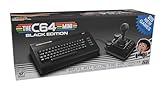
- A glorious half-size recreation of the iconic C64 in a striking black finish
- 25 of the highest rated new games, including; Sam’s Journey, A Pig Quest, Steel Ranger and Knight ‘n’ Grail
- High Definition output at 720p 50 or 60Hz
- Play in original 4:3 or pixel perfect aspect ratios, with or without CRT filters
- Save your progress in one of four save-game slots per game, and return at any time
What the source contains
The code targets 8-bit 6502 systems and is described as an 8KB ROM version designed for ROM and RAM configurations. The repository’s conditional compilation options name several targets:
- Apple II
- Commodore PET
- Ohio Scientific
- MOS Technology KIM-1
- PDP-10 simulation
Its interpreter features include floating-point arithmetic, strings, arrays, mathematical functions, input and output, dynamic variables, stack-based expression evaluation, and string garbage collection. Revision-history entries from 1978 document work on FOR-loop handling, statement parsing, memory use, garbage collection, string functions, numeric precision, and reserved-word parsing.
Free tools Windows power users keep installed
One-click scans. No signup required.
Rank #3

- Vintage Computer design. Commodore - C64 - Uppercase Letter & Commodore - Lettering Blue/Red
- Commodore C64 Uppercase Letter & Commodore Blue / Red
- Lightweight, Classic fit, Double-needle sleeve and bottom hem
Those capabilities make the release useful for studying how a period interpreter fit a substantial language runtime into constrained hardware. They do not establish that every named target can be built with current tools or run without target-specific setup.
How to inspect or reuse it
- Find Microsoft’s official GitHub repository,
microsoft/BASIC-M6502, and read its README and license before changing or redistributing anything. - Open
m6502.asmto examine the interpreter implementation and its historical revision notes. - Choose a repository-listed target and check the source’s conditional compilation and platform assumptions. The repository identifies target configurations, but the supplied documentation does not establish a turnkey modern build process.
- If your goal is to experiment rather than recreate original hardware, use a suitable 6502 emulator or FPGA-based system only after confirming that it supports the required assembled image and target environment.
The GitHub repository was marked archived and read-only as of September 5, 2025. Its MIT license permits reuse subject to the license terms; check the repository’s current status and license text before relying on them for a project.
How the release differs from C64 BASIC
| Question | Microsoft BASIC M6502 8K VER 1.1 | Commodore 64 BASIC |
|---|---|---|
| Relationship | Microsoft’s 6502 BASIC lineage; described by Microsoft as the foundation of Commodore BASIC. | A Commodore adaptation of that lineage, not established as identical to the released source. |
| Target identified in the release | Conditional compilation targets include Apple II, Commodore PET, Ohio Scientific, KIM-1, and PDP-10 simulation. | The repository does not list the C64 as its Commodore target; C64-specific ROM and runtime details are not established by this release. |
| Memory design | Described as an 8KB ROM version designed for ROM and RAM configurations. | Not stated in the Microsoft repository description as a comparison figure for the C64 adaptation. |
| Source and license | Microsoft’s 6,955-line m6502.asm source is available under the MIT license. |
The release does not provide a complete verbatim source dump of the C64’s BASIC ROM. |
What this means for programmers and retrocomputing fans
If you want to understand how early BASIC interpreters worked on 6502 hardware, the release offers unusually direct access to the assembly behind a historically influential implementation. You can study its memory-conscious design, language features, and documented fixes, or adapt it for a compatible project subject to the MIT license.
If your specific goal is to reproduce the Commodore 64’s built-in BASIC exactly, this source alone is not enough: it represents the related Microsoft/PET-era lineage, not a verified complete C64 ROM source. For running experiments, distinguish the assembly source from a ready-to-run interpreter image and verify the assembler, target configuration, and emulator or hardware requirements before starting.
Quick Recap
Best Value

- Inspired by the classics. Compatible with Windows 10(1903) or above, and Android 9.0 or above.
- Programmable keys, Dual Super Buttons, and Super Stick, with independent control panel.
- 87 keys. Top mount style with Kailh Box White Switches.
- Double-Shot ABS keycaps with SA profile. (C64 Edition only)
- Hot-swappable PCB. Support n-key rollover.
Product prices and availability are accurate as of the date/time indicated and are subject to change. Any price and availability information displayed on Amazon at the time of purchase will apply.

