
In 2026, Microsoft and Google are building two different kinds of cloud AI accelerators, while their quantum chips remain research efforts rather than consumer products. Microsoft positions Maia 200 for inference in Azure; Google’s TPU7x, marketed as Ironwood, supports training and inference through Google Cloud. Their published specifications do not establish which is faster or better value: the figures use different precisions and system contexts, and neither company’s announcement is an independent head-to-head test.
Two cloud accelerators, designed for AI workloads
Maia 200 and TPU7x are data-center accelerators offered as part of cloud infrastructure, not standalone chips documented for retail purchase. Their roles overlap, but the companies describe them differently: Microsoft emphasizes inference for Maia 200, while Google describes TPU7x as supporting both large-scale AI training and inference.

Microsoft Maia 200: focused on inference
Microsoft announced Maia 200 on January 26, 2026, describing it as an inference accelerator for Azure. The company says it is built using TSMC’s 3 nm process and has tensor cores with native FP8 and FP4 support. Microsoft’s published specifications include 216 GB of HBM3e memory with 7 TB/s of bandwidth and 272 MB of on-chip SRAM.
Microsoft reports more than 10 PFLOPS at FP4 and more than 5 PFLOPS at FP8. Those are company-published performance figures, not results from an independent workload comparison. Microsoft also says Maia 200 supports large-scale cluster networking, but the cited announcement does not give a pod size comparable to Google’s published TPU7x pod figure.
#1 Best Overall
Microsoft’s claim of 30% better performance per dollar is specifically a comparison with the latest-generation hardware in Microsoft’s own fleet. It is not a measured advantage over Google’s TPU7x or any other vendor’s accelerator.
Google TPU7x: Ironwood for training and inference
Google Cloud release notes say TPU7x, the first release in the Ironwood family and Google Cloud’s seventh-generation TPU, became generally available on March 31, 2026. Google describes it as suitable for large-scale training and inference.
Google Cloud’s TPU7x documentation lists peak compute per chip of 2,307 TFLOPs at BF16 and 4,614 TFLOPs at FP8, plus 192 GiB of HBM and 7,380 GB/s of HBM bandwidth. The documented pod footprint is 9,216 chips, and the chip uses a dual-chiplet organization. These are Google specifications; peak figures do not predict the throughput a particular model or workload will achieve.
Rank #2

- BUILT FOR COLLEGE. AND BEYOND — MacBook Air with the M5 chip packs blazing speed and powerful AI capabilities into an incredibly portable design. And with up to 18 hours of battery life,* this thin and light powerhouse is ready to take on almost any major, just about anywhere.
- TEAR THROUGH TOUGH ASSIGNMENTS — With its faster CPU and unified memory, the M5 chip delivers even more performance and fluidity across apps, making multitasking and creative workflows smooth and responsive. A powerful Neural Engine and next-generation GPU with Neural Accelerators give you a powerful platform for AI.
- MAKE QUICK WORK OF YOUR TO-DO LIST — Apple Intelligence helps you write, express yourself, and get things done effortlessly — whether it’s for school or everyday life. With groundbreaking privacy protections, it gives you peace of mind that no one else can access your data — not even Apple.*
- UP TO 18 HOURS OF BATTERY LIFE — MacBook Air delivers incredible battery life with amazing performance, so you can power through a full day of classes without worrying about plugging in.
- A BRILLIANT 13.6-INCH DISPLAY* — The gorgeous Liquid Retina display on MacBook Air supports 1 billion colors, making photos and videos pop with rich contrast and sharp detail, and text appears supercrisp. So everything — from class presentations to movies to games — looks truly stunning.
Google documents JAX and PyTorch support for TPU7x, but not TensorFlow support. Cloud access is through Compute Engine or Google Kubernetes Engine (GKE). The available zones and supported TPU versions depend on current Google Cloud locations and capacity.
Quick wins for a faster PC:
Scan for outdated or missing drivers - takes under a minuteDriver Scan →Repair Windows errors before they cause bigger problemsFix Now →How the published AI specifications compare
The numbers below come from company announcements and cloud documentation. They describe different precisions and are not a shared benchmark. In particular, a peak figure at FP4 cannot be ranked directly against one at BF16, and a per-chip specification is not the same measure as end-to-end performance across a pod.
| Category | Microsoft Maia 200 | Google TPU7x (Ironwood) |
|---|---|---|
| Published role | Inference accelerator for Azure (Microsoft, announced January 26, 2026) | Large-scale training and inference; Google Cloud seventh-generation TPU, first Ironwood release (Google Cloud, generally available March 31, 2026) |
| Peak compute figures | More than 10 PFLOPS FP4 and more than 5 PFLOPS FP8, as reported by Microsoft | 2,307 TFLOPs BF16 and 4,614 TFLOPs FP8 per chip, as listed by Google Cloud |
| Memory | 216 GB HBM3e and 272 MB on-chip SRAM, as reported by Microsoft | 192 GiB HBM, as listed by Google Cloud |
| Memory bandwidth | 7 TB/s HBM3e bandwidth, as reported by Microsoft | 7,380 GB/s HBM bandwidth, as listed by Google Cloud |
| Published system scale | Large-scale cluster networking is described; a comparable pod chip count is not stated in Microsoft’s cited announcement | 9,216 chips per pod, as listed in Google Cloud documentation |
| Frameworks and access | Deployed in Azure infrastructure; the cited sources do not establish standalone chip sales or a retail purchase path | Compute Engine or GKE; JAX and PyTorch supported, TensorFlow not supported for TPU7x |
Why these numbers do not name a winner
A useful accelerator comparison needs more than peak compute. Before treating one published figure as an advantage, check that both sides use the same basis:
Rank #3
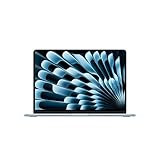
- BUILT FOR COLLEGE. AND BEYOND — MacBook Air with the M5 chip packs blazing speed and powerful AI capabilities into an incredibly portable design. And with up to 18 hours of battery life,* this thin and light powerhouse is ready to take on almost any major, just about anywhere.
- TEAR THROUGH TOUGH ASSIGNMENTS — With its faster CPU and unified memory, the M5 chip delivers even more performance and fluidity across apps, making multitasking and creative workflows smooth and responsive. A powerful Neural Engine and next-generation GPU with Neural Accelerators give you a powerful platform for AI.
- MAKE QUICK WORK OF YOUR TO-DO LIST — Apple Intelligence helps you write, express yourself, and get things done effortlessly — whether it’s for school or everyday life. With groundbreaking privacy protections, it gives you peace of mind that no one else can access your data — not even Apple.*
- UP TO 18 HOURS OF BATTERY LIFE — MacBook Air delivers incredible battery life with amazing performance, so you can power through a full day of classes without worrying about plugging in.
- A BRILLIANT 13.6-INCH DISPLAY* — The gorgeous Liquid Retina display on MacBook Air supports 1 billion colors, making photos and videos pop with rich contrast and sharp detail, and text appears supercrisp. So everything — from class presentations to movies to games — looks truly stunning.
- Workload: inference, pre-training, decoding, mixture-of-experts, and other workloads can stress processors, memory, and networking differently.
- Precision and metric: FP4, FP8, and BF16 are not interchangeable. Confirm whether a figure is per chip, per pod, theoretical peak, or measured throughput on a real workload.
- Memory and scale: capacity and bandwidth matter, as do the way chips are interconnected and how efficiently a workload scales across them.
- Software and access: framework support, deployment setup, zone availability, and capacity affect what a team can actually run.
- Evidence quality: vendor specifications and company-reported performance comparisons are not equivalent to an independently reproducible test using the same model, precision, software, and system configuration.
The published materials from Microsoft and Google do not provide an independent, apples-to-apples Maia 200 versus TPU7x result. Without one, claims that either chip is faster, more efficient, or a better value than the other are not established by these figures.
Cloud access is not chip ownership
Google documents TPU7x access through Compute Engine and GKE, with current zones and supported versions listed in its TPU locations information. Actual access depends on the zone and available capacity, which can change. Microsoft places Maia 200 in Azure infrastructure; the cited announcement does not establish a retail route for buying the accelerator as a standalone component. For both products, the practical access described is cloud-based rather than consumer ownership.
Free tools Windows power users keep installed
One-click scans. No signup required.
The quantum chips are research milestones, not consumer devices
Willow and Majorana 2 belong to a different story from Maia 200 and TPU7x. The AI accelerators are cloud infrastructure for current workloads; the quantum chips are part of company research and development. Neither announcement establishes that a generally useful, large-scale quantum computer is commercially available.
Rank #4

- 🍭 MOLD SIZE: This mold has 4 cavities. The cavity capacity 1.1 ounces. Please do not use with hard candy. This mold is NOT dishwasher safe and should be cleaned by hand. The molds are not suitable for children under 3.
- 🧁 GET CREATIVE: Create goodies for parties such as birthdays and baby showers or delicious wedding favors. Make candies for holidays such a Valentines Days or Christmas. Unleash your inner artist and use the molds to make custom soaps, bath bombs or wax melts.
- 🍩 BE PROFESSIONAL: Create expert looking confections with the addition of our candy cups in a variety of colors and sizes, our high-quality lollipop sticks and clear cello bags. Take your chocolate molding to a new level with our exclusive Chocolatier's Guide, which explains how to melt, mold, and paint chocolate.
- 🍰 CYBRTRAYD: We are a company dedicated to providing confectionery and soap making tools. We want to provide you with quality tools to make your creative process as easy and fun as possible. Our experts are here to help. Your satisfaction is important to us. Contact us with any quality issues or concerns.
Google Willow
Google introduced Willow in a December 2024 announcement as its then-latest quantum chip and framed it as progress toward the company’s roadmap for a useful, large-scale quantum computer. That makes Willow a research milestone in a longer effort, not evidence of a consumer product or broad near-term practical applications.
Microsoft Majorana 2
In its June 2, 2026 Build announcement, Microsoft described Majorana 2 as its next-generation quantum computing chip. Microsoft reported an average qubit lifetime of 20 seconds, with some instances reaching up to a minute, and claimed 1,000 times higher reliability than its previous generation. These are claims in Microsoft’s announcement, not independently validated measurements in the sources cited here.
Microsoft also described a path to a million qubits on a chip that fits in the palm of a hand. That is a roadmap ambition, not a description of Majorana 2’s present capability. The company’s statement that it would achieve a scalable quantum machine by 2029 is likewise a roadmap target, not a guaranteed delivery date.
Do these 3 things before closing this tab:
1Clear out junk files and repair common Windows errors2Fix the driver behind crashes, sound loss and screen glitches3Repair Windows errors before they cause bigger problemsBest Value

- AN AMAZING MAC AT A SURPRISING PRICE — With an incredibly portable and durable aluminum design, up to 16 hours of battery life,* and the A18 Pro chip, MacBook Neo is ready to go wherever school takes you.
- FOUR STUNNING COLORS. ONE DURABLE DESIGN — Choose from four beautiful colors — Silver, Blush, Citrus, or Indigo — each with a color-coordinated keyboard. And MacBook Neo is made with a durable recycled aluminum enclosure that helps it reach 60 percent recycled content by weight — the most ever in any Apple product.*
- FLY THROUGH EVERYDAY ASSIGNMENTS — Whether you’re cramming for finals, using Apple Intelligence* to summarize class notes, creating presentations, or even playing the latest Apple Arcade game,* MacBook Neo delivers the performance and AI capabilities you need to get things done.
- UP TO 16 HOURS OF BATTERY LIFE — MacBook Neo delivers all day battery life, so you can power through from early morning classes to late night study sessions without worrying about plugging in.
- A VIBRANT 13-INCH DISPLAY* — The gorgeous Liquid Retina display on MacBook Neo supports 1 billion colors, so photos and videos pop and text is crisp for easy reading.
Why Willow and Majorana 2 cannot be ranked from these announcements
The two announcements do not provide a common set of independently verified measures for a direct benchmark. Their claims therefore should not be collapsed into a single ranking or treated as proof that one chip is closer to practical general-purpose quantum computing. The available evidence supports describing each company’s stated research milestone and roadmap, while keeping the claims attributed to the company that made them.
Independent reader supportYour contribution helps us test, update, and keep practical guides available for everyone.What to take away
For AI teams, Maia 200 and TPU7x are cloud options whose real-world suitability depends on workload, precision, software, scale, and access. Their vendor-published specifications are useful for understanding design and intended use, but they do not settle a cross-vendor performance contest. For quantum computing, Willow and Majorana 2 signal continuing research; the announcements do not show that consumers can buy these chips or use a generally useful large-scale quantum computer today.
Quick Recap
Product prices and availability are accurate as of the date/time indicated and are subject to change. Any price and availability information displayed on Amazon at the time of purchase will apply.

