
What’s actually slowing this PC down?
Pick the symptom - the matching free tool is one click away.
For a Raspberry Pi streaming 1080p at 30 fps to YouTube Live with H.264, use a video bitrate within YouTube’s recommended 5–14 Mbps range. Set the encoder to constant bitrate (CBR) and use a two-second keyframe interval; YouTube says not to exceed four seconds. These are ingest recommendations, not a promise that a particular Pi, camera, encoder setup, or internet connection can sustain the stream reliably. YouTube’s live encoder guidance distinguishes these settings from its separate recommendations for uploaded videos.
Recommended bitrate and encoder settings for 1080p30
Choose the bitrate for the codec your encoder actually sends. YouTube’s current live encoder guidance, accessed October 2026, gives these recommended video bitrate ranges for 1080p at 30 fps:
| Output video codec | YouTube-recommended bitrate |
|---|---|
| H.264 | 5–14 Mbps |
| AV1 or H.265/HEVC | 4–10 Mbps |
For the common Raspberry Pi camera workflow that outputs H.264, use the H.264 row. The range is a recommendation, not a requirement to choose its maximum: select a bitrate your encoder can sustain and your connection can reliably upload. If your encoder outputs AV1 or H.265, use that codec’s row instead.
- Rate control: constant bitrate (CBR).
- Keyframe interval: two seconds recommended; do not exceed four seconds.
- Ingest protocol: YouTube supports RTMP and RTMPS and recommends RTMPS.
These are YouTube Live ingestion settings. Do not substitute bitrate figures from YouTube’s separate upload-video recommendations.
#1 Best Overall

- Includes Raspberry Pi 4 4GB Model B with 1.5GHz 64-bit quad-core CPU (4GB RAM)
- Includes Pre-Loaded 32GB EVO+ Micro SD Card (Class 10), USB MicroSD Card Reader
- CanaKit Premium High-Gloss Raspberry Pi 4 Case with Integrated Fan Mount, CanaKit Low Noise Bearing System Fan
- CanaKit 3.5A USB-C Raspberry Pi 4 Power Supply (US Plug) with Noise Filter, Set of Heat Sinks, Display Cable - 6 foot (Supports up to 4K60p)
- CanaKit USB-C PiSwitch (On/Off Power Switch for Raspberry Pi 4)
What the Raspberry Pi model changes
A 1080p30 target does not tell you by itself whether a Pi can encode and deliver a stable stream. The model and software encoding path matter, as do the camera, audio, muxing, network, and configuration.
Pi 4 and documented hardware H.264 encoding
The Picamera2 manual describes the H264Encoder as using the Pi’s built-in hardware through V4L2 kernel drivers and supporting up to 1080p30. That statement describes the documented encoder capability; it is not a guarantee for every Raspberry Pi model or complete YouTube streaming setup. See the Picamera2 manual.
Rank #2
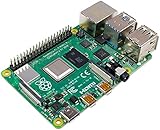
- Broadcom BCM2711, quad-core Cortex-A72 (ARM v8) 64-bit SoC @ 1. 5GHz
- 2. 4 GHz and 5. 0 GHz IEEE 802. 11b/g/n/ac wireless LAN, Bluetooth 5. 0, BLE
- 2 × USB 3. 0 ports, 2 x USB 2. 0 Ports
- 2 × micro HDMI ports supproting up to 4Kp60 video resolution
- Micro SD card slot for loading operating system and data storage
Pi 5 and software encoding
Raspberry Pi’s current camera software guidance describes Pi 5 video encoding as software based. It offers a --low-latency option for real-time streaming scenarios; lower latency trades away some coding efficiency. Raspberry Pi’s camera software documentation and H.264 performance note discuss these paths, but do not establish one universal throughput result for every workload. Do not assume Pi 4 hardware encoding and Pi 5 software encoding behave identically.
Set up and validate the stream
- Identify the encoder’s output codec. Check the actual output configuration, rather than inferring it from the camera or Pi model. Use 5–14 Mbps for H.264 or 4–10 Mbps for AV1/H.265 at 1080p30.
- Configure the encoder for YouTube Live. Set CBR and a two-second keyframe interval, keeping the interval at or below YouTube’s four-second maximum. Use RTMPS if your encoder supports it.
- Check real upload capacity. Run a speed test under conditions like those expected during the broadcast. Your connection must carry the video bitrate as well as audio and other network traffic; leave headroom for variability. YouTube does not give a universal headroom percentage in this guidance, so do not treat the video bitrate as the entire connection requirement or rely on an invented fixed margin.
- Test the complete setup before going live. Use movement and audio representative of the real event. The camera documentation describes ways to stream encoded camera video over a network, but that alone does not verify a complete YouTube RTMPS pipeline: capture, audio, muxing, network stability, configuration, and software versions all affect the result.
- Watch YouTube’s stream health. During the test and broadcast, check stream health and messages in Live Control Room. If the stream is unstable, diagnose the actual encoder and network conditions rather than assuming that a bitrate inside YouTube’s recommended range guarantees delivery.
Troubleshooting 1080p30 streaming
- YouTube reports unstable or insufficient input: Check available upload capacity while the stream is running, including competing traffic and audio. Test again under realistic network conditions; lower the selected bitrate within the recommendation if the connection cannot sustain it.
- The output looks poor despite a stable connection: Confirm the codec and chosen bitrate in the encoder output. A bitrate appropriate for one codec should not be applied blindly to another; use the matching YouTube row and test with representative motion.
- The Pi cannot sustain the target: Confirm the model and encoding path. Pi 5 uses software encoding in current Raspberry Pi camera guidance, while the documented Picamera2 H264Encoder hardware capability is up to 1080p30. Check the encoder’s sustained behavior in your actual configuration instead of relying on an assumed universal performance figure.
- Video arrives but audio or stream packaging fails: Check audio capture, muxing, and protocol configuration as well as the camera encoder. A camera’s network-streaming capability by itself does not establish that the assembled YouTube pipeline is correct.
- Keyframe-related warnings appear: Set the keyframe interval to two seconds and verify it does not exceed four seconds.
Or let it run in the cloud
If your goal is a 24/7 YouTube channel built from uploaded videos rather than a live camera feed, StreamNeo is a different option: upload a recording or create a playlist, add your YouTube stream key, and go live. It loops the videos from the cloud, so nothing has to stay on at home. It supports the uploaded quality up to 4K 60fps at one price per slot, with automatic recovery if YouTube drops the stream. The first day is free with no card. Monthly pricing is $9.99 per month. It streams to YouTube only, and it does not broadcast a live camera feed. See StreamNeo or start the free day.
The Tool Desk
Outbyte PC Repair FREERepair Windows errors before they cause bigger problemsFix Now →Outbyte Driver Updater FREEScan for outdated or missing drivers - takes under a minuteDriver Scan →Quick Recap
Best Value

- Includes Raspberry Pi 4 4GB Model B with 1.5GHz 64-bit quad-core CPU (4GB RAM)
- CanaKit 3.5A USB-C Power Supply with Noise Filter (UL Listed) specially designed for the Raspberry Pi 4 (5-foot cable)
- CanaKit USB-C PiSwitch (On/Off Power Switch)
- Set of 3 Aluminum Heat Sinks for the Raspberry Pi 4
Rank #4

- Vilros Complete Starter Kit for Pi 4 Includes Raspberry Pi 4 Model B Board and all the accessories you need to get started.
- 9-PART KIT WILL HAVE YOU READY TO GET UP AND RUNNING: Kit Includes 1. Raspberry Pi 4 Model B Board 2. Case With Easy to connect Built-in fan 3. 64GB Micro SD card Preloaded with RP OS 4. Vilros Pi 4 Compatible Power Supply with Inline on/off switch (power supply color may vary white/black) 5. Micro HDMI to Standard HDMI cable (5ft) 6. Micro SD to USB adapter to reflash card if desired 7. Neoprene Storage Bag to store all parts when not in use 8. Set of 4 Heatsinks 9. Vilros QuickStart Guide instruction booklet for Pi 4
- PASSIVE & ACTIVE COOLING: The included case is well-vented and the kit also includes a set of heatsinks with thermal stickers for easy application and a pre-installed fan to keep the board cool in any use.
- CONVENIENT ACCESSORIES: The power supply features an inline on/off switch neoprene bag that holds and protects all the parts when not in use and the QuickStart guide is updated and written for Raspberry Pi 4.
- IMPORTANT: Kit does NOT include Keyboard, Mouse or Monitor
Rank #3
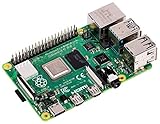
- Broadcom BCM2711, Quad core Cortex-A72 (ARM v8) 64-bit SoC @ 1.5GHz
- 1GB, 2GB, 4GB or 8GB LPDDR4-3200 SDRAM (depending on model)
- 2.4 GHz and 5.0 GHz IEEE 802.11ac wireless, Bluetooth 5.0, BLE Gigabit Ethernet
- 2 USB 3.0 ports; 2 USB 2.0 ports.
- Raspberry Pi standard 40 pin GPIO header (fully backwards compatible with previous boards)
Product prices and availability are accurate as of the date/time indicated and are subject to change. Any price and availability information displayed on Amazon at the time of purchase will apply.

