
Sometimes—but “DDR3” alone is not enough. A server may require ECC unbuffered DIMMs (UDIMMs), registered DIMMs (RDIMMs), or a model-specific combination. Desktop-style non-ECC memory, ECC UDIMMs and RDIMMs are different electrical and logical types. Confirm the exact server, motherboard, processor and firmware documentation before installing or buying a module.
What “regular DDR3” can mean
People use “regular” to describe several different things:
- Desktop, unbuffered memory (UDIMM).
- Non-ECC memory.
- Any 240-pin DDR3 module.
These descriptions are not interchangeable. A DDR3 module can still be unsuitable because of its buffer type, ECC implementation, capacity, rank, voltage or chip organization. Identify whether the part is UDIMM or RDIMM, whether it has ECC, its rated speed and voltage, and its capacity and rank.
UDIMM versus RDIMM: the first compatibility check
| Module type | Typical characteristic | Server requirement |
|---|---|---|
| ECC UDIMM | Unbuffered; includes error-correcting bits | Works only in platforms that explicitly support ECC UDIMMs |
| Non-ECC UDIMM | Unbuffered; no ECC correction | Accepted by some documented platforms, rejected or unsupported by others |
| ECC RDIMM | Registered/buffered address and command signals | Required by many server platforms; must be supported by the board and CPU |
| LRDIMM or other buffered type | Different buffering design | Requires explicit platform support; it is not interchangeable with RDIMM or UDIMM |
Do not mix RDIMMs and UDIMMs unless the server manual specifically documents that configuration. Intel states that mixing is not validated, supported or recommended on its cited DDR3 platforms. The SR1670HV service guide says RDIMMs and UDIMMs cannot be mixed within one system memory configuration, and Supermicro lists mixed UDIMM/RDIMM operation as unsupported for the MBD-X8SIL.
#1 Best Overall

- EXACT-MATCH UPGRADE — 128GB (4X32GB) kit DDR3-1866 (PC3-14900), 4Rx4 ECC, 1.5V, CL13, 240-pin LRDIMM. The precise rank, voltage, and speed your server's memory controller expects, so it's recognized at full capacity and posts correctly.
- VERIFIED FITMENT — The 240-pin Load-Reduced (LRDIMM) form factor for high-DIMM-count, high-capacity server and workstation boards — not an RDIMM or UDIMM. Confirm your platform supports LRDIMM at this capacity before ordering.
- MAXIMUM DENSITY — Load-reduced buffering lowers electrical load on the memory bus, so high-DIMM-count boards reach the highest capacity per channel — registered, ECC-protected operation for virtualization, in-memory databases, and 24/7 multi-socket workloads.
- CHECK YOUR CONFIG — LRDIMM support and maximum capacity vary by platform and BIOS. Confirm your server or board's supported memory type, capacity, and population rules in its manual or QVL before purchase.
- LIFETIME SUPPORT — Backed by a lifetime replacement warranty and free US-based technical support.
Examples of servers that support DDR3 UDIMMs
Some platforms do accept unbuffered memory, but these are model-specific examples rather than a universal rule.
- Intel’s S5520HC and S5500HCV boards support DDR3-800, DDR3-1066 and DDR3-1333 RDIMMs and ECC UDIMMs, according to its compatibility article.
- Supermicro documents ECC-UDIMM-only configurations as well as separate ECC-RDIMM configurations for the MBD-X8SIL; it lists a maximum of 16 GB for ECC UDIMM configurations and 32 GB for ECC RDIMM configurations on that page.
- Intel’s S5520UR guidance lists a maximum of 192 GB using 16 GB DIMMs. The applicable DIMM type and slot-population rules still depend on the board configuration; see the S5520UR memory rules.
These examples show that an ECC UDIMM can be valid server memory when the platform says so. They do not make an arbitrary desktop DDR3 stick compatible.
Rank #2
![[32GB DDR3L RAM] DDR3L-1600 UDIMM 32GB Kit (4x8GB) 2Rx8 PC3L-12800U 8GB PC3-12800 DDR3-1600MHz 240 Pin DIMM Non ECC Unbuffered 1.35V/1.5V CL11 Dual Rank Desktop Memory Ram](https://m.media-amazon.com/images/I/51RufLQVpTL._SL160_.jpg)
- 32GB DDR3L 1600MHz PC3L 12800U Kit (8GBx4) UDIMM 240-Pin Non-ECC Unbuffered 2Rx8 Dual Rank Desktop Memory, With strong compatibility and high stability with motherboards of various brands.
- High-Quality and Strict Test: All Motoeagle chips are from big brand manufacturers ,a high level of reliability. All chips 100% Tested. It can provide your computer with superior memory quality and the stability required for long term system operation.
- Plug and Play: Memory upgrade is one of the fastest, easiest, and most affordable ways to immediately improve the performance of your computer. It can improve your computer system performance, reduce power consumption and extend battery life. Faster burst access speed for improved sequential data throughput, bring you great online and game experience.
- Attention: Before purchase, please ensure your computer ram model, max ram and ram slot. Before installation, please wipe connection finger gently with eraser.
ECC is a separate question from registration
ECC and registered status describe different features. An ECC UDIMM is still unbuffered, while an RDIMM normally includes ECC but is registered. Check both fields in the manual and in the module’s part-number specification.
For example, Intel’s SR1670HV guide requires ECC RDIMMs but permits ECC or non-ECC UDIMMs under stated conditions; it warns that installing one non-ECC UDIMM disables ECC functionality. Other server boards reject non-ECC modules entirely. Never infer the rule from the word “server” on a retailer listing.
Rank #3
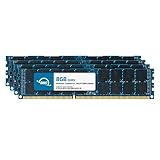
- ECC REGISTERED UPGRADE: This type of memory is used in Workstations and Servers. It will NOT be compatible with standard desktop computers. Also, it cannot be mixed with UNBUFFERED memory.
- OWC 32GB UPGRADE: Consists of 4pcs of 8GB DDR3 1600 PC3-12800 CL11 1Rx4 240-pin 1.5V ECC Registered DIMM Memory RAM Module Upgrade Kit for Select Workstations or Servers memory.
- 100% COMPLIANT: JEDEC-Standard and ROHS Compliant. Warranty-Safe Upgrade. Designed and Tested to Meet or Exceed all Manufacturer OEM Specs.
- MAXIMIZE YOUR SERVER: With OWC's ECC Registered Server Memory, you will extend the life of your old infrastructure or save money when building a new one.
- INDUSTRY LEADING: Consumer-friendly Advanced Replacement Program and Limited Lifetime Warranty, which includes Free Tech Support by Other World Computing.
Speed, voltage, capacity and rank can change the result
A module’s advertised speed is not a guarantee of the server’s operating speed. The Dell PowerEdge M520 manual documents operating frequencies of 800, 1066, 1333 and 1600 MT/s across supported configurations. The actual frequency varies with DIMM type and rank, module rating, modules per channel, voltage, selected system profile and the processor’s maximum supported frequency.
Lenovo’s System x3650 M4 Product Guide likewise makes speed and capacity conditional on the processor and memory configuration. DDR3L (low-voltage DDR3) support is also platform-specific; do not substitute it for standard-voltage DDR3 without confirmation.
Rank #4

- EXACT-MATCH UPGRADE — 16GB (2X8GB) kit DDR3-1600 (PC3-12800), 2Rx8 Unbuffered ECC, 1.35V, 240-pin. The precise rank, voltage, and speed your system's memory controller expects, so it's recognized at full capacity and posts correctly.
- VERIFIED FITMENT — Compatible with Xeon E3. Spec-matched to your board's memory-population rules.
- ENTERPRISE STABILITY — On-module ECC catches and corrects single-bit errors on the fly — stopping silent data corruption and crashes before they reach your work — on a standard unbuffered DIMM that drops into ECC-capable workstation and entry-server boards.
- CHECK YOUR CONFIG — Server and motherboard memory support varies by model. Consult your system or motherboard manual for supported capacities, approved DIMM population order, and installation steps before purchase.
- LIFETIME SUPPORT — Backed by a lifetime replacement warranty and free US-based technical support.
Checklist before you install or buy
- Identify the exact system. Record the server model, motherboard revision if available, installed processor model and firmware version.
- Open the official memory guide. Use the manufacturer manual or qualified-memory list for that exact model, not a generic DDR3 compatibility page.
- Match the buffer type. Confirm UDIMM, RDIMM or LRDIMM. Check whether mixing types is prohibited.
- Match ECC requirements. Determine whether ECC is mandatory, optional or unsupported, and whether one non-ECC module changes system behavior.
- Check physical and electrical specifications. Verify DDR3 versus DDR3L, voltage, capacity per DIMM, total capacity, rank and chip organization.
- Follow population rules. Install modules in the stated channel and slot order. Some channels require all processors to be installed, and limits can change by CPU.
- Verify the exact part number. Compare the manufacturer’s tested part number or qualified list entry before purchasing.
If the documentation does not explicitly support the proposed type and configuration, treat it as incompatible until confirmed. The server may fail to boot, disable ECC or run memory at a lower supported frequency.
Independent reader supportYour contribution helps us test, update, and keep practical guides available for everyone.How to choose between a DDR3 ECC UDIMM and RDIMM
| Choose this | When it is appropriate | What must be confirmed |
|---|---|---|
| DDR3 ECC UDIMM | The server’s qualified list names ECC UDIMMs and your capacity target fits its limits | ECC requirement, maximum DIMM size, rank, speed, voltage and slot order |
| DDR3 ECC RDIMM | The platform requires or explicitly supports registered memory | RDIMM generation, supported ranks and capacities, processor limits and no-UDIMM mixing rule |
| Non-ECC UDIMM | Only where the manual explicitly permits it and reduced/no ECC protection is acceptable | Whether a single non-ECC module disables ECC or is rejected |
Buy by the server’s compatibility table, not by a generic “server RAM” label. The table’s supported type, capacity, rank, speed, voltage and part number take priority over the module’s marketing description.
Do these 3 things before closing this tab:
1Repair Windows errors before they cause bigger problems2Scan for outdated or missing drivers - takes under a minute3Clear out junk files and repair common Windows errorsQuick Recap
Best Value

- Capacity: 32GB (4x 8GB Modules) | Type: DDR3 240-Pin | Speed: 1600MHz PC3-12800 / (PC3-12800E) | ECC Type: ECC-UDIMM (ECC Unbuffered DIMM) | Rank: 2Rx8 (Dual Rank x8) | Voltage: 1.5V
- Designed for ECC UDIMM Compatible Servers/Workstations (Rated Speeds & ECC Capabilities are CPU Dependent). Not Compatible with Desktops/Laptops.
- ECC Types can not be mixed | All installed modules must be ECC UDIMMs in order to function properly | A maximum of eight ranks per memory channel can be installed at once
- All A-Tech memory modules undergo stringent quality control testing to ensure dependable and reliable performance
- Backed by A-Tech's Limited Lifetime Warranty + Tech Support Team available to help before and after your purchase
Product prices and availability are accurate as of the date/time indicated and are subject to change. Any price and availability information displayed on Amazon at the time of purchase will apply.

