
Quick wins for a faster PC:
Scan for outdated or missing drivers - takes under a minuteDriver Scan →Clear out junk files and repair common Windows errorsFree Scan →The Moon is not lawless: an international treaty framework governs its exploration and use. The “legal wild west” label describes a narrower problem: existing rules set broad principles, while governments are still working through how to coordinate increasingly active missions and how those principles apply to resource use.
What law governs the Moon?
The starting point is the 1967 Outer Space Treaty, whose rules apply to the Moon as part of outer space. The treaty permits exploration and use, but it bars national appropriation of the Moon by claims of sovereignty, occupation, use, or other means. It also requires states to act consistently with international law, have due regard for other states’ interests, and take responsibility for their national space activities—including private activities they authorize and continually supervise. These principles appear in the treaty text published by the United Nations Office for Outer Space Affairs (UNOOSA).
That means “Can you own land on the Moon?” and “Who owns the Moon?” have a relatively clear answer at the level of national territory: a country cannot claim lunar land as its sovereign territory. But that does not settle every question about who may use a site, conduct an operation, or retain materials extracted there.
How do the main Moon-related agreements differ?
| Instrument | Legal form and reach | What it says about territory and activity | What it contributes to coordination |
|---|---|---|---|
| Outer Space Treaty | International treaty obligations for its states parties; treaty text published by UNOOSA. | Allows exploration and use while prohibiting national appropriation of the Moon and other celestial bodies. | Sets broad duties, including state responsibility, due regard for other states, and consultation when an activity could cause potentially harmful interference. |
| Moon Agreement | Adopted by the UN General Assembly in 1979; NASA’s history page says it was not ultimately ratified as a universal operating rule. | NASA’s historical overview places it in the history of proposals for governing the Moon; it is not a rule binding all spacefaring states. | Its history and negotiations are covered in NASA’s Governing the Moon: A History. |
| Artemis Accords | Principles established in 2020 by NASA and the U.S. Department of State with seven initial signatory nations; commitments apply to signatories, not universally. | Reinforce the Outer Space Treaty and state that resource extraction and use can be consistent with it when pursued safely and sustainably. | Set out signatory principles on transparency, peaceful purposes, emergency assistance, registration, open scientific data, heritage, resources, deconfliction, and debris mitigation. |
The instruments are not interchangeable. In particular, the Artemis Accords express an approach taken by their signatories; they do not amend the Outer Space Treaty or establish a universally agreed code.
The Tool Desk
Outbyte Driver Updater FREEScan for outdated or missing drivers - takes under a minuteDriver Scan →Outbyte PC Repair FREERepair Windows errors before they cause bigger problemsFix Now →#1 Best Overall

- Comprehensive Celestial Mechanics Tool: The Astronomical Science Instruments enhance deep understanding of the movements of the sun, earth, and moon. This three-sphere model makes complex celestial mechanics accessible for students and enthusiasts by demonstrating rotation and revolution in a tangible way, effectively bridging the gap between textbook theory and real-world astronomical phenomena
- Realistic & Lunar Simulator: This innovative simulator provides a realistic experience of celestial alignments. By rotating the gears, users can witness the captivating and lunar eclipses, captivating children and igniting their interest in astronomy. It serves as an engaging lunar simulator that simplifies the geometry of shadows and space light patterns
- Hands-on DIY : Build your own orbital model with this interactive kit. This educational toy facilitates hands-on learning that makes astronomy concepts tangible and enjoyable for kids. By physically manipulating the sun, earth, and moon spheres, students develop fine motor skills while gaining a spatial perspective of how our solar system operates on a day-to-day basis
- Advanced Educational Classroom Apparatus: Specifically designed as a scientific tool, this model is perfect for classrooms, homeschooling, and science fair projects. It allows teachers to provide an immersive simulation of seasonal changes and day-night cycles, making it a professional-grade astronomical instrument that fits perfectly into any STEM curriculum for elementary and middle schoolers
- Aesthetic Desktop Scientific Decor: With its sleek appearance, this educational apparatus serves not only as a learning tool but also as a sophisticated decorative piece. Measuring 8.26 x 6.69 inches, it is the perfect size for a teacher's desk, a child's bedroom, or a study room, functioning as a thoughtful gift for kids and adults who appreciate the beauty of the universe
Is mining the Moon legal?
The treaty distinction is between claiming territory and using resources. The Outer Space Treaty prohibits national appropriation of the Moon; it does not spell out a comprehensive licensing system or settle all ownership questions arising from extracted material. NASA’s presentation of the Artemis Accords takes the position that extracting and using space resources can comply with the treaty when done in a safe and sustainable way.
That position is not proof that every state agrees on the legal consequences of extraction, including whether or how rights in extracted resources arise. So “mining is legal” is too broad as a universal answer. The more precise answer is that the Accords’ signatories treat resource use as compatible with the treaty, while wider agreement on implementation and property consequences remains unsettled.
Rank #2

- HOBBY MODEL KIT – Unassembled model packed in an envelope with easy to follow instructions. Ideal for ages 14 and up.
- NO GLUE OR SOLDER NEEDED – Parts can be easily clipped from the metal sheets. Tweezers are the recommended tool for bending and twisting the connection tabs.
- PREMIUM SERIES ARTEMIS MOON ROCKET - 3.50 Sheet Model with a Challenging difficulty level. Once assembled, dimensions are 3.30 L x 2.88 W x 7.40 H inches. 115 Pieces. 1:522 Scale.
- FROM STEEL SHEETS TO 3D – Pop out the pieces and connect using tabs and holes. Includes illustrated instructions
- HIGHLY DETAILED ETCHED MODEL – Display your 3D model once completed - collect and build them all.
What are lunar safety zones—and do they create borders?
Under the Artemis Accords, safety zones are temporary areas intended to help coordinate operations and avoid harmful interference. NASA says their size, scope, and duration should reflect the operation, based on scientific and engineering principles; a zone ends when the relevant operation ceases. Signatories also commit to respect free access to areas of celestial bodies and to act with due regard for others.
These are the Accords’ stated principles, not proof that every state accepts every possible zone or its implementation as lawful. The distinction matters: a temporary notice-and-coordination measure is not presented by the Accords as a claim of sovereignty, but its practical boundaries and application can still raise questions when missions operate near one another.
Free tools Windows power users keep installed
One-click scans. No signup required.
Rank #3
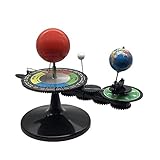
- The model is an excellent way to illustrate Earth's rotation, the planet's revolution around the sun, the seasons of the year, and the orbit of our moon - all in one!
- This device can serve to illustrate to a young child that Earth spins on its axis, that the moon orbits Earth every 28 days, and the Earth orbits the sun once a year,Can help child's astronomy class better understand moon phases, eclipses, season, etc.
- You can learn about the 24 Solar Terms used by farmers in China,It's pretty easy, it comes in English.
- There is a raised button on the sun model, Remove the wire and push the button, the sun will give out light.
- Note: This item will be interesting to kids who are starting to get excited about astronomy, but It is not suitable for rigorous astronomy scientific research!
Why is the law still described as a “wild west”?
Broad treaty duties do not automatically answer operational questions. States need ways to give notice, share mission information, avoid interference, and respond when activities overlap. The Outer Space Treaty calls for consultation when a state has reason to believe a planned activity could cause potentially harmful interference, but it does not provide a detailed lunar traffic-management system.
NASA’s September 30, 2025 report on Artemis Accords implementation discussions illustrates the remaining work. At that meeting, NASA reported 56 country signatories as of that date—not a current 2026 total—and discussions on non-interference recommendations, expected launch dates, general activity descriptions, landing locations, orbital debris, interoperability, and data. Those discussions are evidence of work in progress, not a finalized global code.
Rank #4

- Engaging Educational Tool: The Great Explorations Phases of the Moon kit is an engaging and educational resource designed to teach children about the lunar phases in a fun and interactive way.
- Realistic Moon Replication: Featuring a highly detailed 3D model of the moon, this product offers a realistic representation of the lunar surface and its changing phases.
- Hands-On Learning: Encourage hands-on learning as children manipulate the moon model to understand how the moon's appearance changes throughout its cycle.
- Glow-in-the-Dark Feature: The moon model is made with a special glow-in-the-dark material, allowing kids to observe the moon's phases even in low light conditions, making it a captivating night-time learning experience.
- STEM-Focused: The Great Explorations Phases of the Moon kit promotes STEM (Science, Technology, Engineering, and Mathematics) education by fostering curiosity and scientific inquiry.
What remains unresolved?
- Resource rules: How states will apply treaty principles to extraction, use, and any resulting claims over materials.
- Deconfliction: How missions will give notice, coordinate around operating sites, and handle possible interference in ways accepted beyond the Accords’ signatories.
- Shared procedures: How states can develop practical, predictable rules that support access and safety while respecting the treaty framework.
Those are the gaps behind the metaphor. The Moon has governing law; what is still developing is the shared operational detail needed to apply it as activity expands.
Quick Recap
Best Value
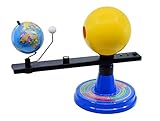
- Dynamic Orbital Motion: The Eisco Sun, Earth, and Moon Orbital Model features a gear-driven mechanism that simulates realistic orbital motion. This interactive globe lets you explore planetary dynamics with precision and detail
- Illuminated Solar Display: A 12V light bulb illuminates the Sun, enhancing the model's visual appeal. This feature makes the Sun-Earth-Moon model with light ideal for demonstrating the interplay of light in our solar system
- Eclipse Alignment Explained: This model allows you to demonstrate solar eclipses by showcasing how the Sun, Moon, and Earth align. It's a powerful tool for understanding these celestial events through hands-on exploration
- Calendar-Based Learning: The month-labeled base connects each celestial position to the calendar year. This feature helps you track Earth's rotation and revolution over time, making the Earth-Sun-Moon orbiter model an educational asset
- Structured Study Guide: The included guide contains three structured activities to deepen your understanding of the solar system. These exercises provide a comprehensive learning experience, enhancing Science kit Earth-Sun-Moon system engagement
Product prices and availability are accurate as of the date/time indicated and are subject to change. Any price and availability information displayed on Amazon at the time of purchase will apply.

