
Many familiar star names have Arabic forms because astronomy travelled through Arabic scholarship: Greek descriptions were translated, adapted, and later transmitted through medieval Latin into modern languages. Some names also come from indigenous Arabian sky traditions. An Arabic-sounding name alone does not tell you which path produced it.
Why do so many familiar star names sound Arabic?
For centuries, astronomers and translators carried knowledge across languages. Greek astronomical works were translated into Arabic, then passed through medieval Latin into later European languages. Along that route, names could be translated, shortened, misunderstood, or reshaped. The International Astronomical Union (IAU) describes modern star names as the result of “translation, misunderstandings, abbreviations and transformation” from Greek texts through Arabic and medieval Latin. The IAU’s account of star naming explains this layered history.


That route is only part of the story. People in Arabia had their own traditions for observing and naming stars, and Arabic scholarship preserved and developed astronomical knowledge. Historical accounts describe both Ptolemaic constellations transmitted through Arabic texts and indigenous Bedouin groupings and names. The Smithsonian-hosted history of star names discusses both traditions.
Arabic form does not always mean Arabic origin
A useful way to understand a star name is to separate its source tradition from the language through which it reached us. A name may reflect indigenous Arabian sky knowledge, or it may be an Arabic translation or adaptation of an earlier Greek description. Its present form can also reflect later Latin and modern-language changes.
#1 Best Overall
| Example | What the history illustrates |
|---|---|
| Aldebaran | Cambridge scholarship describes this as a name of old Arabic origin. |
| Fomalhaut | Its Arabic form derives from a description in Ptolemy’s star catalog, rather than representing the same kind of naming history as Aldebaran. |
These examples are not a complete etymological catalogue; they show why it is misleading to group every Arabic-form name under one explanation. For some older names, origins are difficult to assign confidently, particularly when they predate the early Abbasid period. The University of Arizona’s Two Deserts, One Sky project makes that uncertainty explicit. Cambridge’s discussion of Arabic sources for star names provides further historical context.
What do Arabic star names mean?
Some names have a documented meaning, while the origin or derivation of others is less certain. Aljanah is a clear modern example: in a 2017 announcement, the IAU explained that it comes from Arabic al-janāḥ, meaning “the wing,” and assigned it to Epsilon Cygni. The same announcement retained Gienah for Gamma Corvi, a different star. The IAU’s 2017 release gives the designation and naming details.
Rank #2

- Best Quality: printed on premium luster paper using the highest high-definition ink quality from state-of-the-art printers. Completely eye catching, unframed, ready for the frame of your choice (not included).
- United States all the way: designed, printed, proofed, and expertly packaged right here in our studio in Florida.
- 100% Accurate: star software that pulls the most detailed of skies possible for any date (past, present, or future) and any location.
- Fully Customizable: 3 size options, 4 font choices, any title, date & location! Created for one name, two names, or more.
That distinction matters when reading lists of “Arabic star names.” A gloss such as “the wing” is meaningful when tied to a documented name and star; it should not be treated as proof that every name with an Arabic form has an equally clear or purely Arabic origin.
Did Arabic astronomers name all the stars?
No. Star names arose in different cultures, and many familiar names reflect a chain of transmission rather than a single act of naming. The IAU notes that the historical naming of bright stars occurred across cultures. Its current work is to standardize a limited set of proper names, not to replace the catalogue identifiers used for most stars. Its announcements of approvals in 2016 and 2017 show this standardization in practice: the 2016 approval announcement and the 2017 announcement.
The Tool Desk
Outbyte PC Repair FREERepair Windows errors before they cause bigger problemsFix Now →Outbyte Driver Updater FREEFix the driver behind crashes, sound loss and screen glitchesFind Drivers →Rank #3
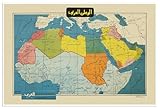
- VINTAGE DESIGN: Historical Arabic map of the Middle East region, featuring detailed geographical boundaries and traditional Arabic text labels
- EDUCATIONAL VALUE: Perfect reference material for studying Middle Eastern geography, borders, and territorial divisions from this historical period
- AUTHENTIC DETAILS: Original Arabic script and cartographic elements preserved in this high-quality reprint of the classic atlas page
- DECORATIVE APPEAL: Distinctive color-coded regions and traditional cartographic styling make this map an elegant wall decoration piece
- PRINT SPECIFICATIONS: Features clear geographical markings, political boundaries, and water bodies with Arabic geographical nomenclature
Nor does a familiar proper name do the same job as a catalogue designation. “Vega” is a proper name people can readily say; an alphanumeric designation is a standardized identifier useful for distinguishing objects in astronomical catalogues. NASA’s Jet Propulsion Laboratory explains why catalogue-style identifiers are useful for tracking astronomical objects: Why Dazzling Stars are Given Boring but Useful Names.
Independent reader supportYour contribution helps us test, update, and keep practical guides available for everyone.Can you buy an official name for a star?
No. A commercial certificate may record a company’s private naming entry, but it does not give the buyer ownership of a star or confer an official name recognized by astronomers. The IAU distinguishes these sales from formal recognition and explains its approach on its page about buying star names.
Rank #4

- 3’x5’ (foot) (90 cm x 150 cm) Polyester Flag
- UV-RESISTANT COLOR FAST INK TO PROTECT VIBRANCY OF COLORS IN SUNLIGHT.
- GREAT FOR HANGING INSIDE OR FROM STANDARD FLAG POLES - LIGHTWEIGHT FABRIC WILL FLY EVEN IN GENTLE BREEZES.
- DOUBLE SEAM WITH 4 ROWS OF STITCHING ON FLY END FOR EXTRA DURABILITY.
- PREMIUM CANVAS HEADER COMPLETE WITH 2 BRASS GROMMETS FOR HOISTING.
For a name’s status, look for recognition through the IAU rather than assuming that a purchased certificate changes a star’s accepted name or catalogue designation.
Quick Recap
Best Value
Product prices and availability are accurate as of the date/time indicated and are subject to change. Any price and availability information displayed on Amazon at the time of purchase will apply.
Recommended Free Tools

