
Pro gamers do use OLED monitors, but OLED was historically less common in tournament setups. The reasons are not simply that OLED is too slow or that professionals reject it: familiar 24.5-inch formats, predictable setup and picture settings, and practical concerns such as burn-in and venue conditions all matter. The trend is changing. ASUS announced that its 24.5-inch OLED ROG Swift PG259QWS Ace would be the official monitor for the November 24–December 13, 2026 PGL CS2 Major Singapore, describing it as the first CS Major to use OLED on the main stage. That is an announced selection as of October 3, 2026, not a report on a completed tournament.
Why OLED was not an automatic choice for tournament play
Professional players and tournament organizers value consistency. A monitor has to fit established setups, support familiar settings and behave predictably across practice and competition. Those practical requirements can slow adoption even when a newer panel technology offers attractive specifications. The available product announcements show manufacturers designing OLED esports monitors around those needs; they do not quantify how much each factor influences pro players overall.
Familiar size and picture presentation
Many esports displays have used a compact 24.5-inch format and LCD-style picture characteristics. Sony’s INZONE M10S, a 27-inch QHD OLED, includes a 24.5-inch play mode and an FPS Pro mode intended to simulate the image characteristics of TN LCD monitors typically used in professional tournaments. That design lets a player use OLED while retaining a familiar active play area and presentation.
ASUS’s PG259QWS Ace also uses a 24.5-inch format, paired with 1920 × 1080 resolution. These choices suggest that esports OLED products are being adapted to established preferences rather than asking every player to change their setup.
#1 Best Overall

- Samsung’s 27” Odyssey OLED G6 Gaming Monitor is engineered for perfection with a QD-OLED Display featuring QHD resolution made to deliver high brightness and a wide range of colors for gameplay
- OLED Safeguard technology supports performance by actively helping to prevent burn-in with a thermal modulation system
- Glare Free Technology keeps screen clear of reflection from external light sources
- The Pantone Validated screen accurately reproduces 2100+ lifelike colors and 110+ skin tone shades
- HDR10 provides brighter highlights and nuanced shadows for added depth and more realistic scenes
Repeatable setups matter
ASUS highlights a position sensor, saved and shareable settings, and esports color modes on the PG259QWS Ace. Its newer Ace displays also emphasize repeatable stand positioning and quick access to picture modes. Those features address the practical challenge of keeping a monitor’s position and settings consistent between sessions. They are evidence of manufacturers’ design priorities, not proof that all teams require the same setup.
Burn-in is a managed risk, not a solved one
OLED pixels can wear unevenly, creating the possibility of persistent image retention or burn-in. Samsung describes safeguards including thermal modulation, logo and taskbar detection, and screen savers. ASUS states a three-year burn-in warranty for the PG259QWS Ace. Protection features and warranty coverage can reduce concern, but they do not make the risk nonexistent; warranty terms vary by region, so check the exact local coverage.
Rank #2

- 27" QHD DISPLAY: Immerse yourself in stunning visuals with a 27-inch QHD (2560x1440) resolution, delivering crisp detail and vibrant colors.
- 240Hz REFRESH RATE & 0.03ms RESPONSE TIME: Enjoy smooth, blur-free gameplay with a lightning-fast 240Hz refresh rate and ultra-low 0.03ms (GtG) response time.
- HDR400 TRUE BLACK: Experience deeper blacks and brighter highlights with HDR400 True Black certification, enhancing contrast and visual realism.
- QD OLED TECHNOLOGY: Quantum Dot OLED panel ensures rich colors with 147.6% sRGB and 110.2% DCI-P3 color gamut coverage, providing stunning color accuracy
- ADAPTIVE-SYNC TECHNOLOGY: Eliminate screen tearing and stuttering with Adaptive-Sync compatibility, ensuring a seamless and fluid gaming experience.
Venue lighting and brightness can affect the choice
Samsung’s buying guide says LCD monitors may reach higher peak brightness in bright settings, while describing OLED as generally faster to respond. That is a manufacturer’s broad comparison, not a universal measurement for every monitor. Tournament teams selecting a display still need to consider the particular panel, reflections and lighting in the venue.
Does OLED actually make a monitor faster?
OLED’s fast pixel transitions can reduce one contributor to perceived motion blur, but response-time figures alone do not establish that a player will perform better. ASUS explains that motion blur can come from both pixel transitions and sample-and-hold behavior: a frame remains visible until the next one is shown. Faster transitions address the first source; a higher refresh rate can help address the second.
Recommended Free Tools
Rank #3
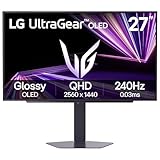
- LG UltraGear OLED Goes Glossy - Experience ultra-smooth, tear-free gameplay with up to 240Hz refresh rate and 0.03ms response time on a glossy, bright 27” QHD OLED display. React instantly, spot every detail, and outpace your opponents in every frame with outrageous speed and clarity.
- Next-Level OLED Brightness, for Next-Level Play - The brilliant OLED display brings every scene to life with jaw-dropping color and intensity. Delivering a standard 275 nits of brightness and peaking at 1300 nits, your games shine with vivid clarity—keeping dark corners detailed, explosions dazzling, and the action always visible no matter the environment.
- VESA DisplayHDR True Black 400 - An OLED display with VESA DisplayHDR True Black 400 and a 1.5M:1 contrast ratio deliver deep blacks and dazzling highlights, so you catch every hidden detail in dark scenes and every spark in the bright ones. With up to 98.5% DCI-P3 color, your worlds burst with vibrant intensity—making every game feel more alive.
- Three UL Certifications. One Clear Advantage for Eye Comfort. - This UltraGear OLED display is three times UL-certified—for Anti-Glare, Flicker-Free, and Low Blue Light. Combined with a glossy finish, the display helps reduce distractions, keep your view crisp, and maintain visual comfort—so you can stay focused and perform at your best, even during extended gaming sessions.
- 27” OLED Brilliance with up to 240Hz of Game-Changing Speed - Experience ultra-smooth, tear-free gameplay with up to 240Hz refresh rate on a glossy, bright 27” QHD OLED display.
In other words, a very low advertised response time is not the same as proof of better aim, reaction time or match results. ASUS lists a 0.02 ms response time for the PG259QWS Ace and Sony lists 0.03 ms for the INZONE M10S; these are manufacturer specifications, not independent head-to-head test results. The sources cited here do not establish that OLED improves tournament outcomes.
OLED esports monitors are arriving in tournament formats
Recent models combine OLED with high refresh rates and features aimed at esports use. ASUS announced the PG259QWS Ace as the official monitor for the 2026 PGL CS2 Major Singapore, scheduled for November 24 to December 13, 2026. ASUS called it the first Counter-Strike Major to use OLED monitors on the main stage. Because the event is in the future as of October 3, 2026, this is a forthcoming adoption announcement, not evidence of the completed tournament’s results.
Rank #4

- 27 Inch OLED Gaming Monitor with QD-OLED Technology - Experience true blacks and infinite contrast with advanced QD-OLED panel, delivering ultra-vivid colors (147% sRGB / 110% DCI-P3) for immersive gaming and content.
- 240Hz 1440p Gaming Monitor for Ultra-Smooth Performance - Play at peak performance with 240Hz refresh rate and ultra-fast 0.03ms response time, reducing motion blur and ghosting for competitive gaming.
- QHD 1440p Resolution with HDMI 2.1 Connectivity - Crisp 2560x1440 resolution with HDMI 2.1 and DisplayPort 1.4 supports high refresh rate gaming on PC, PS5, and Xbox Series X.
- G-SYNC Compatible for Tear-Free Gaming - Enjoy smooth, stutter-free gameplay with adaptive sync technology that reduces screen tearing and improves responsiveness.
- Height Adjustable Gaming Monitor with USB Hub - Ergonomic stand with height, tilt, swivel, and pivot adjustment plus USB 3.2 hub, VESA mount compatibility, and Flicker-Free technology for extended comfort.
Sony announced that its INZONE M10S was co-developed with Fnatic and described its tournament-oriented modes. Sony’s September 2024 announcement also included player comments about the product. Those comments are promotional feedback, not independent comparative tests. For example, Fnatic VALORANT player Jake ‘Boaster’ Howlett said he liked FPS Pro+ because it let him see agents more clearly than he could by adjusting the picture himself.
| Monitor | Published specifications and esports features | What the design illustrates |
|---|---|---|
| ASUS ROG Swift OLED PG259QWS Ace | ASUS (2026) lists 24.5 inches, 1920 × 1080, 720 Hz and a stated 0.02 ms response time. Features include a position sensor, saved and shared settings, esports color modes, and a stated three-year burn-in warranty. ASUS announced it as the official monitor for the 2026 PGL CS2 Major Singapore. | Compact 1080p format, high refresh rate, and tools for repeatable setup. Event use is announced, not yet completed as of October 3, 2026. |
| Sony INZONE M10S | Sony (2024) lists a 27-inch QHD OLED, up to 480 Hz and a stated 0.03 ms response time. It offers a 24.5-inch play mode and FPS Pro mode designed to simulate TN LCD monitor image characteristics; Sony says it was co-developed with Fnatic. | OLED with a smaller play-area option and a familiar FPS presentation. Sony announced October 2024 availability at €1,349/£1,199; those were launch prices, not current prices. |
Specifications and announced features are from the manufacturers, not independent laboratory comparisons. No independent survey establishing what share of professional players use OLED, or controlled comparison showing match outcomes caused by monitor choice, is available in the sources cited here.
Crashes, No Sound, or Screen Glitches?
Random freezes, missing sound and display glitches usually trace back to one bad driver. Find and replace yours safely.Free scan · under a minuteWindows Errors? Fix Them Before They Spread
Repair common Windows errors and clear accumulated junk for a smoother, more stable PC - no reinstall needed.Free scan · no reinstallWhat to compare when choosing an esports monitor
A refresh-rate headline does not tell you whether a monitor suits your game, PC or playing environment. Compare the full setup rather than choosing by response-time figure alone:
Quick Recap
- Size and active play area: Check whether you want a native 24.5-inch display or a larger panel with a reduced play-area mode.
- Resolution and sustainable frame rate: Consider the resolution you can run while maintaining the frame rate your game and PC can actually sustain.
- Refresh rate and motion clarity: Look beyond the maximum refresh rate to the panel’s picture modes and how motion appears in your games.
- Lighting and reflections: Account for the brightness and reflection handling needed in your room or venue.
- Position and settings: If you move between setups, consider how easily you can reproduce monitor height, angle and picture settings.
- Protection and warranty: Review burn-in safeguards and the written warranty that applies in your country.
- Current local price: Check today’s price and stock where you live; a launch price is not a current quote.
Product prices and availability are accurate as of the date/time indicated and are subject to change. Any price and availability information displayed on Amazon at the time of purchase will apply.

